



Global Neuroprosthetics Market Segmentation, By Type (Output Neural Prosthetics and Input Neural Prosthetics), Technique (Deep Brain Stimulation, Vagus Nerve Stimulation, Spinal Cord Stimulation, and Sacral Nerve Stimulation), Application (Motor Neuron Disorders, Physiological Disorders, and Cognitive Disorders), End User (Hospitals and Clinics) - Industry Trends and Forecast to 2032
Neuroprosthetics Market Size
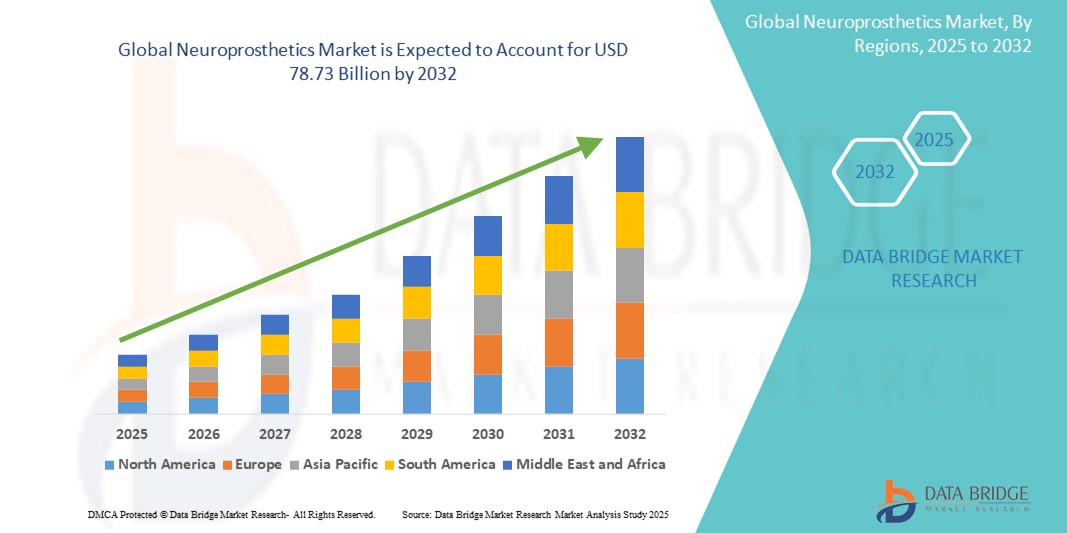
- The global neuroprosthetics market size was valued atUSD 27.41 billion in 2024and is expected to reachUSD 78.73 billion by 2032, at aCAGR of 14.10%during the forecast period
- This growth is driven by factors such as rising neurological disorder cases, technological advancements, an aging population, increased R&D investment, and supportive regulatory and reimbursement policies
Neuroprosthetics Market Analysis
- Neuroprosthetics are advanced medical devices designed to restore or replace neural function in individuals with neurological disorders or injuries. They play a vital role in improving motor control, sensory feedback, and cognitive function, and are used across settings such as hospitals, rehabilitation centers, and research institutions
- The neuroprosthetics market is witnessing steady growth driven by the increasing prevalence of neurological conditions, advancements in brain-computer interface and neural stimulation technologies, rising demand for minimally invasive treatments, and growing support through healthcare funding and R&D initiatives
- North America is expected to dominate the neuroprosthetics marketwith largest market share of 43%, due to a robust healthcare infrastructure, significant government and private funding, and a high level of research and development activity
- Asia-Pacific is expected to be the fastest growing region in the neuroprosthetics market during the forecast period due to increased healthcare investments, rising patient awareness, and efforts to reduce manufacturing costs of neuroprosthetic devices
- Motor neuron disorders segment is expected to dominate the market with alargest market shareof 60% due to high prevalence of conditions such asamyotrophic lateral sclerosis (ALS)and spinal muscular atrophy (SMA), coupled with increasing demand for advanced assistive technologies that restore motor function and improve quality of life in affected patients
Report Scope and Neuroprosthetics Market Segmentation
|
Attributes |
Neuroprosthetics Key Market Insights |
|
Segments Covered |
|
|
Countries Covered |
North America
Europe
Asia-Pacific
Middle East and Africa
South America
|
|
Key Market Players |
|
|
Market Opportunities |
|
|
Value Added Data Infosets |
In addition to the insights on market scenarios such as market value, growth rate, segmentation, geographical coverage, and major players, the market reports curated by the Data Bridge Market Research also include depth expert analysis, patient epidemiology, pipeline analysis, pricing analysis, and regulatory framework. |
Neuroprosthetics Market Trends
“Rising Adoption of Brain-Computer Interface (BCI) Technology”
- One prominent trend in the global neuroprosthetics market is the rising adoption ofbrain-computer interface (BCI)technology
- This trend is driven by the growing need for advanced solutions that enable direct brain-to-device communication, especially for patients with severe motor impairments and neurological conditions
- For instance, companies such as Neuralink and Blackrock Neurotech are actively developing BCI-integrated neuroprosthetics to enhance precision, responsiveness, and user control
- The demand for BCI-enabled systems is increasing across hospitals and research institutions due to their potential to restore motor function and improve patient outcomes
- As the focus on personalized and high-performance neurorehabilitation grows, this trend is expected to drive major innovation and investment in the neuroprosthetics market
Neuroprosthetics Market Dynamics
Driver
“Rising Prevalence of Neurological Disorders”
- The rising prevalence of neurological disorders is a key driver of growth in the neuroprosthetics market, as conditions such as Parkinson’s disease,epilepsy, and ALS increasingly require advanced neural interface solutions for effective management
- This demand is particularly evident in patients with motor neuron disorders, where neuroprosthetics help restore mobility and improve quality of life through targeted neural stimulation
- As neurological conditions become more common globally, especially among aging populations, there is a growing need for innovative, high-precision neuroprosthetic devices across hospitals, rehabilitation centers, and home care settings
- Manufacturers are actively developing next-generation neuroprosthetics that enhance neural signal processing, improve patient adaptability, and support minimally invasive application
- The focus on early intervention, functional recovery, and long-term neurological care is driving adoption in both developed and emerging healthcare markets
For instance,
- Medtronic and Boston Scientific continue to expand their neurostimulation product lines to address a wider range of neurological disorders
- Companies such as Cochlear and Nevro are investing in R&D to meet rising global demand for condition-specific neuroprosthetic solutions
- As the burden of neurological diseases grows, this driver is expected to significantly influence innovation, adoption, and market expansion in the neuroprosthetics sector
Opportunity
“Advancements in Neural Interface Technology”
- Advancements in neural interface technology present a significant opportunity for the neuroprosthetics market, driven by increasing demand for more precise, responsive, and biocompatible neural interaction systems
- Healthcare providers and research institutions are seeking cutting-edge neuroprosthetic solutions that enable seamless brain-device communication, enhance user control, and support real-time data processing
- This opportunity aligns with rapid progress in areas such as flexible electrodes, wireless interfaces, and AI integration, which are expanding the scope and effectiveness of neuroprosthetic applications
For instance,
- Companies such as Synchron and NeuroPace are developing minimally invasive neural interfaces designed to improve signal accuracy and patient comfort
- Blackrock Neurotech is focusing on next-generation BCI technologies aimed at restoring full mobility and communication capabilities for paralyzed individuals
- As innovation in neural interface technology accelerates, the neuroprosthetics market is well-positioned to capitalize on this momentum by delivering transformative solutions that address complex neurological needs
Restraint/Challenge
“Limited Long-term Durability and Reliability”
- Limited long-term durability and reliability present a significant challenge for the neuroprosthetics market, as devices must withstand prolonged use in the human body while maintaining optimal performance
- The need for consistent functionality over extended periods, combined with challenges in ensuring biocompatibility and minimizing device degradation, complicates product development and raises concerns over patient safety and device failure
- This challenge is especially prominent in emerging markets, where healthcare infrastructure may not support the long-term monitoring and maintenance of neuroprosthetic devices, potentially leading to higher costs and reduced accessibility
For instance,
- Companies such as Medtronic and Abbott are focusing on improving device longevity through enhanced materials and better sealing techniques, but smaller players may struggle to meet these standards
- The complexity of ensuring long-term reliability may slow innovation in the sector and hinder the broader adoption of advanced neuroprosthetic solutions, particularly in regions with limited healthcare resources and technical expertise
Neuroprosthetics Market Scope
The market is segmented on the basis of type, technique, application, and end user.
|
Segmentation |
Sub-Segmentation |
|
By Type |
|
|
By Technique |
|
|
By Application |
|
|
By End User
|
|
In 2025, the motor neuron disorders is projected to dominate the market with a largest share in application segment
The motor neuron disorders segment is expected to dominate the neuroprosthetics market with the largest share of 60% in 2025 due to high prevalence of conditions such as amyotrophic lateral sclerosis (ALS) and spinal muscular atrophy (SMA), coupled with increasing demand for advanced assistive technologies that restore motor function and improve quality of life in affected patients.
The spinal cord stimulation is expected to account for the largest share during the forecast period in technique segment
In 2025, the spinal cord stimulation segment is expected to dominate the market with the largest market share of 49.7% due to its proven efficacy in managing chronic pain conditions, rising adoption of minimally invasive procedures, and growing preference for neuromodulation therapies as alternatives to opioids.
Neuroprosthetics Market Regional Analysis
“North America Holds the Largest Share in the Neuroprosthetics Market”
- North America dominates the neuroprostheticsmarket with a share of 43%, driven by a robust healthcare infrastructure, significant government and private funding, and a high level of research and development activity
- U.S.holds a significant share in North America region due to its advanced healthcare system, high adoption of cutting-edge neuroprosthetic technologies, and strong investment in neurological disorder treatments and medical research
- The region's leadership is further bolstered by the presence of major players such as Medtronic, Boston Scientific, and Cochlear, who continue to push the boundaries of neuroprosthetic innovation, alongside favorable regulatory policies from agencies such as the FDA
- As the demand for advanced neuroprosthetics for conditions such as ALS, Parkinson’s disease, and spinal cord injuries grows, North America is poised to maintain its market dominance through 2032, fueled by continuous investment and the adoption of breakthrough neurotechnologies
“Asia-Pacific is Projected to Register the Highest CAGR in the Neuroprosthetics Market”
- Asia-Pacificis expected to witness the highest growth rate in the neuroprostheticsmarket, driven by increased healthcare investments, rising patient awareness, and efforts to reduce manufacturing costs of neuroprosthetic devices
- China holds a significant share due to its large population, expanding healthcare infrastructure, and government initiatives to improve access to advanced medical technologies
- The region’s rapid growth is supported by a surge in neuroprosthetic demand due to rising incidences of neurological disorders and an increasing preference for cost-effective, yet advanced, neuroprosthetic solutions across hospitals and clinics
- With improvements in healthcare accessibility and technology adoption, Asia-Pacific is anticipated to become a major driver of growth in the global neuroprosthetics market, particularly in countries such as China, India, and Japan, through 2032
Neuroprosthetics Market Share
The market competitive landscape provides details by competitor. Details included are company overview, company financials, revenue generated, market potential, investment in research and development, new market initiatives, global presence, production sites and facilities, production capacities, company strengths and weaknesses, product launch, product width and breadth, application dominance. The above data points provided are only related to the companies' focus related to market.
The Major Market Leaders Operating in the Market Are:
- Boston Scientific Corporation(U.S.)
- Zimmer Biomet (U.S.)
- Cochlear Ltd.(Australia)
- Medtronic(U.S.)
- NDI Medical, LLC (U.S.)
- NeuroPace, Inc. (U.S.)
- NEVRO CORP (U.S.)
- Abbott(U.S.)
- Sonova (Switzerland)
- CorTec GmbH (Germany)
- Neuro Device Group S.A. (Poland)
- LivaNova PLC (U.K.)
- MED-EL Medical Electronics (Austria)
Latest Developments in Global Neuroprosthetics Market
- In December 2022, Saskatchewan's Ministry of Health and the Saskatchewan Health Authority launched an expanded Cochlear Implant Program, offering subsidized replacements for external sound processors. Individuals contribute USD 840 per implant, with the Ministry covering the remainder (USD 8,000 to USD 12,000). This initiative aims to enhance accessibility to auditory devices for those in need across the province
- In October 2022, Axoft, a neurotechnology firm, introduced a brain-machine interface (BMI) targeting neurological disorders. This FDA breakthrough device involves neural implants, with an initial USD 8 million in funding for FDA studies and prototype scaling. The innovation seeks to advance treatment efficacy and patient outcomes through advanced neurotechnology solutions
- In July 2021, Researchers at US San Francisco developed a groundbreaking "speech neuroprosthesis." This device enables individuals with severe paralysis to communicate in sentences by translating brain signals directly into spoken words displayed as text on a screen. The innovation represents a significant advancement in assistive technology, enhancing communication and quality of life for paralyzed individuals
- In April 2021, Houston Methodist and Rice University launched a collaborative center for Translational Neural Prosthetics. This partnership focuses on neuroprosthetics research aimed at restoring brain function post-disease or injury. The initiative integrates clinical expertise from Houston Methodist with research capabilities from Rice University, aiming to accelerate innovations in neural prosthetics for neurological rehabilitation
SKU-

研究方法
数据收集和基准年分析是使用具有大样本量的数据收集模块完成的。该阶段包括通过各种来源和策略获取市场信息或相关数据。它包括提前检查和规划从过去获得的所有数据。它同样包括检查不同信息源中出现的信息不一致。使用市场统计和连贯模型分析和估计市场数据。此外,市场份额分析和关键趋势分析是市场报告中的主要成功因素。要了解更多信息,请请求分析师致电或下拉您的询问。
DBMR 研究团队使用的关键研究方法是数据三角测量,其中包括数据挖掘、数据变量对市场影响的分析和主要(行业专家)验证。数据模型包括供应商定位网格、市场时间线分析、市场概览和指南、公司定位网格、专利分析、定价分析、公司市场份额分析、测量标准、全球与区域和供应商份额分析。要了解有关研究方法的更多信息,请向我们的行业专家咨询。
可定制
Data Bridge Market Research 是高级形成性研究领域的领导者。我们为向现有和新客户提供符合其目标的数据和分析而感到自豪。报告可定制,包括目标品牌的价格趋势分析、了解其他国家的市场(索取国家列表)、临床试验结果数据、文献综述、翻新市场和产品基础分析。目标竞争对手的市场分析可以从基于技术的分析到市场组合策略进行分析。我们可以按照您所需的格式和数据样式添加您需要的任意数量的竞争对手数据。我们的分析师团队还可以为您提供原始 Excel 文件数据透视表(事实手册)中的数据,或者可以帮助您根据报告中的数据集创建演示文稿。











