



Global Point of Care Analyzers Market Segmentation By Type (Hemoglobin Analyzers, HbA1c Analyzers, Glucose Analyzers, and Others), End-Users (Clinics, Hospital, Ambulatory Surgical Centers, Laboratories, and Others) – Industry Trends and Forecast to 2032
Point of Care Analyzers Market Analysis
The point of care analyzers market is experiencing robust growth, driven by advancements in healthcare technology and an increasing emphasis on rapid diagnostic solutions. These devices facilitate immediate testing at or near the site of patient care, enabling timely decision-making and improving patient outcomes. Key developments in the market include the integration of digital technologies, such as cloud-based data management and artificial intelligence, which enhance the accuracy and efficiency of test results. Additionally, the rise of portable and user-friendly analyzers is making it easier for healthcare providers in remote and underserved areas to access critical diagnostic information. The COVID-19 pandemic has further accelerated demand for point of care testing, highlighting the need for quick and reliable diagnostics. Major players in the industry are focusing on expanding their product portfolios and enhancing their distribution networks to meet the growing demand. Moreover, collaborations and partnerships among companies and research institutions are fostering innovation, ultimately shaping the future landscape of the point of care analyzers market. As healthcare continues to evolve, the importance of these devices in routine and emergency settings will only increase.
Point of Care Analyzers Market Size
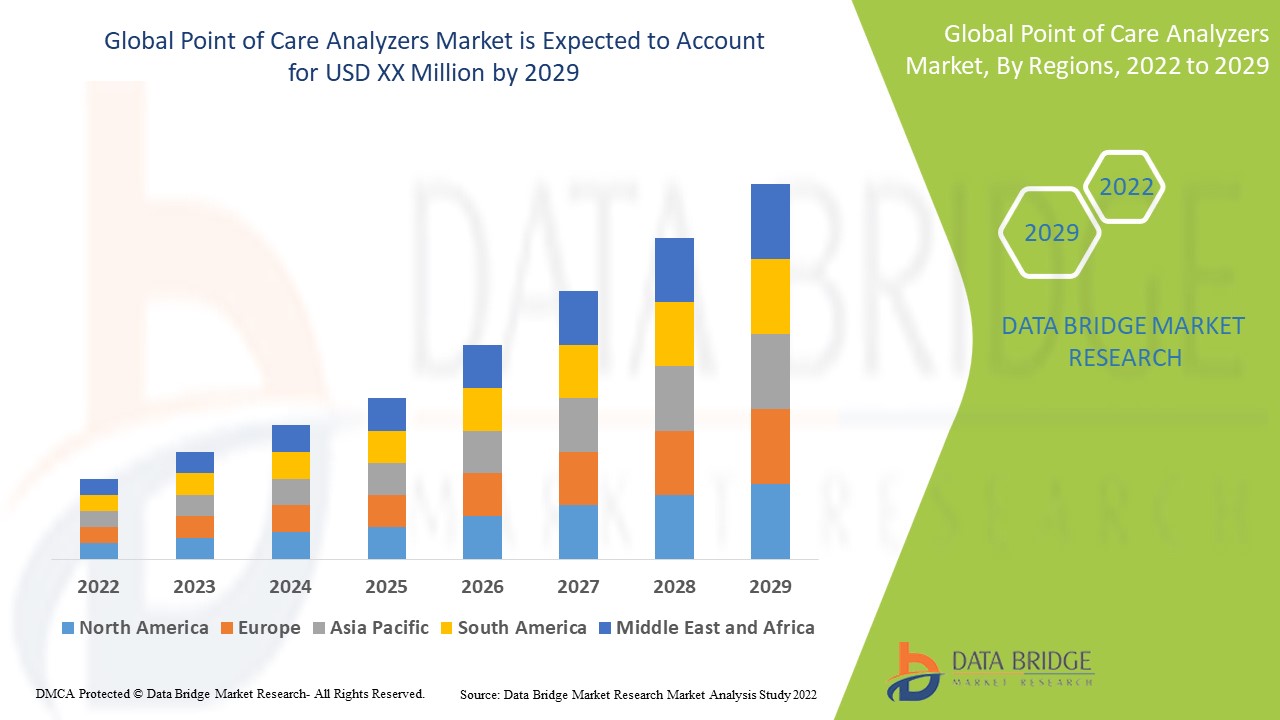
The global point of care analyzers market size was valued at USD 6.45 billion in 2024 and is projected to reach USD 12.58 billion by 2032, with a CAGR of 8.70% during the forecast period of 2025 to 2032. In addition to the insights on market scenarios such as market value, growth rate, segmentation, geographical coverage, and major players, the market reports curated by the Data Bridge Market Research also include depth expert analysis, patient epidemiology, pipeline analysis, pricing analysis, and regulatory framework.
Point of Care Analyzers Market Trends
“Increasing Adoption of Mobile Health (mHealth) Technologies”
The point of care analyzers market is experiencing robust growth, driven by advancements in healthcare technology and an increasing emphasis on rapid diagnostic solutions. One notable trend in the point of care analyzers market is the increasing adoption of mobile health (mHealth) technologies, which are enhancing accessibility and convenience in diagnostics. These portable analyzers allow healthcare professionals to perform tests directly at the patient's location, significantly reducing turnaround time for results. For instance, devices such as the Abbott i-STAT system enable rapid testing of blood samples for critical parameters, such as electrolyte levels and blood gases, at the bedside. This shift towards mHealth improves patient outcomes by facilitating immediate treatment decisions and enhances the efficiency of healthcare delivery in various settings, including emergency departments and outpatient clinics. As healthcare systems increasingly prioritize timely diagnostics, the integration of mobile technologies into point of care testing is expected to reshape the landscape, driving innovation and improving access to essential healthcare services. The growing trend underscores the critical role of point of care analyzers in modern medical practice.
Report Scope and Point of Care Analyzers Market Segmentation
|
Attributes |
Point of Care Analyzers Key Market Insights |
|
Segments Covered |
|
|
Countries Covered |
U.S., Canada and Mexico in North America, Germany, France, U.K., Netherlands, Switzerland, Belgium, Russia, Italy, Spain, Turkey, Rest of Europe in Europe, China, Japan, India, South Korea, Singapore, Malaysia, Australia, Thailand, Indonesia, Philippines, Rest of Asia-Pacific (APAC) in the Asia-Pacific (APAC), Saudi Arabia, U.A.E., South Africa, Egypt, Israel, Rest of Middle East and Africa (MEA) as a part of Middle East and Africa (MEA), Brazil, Argentina and Rest of South America as part of South America |
|
Key Market Players |
EKF Diagnostics Holdings plc (U.K.), Radiometer Medical ApS (Denmark), Abbott (U.S.), F. Hoffmann-La Roche Ltd. (Switzerland), Achira Labs Pvt. Ltd. (India), HemoCue India (India), Trinity Biotech (Ireland), HORIBA (Japan), Nova Biomedical (U.S.), Labcompare (U.S.), MEDQOR LLC (U.S.), Chengdu Seamaty Technology Co., Ltd. (China), and BD (U.S.) |
|
Market Opportunities |
|
|
Value Added Data Infosets |
In addition to the insights on market scenarios such as market value, growth rate, segmentation, geographical coverage, and major players, the market reports curated by the Data Bridge Market Research also include depth expert analysis, patient epidemiology, pipeline analysis, pricing analysis, and regulatory framework. |
Point of Care Analyzers Market Definition
Point of care analyzers are diagnostic devices designed to perform tests and deliver results at or near the site of patient care, rather than in a centralized laboratory. These analyzers enable healthcare professionals to conduct various tests such as blood glucose monitoring, electrolyte analysis, and infectious disease testing quickly and efficiently. By providing immediate results, point of care analyzers facilitate timely decision-making and treatment interventions, improving patient outcomes and enhancing the overall efficiency of healthcare delivery.
Point of Care Analyzers Market Dynamics
Drivers
- Growing Demand for Rapid Diagnostics
The growing demand for rapid diagnostics is a significant driver of the point of care analyzers market, as healthcare providers increasingly prioritize quick and accurate testing to enhance patient care. Demand is driven by the need for immediate test results, which are crucial in emergency and critical care settings where every minute counts. For instance, point of care analyzers can deliver blood glucose readings in less than a minute, enabling swift decisions in diabetic emergencies. Furthermore, during the COVID-19 pandemic, rapid antigen tests gained prominence, underscoring the vital role of point of care testing in managing infectious diseases. This demand for rapid diagnostics continues to propel the adoption of point of care analyzers across various healthcare facilities, solidifying their importance in modern medical practice.
- Rising Incidence of Chronic Diseases
The rising incidence of chronic diseases significantly drives the adoption of point of care analyzers, as the need for regular monitoring and timely diagnosis becomes increasingly critical. According to the World Health Organization (WHO), the global prevalence of diabetes is projected to rise from 422 million in 2014 to 642 million by 2040, emphasizing the urgency for efficient monitoring solutions. Point of care testing enables patients to manage their conditions more effectively by providing immediate results for critical parameters, such as blood glucose and lipid levels. For example, devices like the Dexcom G6 Continuous Glucose Monitoring System allow diabetic patients to track their glucose levels in real time, facilitating timely adjustments to their treatment plans. Moreover, the American Heart Association reports that nearly half of U.S. adults have some form of cardiovascular disease, further underscoring the need for point of care diagnostics. As healthcare systems seek to improve chronic disease management, the demand for point of care analyzers is expected to rise, solidifying their role as essential tools in contemporary healthcare delivery.
Opportunities
- Growing Technological Advancements in Analyzers
Technological advancements in point-of-care (PoC) testing analyzers are unlocking substantial opportunities for new product development, particularly through innovations in miniaturization, automation, and enhanced connectivity. For instance, devices like the Abbott ID NOW utilize advanced technology to provide rapid molecular testing for infectious diseases such as COVID-19 and flu in a compact, portable format. This miniaturization allows healthcare providers to conduct tests in various settings, from hospitals to remote clinics, thereby expanding access to essential diagnostics. Additionally, automation in PoC analyzers is streamlining workflows, reducing the potential for human error, and enhancing the reliability of test results. Furthermore, improved connectivity features, such as integration with electronic health records (EHRs), facilitate seamless data sharing and real-time patient monitoring, which can significantly enhance clinical decision-making. This combination of technological innovations positions the PoC analyzers market for robust growth, as healthcare providers increasingly seek efficient, reliable, and integrated solutions to meet the rising demand for rapid diagnostics.
- Increasing Supportive Government Initiatives
Supportive government initiatives play a crucial role in enhancing healthcare accessibility and efficiency, significantly boosting the adoption of point-of-care (PoC) diagnostic technologies. For example, the U.S. Centers for Medicare & Medicaid Services (CMS) has implemented policies that facilitate reimbursement for PoC testing, encouraging healthcare providers to incorporate these technologies into their practices. Such support is especially vital in underserved areas, where rapid diagnostics can lead to timely treatment and improved health outcomes. Additionally, government funding programs aimed at pandemic preparedness, such as those initiated during the COVID-19 crisis, have accelerated the development and deployment of PoC devices, showcasing their importance in public health response. By reducing regulatory barriers and providing financial incentives for PoC diagnostics, governments are driving innovation and expanding market opportunities for companies developing these essential tools. This environment fosters growth in the PoC diagnostics market as healthcare systems increasingly prioritize efficiency and accessibility in patient care.
Restraints/Challenges
- Significant Expenses Related to Point of Care Analyzers Development
High development costs represent a significant challenge in the point-of-care (PoC) analyzers market, as the research and development of advanced diagnostic technologies demand substantial financial investment. Smaller companies, in particular, may struggle to secure the necessary funding to innovate and bring their products to market. For instance, developing a new PoC device that meets regulatory standards and incorporates cutting-edge technology can require millions of dollars in R&D cexpenses, as seen with companies like Cepheid, which faced considerable financial hurdles in advancing their rapid molecular testing platforms. The high costs can lead to longer development timelines and may deter investors, particularly in a competitive landscape where larger firms often dominate with more extensive resources. This financial barrier can stifle innovation and limit the variety of PoC devices available in the market, ultimately hindering the overall growth of the PoC analyzers sector.
- Lack of User Training and Acceptance
User training and acceptance pose significant challenges in the adoption of point-of-care (PoC) analyzers, as the effective utilization of these devices often necessitates comprehensive training for healthcare providers. Many clinicians may be accustomed to traditional laboratory testing methods, leading to resistance to change and a reluctance to adopt new technologies. For instance, the introduction of the Fingerstick Hemoglobin A1c test aimed at simplifying diabetes management faced initial skepticism from healthcare providers who were more comfortable with conventional laboratory tests, despite the PoC device's potential for rapid results. This resistance can stem from concerns about accuracy, reliability, and the potential disruption of established workflows. Without proper training and a clear understanding of the benefits of PoC analyzers, healthcare professionals may hesitate to integrate these tools into their practice, hindering market growth. As such, ensuring effective training and fostering acceptance among users are crucial for the successful implementation and expansion of PoC diagnostic technologies.
This market report provides details of new recent developments, trade regulations, import-export analysis, production analysis, value chain optimization, market share, impact of domestic and localized market players, analyses opportunities in terms of emerging revenue pockets, changes in market regulations, strategic market growth analysis, market size, category market growths, application niches and dominance, product approvals, product launches, geographic expansions, technological innovations in the market. To gain more info on the market contact Data Bridge Market Research for an Analyst Brief, our team will help you take an informed market decision to achieve market growth.
Point of Care Analyzers Market Scope
The market is segmented on the basis of type and end user. The growth amongst these segments will help you analyse meagre growth segments in the industries and provide the users with a valuable market overview and market insights to help them make strategic decisions for identifying core market applications.
Types
- Hemoglobin Analyzers
- HbA1c Analyzers
- Glucose Analyzers
- Others
End-Users
- Clinics
- Hospitals
- Ambulatory Surgical Centers
- Laboratories
- Others
Point of Care Analyzers Market Regional Analysis
The market is analysed and market size insights and trends are provided by country, type and end user as referenced above.
The countries covered in the market report are U.S., Canada and Mexico in North America, Germany, France, U.K., Netherlands, Switzerland, Belgium, Russia, Italy, Spain, Turkey, Rest of Europe in Europe, China, Japan, India, South Korea, Singapore, Malaysia, Australia, Thailand, Indonesia, Philippines, Rest of Asia-Pacific (APAC) in the Asia-Pacific (APAC), Saudi Arabia, U.A.E., South Africa, Egypt, Israel, Rest of Middle East and Africa (MEA) as a part of Middle East and Africa (MEA), Brazil, Argentina and Rest of South America as part of South America.
North America leads the point of care analyzers market due to significant investment in research and development, driving innovation in healthcare technologies. The region benefits from the presence of major industry players who continuously contribute to advancements in point of care diagnostics. Additionally, well-established healthcare infrastructure supports the widespread adoption of these devices.
Asia-Pacific (APAC) region is projected to experience substantial growth in the point of care analyzers market from 2025 to 2032, driven by ongoing improvements in healthcare infrastructure. Governments and private sectors are increasingly investing in modernizing healthcare facilities, which is fostering greater adoption of diagnostic technologies. Additionally, rising healthcare demands due to population growth and increasing prevalence of chronic diseases further boost market expansion in the region.
The country section of the report also provides individual market impacting factors and changes in regulation in the market domestically that impacts the current and future trends of the market. Data points such as down-stream and upstream value chain analysis, technical trends and porter's five forces analysis, case studies are some of the pointers used to forecast the market scenario for individual countries. Also, the presence and availability of global brands and their challenges faced due to large or scarce competition from local and domestic brands, impact of domestic tariffs and trade routes are considered while providing forecast analysis of the country data.
Point of Care Analyzers Market Share
The market competitive landscape provides details by competitor. Details included are company overview, company financials, revenue generated, market potential, investment in research and development, new market initiatives, global presence, production sites and facilities, production capacities, company strengths and weaknesses, product launch, product width and breadth, application dominance. The above data points provided are only related to the companies' focus related to market.
Point of Care Analyzers Market Leaders Operating in the Market Are:
- EKF Diagnostics Holdings plc (U.K.)
- Radiometer Medical ApS (Denmark)
- Abbott (U.S.)
- F. Hoffmann-La Roche Ltd. (Switzerland)
- Achira Labs Pvt. Ltd. (India)
- HemoCue India (India)
- Trinity Biotech (Ireland)
- HORIBA (Japan)
- Nova Biomedical (U.S.)
- Labcompare (U.S.)
- MEDQOR LLC (U.S.)
- Chengdu Seamaty Technology Co., Ltd. (China)
- BD (U.S.)
Latest Developments in Point of Care Analyzers Market
- In July 2024, Perosphere Technologies, a developer of advanced coagulation diagnostics, has entered into an exclusive distribution agreement with CoRRect Medical for its point-of-care (PoC) coagulometer in Germany. Perosphere’s PoC coagulometer is a reagent-free, pharmacodynamic diagnostic device designed to enable quick assessment of coagulation status. It aids in making informed treatment decisions for patients on anticoagulant therapies, including direct oral anticoagulants (DOACs)
- In July 2024, Roche has finalized its previously announced acquisition of LumiraDx's Point of Care technology for up to USD 350 million. This acquisition, completed after obtaining all necessary antitrust and regulatory approvals, represents a substantial enhancement of Roche's diagnostics portfolio
- In March, 2024, SpinChip Diagnostics has created a compact immunoassay point-of-care (PoC) analyzer that provides diagnostic performance comparable to that of advanced laboratory instruments, using just a droplet of blood and delivering results within minutes. The platform is scalable and has the potential to emerge as one of the most comprehensive testing solutions in the PoC market
- In July 2023, Anbio Biotechnology Ltd. has introduced the Anbio AF-100S, an automated, compact, and cost-effective fluorescent immunoassay (FIA) solution aimed at revolutionizing clinical diagnostics and empowering healthcare providers. The AF-100S FIA is a handheld point-of-care immunodiagnostic tool that delivers rapid, accurate, and reliable results for a variety of analytes
SKU-

研究方法
数据收集和基准年分析是使用具有大样本量的数据收集模块完成的。该阶段包括通过各种来源和策略获取市场信息或相关数据。它包括提前检查和规划从过去获得的所有数据。它同样包括检查不同信息源中出现的信息不一致。使用市场统计和连贯模型分析和估计市场数据。此外,市场份额分析和关键趋势分析是市场报告中的主要成功因素。要了解更多信息,请请求分析师致电或下拉您的询问。
DBMR 研究团队使用的关键研究方法是数据三角测量,其中包括数据挖掘、数据变量对市场影响的分析和主要(行业专家)验证。数据模型包括供应商定位网格、市场时间线分析、市场概览和指南、公司定位网格、专利分析、定价分析、公司市场份额分析、测量标准、全球与区域和供应商份额分析。要了解有关研究方法的更多信息,请向我们的行业专家咨询。
可定制
Data Bridge Market Research 是高级形成性研究领域的领导者。我们为向现有和新客户提供符合其目标的数据和分析而感到自豪。报告可定制,包括目标品牌的价格趋势分析、了解其他国家的市场(索取国家列表)、临床试验结果数据、文献综述、翻新市场和产品基础分析。目标竞争对手的市场分析可以从基于技术的分析到市场组合策略进行分析。我们可以按照您所需的格式和数据样式添加您需要的任意数量的竞争对手数据。我们的分析师团队还可以为您提供原始 Excel 文件数据透视表(事实手册)中的数据,或者可以帮助您根据报告中的数据集创建演示文稿。











