



Global Vascular Imaging Market Segmentation, By Technique (Magnetic Resonance Imaging, Ultrasound, Computed Tomography, Nuclear Imaging, and X-Ray), Procedure (Coronary Angiography, Peripheral Angiography, Neurovascular Angiography, Vascular Ultrasound Procedures, Micro angiography, and Others), Application (Diagnostic Applications and Therapeutic Applications), End User (Hospitals, Diagnostic Imaging Centres, and Others) - Industry Trends and Forecast to 2032
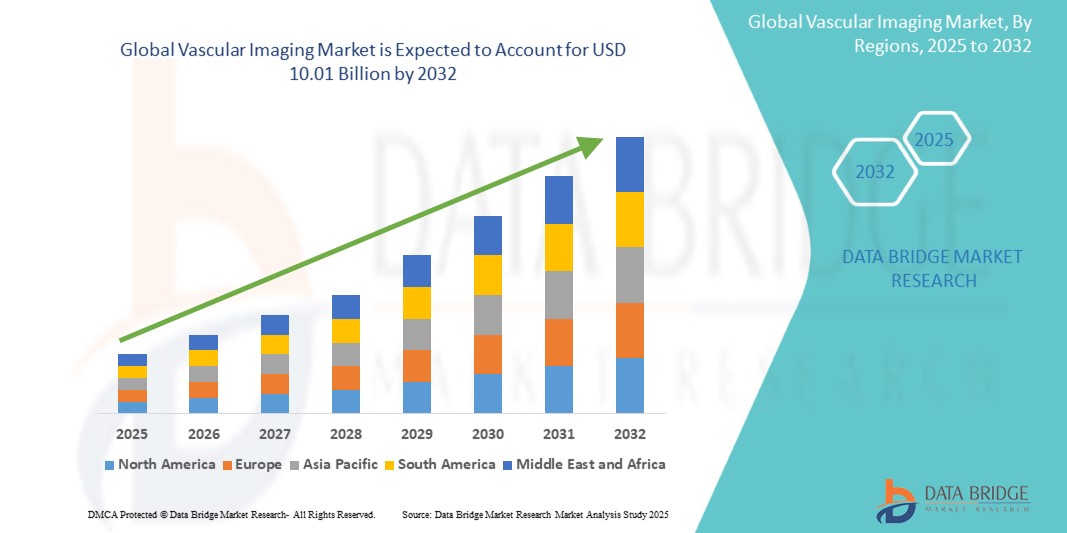
Vascular Imaging Market Size
- The global vascular imaging market size was valued atUSD 6.60 billion in 2024and is expected to reachUSD 10.01 billion by 2032, at aCAGR of 5.35%during the forecast period
- This growth is driven by factors such as rising prevalence of vascular diseases, technological advancements, aging population, preference for non-invasive diagnostics, expanding healthcare infrastructure, and government support
Vascular Imaging Market Analysis
- Vascular imaging is a vital diagnostic tool used to assess blood vessels, detect vascular diseases, and guide therapeutic procedures with precision and safety. It plays a crucial role in hospitals, diagnostic imaging centers, and outpatient settings, supporting accurate disease detection and treatment planning
- The vascular imaging market is experiencing significant growth driven by the rising prevalence of vascular conditions, advancements in imaging technology, increased demand for non-invasive diagnostic methods, the aging population, and expanding healthcare infrastructure
- North America is expected to dominate the vascular imaging marketwith a largest market share of 33.74%, due to a well-established healthcare infrastructure, high adoption of advanced medical technologies, and streamlined repayment regulations
- Asia-Pacific is expected to be the fastest growing region in the vascular imaging market during the forecast period due to increasing prevalence of cardiovascular disorders and the rising demand for advanced diagnostic technologies
- Nuclear imaging segment is expected to dominate the market with a market share of 33.38% due to its ability to provide highly accurate and detailed images of blood flow and vascular structures. Nuclear imaging techniques, such as positron emission tomography (PET) and single-photon emission computed tomography (SPECT), offer precise functional and anatomical information, which is crucial for diagnosing vascular diseases such asatherosclerosisand deep vein thrombosis. In addition, advancements inradiopharmaceuticalsand growing demand for non-invasive diagnostic methods are contributing to the segment's growth
Report Scope andVascular ImagingMarket Segmentation
|
Attributes |
Vascular ImagingKeyMarket Insights |
|
Segments Covered |
|
|
Countries Covered |
North America
Europe
Asia-Pacific
Middle East and Africa
South America
|
|
Key Market Players |
|
|
Market Opportunities |
|
|
Value Added Data Infosets |
In addition to the insights on market scenarios such as market value, growth rate, segmentation, geographical coverage, and major players, the market reports curated by the Data Bridge Market Research also include depth expert analysis, patient epidemiology, pipeline analysis, pricing analysis, and regulatory framework. |
Vascular ImagingMarket Trends
“Increasing Prevalence of Cardiovascular Diseases”
- One prominent trend in the global vascular imaging market is the increasing prevalence of cardiovascular diseases
- This trend is driven by the rising incidence of conditions such as coronary artery disease, stroke, and peripheral artery disease, which require advanced diagnostic imaging for early detection and management
- For instance, healthcare providers are increasingly adopting advanced vascular imaging technologies, such as MRI, CT, and ultrasound, to improve diagnostic accuracy and patient outcomes
- The demand for these imaging techniques is growing across hospitals, diagnostic centers, and outpatient settings due to their ability to offer non-invasive, precise, and timely insights into vascular health
- As cardiovascular disease rates continue to rise globally, this trend is expected to significantly drive innovation and investment in the vascular imaging market
Vascular ImagingMarket Dynamics
Driver
“Growing Demand for Non-Invasive Diagnostic Techniques”
- The growing demand for non-invasive diagnostic techniques is a major driver of growth in the vascular imaging market, as conditions such as cardiovascular diseases, stroke, and peripheral artery disease require accurate, non-invasive methods for diagnosis and monitoring
- This demand is particularly evident in the management of chronic vascular conditions, where patients benefit from imaging technologies that avoid the risks associated with invasive procedures
- As the global burden of cardiovascular diseases increases, especially in aging populations, there is a rising need for reliable and easy-to-use non-invasive imaging solutions across hospitals, clinics, and diagnostic centers
- Manufacturers are responding by developing advanced imaging systems that offer high accuracy, faster results, and improved patient comfort, especially for conditions that require frequent monitoring
- The focus on early diagnosis, disease prevention, and non-invasive treatment options is accelerating the adoption of vascular imaging technologies in both developed and emerging markets
For instance,
- Companies such as Siemens Healthineers and GE Healthcare are investing in cutting-edge MRI and ultrasound technologies to meet the growing demand for non-invasive diagnostic solutions
- Philips Healthcare is enhancing its ultrasound devices with real-time imaging and improved resolution to support faster and more accurate diagnostics
- As the demand for safer, more efficient diagnostic methods continues to rise, this driver is expected to play a significant role in shaping innovation and market expansion in the vascular imaging sector
Opportunity
“Integration of Artificial Intelligence and Machine Learning”
- The integration of artificial intelligence (AI) and machine learning (ML) presents a significant opportunity for the vascular imaging market, driven by the increasing need for enhanced diagnostic accuracy and faster image processing
- Healthcare providers are seeking advanced imaging solutions that leverage AI and ML to improve diagnostic precision, automate image analysis, and assist clinicians in detecting vascular diseases at an earlier stage
- This opportunity aligns with the growing demand for more efficient and accuratediagnostic tools, where AI-driven systems can analyze complex vascular images and provide actionable insights for patient management
For instance,
- Canon Medical Systems has developed AI-based image analysis software to assist in the detection of vascular abnormalities and improve diagnostic workflow
- Fujifilm Healthcare is integrating machine learning algorithms into its ultrasound systems to enhance image quality and support real-time decision-making for vascular disease diagnosis
- As AI and ML technologies continue to advance, the vascular imaging market is poised to capitalize on these innovations, enhancing diagnostic capabilities and improving patient outcomes across healthcare settings
Restraint/Challenge
“High Cost of Equipment and Maintenance”
- The high cost of equipment and maintenance presents a significant challenge for the vascular imaging market, as advanced imaging technologies require substantial investments for initial acquisition and ongoing upkeep
- The need to maintain and service sophisticated imaging systems, such as MRI, CT scanners, and ultrasound machines, contributes to the overall cost burden for healthcare facilities, especially in resource-limited regions
- This challenge is particularly pronounced in emerging markets, where healthcare providers may face budget constraints and struggle to afford or maintain cutting-edge vascular imaging equipment, delaying access to advanced diagnostic capabilities
For instance,
- Smaller healthcare providers, particularly in developing regions, often face difficulties in securing funding for these high-cost systems and maintaining them, limiting their ability to adopt the latest vascular imaging technologies
- The high cost of equipment and maintenance can slow market growth and hinder the widespread adoption of advanced vascular imaging solutions, especially in emerging markets where budgets and infrastructure are more constrained
Vascular Imaging Market Scope
The market is segmented on the basis of technique, procedure, application, and end user.
|
Segmentation |
Sub-Segmentation |
|
ByTechnique |
|
|
ByProcedure |
|
|
ByApplication |
|
|
ByEnd User
|
|
In 2025, the nuclear imaging is projected to dominate the market with a largest share in technique segment
The nuclear imaging segment is expected to dominate the vascular imaging market with the largest share of 33.38% in 2025 due to its ability to provide highly accurate and detailed images of blood flow and vascular structures. Nuclear imaging techniques, such as positron emission tomography (PET) and single-photon emission computed tomography (SPECT), offer precise functional and anatomical information, which is crucial for diagnosing vascular diseases such as atherosclerosis and deep vein thrombosis. In addition, advancements in radiopharmaceuticals and growing demand for non-invasive diagnostic methods are contributing to the segment's growth.
The magnetic resonance imaging is expected to account for the largest share during the forecast period in technique segment
In 2025, the magnetic resonance imaging segment is expected to dominate the market with the largest market share of 34.6% due to its superior ability to provide high-resolution, detailed images of soft tissues without the use of ionizing radiation. MRI is particularly valuable in vascular imaging for assessing blood vessels, detecting abnormalities, and monitoring disease progression, making it a preferred method for diagnosing conditions such as stroke and aneurysms. In addition, advancements in MRI technology, such as higher field strength and faster imaging techniques, along with its non-invasive nature, are driving its increased adoption in clinical settings.
Vascular Imaging Market Regional Analysis
“North America Holds the Largest Share in the Vascular imaging Market”
- North America dominates the vascular imagingmarket with a largest market share of 33.74%, driven by a well-established healthcare infrastructure, high adoption of advanced medical technologies, and streamlined repayment regulations
- U.S.holds a significant share due to its robust healthcare system and high healthcare spending, which facilitates the integration of the latest vascular imaging systems, including MRI, CT, and ultrasound technologies
- The region’s dominance is further bolstered by the increasing incidence of stroke and cardiovascular diseases, which drive demand for advanced diagnostic tools
- The rising preference for non-invasive imaging techniques, such as MRI and ultrasound, is expected to continue fueling market growth in North America, alongside investments in research and development to enhance the capabilities of vascular imaging technologies
“Asia-Pacific is Projected to Register the HighestCAGR in the Vascular imaging Market”
- Asia-Pacificis expected to witness the highest growth rate in the vascular imagingmarket, driven by increasing prevalence of cardiovascular disorders and the rising demand for advanced diagnostic technologies
- China holds a significant share due to its rapidly expanding healthcare infrastructure, large and aging population, and increasing demand for vascular imaging solutions. Government-backed initiatives to improve healthcare access and rising healthcare expenditure further support this growth
- The region’s expansion is supported by rapid urbanization, lifestyle changes, and improving healthcare infrastructure, which collectively contribute to the growing need for accurate and non-invasive diagnostic methods, especially in countries such as India, Japan, and South Korea
- In addition, the demand for vascular imaging solutions is expected to rise due to increasing awareness about early diagnosis and the availability of innovative imaging technologies, positioning Asia-Pacific as a key growth engine in the vascular imaging market through 2032.
Vascular Imaging Market Share
The market competitive landscape provides details by competitor. Details included are company overview, company financials, revenue generated, market potential, investment in research and development, new market initiatives, global presence, production sites and facilities, production capacities, company strengths and weaknesses, product launch, product width and breadth, application dominance. The above data points provided are only related to the companies' focus related to market.
The Major Market Leaders Operating in the Market Are:
- Siemens Healthineers AG(Germany)
- GE HealthCare(U.S.)
- Swedish Medical Center (U.S.)
- Brigham and Women's Hospital (U.S.)
- Hitachi Healthcare Americas (Japan)
- Koninklijke Philips N.V.(Netherlands)
- Shimadzu Corporation (Japan)
- Samsung Medison Co., Ltd. (South Korea)
- Abbott(U.S.)
- FUJIFILM Corporation(Japan)
- Esaote SPA (Italy)
- Carestream Health (U.S.)
- TERUMO CORPORATION (Japan)
- Konica Minolta, Inc. (Japan)
- Pie Medical Imaging B.V. (Netherlands)
- ALPINION MEDICAL SYSTEMS Co., Ltd. (South Korea)
- CorVascular Diagnostics, LLC (U.S.)
Latest Developments in Global Vascular Imaging Market
- In March 2025, Boston Scientific Corporation announced the launch of its iCross Coronary Imaging Catheter in the U.S., aimed at enhancing the deliverability of its iLab Ultrasound Imaging System, a leading intravascular ultrasound (IVUS) technology. By enabling physicians to obtain clearer, more precise images of the heart and coronary arteries, this product introduction is expected to strengthen the company’s position in the vascular imaging market and support the growing demand for advanced intravascular diagnostic tools
- In October 2023, Abbott launched its advanced vascular imaging platform powered by Ultreon 1.0 Software in India. This platform integrates optical coherence tomography (OCT) with artificial intelligence (AI) to offer physicians a detailed and automated assessment of coronary artery blockages. By enabling real-time differentiation of plaque types, assessing calcium severity, and assisting in accurate stent placement, the technology is expected to enhance procedural precision and clinical outcomes. This launch positions Abbott to capitalize on the increasing demand for AI-driven imaging solutions in the vascular imaging market, particularly in the rapidly expanding Indian healthcare sector
- In November 2023, BD launched the SiteRite 9, an advanced ultrasound system engineered to enhance precision in placing vascular access devices. With improved imaging capabilities and user-friendly features, the system aims to reduce complications and improve first-attempt success rates, particularly in complex vascular access cases. This development is expected to strengthen BD’s presence in the vascular imaging market by addressing critical clinical needs and supporting efficiency in hospital and outpatient settings
- In August 2023, GE Healthcare unveiled the Vscan Air SL, a wireless, handheld ultrasound device designed for quick and accurate assessments in vascular and cardiac care. The device combines high-quality imaging with mobility, enabling clinicians to make faster decisions at the point of care. By improving workflow efficiency and supporting early diagnosis in both emergency and routine settings, the Vscan Air SL is positioned to drive adoption of compact imaging tools globally and contribute to the growing demand for portable vascular imaging solutions
- In February 2023, FUJIFILM India expanded its healthcare imaging portfolio at the 75th National Conference of the Indian Radiological and Imaging Association (IRIA), unveiling several advanced diagnostic solutions. The launch included the Arietta 850 DeepInsight and Arietta 650 DeepInsight ultrasound systems, the APERTO Lucent MRI machine, and the Non-DICOM printer APEOS. The company also introduced “FUJIFILM Connect,” a mobile application designed to streamline service and support. These additions underscore FUJIFILM’s commitment to strengthening its presence in the Indian vascular imaging market by offering cutting-edge, user-centric technologies tailored to local healthcare needs
SKU-

研究方法
数据收集和基准年分析是使用具有大样本量的数据收集模块完成的。该阶段包括通过各种来源和策略获取市场信息或相关数据。它包括提前检查和规划从过去获得的所有数据。它同样包括检查不同信息源中出现的信息不一致。使用市场统计和连贯模型分析和估计市场数据。此外,市场份额分析和关键趋势分析是市场报告中的主要成功因素。要了解更多信息,请请求分析师致电或下拉您的询问。
DBMR 研究团队使用的关键研究方法是数据三角测量,其中包括数据挖掘、数据变量对市场影响的分析和主要(行业专家)验证。数据模型包括供应商定位网格、市场时间线分析、市场概览和指南、公司定位网格、专利分析、定价分析、公司市场份额分析、测量标准、全球与区域和供应商份额分析。要了解有关研究方法的更多信息,请向我们的行业专家咨询。
可定制
Data Bridge Market Research 是高级形成性研究领域的领导者。我们为向现有和新客户提供符合其目标的数据和分析而感到自豪。报告可定制,包括目标品牌的价格趋势分析、了解其他国家的市场(索取国家列表)、临床试验结果数据、文献综述、翻新市场和产品基础分析。目标竞争对手的市场分析可以从基于技术的分析到市场组合策略进行分析。我们可以按照您所需的格式和数据样式添加您需要的任意数量的竞争对手数据。我们的分析师团队还可以为您提供原始 Excel 文件数据透视表(事实手册)中的数据,或者可以帮助您根据报告中的数据集创建演示文稿。











