



Global Low-Fat Cheese Market, By Product (Feta, Ricotta, Mozzarella Sticks, Hard Cheese), Distribution Channel (Store-Based, Online), Application (Biscuits, Snacks, Soups, Sauces, Others) - Industry Trends and Forecast to 2030.
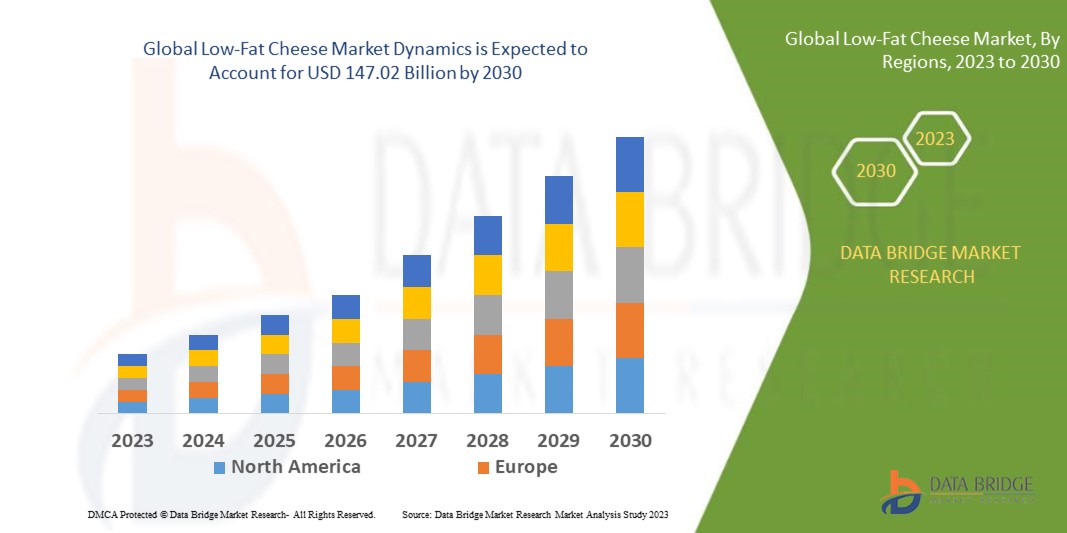
Low-Fat Cheese Market Analysis and Size
Cheese has become a popular product in urban households and the global food processing industry. Low-fat cheese has emerged as the most promising market worldwide in the last decade or so. Low-fat cheese is easy to digest and low in calories, as opposed to bovine cheese, which is difficult to digest and high in cholesterol and fat. Low-fat cheese also contains more vitamins, particularly vitamins A, B1, B2, and B3, and calcium and phosphorus.
Data Bridge Market Research analyses that the low-fat cheese market which was valued at USD 103.65 billion in 2022 is expected to reach the value of USD 147.02 billion by 2030, at a CAGR of 5.0% during the forecast period. In addition to the insights on market scenarios such as market value, growth rate, segmentation, geographical coverage, and major players, the market reports curated by the Data Bridge Market Research also include in-depth expert analysis, geographically represented company-wise production and capacity, network layouts of distributors and partners, detailed and updated price trend analysis and deficit analysis of supply chain and demand.
Low-Fat Cheese Market Scope and Segmentation
|
Report Metric |
Details |
|
Forecast Period |
2023 to 2030 |
|
Base Year |
2022 |
|
Historic Years |
2021 (Customizable to 2015-2020) |
|
Quantitative Units |
Revenue in USD Billion, Volumes in Units, Pricing in USD |
|
Segments Covered |
Product (Feta, Ricotta, Mozzarella Sticks, Hard Cheese), Distribution Channel (Store-Based, Online), Application (Biscuits, Snacks, Soups, Sauces, Others) |
|
Countries Covered |
U.S., Canada and Mexico in North America, Germany, Sweden, Poland, Denmark, France, U.K., Netherlands, Switzerland, Belgium, Russia, Italy, Spain, Turkey, Rest of Europe in Europe, China, Japan, India, South Korea, Singapore, Malaysia, Australia, Thailand, Indonesia, Philippines, Rest of Asia-Pacific (APAC) in the Asia-Pacific (APAC), Saudi Arabia, U.A.E., South Africa, Egypt, Israel, Rest of Middle East and Africa (MEA) as a part of Middle East and Africa (MEA), Brazil, Argentina and Rest of South America as part of South America |
|
Market Players Covered |
Hain Celestial (U.S.), Dairy Farmers of America, Inc. (U.S.), General Mills Inc. (U.S.), Danone S.A. (France) GCMMF (India), Conagra Brands, Inc. (U.S.), Nestlé S.A. (Switzerland), Land O' Lakes, Inc. (U.S.), Kerry Group (Ireland), The Kraft Heinz Company (U.S.), ADM (U.S.), Lactosan A/S (Denmark), Aarkay Food Products Ltd. (India), All American Foods (U.S.), Commercial Creamery Company (U.S.), Kanegrade Limited (U.K.), and DairiConcepts, L.P (U.S.) |
|
Market Opportunities |
|
Market Definition
Low-fat cheese is a type of dairy product with lower calories and cholesterol because it contains less than 30% fat. It is also referred to as light or low calorie. Low-fat cheese contains less saturated fat and cholesterol, linked to an increased risk of heart disease. This cheese is available in various forms and is a healthier alternative to regular cheese.
Low-Fat Cheese Market Dynamics
Drivers
- Increasing Public Awareness of the Health Benefits of Low-Fat Cheese
The introduction of diverse cheese varieties within the low-fat segment presents a significant growth opportunity for the global low-fat cheese market. As manufacturers expand their product offerings to include options such as provolone, mozzarella, and cheddar with reduced fat content, they cater to the evolving preferences of health-conscious consumers. This diversification addresses the demand for flavorful, low-fat alternatives, offering consumers a wider selection of options. The opportunity lies in attracting a broader audience who seeks both health benefits and taste, contributing to the market's expansion and potential for increased revenue. With an array of low-fat cheese choices available, the market is better positioned to meet the diverse culinary needs and preferences of consumers, ultimately driving its growth.
- Increased Demand for Ready-to-Eat Food Products
Growing health problems as a result of increased demand for canned and frozen food products, and rising disposable income among individuals, are some of the factors driving the low-fat cheese market's growth.
Opportunity
- Diverse Cheese Varieties
The increased snack consumption presents a substantial opportunity for the global low-fat cheese market, driven by a growing customer base seeking convenient, nutritious, and diverse snacking options. Rice cakes, known for their portability and health-conscious appeal, align with the convenience and health trends in snacking. As consumers prioritize taste and nutrition, manufacturers can seize the opportunity by offering a variety of flavors and premium options, potentially expanding into new global markets and leveraging online sales channels to reach a wider audience. This shift in consumer behaviour opens doors for the low-fat cheese market to thrive in a changing snack landscape
Restraint/Challenge
- Texture and Flavor as Key Factors
Consumers have well-established preferences for the rich and indulgent texture and flavor of traditional cheeses. Low-fat cheese products often struggle to match these sensory expectations, posing a significant challenge for their acceptance and growth in the global market.
This low-fat cheese market report provides details of new recent developments, trade regulations, import-export analysis, production analysis, value chain optimization, market share, impact of domestic and localized market players, analyses opportunities in terms of emerging revenue pockets, changes in market regulations, strategic market growth analysis, market size, category market growths, application niches and dominance, product approvals, product launches, geographic expansions, technological innovations in the market. To gain more info on the low-fat cheese market contact Data Bridge Market Research for an Analyst Brief, our team will help you take an informed market decision to achieve market growth.
Recent Developments
- According to European commission, the government funded cheese coat technique for manufacturing low-fat mozzarella cheese with superior quality has been developed to cater the consumer demands for low fat cheeses. The project created a mozzarella-style cheese with less than 3% fat that tastes far superior to low-fat varieties on the market. The project team isolated novel starter cultures to improve the texture and taste of low-fat mozzarella-such as cheeses, focusing on acidity, milk-fat ratio, casein-to-fat ratio, melting factor, and temperature. It also developed an oil coating process for cheese shreds in order to improve the properties of the cheese while removing all of the fat.
Global Low-Fat Cheese Market Scope
The low-fat cheese market is segmented on the basis of product, distribution channel and application. The growth amongst these segments will help you analyze meagre growth segments in the industries and provide the users with a valuable market overview and market insights to help them make strategic decisions for identifying core market applications.
Product
- Feta
- Ricotta
- Mozzarella Sticks
- Hard Cheese
Distribution channel
- Store-Based
- Online
Application
Low-Fat Cheese Market Regional Analysis/Insights
The low-fat cheese market is analysed and market size insights and trends are provided by product, distribution channel and application as referenced above.
The countries covered in the low-fat cheese market report are U.S., Canada and Mexico in North America, Germany, France, U.K., Netherlands, Switzerland, Belgium, Russia, Italy, Spain, Turkey, Rest of Europe in Europe, China, Japan, India, South Korea, Singapore, Malaysia, Australia, Thailand, Indonesia, Philippines, Rest of Asia-Pacific (APAC) in the Asia-Pacific (APAC), Saudi Arabia, U.A.E., South Africa, Egypt, Israel, Rest of Middle East and Africa (MEA) as a part of Middle East and Africa (MEA), Brazil, Argentina and Rest of South America as part of South America.
In developing countries such as India, there has been a shift from staple foods to processed and packaged foods. Furthermore, the expansion of retail channels such as supermarkets and hypermarkets in these countrie’s urban areas is expected to increase the availability of processed and packaged food. Low-fat cheese demand is expected to rise in the coming years due to rising demand for packaged foods such as snacks, bakery and confectionery products, and ready-to-eat meals.
The country section of the report also provides individual market impacting factors and changes in market regulation that impact the current and future trends of the market. Data points such as down-stream and up-stream value chain analysis, technical trends and porter's five forces analysis, case studies are some of the pointers used to forecast the market scenario for individual countries. Also, the presence and availability of global brands and their challenges faced due to large or scarce competition from local and domestic brands, impact of domestic tariffs and trade routes are considered while providing forecast analysis of the country data.
Competitive Landscape and Low-Fat Cheese Market Share Analysis
The low-fat cheese market competitive landscape provides details by competitor. Details included are company overview, company financials, revenue generated, market potential, investment in research and development, new market initiatives, global presence, production sites and facilities, production capacities, company strengths and weaknesses, product launch, product width and breadth, application dominance. The above data points provided are only related to the company’s focus related to low-fat cheese market.
Some of the major players operating in the low-fat cheese market are:
- Hain Celestial (U.S.)
- Dairy Farmers of America, Inc. (U.S.)
- General Mills Inc. (U.S.)
- Danone S.A. (France)
- GCMMF (India)
- Conagra Brands, Inc. (U.S.)
- Nestlé S.A. (Switzerland)
- Land O' Lakes, Inc. (U.S.)
- Kerry Group (Ireland)
- The Kraft Heinz Company (U.S.)
- ADM (U.S.)
- Lactosan A/S (Denmark)
- Aarkay Food Products Ltd. (India)
- All American Foods (U.S.)
- Commercial Creamery Company (U.S.)
- Kanegrade Limited (U.K.)
- DairiConcepts, L.P (U.S.)
SKU-
Obtenga acceso en línea al informe sobre la primera nube de inteligencia de mercado del mundo

- Panel de análisis de datos interactivo
- Panel de análisis de empresas para oportunidades con alto potencial de crecimiento
- Acceso de analista de investigación para personalización y consultas
- Análisis de la competencia con panel interactivo
- Últimas noticias, actualizaciones y análisis de tendencias
- Aproveche el poder del análisis de referencia para un seguimiento integral de la competencia
Metodología de investigación
La recopilación de datos y el análisis del año base se realizan utilizando módulos de recopilación de datos con muestras de gran tamaño. La etapa incluye la obtención de información de mercado o datos relacionados a través de varias fuentes y estrategias. Incluye el examen y la planificación de todos los datos adquiridos del pasado con antelación. Asimismo, abarca el examen de las inconsistencias de información observadas en diferentes fuentes de información. Los datos de mercado se analizan y estiman utilizando modelos estadísticos y coherentes de mercado. Además, el análisis de la participación de mercado y el análisis de tendencias clave son los principales factores de éxito en el informe de mercado. Para obtener más información, solicite una llamada de un analista o envíe su consulta.
La metodología de investigación clave utilizada por el equipo de investigación de DBMR es la triangulación de datos, que implica la extracción de datos, el análisis del impacto de las variables de datos en el mercado y la validación primaria (experto en la industria). Los modelos de datos incluyen cuadrícula de posicionamiento de proveedores, análisis de línea de tiempo de mercado, descripción general y guía del mercado, cuadrícula de posicionamiento de la empresa, análisis de patentes, análisis de precios, análisis de participación de mercado de la empresa, estándares de medición, análisis global versus regional y de participación de proveedores. Para obtener más información sobre la metodología de investigación, envíe una consulta para hablar con nuestros expertos de la industria.
Personalización disponible
Data Bridge Market Research es líder en investigación formativa avanzada. Nos enorgullecemos de brindar servicios a nuestros clientes existentes y nuevos con datos y análisis que coinciden y se adaptan a sus objetivos. El informe se puede personalizar para incluir análisis de tendencias de precios de marcas objetivo, comprensión del mercado de países adicionales (solicite la lista de países), datos de resultados de ensayos clínicos, revisión de literatura, análisis de mercado renovado y base de productos. El análisis de mercado de competidores objetivo se puede analizar desde análisis basados en tecnología hasta estrategias de cartera de mercado. Podemos agregar tantos competidores sobre los que necesite datos en el formato y estilo de datos que esté buscando. Nuestro equipo de analistas también puede proporcionarle datos en archivos de Excel sin procesar, tablas dinámicas (libro de datos) o puede ayudarlo a crear presentaciones a partir de los conjuntos de datos disponibles en el informe.











