


Chine Mobilité électroniqueSegmentation du marché, par type de véhicule (voitures électriques,Vélos électriques, Scooters électriques/Scooters motorisés,Motocycles électriques, et autres), composants (Système de gestion des batteries(BMS), contrôleur de charge de véhicule électrique (EVCC), boîte électronique (boîte de distribution électrique), unité de déconnexion de batterie (BDU), et autres), tension (48V, 36V, au-dessus de 48V, 24V et moins de 24V), type de batterie (Li-Ion,Acides de plomb scellés, et NiMH), mode de charge (charge etChargement sans fil), Utilisation (utilisation personnelle, utilisation commerciale et utilisation partagée de la mobilité) – Tendances et prévisions de l'industrie jusqu'en 2032
Analyse du marché de la mobilité électronique
Le marché de la mobilité électronique se développe rapidement à mesure que les consommateurs et les entreprises s'orientent versVéhicules électriques(EV). Ce changement est dû aux préoccupations environnementales, aux politiques gouvernementales et aux progrès de la technologie des piles. Les gouvernements du monde entier offrent des subventions, des avantages fiscaux et des règlements sur les émissions pour encourager l'adoption des VE. Dans le même temps, les investissements dans les infrastructures de tarification rendent le transport électrique plus accessible. Les innovations technologiques, telles que l'amélioration de l'efficacité de la batterie et une charge plus rapide, rendent les véhicules électriques plus pratiques. En outre, la recharge intelligente et la conduite autonome renforcent l'attrait de la mobilité électronique.
Taille du marché de la mobilité électronique
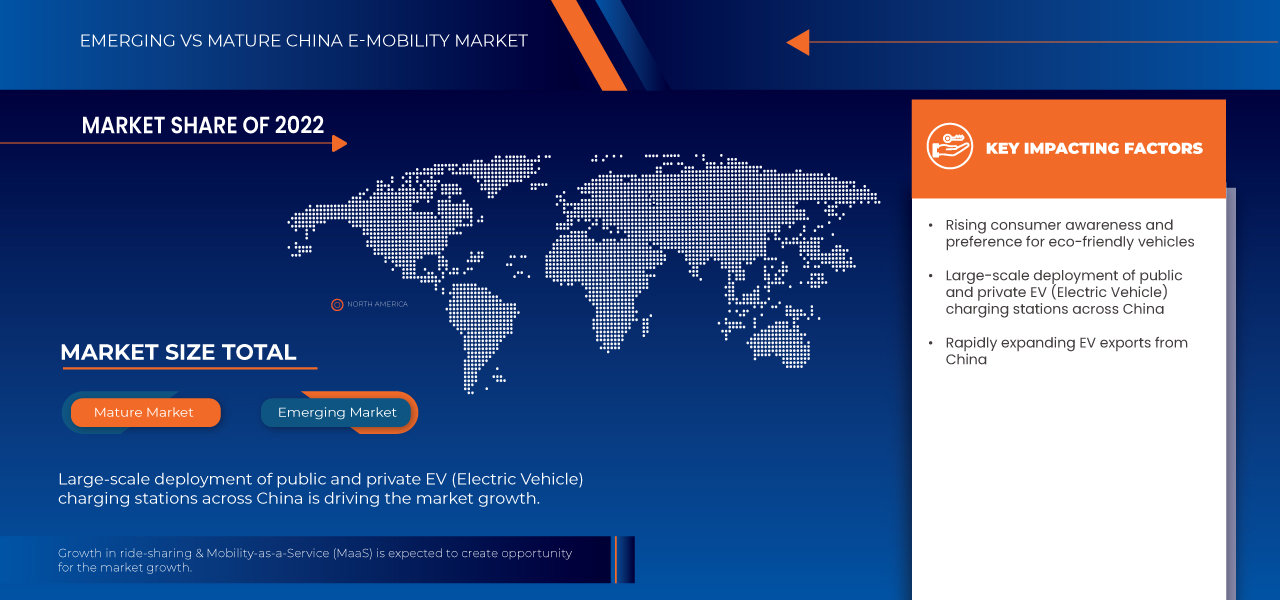
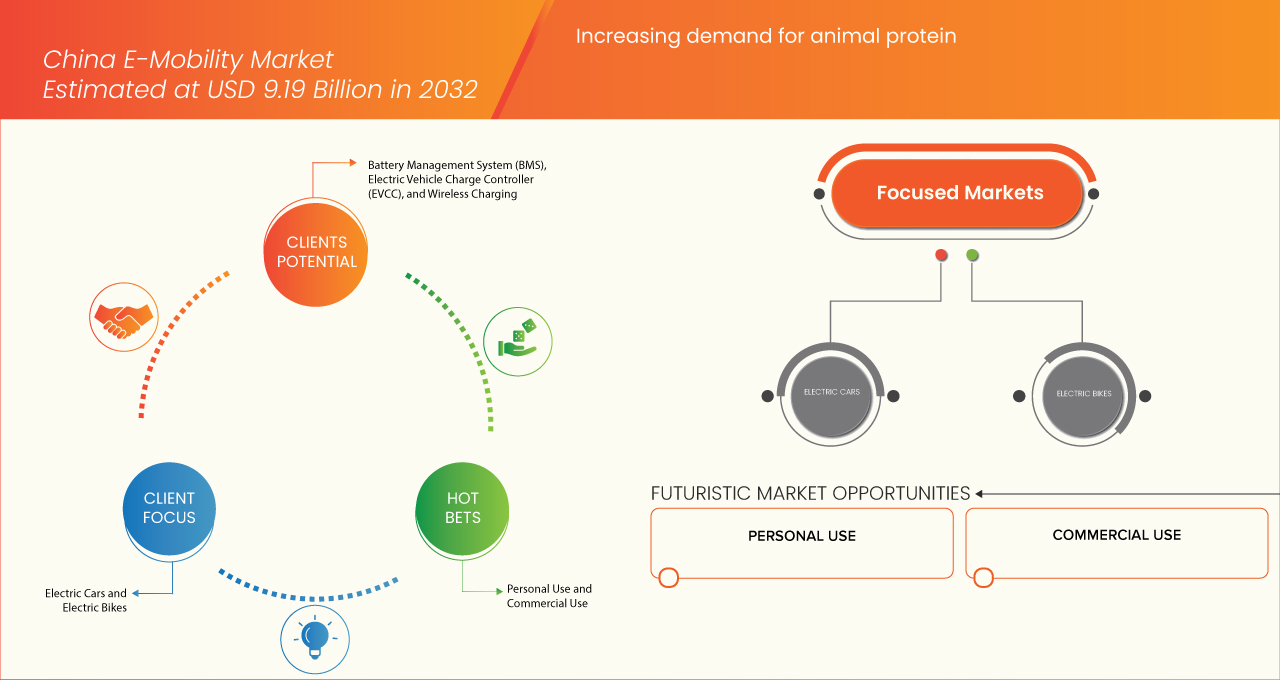
Le marché chinois de la mobilité électronique devrait atteindre 919,56 milliards de dollars d'ici 2032, contre 153,45 milliards en 2024, avec une croissance substantielle du TCAC de 25,3% au cours de la période de prévision 2025-2032. Outre les perspectives du marché telles que la valeur de marché, le taux de croissance, les segments de marché, la couverture géographique, les acteurs du marché et le scénario du marché, le rapport de marché préparé par l'équipe de recherche sur le marché de Data Bridge comprend une analyse approfondie des experts, une analyse des importations et des exportations, une analyse des prix, une analyse de la consommation de production et une analyse PESTLE.
Mobilité ETendances du marché
Sensibilisation accrue des consommateurs et préférence pour les véhicules respectueux de l'environnement
Comme les préoccupations environnementales, comme la pollution atmosphérique et les émissions de carbone, occupent une place centrale dans le monde, les consommateurs chinois accordent de plus en plus d'importance à la durabilité dans leurs décisions d'achat. Ce changement de comportement des consommateurs est non seulement en train de remodeler le paysage automobile, mais aussi de stimuler la demande de véhicules électriques (EV) et d'autres formes de mobilité électrique.
La Chine, qui est le plus grand marché automobile au monde, est aux prises avec de graves problèmes environnementaux, notamment le smog urbain et les émissions élevées de gaz à effet de serre. En réponse, le gouvernement a mis en oeuvre des politiques rigoureuses pour promouvoir l'énergie propre et réduire la dépendance à l'égard des combustibles fossiles. Toutefois, le succès de ces politiques est amplifié par un segment croissant de consommateurs soucieux de l'environnement qui recherchent activement des solutions de rechange plus écologiques. Cette tendance est alimentée par une large couverture médiatique, des campagnes éducatives et l'impact visible du changement climatique, qui ont influé collectivement sur la perception et le comportement du public. La préférence pour les véhicules écologiques est encore renforcée par les avantages tangibles qu'ils offrent. Les véhicules électriques sont considérés non seulement comme durables sur le plan environnemental, mais aussi comme rentables à long terme, grâce à des coûts d'exploitation et d'entretien moins élevés que les véhicules classiques du moteur à combustion interne (ICE).
De plus, les progrès de la technologie des véhicules électriques, comme l'amélioration de la durée de vie des batteries, l'accélération de l'infrastructure de recharge et l'amélioration des performances, ont rendu les véhicules électriques plus attrayants pour un public plus large. Les consommateurs chinois, en particulier dans les zones urbaines, considèrent de plus en plus les VE comme un choix pratique et responsable, en adéquation avec leurs aspirations à un mode de vie moderne et durable.
Portée du rapport et segmentation du marché de la mobilité électronique
| Attributs | Mobilité EPrincipales perspectives du marché |
| Segments couverts |
|
| Principaux acteurs du marché | Volkswagen (Allemagne), BYD Co., Ltd. (Chine), Tesla (États-Unis), BMW AG (Allemagne), General Motors (États-Unis), NIO (Chine), Honda Motor Co., Ltd (Japon), Mercedes-Benz Group AG (Allemagne), KTM Sportmotocycle GmbH (Autriche) et Vmoto Limited (Australie) entre autres |
| Possibilités de marché |
|
| Infos sur la valeur ajoutée | Outre les perspectives du marché telles que la valeur de marché, le taux de croissance, les segments de marché, la couverture géographique, les acteurs du marché et le scénario du marché, le rapport de marché préparé par l'équipe de recherche sur le marché de Data Bridge comprend une analyse approfondie des experts, une analyse des importations et des exportations, une analyse des prix, une analyse de la consommation de production et une analyse PESTLE. |
Mobilité EMarchéDéfinition
Un véhicule électrique (EV) est un mode de transport alimenté par l'électricité au lieu des combustibles fossiles traditionnels. Les véhicules électriques utilisent des batteries rechargeables pour conduire un moteur électrique, réduire les émissions de carbone et la dépendance à l'essence ou au diesel. Ils sont de différents types, notamment les véhicules électriques à batterie (VAB), les véhicules électriques hybrides rechargeables (VAB) et les véhicules électriques hybrides (VAB). Le marché des véhicules électriques fait référence à l'industrie mondiale axée sur la production, la vente et l'adoption de véhicules électriques. Sous l'impulsion des progrès technologiques, de la réglementation environnementale et de la demande de mobilité durable des consommateurs, le marché se développe rapidement. Les joueurs clés comprennent Tesla, BYD, et les constructeurs d'automobiles qui ont vécu la transition vers les EV. Les gouvernements du monde entier soutiennent l'adoption des véhicules électriques au moyen d'incitations, de l'expansion des infrastructures de tarification et de réglementations plus strictes en matière d'émissions. Le marché englobe également la technologie des batteries, les réseaux de recharge et les chaînes d'approvisionnement pour les matériaux essentiels tels que le lithium et le cobalt. Au fur et à mesure que l'innovation se poursuivra, les véhicules électriques domineront l'avenir des transports.
Mobilité EMarchéDynamique
Conducteurs
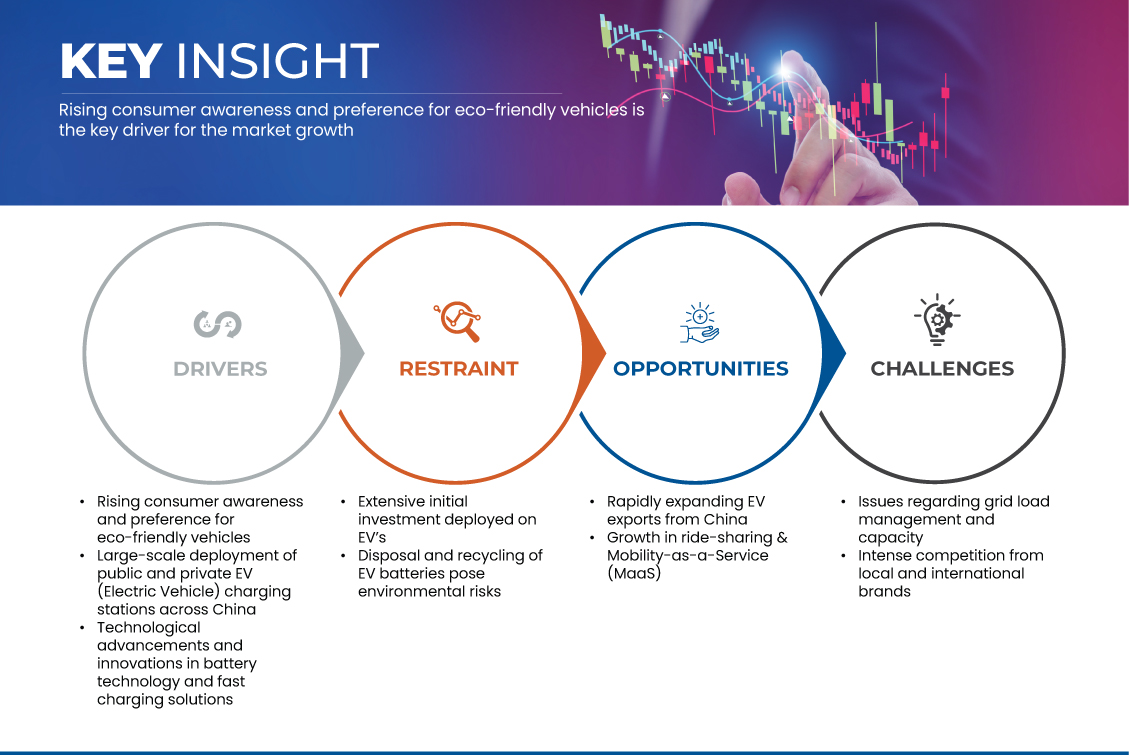
- Déploiement à grande échelle de stations de recharge des véhicules électriques publics et privés
En tant que plus grand marché d'EV au monde, la Chine met l'accent sur la construction d'une infrastructure de recharge robuste et s'attaque à l'un des obstacles les plus importants à l'adoption d'EV : l'anxiété de portée. Cette expansion de l'infrastructure renforce non seulement la confiance des consommateurs, mais crée également un écosystème sans faille qui favorise l'adoption généralisée de véhicules électriques.
Le réseau de recharge de la Chine a connu une croissance exponentielle ces dernières années, avec plus de 1,7 million de points de recharge publics et des millions d'installations privées supplémentaires à partir de 2023. Ce déploiement massif de l'infrastructure répond directement à la demande croissante de véhicules électriques, alimentée par les politiques gouvernementales, la sensibilisation à l'environnement et les progrès technologiques. En veillant à ce que les bornes de recharge soient largement accessibles, la Chine élimine les préoccupations pratiques qui ont historiquement empêché les consommateurs de passer à la mobilité électrique. Le déploiement d'infrastructures de tarification stimule également l'innovation et la concurrence dans le secteur de la mobilité électronique. Les entreprises investissent dans des technologies en mutation rapide, dans l'intégration des réseaux intelligents et dans les stations à énergie renouvelable, ce qui améliore l'efficacité et la durabilité globales du réseau. Ce progrès technologique attire les acteurs mondiaux et favorise les partenariats entre les constructeurs automobiles, les fournisseurs d'énergie et les entreprises technologiques, ce qui propulse l'expansion du marché.
Par exemple,
XPENG et Volkswagen Group China ont signé un protocole d'accord (PE) pour développer conjointement l'un des plus grands réseaux chinois de recharge ultrarapide. Ce partenariat permet l'accès mutuel à plus de 20 000 piles de recharge dans 420 villes, ce qui accroît considérablement l'infrastructure de recharge. Les deux entreprises exploreront les stations de recharge ultrarapides co-marquées, accéléreront l'expansion du réseau et amélioreront l'expérience de recharge EV, ce qui permettra de déployer davantage de stations de recharge publiques et privées en Chine. Ces collaborations accélèrent le déploiement des infrastructures de tarification, en particulier dans les zones rurales mal desservies, tout en introduisant des solutions innovantes qui améliorent la commodité des utilisateurs.
- Progrès technologiques et innovations en technologie des batteries et solutions de recharge rapide
Ces développements s'attaquent à des défis critiques tels que les limites de portée, le temps de facturation et les coûts, tout en améliorant l'attrait général et la faisabilité des véhicules électriques pour les consommateurs et les entreprises. En conséquence, la Chine renforce sa position de leader mondial dans l'industrie des véhicules électriques, la technologie jouant un rôle clé dans la croissance du marché.
L'une des percées les plus importantes est dans la technologie de la batterie, où les entreprises chinoises dirigent la charge dans le développement de solutions de haute performance, rentable. Par exemple, CATL (Contemporary Amperex Technology Co. Ltd.), le plus grand fabricant de batteries au monde, a introduit des batteries à ions sodium et la technologie CTP, qui offrent une densité d'énergie plus élevée, des durées de vie plus longues et des coûts réduits. Ces innovations rendent les véhicules électriques plus abordables et plus efficaces, ce qui permet aux constructeurs automobiles de produire des véhicules à plus longue portée, comme la berline NIO-ET7 qui dispose d'une autonomie de plus de 1 000 kilomètres sur une seule charge. Il s'agit d'un changement de jeu pour les consommateurs, car il élimine l'anxiété de portée et fait des EV une option viable pour les voyages à longue distance. Parallèlement, les avancées dans les solutions de recharge rapide révolutionnent l'expérience de charge EV. Des entreprises comme Star Charge et TELD déploient des chargeurs ultrarapides capables de fournir jusqu'à 350 kW, permettant aux EV de recharger de 20% à 80% en seulement 15-20 minutes. Cela est particulièrement important pour les flottes commerciales et les services de conduite, où le temps d'arrêt est un facteur critique.
Par exemple,
Star Charge, l'un des principaux fournisseurs chinois d'infrastructures de recharge, a déployé des chargeurs ultra-rapides capables de fournir 350 kW, permettant aux EV de recharger de 20% à 80% en seulement 15-20 minutes. Ces chargeurs sont stratégiquement situés le long des autoroutes et dans les centres urbains, assurant des déplacements sans heurts sur de longues distances.
Possibilités
- Expansion rapide des exportations de véhicules électriques en provenance de Chine
L'expansion rapide des exportations de véhicules électriques (EV) en provenance de Chine représente une opportunité importante pour le marché de la mobilité électronique du pays. Alors que le passage au transport durable s'accélère, la Chine se positionne comme une force dominante dans le secteur des véhicules électriques, tirant parti de ses solides capacités de fabrication, de la technologie de pointe et de l'appui du gouvernement. Les exportations de véhicules électriques en Chine ont connu une croissance exponentielle ces dernières années, grâce à une combinaison de prix compétitifs, de conceptions innovantes et d'une demande croissante de solutions de remplacement plus écologiques dans le monde. Avec les marchés internationaux, en particulier en Europe, en Asie du Sud-Est, et même les marchés émergents, de plus en plus en vogue, les constructeurs automobiles de la Chine sont prêts à diriger cette charge. La vaste capacité de production et les économies d'échelle du pays lui permettent d'offrir des VE à des prix attrayants pour les marchés sensibles aux coûts, tandis que ses progrès technologiques continuent d'améliorer les performances et l'attrait de ses offres électriques.
Par exemple,
En juin 2024, selon un article publié par APCO Worldwide LLC., l'industrie des véhicules électriques (EV) de la Chine s'est rapidement développée, dépassant le Japon comme le plus grand exportateur mondial en 2023. Cette croissance, alimentée par l'innovation, des politiques favorables et des technologies de pointe en matière de piles, fait l'objet d'un examen global, l'UE, les États-Unis et d'autres pays imposant des tarifs. Les multinationales doivent s'adapter à l'évolution de la dynamique commerciale et à l'évolution du marché.
- Croissance du covoiturage et de la mobilité en tant que service (Maas)
À mesure que l'urbanisation continue d'augmenter, tant à l'échelle mondiale qu'à l'échelle nationale, les systèmes de transport sont sous pression pour s'adapter à la demande croissante de solutions efficaces, durables et rentables. C'est là que les véhicules électriques (EV) et les plates-formes MaaS entrent en jeu, et la Chine est à l'avant-garde des deux tendances, ce qui lui permet de tirer parti de la croissance de ces secteurs.
Les services de covoiturage, comme Didi Chuxing, sont profondément intégrés dans le paysage des transports en Chine. L'évolution croissante vers la mobilité partagée, stimulée par les préoccupations concernant la congestion du trafic, la pollution et les coûts, s'harmonise parfaitement avec l'augmentation des véhicules électriques. Alors que les villes cherchent à réduire les émissions de carbone, l'intégration des véhicules électriques dans les flottes de covoiturage devient une priorité. Pour la Chine, avec son écosystème avancé de fabrication d'EV, c'est une opportunité sans précédent
Par exemple,
En septembre 2023, selon un article publié par Elsevier, La croissance de la covoiturage et de la mobilité en tant que service (MaaS) en Chine s'est accélérée, avec l'expansion des plateformes MaaS dans 41 villes, principalement dans les régions développées. La montée en puissance des modèles contrôlés par le public et des modèles de partenariat reflète l'intégration croissante des services de mobilité. Cependant, l'équilibre entre le contrôle public et la participation du secteur privé demeure un défi de gouvernance.
Restrictions et difficultés
- Questions relatives à la gestion de la charge et à la capacité du réseau
Alors que le pays pousse vers l'énergie verte et le transport durable est louable, le nombre croissant de véhicules électriques exerce une pression considérable sur le réseau électrique, qui peut lutter pour suivre la demande croissante. À mesure qu'un plus grand nombre de consommateurs passent aux véhicules électriques, la nécessité d'une infrastructure de recharge fiable devient essentielle. Les stations de recharge EV tirent des quantités importantes d'électricité, en particulier pendant les heures de pointe, qui peuvent submerger les réseaux locaux. Dans les zones densément peuplées, cela peut entraîner des pénuries d'électricité, des inefficacités du système et une instabilité potentielle du réseau. En outre, le calendrier irrégulier de la tarification des véhicules électriques — souvent la nuit lorsque la demande d'électricité est traditionnellement faible — peut créer de nouveaux déséquilibres dans l'offre et la demande d'électricité, ce qui complique la gestion du réseau
Par exemple,
En juin 2024, selon un article publié par Dynamic Ratings, l'augmentation du nombre de véhicules électriques (EV) présente des défis importants pour l'entretien du réseau, notamment l'augmentation de la demande d'électricité, les problèmes de charge maximale et la pression sur les réseaux de distribution. Dynamic Ratings répond à ces défis grâce à des solutions de surveillance en temps réel, à l'amélioration de la stabilité du réseau, à la maintenance prédictive et à l'optimisation de l'infrastructure EV pour améliorer la fiabilité et soutenir les transitions énergétiques durables.
- Intense concurrence des marques locales et internationales
En tant que plus grand marché mondial de véhicules électriques (EV), la Chine a attiré un large éventail d'acteurs en quête de parts de marché, rendant de plus en plus difficile pour les entreprises de maintenir un avantage concurrentiel. Sur le front local, les constructeurs automobiles chinois, y compris les géants établis tels que BYD, NIO et Geely, avancent rapidement dans l'espace EV. Ces entreprises bénéficient d'une connaissance approfondie du marché intérieur, d'incitations gouvernementales favorables et d'une base manufacturière bien établie. Leurs stratégies agressives, notamment l'établissement de prix concurrentiels, l'expansion des offres de modèles et les innovations technologiques de pointe, font qu'il est difficile pour les nouveaux arrivants d'entrer sur le marché.
Par exemple,
En octobre 2024, selon un article de Global Times, l'industrie chinoise des véhicules électriques continue de prospérer malgré l'augmentation du protectionnisme dans les pays occidentaux. Les États-Unis, le Canada et l'UE ont imposé des droits élevés sur les importations de véhicules électriques en Chine, ce qui pose des défis. Cependant, la Chine a un potentiel de marché important, de solides investissements en recherche et développement (R-D) et une approche ouverte de la concurrence mondiale contribuent à soutenir la croissance et la compétitivité de son secteur des VE.
Ce rapport de marché fournit des détails sur les nouveaux développements récents, la réglementation commerciale, l'analyse des importations et des exportations, l'analyse de la production, l'optimisation de la chaîne de valeur, la part de marché, l'impact des acteurs du marché national et local, l'analyse des possibilités en termes de nouvelles poches de revenus, les changements dans la réglementation du marché, l'analyse stratégique de la croissance du marché, la taille du marché, la catégorie de croissance du marché, les créneaux d'application et la position dominante, les approbations de produits, les lancements de produits, les expansions géographiques, les innovations technologiques sur le marché. Pour obtenir plus d'informations sur le marché, contactez Data Bridge Market Research pour un résumé d'analyste, notre équipe vous aidera à prendre une décision de marché éclairée pour atteindre la croissance du marché.
Étendue du marché de la mobilité électronique
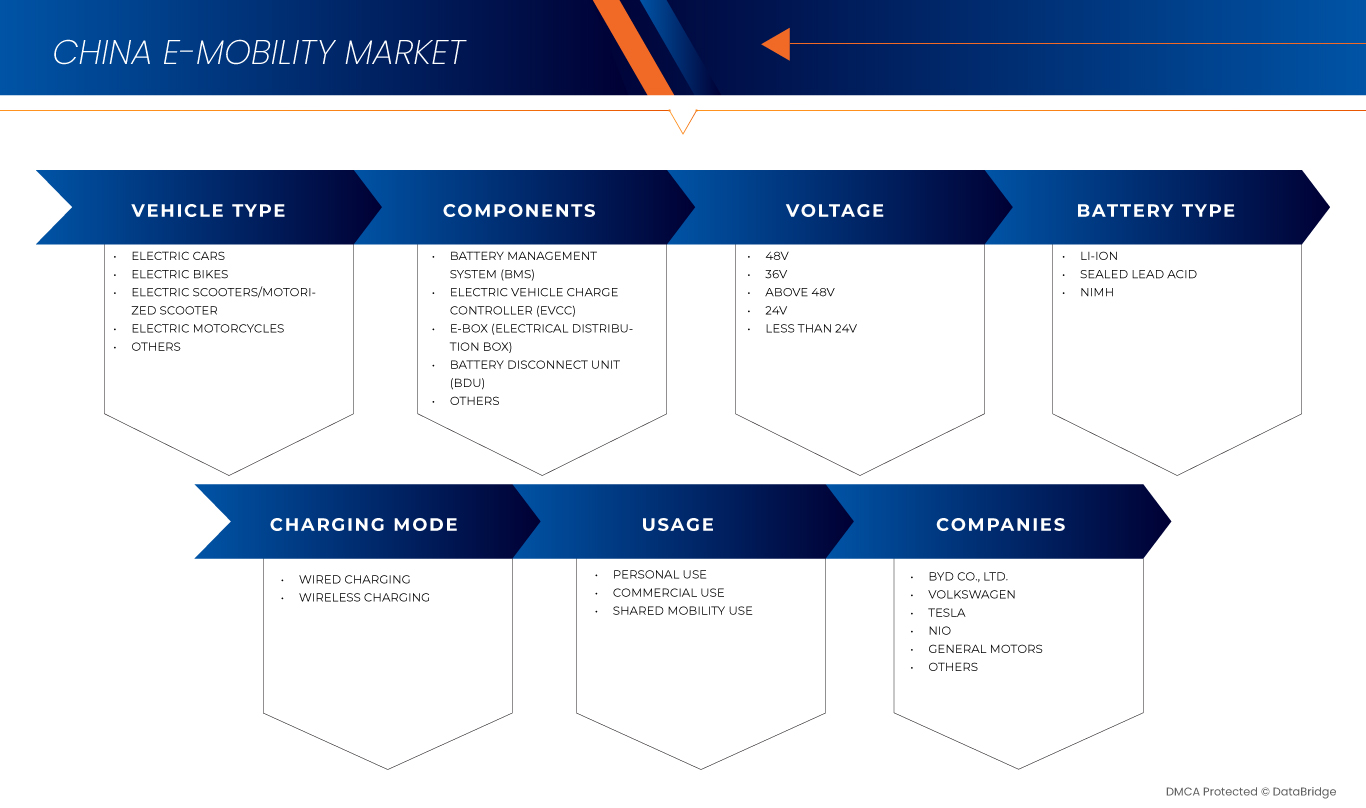
Le marché est segmenté en fonction du type de véhicule, des composants, de la tension, du type de batterie, du mode de charge et de l'utilisation La croissance de ces segments vous aidera à analyser des segments de croissance médiocres dans les industries et à fournir aux utilisateurs une vue d'ensemble du marché et des perspectives de marché précieuses pour les aider à prendre des décisions stratégiques pour identifier les applications du marché central.
Type de véhicule
- Voitures électriques
- Voitures électriques, par composant
- Système de gestion des batteries (BMS)
- Contrôleur de charge des véhicules électriques (EVCC)
- Boîte électronique (boîte électronique)
- Unité de déconnexion de la batterie (EDR)
- Autres
- Voitures électriques, par composant
- Vélos électriques
- Vélos électriques, par composant
- Système de gestion des batteries (BMS)
- Contrôleur de charge des véhicules électriques (EVCC)
- Boîte électronique (boîte électronique)
- Unité de déconnexion de la batterie (EDR)
- Autres
- Vélos électriques, par composant
- Scooter électrique/Scooters motorisés
- Scooter électrique/scooters motorisés, par composant
- Système de gestion des batteries (BMS)
- Contrôleur de charge des véhicules électriques (EVCC)
- Boîte électronique (boîte électronique)
- Unité de déconnexion de la batterie (EDR)
- Autres
- Scooter électrique/scooters motorisés, par composant
- Moto électrique
- Moto électrique, par composant
- Système de gestion des batteries (BMS)
- Contrôleur de charge des véhicules électriques (EVCC)
- Boîte électronique (boîte électronique)
- Unité de déconnexion de la batterie (EDR)
- Autres
- Moto électrique, par composant
- Autres
- Autres, Par composante
- Système de gestion des batteries (BMS)
- Contrôleur de charge des véhicules électriques (EVCC)
- Boîte électronique (boîte électronique)
- Unité de déconnexion de la batterie (EDR)
- Autres
- Autres, Par composante
Composantes
- Système de gestion des batteries (BMS)
- Contrôleur de charge des véhicules électriques (EVCC)
- Boîte électronique (boîte électronique)
- Unité de déconnexion de la batterie (EDR)
- Autres
Tension
- 48V
- 36V
- Plus de 48 V
- 24 V
- Moins de 24V
Type de batterie
- Lion
- Acides de plomb scellés
- NIMH
Mode de charge
- Chargement par fil
- Chargement sans fil
Utilisation
- Usage personnel
- Utilisation commerciale
- Utilisation partagée de la mobilité
Part de marché de la mobilité électronique
Le paysage concurrentiel du marché fournit des détails par les concurrents. Les détails inclus sont l'aperçu de l'entreprise, les finances de l'entreprise, les revenus générés, le potentiel du marché, les investissements dans la recherche et le développement, les nouvelles initiatives du marché, la présence de la Chine, les sites et installations de production, les capacités de production, les forces et faiblesses de l'entreprise, le lancement de produits, la largeur et l'étendue du produit, la domination de l'application. Les données ci-dessus fournies ne sont liées qu'à la concentration des entreprises sur le marché.
Mobilité ELes leaders du marché opérant sur le marché sont :
- Volkswagen (Allemagne)
- BYD Co., Ltd. (Chine)
- Tesla (États-Unis)
- BMW AG (Allemagne)
- General Motors (États-Unis)
- NIO (Chine)
- Honda Motor Co., Ltd (Japon)
- Mercedes-Benz Group AG (Allemagne)
- KTM Sportmotocycle GmbH (Autriche)
- Vmoto Limited (Australie)
Les derniers développements du marché de la mobilité électronique
- En juillet 2024, Volkswagen a été reconnue comme la marque de volume la plus innovante pour les systèmes d'entraînement électrique, recevant le prestigieux Prix INNOVATIONS Automotive 2024 du Center of Automotive Management (CAM). Ce prix annuel souligne les progrès de Volkswagen dans la mobilité électrique, y compris l'amélioration de la portée, de la consommation d'énergie et de la capacité de charge
- En novembre 2022, Tesla's Model 3 a reçu une prestigieuse note 5 étoiles de Green NCAP, obtenant un indice global pondéré remarquable de 9,8/10. Green NCAP, une initiative indépendante d'évaluation de la durabilité des véhicules, a reconnu le modèle 3 pour son efficacité énergétique exceptionnelle et son impact environnemental minimal
- En février 2025, NIO et ZF ont franchi une étape importante avec l'intégration de la technologie de guidage par fil de ZF dans le châssis NIO ET9. Cette percée offre une expérience de direction entièrement numérique et personnalisable avec des rapports de direction variables, améliorant la sécurité, le confort et la précision, fixant une nouvelle norme pour les véhicules électriques intelligents
- En décembre 2024, la nouvelle technologie e:HEV de Honda, présentée en décembre 2024, met l'accent sur l'amélioration de l'économie de carburant et des performances de conduite. Le système bascule parfaitement entre les modes électriques, hybrides et moteurs. Avec des composants améliorés et l'introduction de Honda S+ Shift, Honda vise à atteindre la neutralité carbone et optimiser les performances des véhicules hybrides d'ici 2030
SKU-
Accédez en ligne au rapport sur le premier cloud mondial de veille économique

- Tableau de bord d'analyse de données interactif
- Tableau de bord d'analyse d'entreprise pour les opportunités à fort potentiel de croissance
- Accès d'analyste de recherche pour la personnalisation et les requêtes
- Analyse de la concurrence avec tableau de bord interactif
- Dernières actualités, mises à jour et analyse des tendances
- Exploitez la puissance de l'analyse comparative pour un suivi complet de la concurrence
Table des matières
1 INTRODUCTION
1.1 OBJECTIFS DE L'ÉTUDE
1.2 DÉFINITION DU MARCHÉ
1.3 Aperçu général
1.4 LIMITATIONS
1.5 MARCHÉS COUVERTS
2 SEGMENTATION DU MARCHÉ
2.1 MARCHÉS COUVERTS
2.2 CHAMP D'APPLICATION GÉOGRAPHIQUE
2.3 ANS CONSIDÉRÉS POUR L'ÉTUDE
2.4 MONNAIE ET PRÊT
2.5 MODÈLE DE VALIDATION DES DONNÉES DU TRIPOD DBMR
2.6 MODÈLE MULTIVARIAT
2.7 INTERVENTIONS PRIMAIRES AVEC LES PRINCIPAUX DIRECTEURS DE L'AVIS
2.8 GRID DE POSITION DU MARCHÉ DBMR
2.9 ANALYSE DU PARTAGE DES VENDEURS DBMR
2.1 SOURCES SECONDAIRES
2.11 OBSERVATIONS
3 RÉSUMÉ
4 PRIMAIRES
4.1 CINQ FORCES PORTÉES
4.1.1 LA PROTECTION DES NOUVEAUX ENTRANTS
4.1.2 MENACES DES SUBSTITAIRES
4.1.3 POUVOIR D'ACHETEURS
4.1.4 POUVOIR DE FABRICATION
4.1.5 RIVALISATION COMPÉTITIVE
4.2 ANALYSE COMPÉTITIVE DES ENTREPRISES
4.2.1 DÉVELOPPEMENT STRATÉGIQUE
4.2.2 PROCESSUS DE MISE EN OEUVRE DE LA TECHNOLOGIE
4.2.2.1 DÉFIS
4.2.2.2 MISE EN OEUVRE DE L'ENTREPRISE/SOURCE (TROISIÈME PARTIE)
4.2.3 BASE DU CLIENT
4.2.4 POSITION DES SERVICES
4.2.5 FRAIS DE CLASSEMENT/TRAITEMENT (B2B OU B2C)
4.2.6 PORTÉE DE LA DEMANDE
4.2.6.1 VÉHICULES ÉLECTRIQUES DE PASSAGE (EVS)
4.2.6.2 VÉHICULES COMMERCIAUX (LOGISTIQUES, BUSES ET VEILLES)
4.2.6.3 ROUTE ET MOBILITÉ AUTONOME
4.2.6.4 INFRASTRUCTURE DES BATTERIES ET DE LA CHARGE
4.2.6.5 VILLES ET SOLUTIONS DE MOBILITÉ INTÉGRÉES
4.2.7 PLATE-FORME DE SERVICE
4.2.7.1 ÉCOSYSTÈMES NUMÉRIQUES DE L ' AUTOMAQUE
4.2.7.2 PLATES-FORMES DU RÉSEAU DE CHARGEMENT ET DE BATTERIE
4.2.7.3 MOBILITÉ-AS-A-SERVICE (MAAS) et PLATES-FORMES DE HAUTEUR
4.2.7.4 PLATES DE GESTION DE LA MOBILITÉ FLEET ET SMART
4.3 PLATE-FORME DE SERVICE DES ENTREPRISES
4.4 TENDANCES DE L'INDUSTRIE ET SCÉNARIO FUTURISTIQUE
4.4.1 APERÇU DE L'INDUSTRIE
4.4.2 DYNAMIQUES DU MARCHÉ
4.4.2.1 POLITIQUES GOUVERNEMENTALES
4.4.2.2 TECHNOLOGIE ET INNOVATION
4.4.2.3 CHARGEMENT DES INFRASTRUCTURES
4.4.2.4 ADOPTION DU CONSOMMATEUR
4.4.2.5 INVESTISSEMENT ET FINANCEMENT
4.4.3 SCÉNARIO FUTURISTIQUE
4.4.3.1 ADOPTION DU PRINCIPAL
4.4.3.2 TECHNOLOGIE ET RECYCLAGE DES BATTERIES
4.4.3.3 EVS AUTONOMEUX ET CONNEXES
4.4.3.4 ÉLECTRIFICATION DES TRANSPORTS PUBLICS
4.4.3.5 EXPANSION MONDIALE
4.4.4 CONCLUSION
4.5 NOUVELLES OPPORTUNITÉS DE REVENU DES ENTREPRISES
4.5.1 TECHNOLOGIES DES BATTERIES: CHIMIQUES AVANCÉES, RECYCLAGE ET DEMANDES DE DEUXIÈME LIE
4.5.1.1 INNOVATION DES BATTERIES ET CHEMISTIES AVANCÉES
4.5.1.2 RECYCLAGE DES BATTERIES ET DEMANDES DE DEUXIÈME LIE
4.5.2 CHARGAGE DE L'INFRASTRUCTURE ET INTÉGRATION DE L'ÉNERGIE
4.5.2.1 EXPANSION DU RÉSEAU PUBLIC ET PRIVÉ
4.5.2.2 SERVICES DE CHARGAGE DE LA BATTERIE ET SERVICES DE CHARGEMENT DE LA SOUSCRIPTION
4.5.3 MODÈLES D'ENTREPRISE ET D'ENTREPRISE DE LOGEMENT
4.5.3.1 MODÈLES DE PARTAGE, DE LAISEMENT ET DE SOUS-CRIPTION DES VE
4.5.3.2 LOGICIELS DE MOBILITÉ SMART, AI ET TECHNOLOGIE AUTONOME
4.5.4 ÉNERGIE RENOUVELABLE ET INTÉGRATION DU GRID
4.5.4.1 INTÉGRATION DES VÉHICULES À GRID (V2G) ET DE L ' ÉNERGIE GRANDE
4.5.5 CONCLUSION
4.6 PÉNÉTRATION ET PROSPECT DE LA CROISSANCE
4.6.1 PÉNÉTRATION DU MARCHÉ DANS LE SECTEUR DE LA MOBILITÉ E
4.6.1.1 TENDANCES D'ADOPTION: PRÉFÉRENCES DU CONSOMMATEUR, DU FLEET ET DU CORPORAT
4.6.1.2 CHARGEMENT DES INFRASTRUCTURES ET DE LA LECTURE ÉCOSYSTÈME
4.6.1.3 PLAYEURS CLÉS DE L'INDUSTRIE ET LANGUE COMPÉTITIVE
4.6.1.4 LANGUE RÉGLEMENTAIRE ET POLITIQUE
4.6.2 PROSPECTIVES DE LA CROISSANCE DU MARCHÉ DE LA MOBILITÉ E
4.6.2.1 INNOVATIONS TECHNOLOGIQUES D'EXPANSION DU MARCHÉ
4.6.2.2 STRATÉGIES DE CHAÎNE D'APPROVISIONNEMENT ET DE LOCALISATION
4.6.2.3 EXPANSION DU MARCHÉ INTERNATIONAL
4.6.2.4 DÉFIS ET RISQUES DE LA CROISSANCE
4.6.2.5 PERSPECTIVES FUTURS ET IMPLICATIONS À LONG TERME
4.6.3 CONCLUSION
4.7 ANALYSE TECHNOLOGIQUE
4.8 UTILISATION ANALYSE DES CAS
5 COUVERTURE DU RÈGLEMENT
6 APERÇU DU MARCHÉ
6.1 Les conducteurs
6.1.1 SENSIBILISATION ET PRÉFÉRENCE DES CONSOMMATEURS POUR LES VÉHICULES ECONOMIQUES
6.1.2 DÉPLACEMENT DE LARGE-SCALE DES VÉHICULES PUBLICS ET PRIVÉS (VÉHICULES ÉLECTRIQUES)
6.1.3 AVANCEMENTS ET INNOVATIONS TECHNOLOGIQUES DANS LE DOMAINE DE LA TECHNOLOGIE DES BATTERIES ET DES SOLUTIONS DE CHARGE ANTÉRIEURE
6.2 RÉSULTATS
6.2.1 INVESTISSEMENT INITIAL EXTENSIF DÉPLOYÉ SUR LES VÉHICULES
6.2.2 ÉLIMINATION ET RECYCLAGE DES RISQUES ENVIRONNEMENTAUX
6.3 OPPORTUNITÉS
6.3.1 EXPLOITATION RAPIDE DES EXPORTATIONS EV DE CHINE
6.3.2 CROISSANCE DANS LE PARTAGE RIDE ET LA MOBILITÉ-AS-A-SERVICE (MAAS)
6.4 DÉFIS
6.4.1 QUESTIONS CONCERNANT LA GESTION ET LA CAPACITÉ DES PRÊTS GRID
6.4.2 CONCURRENCE INTENTE DES MARQUES LOCALES ET INTERNATIONALES
7 MARCHÉ DE LA MOBILITÉ E DE LA CHINE, PAR TYPE DE VÉHICULE
7.1 Aperçu général
7.2 CARS ÉLECTRIQUES
7.3 BIKES ÉLECTRIQUES
7.4 SCOOTEURS ÉLECTRIQUES/MOTORISES
7.5 MOTEUR ÉLECTRIQUE
7.6 AUTRES
8 CHINE MARCHÉ DE LA MOBILITÉ E, PAR COMPOSANTES
8.1 Aperçu général
8.2 SYSTÈME DE GESTION DES BATTERIES
8.3 CONTRÔLE DE LA CHARGE ÉLECTRIQUE (EVCC)
8.4 Boîte électronique (boîte DE DISTRIBUTION ÉLECTRIQUE)
8.5 UNITÉ DE DISCONNECT DES BATTERIES (EDR)
8.6 AUTRES
9 CHINE MARCHÉ DE LA MOBILITÉ E, PAR VOLTAGE
9.1 Aperçu général
9.2 48V
9,3 36 V
9.4 ABOVE 48V
9,5 24V
9.6 MOINS DE 24V
10 CHINE MARCHÉ DE LA MOBILITÉ E, PAR TYPE DE BATTERIE
10.1 Aperçu général
10.2 LI-ION
10.3 ACIDE DE CÔTE
10.4 NIMH
11 CHINE MARCHÉ DE LA MOBILITÉ E, EN CHARGANT LE MODE
11.1 Aperçu général
11.2 CHARGEMENT VÉRIFIER
11.3 CHARGEMENT DE L'ÉCRAN
12 CHINE MARCHÉ DE LA MOBILITÉ E, PAR UTILISATION
12.1 Aperçu général
12.2 UTILISATION PERSONNELLE
12.3 UTILISATION COMMERCIALE
12.4 UTILISATION PAR MOBILITÉ PARTÉE
13 CHINE MARCHÉ DE LA MOBILITÉ ÉLECTRONIQUE: PAYSAGE DE L'ENTREPRISE
13.1 ANALYSE DU PARTAGE DES ENTREPRISES: CHINE
14 SWOT
15 PROFILS D'ENTREPRISE
15.1 BYD CO., LTD.
15.1.1 COMPAGNIE
15.1.2 PORTEFEUILLE DE PRODUITS
15.1.3 DÉVELOPPEMENT RÉCENT
15.2 VOLKSWAGEN
15.2.1 COMPAGNIE SNAPSHOT
15.2.2 ANALYSE DES RECETTES
15.2.3 PORTEFEUILLE DE PRODUITS
15.2.4 NOUVELLES
15.3 TESLA
15.3.1 COMPAGNIE SNAPSHOT
15.3.2 ANALYSE DES RECETTES
15.3.3 PORTEFEUILLE DE PRODUITS
15.3.4 NOUVELLES RECENTES
15,4 NIO
15.4.1 COMPAGNIE SNAPSHOT
15.4.2 ANALYSE DES RECETTES
15.4.3 PORTEFEUILLE DE PRODUITS
15.4.4 DÉVELOPPEMENT RÉCENT/NOUVELLES
15.5 MOTEURS GÉNÉRAUX
15.5.1 COMPAGNIE SNAPSHOT
15.5.2 ANALYSE DES RECETTES
15.5.3 PORTEFEUILLE DU PRODUIT/MARQUE
15.5.4 DÉVELOPPEMENT RÉCENT
15.6 BMW AG
15.6.1 COMPAGNIE SNAPSHOT
15.6.2 ANALYSE DES RECETTES
15.6.3 PORTEFEUILLE DE PRODUITS
15.6.4 DÉVELOPPEMENT RÉCENT
15.7 HONDA MOTOR CO., LTD.
15.7.1 COMPAGNIE SNAPSHOT
15.7.2 ANALYSE DES RECETTES
15.7.3 PORTEFEUILLE DE PRODUITS
15.7.4 DÉVELOPPEMENT RÉCENT
15.8 GMBH DE SPORTMOTORCYCLE KTM
15.8.1 COMPAGNIE SNAPSHOT
15.8.2 PORTEFEUILLE MARQUE
15.8.3 DÉVELOPPEMENT RÉCENT
15.9 MERCEDES-BENZ GROUP AG
15.9.1 COMPAGNIE SNAPSHOT
15.9.2 ANALYSE DES RECETTES
15.9.3 PORTEFEUILLE DE PRODUITS
15.9.4 DÉVELOPPEMENT RÉCENT/NOUVELLES
15.1 VMOTO LIMITÉE
15.10.1 COMPAGNIE SNAPSHOT
15.10.2 PORTEFEUILLE DE PRODUITS
15.10.3 DÉVELOPPEMENT RÉCENT
16 QUESTIONNAIRE
17 RAPPORTS CONNEXES
Liste des tableaux
TABLEAU 1 PLATE-FORME DES SERVICES D'ENTREPRISE
TABLEAU 2 TECHNOLOGIE
TABLEAU 3 MARCHÉ DE LA MOBILITÉ E DE LA CHINE: ANALYSE DES CAS
TABLEAU 4 MARCHÉ DE LA MOBILITÉ E DE LA CHINE, PAR TYPE DE VÉHICULE, 2018-2032 (MILLION D'USD)
TABLEAU 5 CARS ÉLECTRIQUES CHINE SUR LE MARCHÉ DE LA MOBILITÉ E, PAR COMPOSANT, 2018-2032 (MILLIONS DE USD)
TABLEAU 6 BIKES ELECTRIQUES DE CHINE SUR LE MARCHÉ DE LA MOBILITÉ E, PAR COMPOSANT, 2018-2032 (MILLIONS DE USD)
TABLEAU 7 SCOOTEURS ÉLECTRIQUES CHINE/MOTORISES SUR LE MARCHÉ DE LA MOBILITÉ E, PAR COMPOSANT, 2018-2032 (MILLION DE USD)
TABLEAU 8 MOTORCYCLE ELECTRIQUE DE CHINE SUR LE MARCHÉ DE LA MOBILITÉ E, PAR COMPOSANT, 2018-2032 (MILLION DE USD)
TABLEAU 9 CHINE AUTRES SUR LE MARCHÉ DE LA MOBILITÉ E, PAR COMPOSANT, 2018-2032 (MILLION DE USD)..
TABLEAU 10 MARCHÉ DE LA MOBILITÉ E DE LA CHINE, PAR COMPOSANT, 2018-2032 (MILLIONS DE USD)
TABLEAU 11 MARCHÉ DE LA MOBILITÉ E DE LA CHINE, PAR VOLTAGE, 2018-2032 (MILLIONS DE USD)
TABLEAU 12 MARCHÉ DE LA MOBILITÉ E DE LA CHINE, PAR TYPE DE BATTERIE, 2018-2032 (MILLION DE USD)
TABLEAU 13 MARCHÉ DE LA MOBILITÉ E CHINE, PAR MODE DE CHARGEMENT, 2018-2032 (MILLION DE USD)
TABLEAU 14 MARCHÉ DE LA MOBILITÉ E CHINE, PAR UTILISATION, 2018-2032 (MILLIONS D'USD)
Liste des figures
FIGURE 1 CHINE Marché électronique de la mobilité
FIGURE 2 CHINE Marché électronique de la mobilité: TRIANGULATION DES DONNÉES
FIGURE 3 CHINE MARCHÉ DE LA MOBILITÉ E: ANALYSE DES DROGUES
FIGURE 4 CHINE MARCHÉ DE LA MOBILITÉ E: ANALYSE RÉGIONALE DE LA CHINE
FIGURE 5 CHINE Marché électronique de la mobilité: ANALYSE DE LA RECHERCHE EN ENTREPRISE
FIGURE 6 CHINE MARCHÉ DE LA MOBILITÉ E: MODÈLE MULTIVARIATE
FIGURE 7 CHINE MARCHÉ DE LA MOBILITÉ E: DÉMOGRAPHIQUES INTERVIEW
FIGURE 8 CHINE MARCHÉ DE LA MOBILITÉ E: GRID DE POSITION DU MARCHÉ DU DBMR
FIGURE 9 CHINE MARCHÉ DE LA MOBILITÉ E: ANALYSE DU PARTAGE DES VENDEURS
FIGURE 10 CHINE MARCHÉ DE LA MOBILITÉ E: SEGMENTATION
FIGURE 11 RÉSUMÉ: MARCHÉ DE LA MOBILITÉ E DE CHAIN
FIGURE 12 SENSIBILISATION ET PRÉFÉRENCE DES CONSOMMATEURS POUR LES VÉHICULES ÉCONOMIQUES EST PRÉVUE À CONDUIRE LE MARCHÉ DE LA MOBILITÉ E DE LA CHINE DANS LA PÉRIODE PRÉCÉDENTE
FIGURE 13 LE SEGMENT DES CARS ÉLECTRIQUES EST EXPRIMÉ EN 2025 ET 2032
FIGURE 14 CINQ SEGMENTS COMPRIS SUR LE MARCHÉ DE LA MOBILITÉ E CHIENNE, PAR TYPE DE VÉHICULE
FIGURE 15 CHINE MARCHÉ DE LA MOBILITÉ E: DÉCISIONS STRATÉGIQUES
FIGURE 16 PORTEURS CINQ FORCES
FIGURE 17 DROGUES, RÉSULTATS, OBLIGATIONS ET DÉFIS DU MARCHÉ DE LA MOBILITÉ E DE LA CHINE
FIGURE 18 CHINE MARCHÉ DE LA MOBILITÉ E, PAR TYPE DE VÉHICULE, 2024
FIGURE 19 CHINE MARCHÉ DE LA MOBILITÉ E, PAR COMPOSANTES, 2024
FIGURE 20 CHINE MARCHÉ DE LA MOBILITÉ E, PAR VOLTAGE, 2024
FIGURE 21 MARCHÉ DE LA MOBILITÉ E CHINE, PAR TYPE DE BATTERIE, 2024
FIGURE 22 MARCHÉ DE LA MOBILITÉ E DE LA CHINE, PAR MODE DE CHARGEMENT, 2024
FIGURE 23 CHINE MARCHÉ DE LA MOBILITÉ E, PAR UTILISATION, 2024
FIGURE 24 CHINE MARCHÉ DE LA MOBILITÉ E: ENTREPRISE PARTAGE 2024 (%)

Méthodologie de recherche
La collecte de données et l'analyse de l'année de base sont effectuées à l'aide de modules de collecte de données avec des échantillons de grande taille. L'étape consiste à obtenir des informations sur le marché ou des données connexes via diverses sources et stratégies. Elle comprend l'examen et la planification à l'avance de toutes les données acquises dans le passé. Elle englobe également l'examen des incohérences d'informations observées dans différentes sources d'informations. Les données de marché sont analysées et estimées à l'aide de modèles statistiques et cohérents de marché. De plus, l'analyse des parts de marché et l'analyse des tendances clés sont les principaux facteurs de succès du rapport de marché. Pour en savoir plus, veuillez demander un appel d'analyste ou déposer votre demande.
La méthodologie de recherche clé utilisée par l'équipe de recherche DBMR est la triangulation des données qui implique l'exploration de données, l'analyse de l'impact des variables de données sur le marché et la validation primaire (expert du secteur). Les modèles de données incluent la grille de positionnement des fournisseurs, l'analyse de la chronologie du marché, l'aperçu et le guide du marché, la grille de positionnement des entreprises, l'analyse des brevets, l'analyse des prix, l'analyse des parts de marché des entreprises, les normes de mesure, l'analyse globale par rapport à l'analyse régionale et des parts des fournisseurs. Pour en savoir plus sur la méthodologie de recherche, envoyez une demande pour parler à nos experts du secteur.
Personnalisation disponible
Data Bridge Market Research est un leader de la recherche formative avancée. Nous sommes fiers de fournir à nos clients existants et nouveaux des données et des analyses qui correspondent à leurs objectifs. Le rapport peut être personnalisé pour inclure une analyse des tendances des prix des marques cibles, une compréhension du marché pour d'autres pays (demandez la liste des pays), des données sur les résultats des essais cliniques, une revue de la littérature, une analyse du marché des produits remis à neuf et de la base de produits. L'analyse du marché des concurrents cibles peut être analysée à partir d'une analyse basée sur la technologie jusqu'à des stratégies de portefeuille de marché. Nous pouvons ajouter autant de concurrents que vous le souhaitez, dans le format et le style de données que vous recherchez. Notre équipe d'analystes peut également vous fournir des données sous forme de fichiers Excel bruts, de tableaux croisés dynamiques (Fact book) ou peut vous aider à créer des présentations à partir des ensembles de données disponibles dans le rapport.











