


What is the Electric Motorcycles Market Size and Growth Rate?
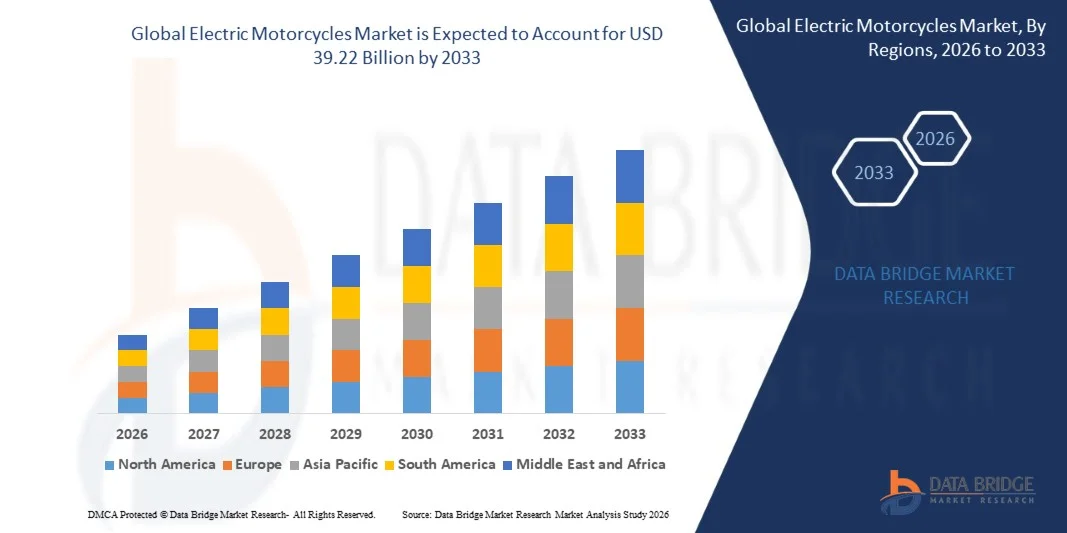
- As per Data Bridge Market Research analysis, the Electric Motorcycles market was valued at USD 24.12 billion in 2025 and is projected to reach USD 39.22 billion by 2033, growing at a CAGR of 6.26% from 2026 to 2033.
- The market is experiencing consistent growth driven by the rising adoption of sustainable and low-emission transportation, increasing demand for cost-efficient personal mobility, and expanding availability of electric motorcycle models across urban, intercity, recreational, and commercial applications. Advancements in battery technology, improved vehicle range and performance, and supportive government policies are further strengthening electric motorcycle adoption.
- The increasing focus on reducing fuel costs and dependence on conventional internal combustion engine vehicles is encouraging consumers and fleet operators to adopt electric motorcycles. Lithium-ion batteries, fast-charging technologies, battery-swapping solutions, connected features, and improved powertrain efficiency are enhancing vehicle usability, while the expansion of charging infrastructure and government incentives is supporting wider market penetration.
Market Size & Forecast
- Global Market Value (2025): USD 24.12 Billion
- Expected Market Value (2033): USD 39.22 Billion
- Forecast CAGR (2026–2033): 6.26%
- Leading Region in 2025: North America
- Fastest Growing Region: Asia Pacific
What are the Major Takeaways of the Electric Motorcycles Market?
- Asia-Pacific dominated the electric motorcycles market with the largest revenue share of 73.28% in 2025, supported by high electric two-wheeler adoption, expanding domestic manufacturing, government incentives for vehicle electrification, and increasing demand for affordable and sustainable mobility solutions across China, India, Japan, and Southeast Asia.
- South America is expected to be the fastest-growing region at a CAGR of 27.07% from 2026 to 2033, fueled by increasing electric motorcycle adoption, expanding urban mobility requirements, improving charging infrastructure, and growing investments in electric vehicle ecosystems.
- The lithium-ion battery segment led the market with a 64.52% share in 2025, driven by higher energy density, lighter weight, longer service life, faster charging capability, and increasing adoption of lithium-ion technology in electric motorcycles.
- The lithium-ion battery segment is expected to register a CAGR of 28.39% from 2026 to 2033, supported by continued improvements in battery energy density, declining battery costs, enhanced charging performance, and rising demand for longer-range electric motorcycles.
- The hub motor segment dominated the motor type category with a 62.29% share in 2025, supported by its compact design, lower maintenance requirements, efficient power delivery, and suitability for a broad range of electric motorcycle applications.
- The mid-drive motor segment is expected to be the fastest-growing motor type at a CAGR of 28.49% from 2026 to 2033, driven by improved torque delivery, better weight distribution, enhanced climbing performance, and increasing demand for high-performance electric motorcycles.
- The personal-use segment accounted for the largest end-use share of 78.31% in 2025, supported by increasing consumer preference for economical personal transportation, lower operating and maintenance costs, and growing environmental awareness.
- The commercial-use segment is expected to register a CAGR of 29.34% from 2026 to 2033, driven by increasing last-mile delivery activities, e-commerce expansion, food-delivery services, fleet electrification, and the lower operating costs associated with electric motorcycles.
Report Scope and Electric Motorcycles Market Segmentation
|
Attributes |
Electric Motorcycles Key Market Insights |
|
Segments Covered |
|
|
Countries Covered |
North America
Europe
Asia-Pacific
Middle East and Africa
South America
|
|
Key Market Players |
|
|
Market Opportunities |
|
|
Value Added Data Infosets |
In addition to the market insights such as market value, growth rate, market segments, geographical coverage, market players, and market scenario, the market report curated by the Data Bridge Market Research team includes in-depth expert analysis, import/export analysis, pricing analysis, production consumption analysis, and pestle analysis. |
What is the Key Trend in the Electric Motorcycles Market?
- Electric motorcycles are increasingly integrating connected technologies, digital instrument clusters, telematics, over-the-air software updates, and smartphone-enabled features to improve rider convenience, vehicle monitoring, navigation, safety, and overall riding experience. Connected electric two-wheelers recorded strong growth in India during 2025, with 88% of electric models offering connected technology in Q4 2025, highlighting the increasing integration of software and connectivity into electric mobility.
- For instance, in February 2026, CyberMedia Research reported that the connected electric two-wheeler segment in India grew 34% year on year in Q4 2025, while digital cluster adoption increased to 58%, supported by demand for app connectivity, over-the-air updates, navigation, ride analytics, and remote diagnostics.
- Electric motorcycle manufacturers are increasingly focusing on advanced lithium-ion battery systems, higher energy density, longer driving range, faster charging, removable batteries, and battery-swapping technologies to address range concerns and improve vehicle usability across urban and commercial applications.
- Charging infrastructure and flexible charging solutions are also becoming increasingly important as manufacturers and mobility operators seek to reduce charging downtime and improve electric motorcycle utilization. Battery-swapping systems are gaining attention in markets where access to conventional charging infrastructure remains limited, particularly for commercial and high-utilization applications.
- For instance, in August 2025, CyberMedia Research reported that removable battery systems were gaining popularity in India because of their charging flexibility, particularly in markets with constrained power infrastructure, while connected technologies and digital clusters were becoming increasingly common across electric two-wheelers.
- As manufacturers increasingly prioritize connectivity, battery performance, charging convenience, software integration, and lower operating costs, the adoption of technologically advanced electric motorcycles is expected to accelerate across personal mobility, urban commuting, and commercial applications.
What are the Key Drivers of the Electric Motorcycles Market?
- The growing demand for low-emission and cost-efficient transportation is significantly increasing the adoption of electric motorcycles as consumers and commercial operators seek alternatives to conventional internal combustion engine motorcycles. Lower running costs, fuel savings, and increasing environmental awareness are supporting demand for electric motorcycles across urban and inter-city mobility applications.
- For instance, in April 2026, Business Standard reported that electric motorcycle volumes in India increased 28% year on year to 17,173 units in FY2026 from 13,430 units in FY2025, indicating increasing consumer interest supported by new product launches and evolving electric motorcycle use cases.
- The expansion of government incentives, domestic electric vehicle manufacturing initiatives, and charging infrastructure is further supporting electric motorcycle adoption by improving affordability, ecosystem readiness, and consumer confidence. Policy support remains an important factor in encouraging manufacturers and consumers to transition toward electric mobility.
- Increasing integration of connected technologies, digital clusters, telematics, navigation, over-the-air updates, and smartphone-enabled functions is also driving demand for technologically advanced electric motorcycles. These features improve vehicle monitoring, rider convenience, safety, personalization, and fleet management capabilities.
- With consumers and fleet operators increasingly prioritizing lower operating costs, sustainability, connected functionality, improved battery performance, and convenient charging, electric motorcycles are expected to experience increasing adoption across major mobility markets during the forecast period.
Which Factors are Challenging the Growth of the Electric Motorcycles Market?
- High initial purchase costs and complex research and development requirements can restrict the adoption of electric motorcycles, particularly in price-sensitive markets where consumers compare electric motorcycles with lower-cost conventional motorcycles.
- For instance, in December 2025, a NITI Aayog analysis highlighted high R&D costs, technology constraints, and consumer expectations related to power, speed, and range as important challenges affecting the development and adoption of electric motorcycles in India.
- These cost pressures become more significant for high-performance electric motorcycles requiring larger battery packs, advanced powertrains, sophisticated electronics, thermal management systems, and specialized charging technologies, increasing manufacturing and ownership costs.
- Limited charging infrastructure, range anxiety, battery life concerns, service availability, and charging-time requirements can also restrict wider adoption, particularly in regions where electric vehicle infrastructure remains underdeveloped.
- For instance, in February 2025, the study titled “Battery Capacity or Charging Infrastructure Cost Modeling Study to Evaluate Investments of Electric Motorcycles and Supporting Infrastructure in Malaysia,” published in the World Electric Vehicle Journal, evaluated the cost-effectiveness of electric motorcycle battery capacity and charging infrastructure investments, highlighting the importance of developing charging infrastructure alongside electric motorcycle deployment.
- The combination of high upfront costs, complex R&D requirements, battery and range limitations, charging infrastructure gaps, and service-network requirements can slow electric motorcycle adoption in price-sensitive and infrastructure-constrained markets despite the long-term operating and environmental benefits offered by electric mobility.
How is the Electric Motorcycles Market Segmented?
The Electric Motorcycles Market is segmented on the basis of motorcycle type, motor type, horsepower, battery type, charging power and end use.
- By Motorcycle Type
On the basis of motorcycle type, the electric motorcycles market is segmented into street, sport, and off-road. The street segment dominated the market with a 58% share in 2024, owing to strong adoption for daily commuting, urban mobility, and short-distance travel. Street electric motorcycles provide a balance of performance, affordability, and riding range, making them suitable for a broad consumer base. Their practical design supports maneuverability in congested urban environments while reducing operating and maintenance costs compared with conventional motorcycles. Growing investments in urban charging infrastructure and government incentives for electric two-wheelers are further supporting adoption. The segment also benefits from increasing consumer preference for convenient and environmentally sustainable transportation solutions.
The sport segment is projected to register the fastest growth at a CAGR of 17.0% during the forecast period, driven by increasing consumer demand for high-performance electric motorcycles capable of delivering strong acceleration, high speeds, and advanced riding dynamics. Improvements in electric drivetrain technology are enabling manufacturers to develop motorcycles with higher power output, improved torque delivery, and enhanced handling characteristics. Growing investment in premium electric motorcycle development is further supporting the segment. Increasing consumer confidence in performance-oriented electric motorcycles and the expansion of premium product portfolios are also contributing to growth.
- By Motor Type
On the basis of motor type, the electric motorcycles market is segmented into hub motor and mid-drive motor. The hub motor segment dominated the market with a 62.29% share in 2025, supported by its relatively simple construction, lower maintenance requirements, and cost advantages. Hub motors integrate the motor directly into the wheel, reducing the number of mechanical components required for power transmission. This configuration supports easier manufacturing and installation while providing reliable performance for urban commuting applications. The lower mechanical complexity also reduces maintenance requirements for users. Increasing demand for affordable electric motorcycles is further supporting adoption of hub motor systems.
The mid-drive motor segment is projected to register the fastest growth at a CAGR of 28.49% through 2031, driven by increasing demand for improved weight distribution, stronger torque delivery, and enhanced riding performance. Mid-drive systems position the motor closer to the center of the motorcycle, improving overall balance and handling characteristics. They also enable more efficient use of the motorcycle's gearing system, making them suitable for performance-oriented and higher-powered applications. Growing demand for premium electric motorcycles and technological improvements in powertrain efficiency are further supporting adoption. Increasing development of advanced electric drivetrains is expected to strengthen the segment's growth.
- By Horsepower
On the basis of horsepower, the electric motorcycles market is segmented into below 25 kW, 25 kW to 50 kW, 51 kW to 75 kW, 76 kW to 100 kW, and above 100 kW. The 25 kW to 50 kW segment dominated the market with a 42% share in 2024, owing to its ability to provide a balance between performance, riding range, and everyday usability. Electric motorcycles within this power range are suitable for both urban commuting and highway applications, making them attractive to mainstream riders. The segment provides higher performance than entry-level motorcycles while maintaining a practical balance between power consumption and battery requirements. Growing availability of mid-power electric motorcycle models is further supporting adoption. Increasing consumer preference for motorcycles that combine performance with practical range is also contributing to segment growth.
The above 100 kW segment is projected to register the fastest growth during the forecast period, driven by increasing demand for high-performance electric motorcycles designed for premium, sport, racing, and specialized applications. Higher-powered electric motorcycles provide rapid acceleration, strong torque delivery, and higher top-speed capabilities. Improvements in battery technology and thermal management are enabling manufacturers to develop increasingly powerful electric powertrains. Growing investment in premium electric motorcycle platforms is further supporting demand. However, a verified CAGR for the exact above 100 kW segment under the 2025–2033 market scope is not publicly disclosed.
- By Battery Type
On the basis of battery type, the electric motorcycles market is segmented into lithium-ion, lead acid, and others. The lithium-ion segment dominated the market with a 64.52% share in 2025, owing to its high energy density, lightweight characteristics, longer operating life, and ability to support higher motorcycle range. Lithium-ion batteries provide greater energy storage within a relatively compact and lightweight package, making them suitable for both urban commuting and high-performance electric motorcycles. Their ability to deliver consistent power output also supports improved vehicle performance. Continuous improvements in battery technology and declining battery costs are further encouraging adoption. Growing investments in advanced battery manufacturing and electric mobility are strengthening the segment's position.
The others segment is projected to register the fastest growth at a CAGR of 26.92% through 2031, driven by the development and adoption of emerging battery chemistries offering improvements in energy density, charging performance, cost, and durability. Manufacturers are increasingly exploring alternative battery technologies to reduce dependence on conventional lithium-ion chemistries and address raw-material constraints. Improvements in battery safety and energy-storage capabilities are also supporting research into alternative technologies. Increasing investment in next-generation battery development is expected to expand the adoption of emerging technologies.
- By Charging Power
On the basis of charging power, the electric motorcycles market is segmented into below 10 kW, 10 kW to 20 kW, and above 20 kW. The below 10 kW segment dominated the market, supported by its suitability for residential charging, daily commuting, and standard electric motorcycle applications. Lower-power charging systems generally require less electrical infrastructure and can be integrated more easily into residential and small commercial environments. Their lower installation requirements also make them suitable for cost-sensitive consumers and emerging electric mobility markets. Increasing availability of home-charging solutions is further supporting adoption. The growing use of electric motorcycles for short-distance commuting is also strengthening demand for lower-power charging systems.
The above 20 kW segment is projected to register the fastest growth during the forecast period, driven by increasing demand for rapid charging and high-performance electric motorcycles. Higher-power charging systems can reduce charging times and improve vehicle utilization, particularly for premium motorcycles and commercial fleets. Growing demand for longer-distance electric motorcycle travel is increasing the importance of faster charging solutions. Expansion of public charging infrastructure is further supporting the deployment of high-power charging systems. Increasing technological improvements in charging equipment are also expected to support segment growth.
- By End Use
On the basis of end use, the electric motorcycles market is segmented into personal and commercial. The personal segment dominated the market with a 78.31% share in 2025, supported by increasing consumer adoption of electric motorcycles for daily commuting, personal mobility, and recreational riding. Lower operating and maintenance costs compared with conventional motorcycles are encouraging consumers to shift toward electric alternatives. Growing awareness of environmental sustainability and increasing availability of electric motorcycle models are further supporting adoption. Government incentives and expanding charging infrastructure are improving the practicality of electric motorcycle ownership. Increasing urbanization and demand for cost-efficient transportation are also contributing to segment growth.
The commercial segment is projected to register the fastest growth during the forecast period, driven by increasing adoption of electric motorcycles for delivery, logistics, fleet mobility, and last-mile transportation applications. Electric motorcycles can help commercial operators reduce fuel and maintenance expenses while supporting lower-emission transportation operations. Growing e-commerce and food-delivery activity is increasing demand for cost-efficient fleet vehicles. Businesses are also adopting electric motorcycles to support sustainability objectives and comply with increasingly stringent emission requirements. Expansion of charging infrastructure and improvements in battery range are further strengthening commercial adoption.
Which Region Holds the Largest Share of the Electric Motorcycles Market?
- Asia Pacific dominated the Electric Motorcycles market with the largest revenue share of 73.28% in 2025, supported by the high adoption of electric two-wheelers, strong two-wheeler culture, expanding manufacturing capabilities, favorable government incentives, and increasing demand for cost-efficient urban mobility solutions.
- The region also benefits from expanding battery-swapping and charging infrastructure, increasing deployment of electric motorcycles for personal transportation and delivery services, and the presence of major electric two-wheeler manufacturing ecosystems in China, India, Japan, and Southeast Asia. Growing urbanization, rising fuel costs, government support for vehicle electrification, and increasing investments in domestic battery and vehicle manufacturing continue to strengthen Asia Pacific's leadership position in the global market.
U.S. Electric Motorcycles Market Insight
The U.S. electric motorcycles market is witnessing strong growth due to rising consumer interest in zero-emission transportation, increasing availability of premium electric motorcycles, and growing investments in charging infrastructure. The country’s established motorcycle market, increasing focus on vehicle electrification, and growing demand for high-performance electric motorcycles are supporting market expansion. In addition, improvements in battery range, charging performance, and electric powertrain technology are increasing the practicality of electric motorcycles for commuting and recreational applications. Growing availability of advanced electric motorcycle models and increasing consumer awareness of lower operating and maintenance costs are further supporting adoption.
Asia-Pacific Electric Motorcycles Market Insight
The Asia-Pacific Electric Motorcycles market is witnessing strong growth, supported by the region's large two-wheeler user base, expanding electric mobility ecosystem, and strong manufacturing presence. China, India, Japan, and Southeast Asian countries are increasingly adopting electric motorcycles for personal transportation, commuting, delivery, and logistics applications. Growing government support for vehicle electrification, expansion of charging and battery-swapping infrastructure, and increasing investments in domestic electric vehicle manufacturing are supporting regional market expansion. In addition, rising urbanization, fuel-cost pressures, and demand for affordable and efficient transportation are accelerating the transition toward electric motorcycles across the region. Asia Pacific accounted for 73.28% of the global electric motorcycle market in 2025, reinforcing its position as the leading regional market.
Japan Electric Motorcycles Market Insight
The Japan electric motorcycles market is witnessing consistent growth due to rising investments in The Japan Electric Motorcycles market is witnessing consistent growth due to increasing investments in electric mobility, advanced battery technologies, and next-generation vehicle systems. Japan's established automotive and motorcycle manufacturing capabilities provide a strong foundation for the development of electric powertrains, battery systems, and connected motorcycle technologies. Increasing consumer interest in environmentally sustainable transportation, together with the country's focus on reducing transport-related emissions, is supporting market development. Moreover, advancements in battery performance, charging technologies, lightweight vehicle components, and intelligent mobility systems are contributing to the gradual adoption of electric motorcycles across personal and recreational applications.
China Electric Motorcycles Market Insight
The China electric motorcycles market is growing rapidly, supported by the country's extensive electric two-wheeler ecosystem, large domestic consumer base, established manufacturing infrastructure, and strong battery supply chain. Increasing adoption of electric motorcycles for urban commuting, delivery, logistics, and personal transportation is significantly boosting market demand. In addition, China's large-scale production capabilities, extensive charging and battery-swapping infrastructure, and growing investments in advanced battery and electric powertrain technologies are strengthening the market. Rising demand for affordable electric mobility and continued development of high-performance electric motorcycle models are further supporting China's position as a major market within the Asia-Pacific region.
U.K. Electric Motorcycles Market Insight
The U.K. electric motorcycles market is experiencing steady growth, supported by increasing consumer interest in low-emission transportation, government efforts toward vehicle electrification, and growing availability of electric motorcycle models. Increasing adoption of electric mobility solutions across urban commuting and recreational applications is contributing to market expansion. Furthermore, improvements in battery range, charging infrastructure, and electric powertrain performance are improving the practicality of electric motorcycles. Growing emphasis on reducing transportation emissions and increasing consumer awareness of lower operating costs are further supporting the adoption of electric motorcycles across the country.
Germany Electric Motorcycles Market Insight
The Germany electric motorcycles market is expanding steadily due to the country's strong automotive manufacturing base, increasing focus on sustainable mobility, and growing investments in electric vehicle technologies. Consumers and manufacturers are increasingly focusing on low-emission transportation solutions, advanced battery systems, and efficient electric powertrains. Growing availability of premium and performance-oriented electric motorcycles is supporting demand across urban commuting and recreational applications. Continuous advancements in battery technology, charging infrastructure, vehicle connectivity, and lightweight components, along with Germany's strong focus on automotive innovation and decarbonization, are further contributing to market growth.
Which are the Top Companies in Electric Motorcycles Market?
The electric motorcycles industry is primarily led by well-established companies, including:
- Bajaj Auto Ltd. (India)
- BMW AG (Germany)
- Ducati Motor Holding S.p.A. (Italy)
- Eicher Motors Limited (India)
- Hero MotoCorp Ltd. (India)
- Chongqing Jialing Jiapeng Industrial Co., Ltd. (China)
- Honda Motor Co., Ltd. (Japan)
- KTM Sportmotorcycle GmbH (Austria)
- Kawasaki Heavy Industries, Ltd. (Japan)
- Piaggio & C. S.p.A. (Italy)
- Suzuki Motor Corporation (Japan)
- Triumph Motorcycles (U.K.)
- TVS Motor Company Limited (India)
- VMoto Limited (Australia)
- Yamaha Motor Co., Ltd. (Japan)
- Zero Motorcycles, Inc. (U.S.)
- LiveWire Group, Inc. (U.S.)
- Energica Motor Company S.p.A. (Italy)
- Stark Future S.L. (Spain)
- Ultraviolette Automotive Pvt. Ltd. (India)
- Revolt Motors (India)
- Matter Motor Works Pvt. Ltd. (India)
- Tork Motors Pvt. Ltd. (India)
- Oben Electric (India)
- Maeving (U.K.)
- RGNT Motorcycles (U.K.)
- Surron (China)
- Fuell Inc. (U.S.)
- Tacita (Italy)
- Pursang Motorcycles (Spain)
What are Latest Developments in Electric Motorcycles Market?
- In November 2025, Honda unveiled the WN7, its first electric motorcycle, at EICMA 2025 in Milan, introducing a new high-performance model for the global electric motorcycle market. The WN7 features a 50 kW water-cooled motor with an integrated inverter, a 9.3 kWh lithium-ion battery, and compatibility with CCS2 fast charging and Type 2 normal charging. The model provides a 140 km cruising range and can charge from 20% to 80% in approximately 30 minutes using a fast charger. This development highlights the industry's movement toward higher-performance electric motorcycles with faster charging, advanced powertrains, and improved riding capabilities.
- In February 2025, Royal Enfield introduced the Flying Flea brand in India and showcased the Flying Flea C6 as its first electric motorcycle. The model combines a lightweight design with a retro-futuristic appearance and is positioned for city-focused mobility. The launch marked Royal Enfield's entry into the electric motorcycle segment through a dedicated brand focused on electric mobility and premium urban riding experiences. This development demonstrates increasing participation of established motorcycle manufacturers in the electric motorcycle market and growing emphasis on differentiated electric models.
- In February 2025, Ola Electric entered the electric motorcycle segment with the launch of its Roadster X series in India. The lineup introduced multiple variants with introductory prices starting at INR 74,999, with deliveries planned from March 2025. The Roadster X series was developed to expand Ola Electric's presence beyond electric scooters and address the large motorcycle-oriented two-wheeler market in India. The launch reflects increasing competition in the electric motorcycle segment and growing efforts by electric two-wheeler manufacturers to expand product portfolios into motorcycles.
- In August 2024, Yamaha Motor and Honda announced an agreement for Honda to supply Yamaha with electric motorcycle models for the Japanese Class-1 category based on the Honda EM1 e: and BENLY e: I. The models use Honda Mobile Power Pack e: swappable batteries developed in accordance with common battery specifications established through the Japanese motorcycle industry's battery-swapping initiatives. The collaboration is intended to expand electric motorcycle offerings for personal mobility and business applications while addressing challenges related to range, charging time, performance, and cost.
- In June 2024, Zapp Electric Vehicles announced an agreement to appoint Bounce Electric 1 as its contract manufacturing partner for the i300 electric urban motorcycle in India. The partnership was intended to support homologation, local assembly, distribution, and commercial rollout of the i300 in one of the world's largest two-wheeler markets. The companies planned to use Bounce's domestic vehicle assembly capabilities to facilitate the market entry of the electric motorcycle. This development highlights the increasing use of local manufacturing partnerships to accelerate commercialization and market expansion of electric motorcycles.

- Interactive Data Analysis Dashboard
- Company Analysis Dashboard for high growth potential opportunities
- Research Analyst Access for customization & queries
- Competitor Analysis with Interactive dashboard
- Latest News, Updates & Trend analysis
- Harness the Power of Benchmark Analysis for Comprehensive Competitor Tracking
Data collection and base year analysis are done using data collection modules with large sample sizes. The stage includes obtaining market information or related data through various sources and strategies. It includes examining and planning all the data acquired from the past in advance. It likewise envelops the examination of information inconsistencies seen across different information sources. The market data is analysed and estimated using market statistical and coherent models. Also, market share analysis and key trend analysis are the major success factors in the market report. To know more, please request an analyst call or drop down your inquiry.
The key research methodology used by DBMR research team is data triangulation which involves data mining, analysis of the impact of data variables on the market and primary (industry expert) validation. Data models include Vendor Positioning Grid, Market Time Line Analysis, Market Overview and Guide, Company Positioning Grid, Patent Analysis, Pricing Analysis, Company Market Share Analysis, Standards of Measurement, Global versus Regional and Vendor Share Analysis. To know more about the research methodology, drop in an inquiry to speak to our industry experts.
Data Bridge Market Research is a leader in advanced formative research. We take pride in servicing our existing and new customers with data and analysis that match and suits their goal. The report can be customized to include price trend analysis of target brands understanding the market for additional countries (ask for the list of countries), clinical trial results data, literature review, refurbished market and product base analysis. Market analysis of target competitors can be analyzed from technology-based analysis to market portfolio strategies. We can add as many competitors that you require data about in the format and data style you are looking for. Our team of analysts can also provide you data in crude raw excel files pivot tables (Fact book) or can assist you in creating presentations from the data sets available in the report.













