Global Airborne Surveillance Market Size, Share, and Trends Analysis Report – Industry Overview and Forecast to 2033

Request for TOC TOC のリクエスト Speak to Analyst アナリストに相談する Free Sample Report 無料サンプルレポート Inquire Before Buying 事前に問い合わせる Buy Now今すぐ購入

Global Airborne Surveillance Market Size, Share, and Trends Analysis Report – Industry Overview and Forecast to 2033

Global Airborne Surveillance Market Segmentation, By Type (LiDAR, RADAR, and Imaging System), Product Type (Manned Systems and Unmanned System), Application (Military, Defense and Security, and Commercial)- Industry Trends and Forecast to 2033

  • Semiconductors and Electronics
  • Nov 2021
  • Global
  • 350 ページ
  • テーブル数: 220
  • 図の数: 60

Global Airborne Surveillance Market Size, Share, and Trends Analysis Report

Market Size in USD Billion

CAGR :  % Diagram

Chart Image USD 7.01 Billion USD 10.31 Billion 2025 2033
Diagram 予測期間
2026 –2033
Diagram 市場規模(基準年)
USD 7.01 Billion
Diagram Market Size (Forecast Year)
USD 10.31 Billion
Diagram CAGR
%
Diagram Major Markets Players
  • BAE Systems (U.K.)
  • Israel Aerospace Industries Ltd. (Israel)
  • Leonardo (Italy)
  • Boeing (U.S.)
  • Leica Geosystems AG (Switzerland)

Global Airborne Surveillance Market Segmentation, By Type (LiDAR, RADAR, and Imaging System), Product Type (Manned Systems and Unmanned System), Application (Military, Defense and Security, and Commercial)- Industry Trends and Forecast to 2033

Airborne Surveillance Market Size

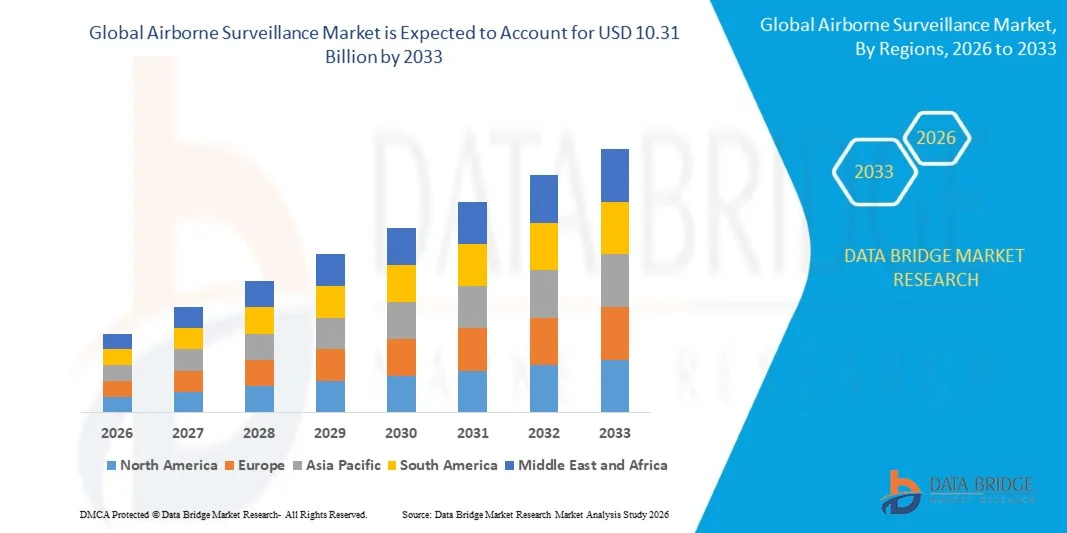
  • The global airborne surveillance market size was valued at USD 7.01 billion in 2025 and is expected to reach USD 10.31 billion by 2033, at a CAGR of 4.95% during the forecast period
  • The market growth is largely fuelled by the increasing demand for advanced intelligence, surveillance, and reconnaissance (ISR) systems across defense and homeland security applications
  • Rising geopolitical tensions and the need for real-time situational awareness are driving investments in airborne surveillance platforms such as UAVs, aircraft, and helicopters

Airborne Surveillance Market Analysis

  • The market is experiencing steady growth due to the increasing adoption of unmanned aerial vehicles and integrated surveillance systems that provide enhanced operational efficiency and data accuracy in defense operations
  • In addition, growing investments in border security, maritime surveillance, and disaster management are expanding the application scope of airborne surveillance systems across both military and civilian sectors
  • North America dominated the airborne surveillance market with the largest revenue share in 2025, driven by increasing defense spending, strong presence of leading aerospace and defense companies, and rising demand for advanced intelligence, surveillance, and reconnaissance systems
  • Asia-Pacific region is expected to witness the highest growth rate in the global airborne surveillance market, driven by rising geopolitical tensions, rapid modernization of defense capabilities, increasing adoption of UAVs, and growing government initiatives to strengthen surveillance and security infrastructure
  • The RADAR segment held the largest market revenue share in 2025 driven by its ability to operate in all weather conditions and provide long-range detection and tracking capabilities. Radar systems are extensively deployed across military and border surveillance operations due to their high reliability and continuous monitoring capabilities. Their effectiveness in detecting moving and stationary targets over vast distances enhances situational awareness and strengthens defense preparedness

Airborne Surveillance Market

Report Scope and Airborne Surveillance Market Segmentation        

Attributes

Airborne Surveillance Key Market Insights

Segments Covered

  • By Type: LiDAR, RADAR, and Imaging System
  • By Product Type: Manned Systems and Unmanned System
  • By Application: Military, Defense and Security, and Commercial

Countries Covered

North America

  • U.S.
  • Canada
  • Mexico

Europe

  • Germany
  • France
  • U.K.
  • Netherlands
  • Switzerland
  • Belgium
  • Russia
  • Italy
  • Spain
  • Turkey
  • Rest of Europe

Asia-Pacific

  • China
  • Japan
  • India
  • South Korea
  • Singapore
  • Malaysia
  • Australia
  • Thailand
  • Indonesia
  • Philippines
  • Rest of Asia-Pacific

Middle East and Africa

  • Saudi Arabia
  • U.A.E.
  • South Africa
  • Egypt
  • Israel
  • Rest of Middle East and Africa

South America

  • Brazil
  • Argentina
  • Rest of South America

Key Market Players

BAE Systems (U.K.)
Israel Aerospace Industries Ltd. (Israel)
Leonardo (Italy)
Boeing (U.S.)
Leica Geosystems AG (Switzerland)
• Thales Group (France)
• Lockheed Martin Corporation (U.S.)
• Saab (Sweden)
• FLIR Systems Inc. (U.S.)
• Raytheon Company (U.S.)
• Northrop Grumman (U.S.)
• L-3 Corporate (U.S.)
• UTC Aerospace Systems (U.S.)
• Safran (France)
• Start-Up Ecosystem (Global)
• Teledyne Technologies (U.S.)

Market Opportunities

• Increasing Adoption Of Unmanned Aerial Vehicles
• Rising Demand For Advanced Border And Maritime Surveillance Systems

Value Added Data Infosets

In addition to the insights on market scenarios such as market value, growth rate, segmentation, geographical coverage, and major players, the market reports curated by the Data Bridge Market Research also include in-depth expert analysis, geographically represented company-wise production and capacity, network layouts of distributors and partners, detailed and updated price trend analysis and deficit analysis of supply chain and demand.

Airborne Surveillance Market Trends

“Increasing Adoption of Advanced ISR and UAV Technologies”

• The growing need for real-time intelligence, surveillance, and reconnaissance is significantly shaping the airborne surveillance market, as defense and security agencies increasingly prioritize advanced monitoring solutions. Airborne surveillance systems are gaining traction due to their ability to provide wide-area coverage, high-resolution imaging, and real-time data transmission. This trend is strengthening their adoption across military, border security, and disaster management applications, encouraging manufacturers to innovate with advanced sensor and communication technologies

• Rising geopolitical tensions and security concerns have accelerated the demand for airborne surveillance platforms such as unmanned aerial vehicles and surveillance aircraft. Governments and defense organizations are investing heavily in modernizing surveillance capabilities to enhance situational awareness and response efficiency. This has also led to collaborations between technology providers and defense agencies to develop integrated and multi-mission surveillance systems

• Technological advancements are influencing purchasing decisions, with manufacturers focusing on radar systems, electro-optical/infrared sensors, and AI-based data analytics. These innovations enhance detection accuracy, target tracking, and mission efficiency, while also enabling automation and reduced human intervention. Companies are increasingly integrating advanced communication systems to ensure seamless data sharing and interoperability across defense networks

• For instance, in 2024, Lockheed Martin Corporation and Northrop Grumman Corporation expanded their airborne surveillance capabilities with next-generation ISR platforms. These systems were introduced to enhance mission effectiveness and provide real-time intelligence support for defense operations. The advancements also improved operational flexibility and strengthened defense preparedness across multiple regions

• While demand for airborne surveillance systems is increasing, sustained market growth depends on continuous technological innovation, cost management, and regulatory compliance. Manufacturers are focusing on improving system integration, reducing operational costs, and developing scalable solutions to meet evolving defense and security requirements

Airborne Surveillance Market Dynamics

Driver

“Rising Demand for Enhanced Security and Surveillance Capabilities”

• Increasing global security concerns and the need for effective border and maritime monitoring are major drivers for the airborne surveillance market. Governments are deploying advanced airborne systems to strengthen national security, monitor critical infrastructure, and manage emergency situations. This trend is driving the adoption of both manned and unmanned surveillance platforms across various applications

• Expanding applications in defense, homeland security, environmental monitoring, and disaster response are influencing market growth. Airborne surveillance systems provide real-time data, improved situational awareness, and rapid response capabilities, enabling authorities to make informed decisions and enhance operational efficiency

• Defense organizations and technology providers are actively promoting airborne surveillance solutions through strategic investments, product innovations, and collaborative programs. These efforts are supported by increasing government budgets for defense modernization and the growing importance of intelligence-driven operations

• For instance, in 2023, Boeing and Airbus enhanced their surveillance aircraft offerings with advanced sensor integration and communication systems. These developments were driven by rising demand for efficient surveillance solutions, improving mission capabilities and strengthening their market presence

• Although growing security needs support market expansion, broader adoption depends on cost efficiency, technological integration, and regulatory approvals. Investments in advanced technologies and infrastructure will be essential to meet increasing global demand

Restraint/Challenge

“High Operational Costs and Regulatory Constraints”

• The high cost of airborne surveillance systems, including procurement, maintenance, and operation, remains a key challenge, limiting adoption among smaller defense agencies and commercial users. Advanced technologies and specialized components contribute to elevated system costs, impacting overall affordability and deployment scale

• Regulatory and airspace restrictions also pose challenges, particularly for unmanned aerial vehicles used in surveillance operations. Compliance with aviation regulations and data privacy concerns can limit operational flexibility and delay project implementation in certain regions

• Infrastructure and technical challenges further impact market growth, as airborne surveillance systems require robust communication networks, skilled personnel, and continuous system upgrades. Integration with existing defense and security frameworks can also involve complexities and additional costs

• For instance, in 2024, operators in regions such as Southeast Asia and parts of Europe reported delays in deploying UAV-based surveillance systems due to regulatory approvals and high operational expenses. These barriers affected timely implementation and limited the scalability of surveillance programs

• Overcoming these challenges will require cost optimization, streamlined regulatory frameworks, and increased collaboration between governments and industry players. Investment in advanced technologies, training, and infrastructure development will be critical to unlocking the full potential of the global airborne surveillance market

Airborne Surveillance Market Scope

The airborne surveillance market is segmented into notable segments based on type, product type, and application.

• By Type

On the basis of type, the airborne surveillance market is segmented into LiDAR, RADAR, and imaging system. The RADAR segment held the largest market revenue share in 2025 driven by its ability to operate in all weather conditions and provide long-range detection and tracking capabilities. Radar systems are extensively deployed across military and border surveillance operations due to their high reliability and continuous monitoring capabilities. Their effectiveness in detecting moving and stationary targets over vast distances enhances situational awareness and strengthens defense preparedness.

The imaging system segment is expected to witness the fastest growth rate from 2026 to 2033, driven by advancements in electro-optical and infrared technologies. These systems enable high-resolution image capture, real-time video surveillance, and improved target identification across diverse environments. Increasing demand for precision monitoring in disaster management, environmental surveillance, and commercial applications is accelerating adoption. Continuous innovation in sensor quality and data analytics is further enhancing performance and expanding use cases.

• By Product Type

On the basis of product type, the airborne surveillance market is segmented into manned systems and unmanned system. The manned systems segment held the largest market revenue share in 2025 driven by their extensive use in complex military operations and long-established deployment infrastructure. These systems support higher payload capacities, extended flight durations, and advanced onboard systems, making them suitable for strategic surveillance missions. Their ability to integrate multiple sensors and technologies ensures comprehensive intelligence gathering across large operational areas.

The unmanned system segment is expected to witness the fastest growth rate from 2026 to 2033, driven by increasing adoption of UAVs for surveillance and reconnaissance missions. Unmanned systems offer cost efficiency, operational flexibility, and reduced risk to human personnel, making them highly attractive for modern defense strategies. Their growing use in commercial applications such as agriculture monitoring, disaster response, and infrastructure inspection is further contributing to segment growth. Advancements in autonomous navigation and AI integration are also enhancing their capabilities.

• By Application

On the basis of application, the airborne surveillance market is segmented into military, defense and security, and commercial. The military segment held the largest market revenue share in 2025 driven by rising defense budgets and the growing need for advanced intelligence and reconnaissance systems. Airborne surveillance plays a vital role in mission planning, threat detection, and battlefield monitoring, ensuring strategic advantage. Continuous investments in upgrading surveillance technologies are further strengthening this segment’s dominance.

The defense and security segment is expected to witness the fastest growth rate from 2026 to 2033, driven by increasing investments in border control, homeland security, and critical infrastructure protection. Governments are deploying advanced airborne surveillance solutions to enhance monitoring capabilities and respond to emerging threats effectively. The rising need for real-time intelligence and rapid response systems is accelerating adoption across law enforcement and security agencies. Expanding use in urban surveillance and public safety initiatives is also contributing to sustained growth.

Airborne Surveillance Market Regional Analysis

• North America dominated the airborne surveillance market with the largest revenue share in 2025, driven by increasing defense spending, strong presence of leading aerospace and defense companies, and rising demand for advanced intelligence, surveillance, and reconnaissance systems

• Governments and defense agencies in the region highly prioritize real-time monitoring, border security, and integration of advanced technologies such as radar, AI, and satellite communication into airborne platforms

• This widespread adoption is further supported by well-established defense infrastructure, technological advancements, and continuous investments in modernizing surveillance capabilities, establishing airborne surveillance systems as critical assets for national security and defense operations

U.S. Airborne Surveillance Market Insight

The U.S. airborne surveillance market captured the largest revenue share in 2025 within North America, fueled by significant investments in defense modernization and rapid adoption of advanced surveillance technologies. The country emphasizes strengthening intelligence and reconnaissance capabilities through deployment of sophisticated airborne platforms. Increasing integration of AI, advanced sensors, and real-time data analytics is enhancing operational efficiency and mission effectiveness. In addition, the presence of major defense contractors and ongoing innovation in UAV technologies are further propelling market growth.

Europe Airborne Surveillance Market Insight

The Europe airborne surveillance market is expected to witness the fastest growth rate from 2026 to 2033, primarily driven by rising security concerns, increasing defense budgets, and stringent regulatory frameworks. The region is focusing on enhancing border surveillance and maritime monitoring capabilities to address evolving threats. Growing adoption of advanced surveillance aircraft and UAVs across multiple applications is supporting market expansion. In addition, collaborative defense initiatives among European nations are accelerating technological advancements and deployment.

U.K. Airborne Surveillance Market Insight

The U.K. airborne surveillance market is expected to witness the fastest growth rate from 2026 to 2033, driven by increasing investments in defense and security infrastructure. Rising concerns regarding border protection, terrorism, and national security are encouraging adoption of advanced surveillance systems. The country is also focusing on integrating modern technologies such as AI and data analytics into airborne platforms. Strong government support and ongoing modernization programs are expected to further stimulate market growth.

Germany Airborne Surveillance Market Insight

The Germany airborne surveillance market is expected to witness the fastest growth rate from 2026 to 2033, fueled by growing emphasis on security, technological innovation, and defense modernization. Germany’s advanced industrial base and focus on engineering excellence support the development and adoption of high-performance surveillance systems. Increasing deployment of UAVs and advanced radar systems is enhancing monitoring capabilities. Furthermore, integration of surveillance solutions into broader defense and security networks is driving sustained growth.

Asia-Pacific Airborne Surveillance Market Insight

The Asia-Pacific airborne surveillance market is expected to witness the fastest growth rate from 2026 to 2033, driven by rising geopolitical tensions, increasing defense budgets, and rapid technological advancements. Countries such as China, India, and Japan are investing heavily in strengthening surveillance and reconnaissance capabilities. The growing focus on border security, disaster management, and maritime monitoring is accelerating adoption of airborne surveillance systems. In addition, expanding domestic manufacturing capabilities are improving affordability and accessibility across the region.

Japan Airborne Surveillance Market Insight

The Japan airborne surveillance market is expected to witness the fastest growth rate from 2026 to 2033 due to increasing focus on national security, disaster preparedness, and technological innovation. The country is investing in advanced airborne systems to enhance monitoring and response capabilities. Integration of surveillance platforms with IoT and AI technologies is improving efficiency and data accuracy. Moreover, Japan’s emphasis on modernization and infrastructure development is supporting steady market growth.

China Airborne Surveillance Market Insight

The China airborne surveillance market accounted for the largest market revenue share in Asia Pacific in 2025, attributed to rapid technological advancements, strong government support, and increasing defense expenditures. China is actively expanding its surveillance capabilities across military and security applications. The growing focus on smart surveillance systems and integration of advanced technologies is driving adoption. In addition, the presence of domestic manufacturers and large-scale production capabilities is further strengthening the market position.

Airborne Surveillance Market Share

The Airborne Surveillance industry is primarily led by well-established companies, including:

• BAE Systems (U.K.)
• Israel Aerospace Industries Ltd. (Israel)
• Leonardo (Italy)
• Boeing (U.S.)
• Leica Geosystems AG (Switzerland)
• Thales Group (France)
• Lockheed Martin Corporation (U.S.)
• Saab (Sweden)
• FLIR Systems Inc. (U.S.)
• Raytheon Company (U.S.)
• Northrop Grumman (U.S.)
• L-3 Corporate (U.S.)
• UTC Aerospace Systems (U.S.)
• Safran (France)
• Start-Up Ecosystem (Global)
• Teledyne Technologies (U.S.)

Latest Developments in Global Airborne Surveillance Market

  • In May 2024, Sweden, government initiative, announced the donation of two radar surveillance and command aircraft to Ukraine to strengthen its defense capabilities and enhance real-time air monitoring amid ongoing conflict. This development is aimed at boosting Ukraine’s surveillance efficiency and situational awareness. The initiative is expected to accelerate the adoption of advanced airborne surveillance systems and highlight the strategic importance of radar-based platforms. It also reinforces international defense collaborations and drives demand for modern surveillance technologies in conflict-prone regions
  • In December 2023, Saudi Arabia, procurement agreement, announced the acquisition of upgraded RE-3A tactical radar systems from the U.S. to modernize its airborne surveillance infrastructure. The upgrade is intended to enhance air monitoring, threat detection, and intelligence capabilities for military aircraft. This move strengthens the country’s defense preparedness and supports long-term modernization goals. It is expected to drive market growth by increasing demand for advanced radar and surveillance upgrades across global defense sectors
  • In November 2023, Leonardo, product innovation, expanded the capabilities of its AESA radar systems by focusing on software-defined radar solutions for specialized aircraft and missions. This development aims to improve flexibility, performance, and adaptability of airborne surveillance platforms. The innovation enhances mission efficiency and supports multi-role operations across defense applications. It also indicates a shift toward next-generation, software-driven surveillance technologies, positively impacting market competitiveness
  • In November 2023, Bombardier Defense, product delivery, delivered its seventh GlobalEye airborne surveillance system to Saab, equipped with advanced multi-domain sensors for air, land, and sea monitoring. This platform enhances situational awareness and operational efficiency for defense forces. The delivery highlights growing demand for integrated surveillance solutions with advanced sensing capabilities. It is expected to strengthen market expansion by encouraging further investments in high-performance airborne surveillance platforms
  • In September 2023, Saab, product launch, introduced its first airborne surveillance system for Poland, featuring the Saab 340 AEW equipped with Erieye radar. The system is designed to strengthen Poland’s national security and territorial monitoring capabilities. This development supports rapid deployment and enhances defense readiness through improved surveillance coverage. It also boosts Saab’s presence in the European market and drives demand for advanced early warning systems


SKU-

世界初のマーケットインテリジェンスクラウドに関するレポートにオンラインでアクセスする

  • インタラクティブなデータ分析ダッシュボード
  • 成長の可能性が高い機会のための企業分析ダッシュボード
  • カスタマイズとクエリのためのリサーチアナリストアクセス
  • インタラクティブなダッシュボードによる競合分析
  • 最新ニュース、更新情報、トレンド分析
  • 包括的な競合追跡のためのベンチマーク分析のパワーを活用
デモのリクエスト

調査方法

データ収集と基準年分析は、大規模なサンプル サイズのデータ​​収集モジュールを使用して行われます。この段階では、さまざまなソースと戦略を通じて市場情報または関連データを取得します。過去に取得したすべてのデータを事前に調査および計画することも含まれます。また、さまざまな情報ソース間で見られる情報の不一致の調査も含まれます。市場データは、市場統計モデルと一貫性モデルを使用して分析および推定されます。また、市場シェア分析と主要トレンド分析は、市場レポートの主要な成功要因です。詳細については、アナリストへの電話をリクエストするか、お問い合わせをドロップダウンしてください。

DBMR 調査チームが使用する主要な調査方法は、データ マイニング、データ変数が市場に与える影響の分析、および一次 (業界の専門家) 検証を含むデータ三角測量です。データ モデルには、ベンダー ポジショニング グリッド、市場タイムライン分析、市場概要とガイド、企業ポジショニング グリッド、特許分析、価格分析、企業市場シェア分析、測定基準、グローバルと地域、ベンダー シェア分析が含まれます。調査方法について詳しくは、お問い合わせフォームから当社の業界専門家にご相談ください。

カスタマイズ可能

Data Bridge Market Research は、高度な形成的調査のリーダーです。当社は、既存および新規のお客様に、お客様の目標に合致し、それに適したデータと分析を提供することに誇りを持っています。レポートは、対象ブランドの価格動向分析、追加国の市場理解 (国のリストをお問い合わせください)、臨床試験結果データ、文献レビュー、リファービッシュ市場および製品ベース分析を含めるようにカスタマイズできます。対象競合他社の市場分析は、技術ベースの分析から市場ポートフォリオ戦略まで分析できます。必要な競合他社のデータを、必要な形式とデータ スタイルでいくつでも追加できます。当社のアナリスト チームは、粗い生の Excel ファイル ピボット テーブル (ファクト ブック) でデータを提供したり、レポートで利用可能なデータ セットからプレゼンテーションを作成するお手伝いをしたりすることもできます。


業界関連レポート

お客様の声