


Radar System Market Overview
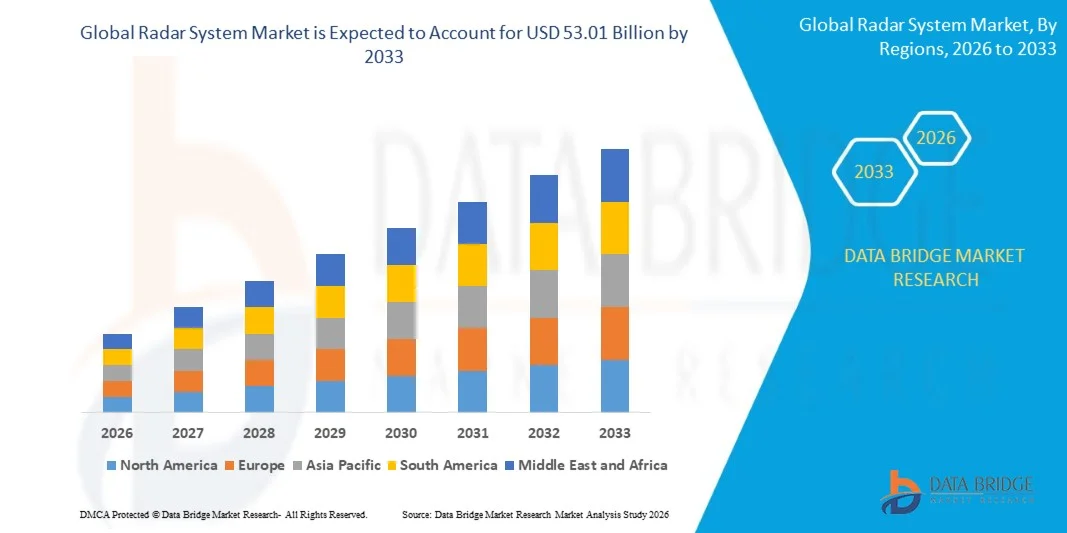
The Radar System Market was valued at USD 31.94 Billion in 2025 and is projected to reach USD 53.01 Billion by 2033, growing at a CAGR of 6.54% from 2026 to 2033. The market is experiencing consistent growth driven by rising defense modernization programs, increasing demand for advanced surveillance and threat detection systems, and growing adoption of radar technologies across aerospace, automotive, and maritime applications. Expanding deployment of phased array and active electronically scanned array radar systems, along with advancements in signal processing and electronic warfare capabilities, are further supporting market expansion across major regions.
The increasing global focus on strengthening national security and enhancing situational awareness, combined with rising geopolitical tensions, is encouraging governments and defense agencies to invest heavily in next-generation radar systems. Advanced radar technologies are increasingly being deployed for air defense, border surveillance, maritime security, weather monitoring, and autonomous mobility applications, helping improve detection accuracy and operational efficiency. Continuous innovations in AI-enabled radar systems and growing integration of radar sensors into connected and autonomous platforms are further accelerating market development.
Key Market Trends & Insights
- North America dominated the Radar System Market with the largest revenue share of 40% in 2025, supported by high defense spending, extensive deployment of advanced surveillance technologies, and strong investments in aerospace and homeland security programs
- The pulsed radar segment led the market with a 68.4% share in 2025, driven by its extensive use in defense surveillance, air traffic control, and long-range target detection applications
- Asia-Pacific is expected to be the fastest-growing region at a CAGR of 9.5% from 2026 to 2033, fueled by rising defense budgets, expanding aerospace activities, and increasing demand for border surveillance capabilities
- Millimetric band are the fastest-growing frequency band type, projected to register a CAGR of 13.2% from 2026 to 2033, supported by increasing adoption in automotive radar and high-frequency sensing applications
- The synthetic aperture radar segment dominated the vehicle radars category with a 61.3% revenue share in 2025, led by its extensive use in airborne surveillance, earth observation, and military reconnaissance missions
- Long range radars accounted for 46.2% of the market in 2025, preferred by extensive utilization in air defense, maritime surveillance, and missile detection applications
- The automotive segment is the fastest-growing application category, with a CAGR of 12.5% from 2026 to 2033, driven by increasing penetration of advanced driver assistance systems and autonomous vehicle technologies
Market Size & Forecast
- Global Market Value (2025): USD 31.94 Billion
- Expected Market Value (2033): USD 53.01 Billion
- Forecast CAGR (2026–2033): 6.54%
- Leading Region in 2025: North America
- Fastest Growing Region: Asia-Pacific
Report Scope and Radar System Market Segmentation
|
Attributes |
Radar System Key Market Insights |
|
Segments Covered |
|
|
Countries Covered |
North America · U.S. · Canada · Mexico Europe · Germany · France · U.K. · Netherlands · Switzerland · Belgium · Russia · Italy · Spain · Turkey · Rest of Europe Asia-Pacific · China · Japan · India · South Korea · Singapore · Malaysia · Australia · Thailand · Indonesia · Philippines · Rest of Asia-Pacific Middle East and Africa · Saudi Arabia · U.A.E. · South Africa · Egypt · Israel · Rest of Middle East and Africa South America · Brazil · Argentina · Rest of South America |
|
Key Market Players |
· Lockheed Martin Corporation. (US) · Rockwell Collins, Inc. (US) · Saab AB (Sweden) · Honeywell International Inc. (US) · General Dynamics Corporation (US) · Rheinmetall AG (Germany) · BAE Systems. (UK) · Northrop Grumman Corporation. (US) · Raytheon Technologies. (US) · Thales Group (France) · Reutech Radar Systems. (South Africa) · IAI (India) · Airbus S.A.S. (France) · L3Harris Technologies, Inc. (US) · Infineon Technologies AG (Germany) |
|
Market Opportunities |
· Expansion of Automotive Radar for Autonomous Vehicles · Increasing Demand for Space-Based Radar and Earth Observation Systems · Rising Deployment of Coastal and Maritime Surveillance Radar Networks |
|
Value Added Data Infosets |
In addition to the insights on market scenarios such as market value, growth rate, segmentation, geographical coverage, and major players, the market reports curated by the Data Bridge Market Research also include in-depth expert analysis, geographically represented company-wise production and capacity, network layouts of distributors and partners, detailed and updated price trend analysis and deficit analysis of supply chain and demand. |
Radar System Market Trends
Trend: Growing Adoption of AESA and Phased Array Radar Technologies
Radar manufacturers and defense agencies are increasingly adopting Active Electronically Scanned Array (AESA) and phased array technologies to improve target detection, tracking accuracy, and electronic warfare capabilities. These advanced systems provide faster beam steering, greater resistance to jamming, and enhanced multi-target engagement compared with conventional mechanically scanned radars. Growing requirements for next-generation air defense systems, naval surveillance platforms, and combat aircraft are accelerating deployment across military and aerospace applications. Rising investments in digital radar architectures are further supporting technology advancement.
Companies such as RTX's Raytheon introduced the APG-82(V)X GaN-based AESA radar in September 2025, offering improved range and processing capabilities for advanced combat aircraft applications, highlighting the increasing shift toward electronically scanned radar systems.
Radar System Market Dynamics
Key Market Driver: Rising Defense Modernization and Surveillance Investments
Increasing geopolitical tensions and evolving security threats are significantly driving investments in advanced radar technologies worldwide. Governments are expanding defense budgets and upgrading air defense, missile detection, maritime surveillance, and border security capabilities to strengthen national security. Growing demand for early warning systems and integrated battlefield awareness is accelerating procurement of sophisticated radar platforms. Continuous advancements in AI-enabled signal processing and electronic warfare technologies are further enhancing radar system performance.
According to the Stockholm International Peace Research Institute (SIPRI), global military expenditure reached approximately USD 2.72 trillion in 2024, while organizations such as the U.S. Department of Defense continue investing heavily in next-generation radar capabilities. In June 2025, Raytheon secured a USD 536 million contract from the U.S. Navy for the SPY-6 radar family, supporting the expansion of advanced maritime surveillance systems.
Key Restraint/Challenge: High Development and Deployment Costs of Advanced Radar Systems
A major challenge in the Radar System market is the substantial investment required for the development, deployment, and maintenance of advanced radar platforms. High-performance radar systems require sophisticated semiconductors, phased array antennas, digital signal processors, and complex software architectures, resulting in elevated production costs. Integration with military aircraft, naval vessels, and missile defense systems further increases overall project expenditure and implementation timelines. Long procurement cycles and stringent testing requirements also limit rapid adoption.
The European Common Radar System Mark 1 (ECRS Mk1) program jointly developed by HENSOLDT and Indra illustrates the complexity and significant investment associated with next-generation radar technologies, with production milestones achieved in June 2025 after extensive development efforts.
Key Market Opportunity: Rising Deployment of Coastal and Maritime Surveillance Radar Networks
Increasing concerns regarding maritime security, illegal fishing, smuggling, and protection of strategic sea routes are creating significant opportunities for the radar system market. Governments are expanding coastal monitoring infrastructure and strengthening naval surveillance capabilities to improve situational awareness across territorial waters. Advancements in long-range radar systems, AI-enabled target recognition, and integrated command systems are improving operational efficiency and coverage. Growing investments in unmanned maritime platforms and smart surveillance networks are further supporting market expansion.
Organizations such as the U.S. Navy and numerous Indo-Pacific defense agencies are increasing investments in maritime surveillance technologies. In October 2025, RTX's Raytheon began initial production of the SharpSight multi-domain surveillance radar, supporting the growing demand for advanced coastal and maritime monitoring capabilities across defense and security applications.
Radar System Market Scope
The radar system market is segmented on the basis of technology, component, range, application, frequency band, and vehicle radars.
- By Technology
On the basis of technology, the Radar System Market is segmented into Pulsed Radar and CW Radar. The Pulsed Radar segment dominated the market with the largest share of 68.4% in 2025, driven by its extensive use in defense surveillance, air traffic control, and long-range target detection applications. The technology offers superior range measurement and target discrimination capabilities, making it highly suitable for military and aerospace operations. Continuous modernization of defense infrastructure and increasing procurement of advanced radar platforms are supporting segment growth. Its ability to operate effectively under adverse weather conditions further enhances adoption. Strong investments in next-generation phased array systems continue to reinforce the segment's leading position.
The CW Radar segment is projected to register the fastest growth at a CAGR of 8.9% from 2026 to 2033, driven by rising deployment in automotive safety systems and industrial monitoring applications. Continuous wave radar technology provides accurate velocity measurement and enhanced object detection capabilities for short-range environments. Growing adoption of adaptive cruise control, collision avoidance systems, and smart manufacturing solutions is accelerating demand. Advancements in signal processing technologies are improving detection efficiency and reducing system complexity. Increasing integration of radar sensors in autonomous mobility platforms is further supporting market expansion.
- By Component
On the basis of component, the Radar System Market is segmented into Antenna, Transmitter, and Receiver. The Antenna segment dominated the market with a share of 41.8% in 2025, supported by the critical role of antenna systems in determining radar accuracy, coverage, and performance. Rising deployment of electronically scanned array antennas across defense and aerospace applications is contributing to segment growth. Advanced antenna technologies provide improved target tracking and enhanced signal transmission capabilities. Increasing investments in naval and airborne surveillance systems are strengthening demand. Continuous innovations in compact and lightweight antenna designs further support the segment's dominant position.
The Receiver segment is projected to register the fastest growth at a CAGR of 9.4% from 2026 to 2033, driven by increasing demand for high-sensitivity radar systems across defense and automotive sectors. Advanced receivers improve signal processing efficiency and enable accurate detection of low-signature targets. Growing utilization of digital radar architectures is encouraging the adoption of sophisticated receiver technologies. Improvements in noise reduction and frequency management capabilities are enhancing overall system performance. Expanding deployment of autonomous platforms and intelligent sensing applications is accelerating segment growth.
- By Range
On the basis of range, the Radar System Market is segmented into Short Range Radars, Medium Range Radars, and Long Range Radars. The Long Range Radars segment dominated the market with the largest share of 46.2% in 2025, driven by extensive utilization in air defense, maritime surveillance, and missile detection applications. These systems provide broad-area coverage and support early warning capabilities required for national security operations. Increasing investments in border monitoring and strategic defense modernization programs are supporting demand. Technological advancements in phased array and digital beamforming technologies are improving performance. Continuous requirement for enhanced situational awareness further strengthens segment leadership.
The Short Range Radars segment is projected to register the fastest growth at a CAGR of 10.1% from 2026 to 2033, driven by expanding adoption in automotive safety systems and industrial automation applications. Rising demand for advanced driver assistance systems is increasing the deployment of short-range radar sensors. These systems offer precise object detection and obstacle avoidance capabilities in congested environments. Advancements in compact radar modules and semiconductor technologies are improving efficiency and reducing costs. Growing development of autonomous vehicles is further accelerating segment expansion.
- By Application
On the basis of application, the Radar System Market is segmented into Naval, Ground, Space-Based, Air, Automotive, Aviation, Industrial, Weather Monitoring, and Others. The Air segment dominated the market with a share of 29.7% in 2025, supported by extensive deployment of radar systems in fighter aircraft, surveillance aircraft, and air defense networks. Rising defense spending and increasing procurement of advanced airborne platforms are contributing to segment growth. Airborne radar systems provide superior target detection, tracking, and navigation capabilities for military and civilian applications. Continuous advancements in AESA radar technologies are enhancing operational efficiency. Growing emphasis on airspace security and situational awareness further reinforces segment dominance.
The Automotive segment is projected to register the fastest growth at a CAGR of 12.5% from 2026 to 2033, driven by increasing penetration of advanced driver assistance systems and autonomous vehicle technologies. Automotive radar systems support collision avoidance, adaptive cruise control, and blind-spot detection functions. Stringent vehicle safety regulations and rising consumer demand for intelligent mobility solutions are accelerating adoption. Technological developments in compact radar sensors are improving accuracy and affordability. Expanding electric and autonomous vehicle production is further supporting segment growth.
- By Frequency Band
On the basis of frequency band, the Radar System Market is segmented into HF Band, V/UHF Band, L Band, S Band, C Band, X Band, K/KU/KA Band, and Millimetric Band. The X Band segment dominated the market with the largest share of 31.5% in 2025, driven by its extensive use in defense, aviation, maritime surveillance, and weather monitoring applications. X Band radar systems provide high-resolution imaging and accurate target tracking capabilities. Increasing deployment across naval vessels and airborne platforms is supporting segment expansion. Advancements in signal processing and phased array technologies are improving operational efficiency. Strong demand for precision surveillance solutions continues to strengthen the segment's leading position.
The Millimetric Band segment is projected to register the fastest growth at a CAGR of 13.2% from 2026 to 2033, driven by increasing adoption in automotive radar and high-frequency sensing applications. Millimeter wave technologies provide enhanced accuracy and faster response times for autonomous systems. Rising deployment of ADAS technologies and industrial automation solutions is accelerating demand. Continuous advancements in semiconductor components are improving system performance and reducing costs. Expanding applications in smart mobility and intelligent infrastructure are further driving segment growth.
- By Vehicle Radars
On the basis of vehicle radars, the Radar System Market is segmented into Synthetic Aperture Radar and Maritime Patrol Radar. The Synthetic Aperture Radar segment dominated the market with a share of 61.3% in 2025, supported by its extensive use in airborne surveillance, earth observation, and military reconnaissance missions. The technology provides high-resolution imaging capabilities regardless of weather conditions or time of day. Increasing investments in space-based monitoring and intelligence gathering operations are supporting demand. Advancements in image processing and sensor technologies are enhancing operational effectiveness. Rising requirements for precision surveillance continue to reinforce the segment's dominant position.
The Maritime Patrol Radar segment is projected to register the fastest growth at a CAGR of 9.7% from 2026 to 2033, driven by increasing focus on maritime security and coastal surveillance activities. Growing concerns regarding illegal fishing, smuggling, and territorial monitoring are encouraging the deployment of advanced maritime radar systems. These systems provide improved target detection and tracking capabilities across large oceanic regions. Rising naval modernization programs and expanding investments in maritime patrol aircraft are accelerating adoption. Increasing emphasis on protecting strategic sea routes is further supporting segment growth.
Radar System Market Regional Analysis
North America dominated the radar system market and accounted for the largest revenue share of 40% in 2025, driven by high defense spending, extensive deployment of advanced surveillance technologies, and strong investments in aerospace and homeland security programs. The region benefits from the presence of leading defense contractors and continuous modernization of military infrastructure. Increasing demand for air defense systems, maritime surveillance, and weather monitoring solutions is supporting market expansion. Rapid advancements in phased array radar and AI-enabled target detection technologies are further enhancing operational capabilities. In addition, strong government funding and technological innovation continue to reinforce North America's leadership position in the global market.
U.S. Radar System Market Insight
The U.S. radar system market is experiencing strong growth driven by rising investments in defense modernization, increasing deployment of advanced air and missile defense systems, and expanding applications across aerospace and homeland security sectors. Military agencies are actively upgrading surveillance and target tracking capabilities to address evolving security threats. The country's strong presence of major defense manufacturers and advanced research infrastructure is supporting technological advancements. Growing adoption of AESA radar technologies and next-generation combat systems is accelerating demand. In addition, increasing investments in autonomous platforms and space-based surveillance are further supporting market growth across the U.S.
Canada Radar System Market Insight
The Canada radar system market is witnessing steady growth supported by increasing investments in border surveillance, maritime security, and air traffic management infrastructure. Government initiatives aimed at strengthening national defense capabilities are encouraging deployment of advanced radar technologies. The country's vast geographical area and growing focus on Arctic monitoring are creating additional demand for long-range radar systems. Rising adoption of weather monitoring and aviation radar solutions is further contributing to market expansion. In addition, continuous modernization of defense and aerospace capabilities is supporting long-term growth in Canada.
Europe Radar System Market Insight
The Europe radar system market is expanding steadily due to increasing defense modernization programs, rising investments in airspace security, and growing adoption of advanced surveillance technologies. The region benefits from strong aerospace manufacturing capabilities and increasing collaboration among NATO member countries. Demand for radar systems across naval, aviation, and border security applications is continuing to rise. Technological advancements in digital radar architectures and electronic warfare capabilities are supporting innovation. Increasing emphasis on strengthening regional defense preparedness is further contributing to market growth across Europe.
U.K. Radar System Market Insight
The U.K. radar system market is growing steadily, driven by rising investments in military modernization, increasing focus on maritime security, and strong aerospace industry capabilities. Defense agencies are actively deploying advanced radar systems to enhance surveillance and threat detection capabilities. The country's established defense manufacturing ecosystem is supporting continuous innovation in radar technologies. Growing demand for air traffic control and weather monitoring systems is further strengthening market expansion. In addition, increasing investments in next-generation combat aircraft and naval platforms are supporting long-term growth in the U.K.
Germany Radar System Market Insight
The Germany radar system market is expanding due to increasing defense expenditure, strong industrial capabilities, and growing demand for advanced surveillance systems. The country's automotive and aerospace sectors are actively adopting radar technologies for safety and navigation applications. Rising investments in air defense and electronic warfare capabilities are accelerating deployment of sophisticated radar platforms. Strong emphasis on technological innovation and digitalization is supporting the development of advanced sensing solutions. In addition, increasing participation in European defense initiatives is further driving market growth in Germany.
Asia-Pacific Radar System Market Insight
The Asia-Pacific radar system market is expected to register the fastest growth with a CAGR of 9.5% from 2026 to 2033, driven by rising defense budgets, expanding aerospace activities, and increasing demand for border surveillance capabilities. Rapid industrialization and growing adoption of automotive radar technologies are significantly contributing to market expansion. Countries such as China, India, Japan, and South Korea are investing heavily in indigenous radar development and military modernization programs. Increasing deployment of weather monitoring systems and air traffic management infrastructure is further supporting growth. In addition, rising geopolitical tensions and advancements in electronic warfare technologies are accelerating regional market expansion.
Japan Radar System Market Insight
The Japan radar system market is witnessing steady growth supported by increasing investments in defense capabilities, strong technological expertise, and growing demand for advanced maritime surveillance systems. The country is actively modernizing its air defense infrastructure to enhance national security preparedness. Rising adoption of radar technologies across aerospace and weather monitoring applications is supporting market development. Japan's advanced electronics industry is enabling continuous innovation in radar components and signal processing technologies. In addition, increasing focus on autonomous mobility and smart transportation systems is strengthening demand in Japan.
China Radar System Market Insight
The China radar system market is growing rapidly due to expanding defense expenditure, rising investments in indigenous military technologies, and strong growth in aerospace and space exploration activities. The country is actively deploying advanced radar systems across air defense, naval surveillance, and missile detection applications. Continuous advancements in phased array and electronic warfare technologies are enhancing operational capabilities. Growing adoption of automotive radar and industrial sensing solutions is further supporting market expansion. In addition, increasing emphasis on strengthening national security and technological self-reliance is driving significant growth in China.
Radar System Market Share
The radar system industry is primarily led by well-established companies, including:
- Lockheed Martin Corporation. (US)
- Rockwell Collins, Inc. (US)
- Saab AB (Sweden)
- Honeywell International Inc. (US)
- General Dynamics Corporation (US)
- Rheinmetall AG (Germany)
- BAE Systems. (UK)
- Northrop Grumman Corporation. (US)
- Raytheon Technologies. (US)
- Thales Group (France)
- Reutech Radar Systems. (South Africa)
- IAI (India)
- Airbus S.A.S. (France)
- L3Harris Technologies, Inc. (US)
- Infineon Technologies AG (Germany)
Latest Developments in Radar System Market
- In October 2025, RTX's Raytheon commenced initial production of the SharpSight multi-domain surveillance radar, strengthening the radar system market through the introduction of advanced surveillance capabilities for land and maritime operations. The system's compatibility with both manned and unmanned platforms is expanding application opportunities and supporting growing demand for flexible next-generation radar technologies
- In September 2025, RTX's Raytheon introduced the APG-82(V)X gallium nitride-based AESA radar, enhancing the market with improved detection range, faster processing capabilities, and stronger electronic warfare performance. The launch is accelerating the transition toward high-performance radar architectures and encouraging further investments in advanced airborne radar systems
- In June 2025, HENSOLDT and Indra completed production of the first ECRS Mk1 AESA radar systems for the Eurofighter program, contributing to market growth by advancing next-generation military radar technologies in Europe. The milestone is supporting defense modernization initiatives and increasing demand for electronically scanned array radar solutions
- In June 2025, Raytheon secured a USD 536 million contract from the U.S. Navy for the SPY-6 radar family, reinforcing the radar system market by supporting large-scale deployment and upgrades of advanced maritime radar systems. The contract is strengthening long-term revenue opportunities for defense radar manufacturers and driving continuous technological advancements in naval surveillance capabilities
- In February 2025, Raphe mPhibr and HENSOLDT entered into a partnership to co-develop MIMO-based landing aid radar technology, positively impacting the market by promoting innovation in aircraft navigation and unmanned aerial systems. The collaboration is supporting the development of indigenous radar capabilities and expanding opportunities for advanced aviation radar applications in emerging markets

- Interactive Data Analysis Dashboard
- Company Analysis Dashboard for high growth potential opportunities
- Research Analyst Access for customization & queries
- Competitor Analysis with Interactive dashboard
- Latest News, Updates & Trend analysis
- Harness the Power of Benchmark Analysis for Comprehensive Competitor Tracking
Global Radar System Market, Supply Chain Analysis and Ecosystem Framework
To support market growth and help clients navigate the impact of geopolitical shifts, DBMR has integrated in-depth supply chain analysis into its Global Radar System Market research reports. This addition empowers clients to respond effectively to global changes affecting their industries. The supply chain analysis section includes detailed insights such as Global Radar System Market consumption and production by country, price trend analysis, the impact of tariffs and geopolitical developments, and import and export trends by country and HSN code. It also highlights major suppliers with data on production capacity and company profiles, as well as key importers and exporters. In addition to research, DBMR offers specialized supply chain consulting services backed by over a decade of experience, providing solutions like supplier discovery, supplier risk assessment, price trend analysis, impact evaluation of inflation and trade route changes, and comprehensive market trend analysis.
Data collection and base year analysis are done using data collection modules with large sample sizes. The stage includes obtaining market information or related data through various sources and strategies. It includes examining and planning all the data acquired from the past in advance. It likewise envelops the examination of information inconsistencies seen across different information sources. The market data is analysed and estimated using market statistical and coherent models. Also, market share analysis and key trend analysis are the major success factors in the market report. To know more, please request an analyst call or drop down your inquiry.
The key research methodology used by DBMR research team is data triangulation which involves data mining, analysis of the impact of data variables on the market and primary (industry expert) validation. Data models include Vendor Positioning Grid, Market Time Line Analysis, Market Overview and Guide, Company Positioning Grid, Patent Analysis, Pricing Analysis, Company Market Share Analysis, Standards of Measurement, Global versus Regional and Vendor Share Analysis. To know more about the research methodology, drop in an inquiry to speak to our industry experts.
Data Bridge Market Research is a leader in advanced formative research. We take pride in servicing our existing and new customers with data and analysis that match and suits their goal. The report can be customized to include price trend analysis of target brands understanding the market for additional countries (ask for the list of countries), clinical trial results data, literature review, refurbished market and product base analysis. Market analysis of target competitors can be analyzed from technology-based analysis to market portfolio strategies. We can add as many competitors that you require data about in the format and data style you are looking for. Our team of analysts can also provide you data in crude raw excel files pivot tables (Fact book) or can assist you in creating presentations from the data sets available in the report.













