Global Obsessive-Compulsive Disorder (OCD) Drugs Market Segmentation, By Severity (Mild To Moderate and Moderate To Severe), Sub-Type (Contamination Obsessions With Washing/Cleaning Compulsion, Harm Obsessions With Checking Compulsions, Obsessions Without Visible Compulsions, Symmetry Obsessions With Ordering, Arranging and Counting Compulsions, Hoarding, and Others), Drugs (Antidepressants, Antipsychotics, Selective serotonin reuptake inhibitors (SSRIs), NMDA Blocker, and Others), Route Of Administration (Oral and Parenteral), Population Type (Pediatrics and Adults), End User (Hospitals, Specialty Clinics, Home Healthcare, and Others), Distribution Channel (Hospital Pharmacy, Retail Pharmacy, Online Pharmacy, and Others) - Industry Trends and Forecast to 2032
Obsessive-Compulsive Disorder (OCD) Drugs Market Size
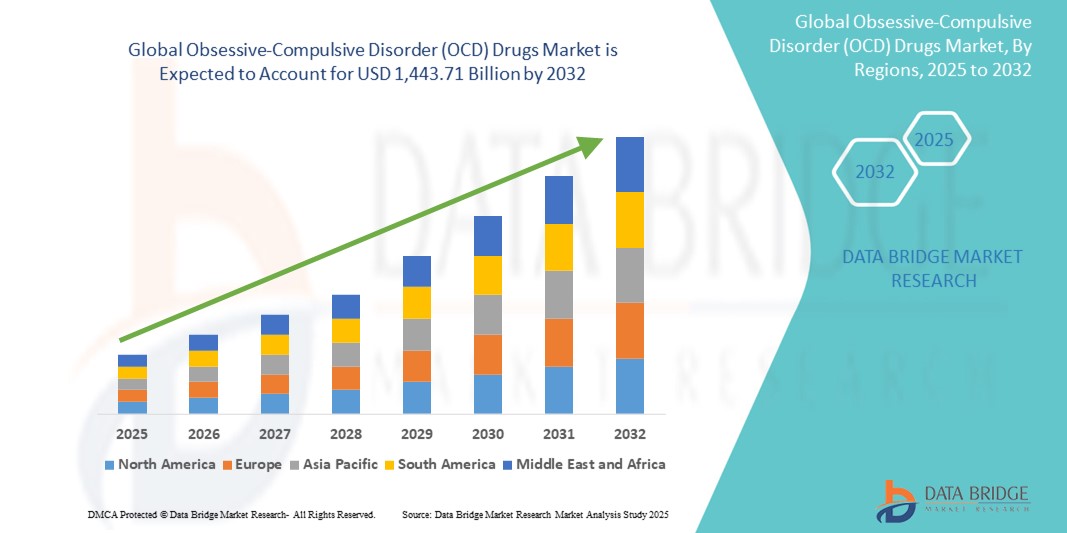
- The global obsessive-compulsive disorder (OCD) drugs market size was valued at USD 688.37 million in 2024 and is expected to reach USD 1,443.71 million by 2032, at a CAGR of 9.7% during the forecast period
- The market growth is largely fueled by the rising prevalence of OCD globally, increasing awareness and diagnosis rates, and the expansion of treatment options. This includes both approved and off-label pharmacological treatments, with Selective Serotonin Reuptake Inhibitors (SSRIs) dominating the market due to their proven efficacy
- Furthermore, increasing research and development activities for novel drug products, along with favorable government initiatives and investments in mental health programs, are accelerating the development of more precise and effective treatments. This collective momentum is significantly boosting the industry's growth by expanding accessibility and promoting early intervention for individuals with OCD
Obsessive-Compulsive Disorder (OCD) Drugs Market Analysis
- The obsessive-compulsive disorder (OCD) drugs market is primarily driven by the increasing prevalence of OCD worldwide, coupled with a growing recognition of mental health issues and improved diagnosis rates. Pharmacological interventions are crucial for managing OCD symptoms and improving patient quality of life.
- The escalating demand for OCD drugs is largely fueled by advancements in drug development, including the exploration of novel mechanisms beyond the serotonergic system, and the increasing acceptance of off-label medications as adjuncts to approved therapies.
- 北米は、強迫性障害(OCD)薬市場で2024年に40.5%という最大の収益シェアを占め、市場を支配しています。その特徴は、OCDの有病率の高さ、確立された医療インフラ、精神疾患に対する意識の高まり、そしてこの地域の主要業界プレーヤーによる多額の研究開発投資です。
- アジア太平洋地域は、メンタルヘルス意識の高まり、患者数の増加、急速な経済発展、各国の研究能力の向上により、予測期間中に強迫性障害(OCD)薬市場で最も急速に成長する地域になると予想されています。
- 選択的セロトニン再取り込み阻害薬(SSRI)セグメントは、OCDの主要神経伝達物質であるセロトニンを直接調節し、副作用プロファイルを管理しやすい効果的な症状緩和をもたらす第一選択治療薬としての効果が実証されていることから、2024年には65.5%の市場シェアを獲得し、強迫性障害(OCD)薬市場を席巻するでしょう。
レポートの範囲と強迫性障害(OCD)治療薬市場のセグメンテーション
|
属性 |
強迫性障害(OCD)治療薬の主要市場分析 |
|
対象セグメント |
|
|
対象国 |
北米
ヨーロッパ
アジア太平洋
中東およびアフリカ
南アメリカ
|
|
主要な市場プレーヤー |
|
|
市場機会 |
|
|
Value Added Data Infosets |
In addition to the insights on market scenarios such as market value, growth rate, segmentation, geographical coverage, and major players, the market reports curated by the Data Bridge Market Research also include in-depth expert analysis, pricing analysis, brand share analysis, consumer survey, demography analysis, supply chain analysis, value chain analysis, raw material/consumables overview, vendor selection criteria, PESTLE Analysis, Porter Analysis, and regulatory framework. |
Obsessive-Compulsive Disorder (OCD) Drugs Market Trends
“Advancements in Novel Drug Development and Personalized Treatment Approaches”
- A significant and accelerating trend in the global obsessive-compulsive disorder (OCD) drugs market is the increasing focus on developing novel drug classes and more targeted, personalized treatment approaches beyond traditional Selective Serotonin Reuptake Inhibitors (SSRIs). This shift is driven by the unmet needs of treatment-resistant patients and a deeper understanding of OCD's neurobiology
- For instance, research into NMDA blockers is showing promise for treatment-resistant OCD cases, targeting glutamatergic dysfunction as a new therapeutic avenue. Similarly, companies such as Biohaven Pharmaceuticals are investigating drugs such as troriluzole, which manages glutamate activity, in Phase 3 clinical trials, indicating a move towards different neurotransmitter systems
- AI integration, while not directly for drug action, is also influencing the market by aiding in drug discovery and potentially in personalizing treatment decisions. Furthermore, innovative non-pharmacological approaches such as Deep Transcranial Magnetic Stimulation (DTMS) are gaining traction, reflecting a broader trend towards diverse therapeutic options for complex cases
- The development of these novel mechanisms and the pursuit of personalized medicine are fundamentally reshaping expectations for OCD treatment, moving beyond a one-size-fits-all approach to more tailored interventions. Companies are also exploring augmentation strategies with antipsychotics alongside SSRIs for enhanced efficacy in challenging cases.
- The demand for more effective and individualized treatment options for OCD is growing rapidly, as patients and clinicians seek solutions for those who do not respond adequately to conventional therapies, thereby significantly boosting innovation and growth in the industry
Obsessive-Compulsive Disorder (OCD) Drugs Market Dynamics
Driver
“Growing Awareness, Diagnosis Rates, and Reduced Stigma”
- The increasing global awareness of mental health issues, coupled with rising diagnosis rates for obsessive-compulsive disorder (OCD) and a significant reduction in associated social stigma, is a primary driver for the heightened demand for OCD drugs
- As societal attitudes towards mental health evolve, more individuals are actively seeking professional help and support. For instance, reports indicate a growing number of diagnosed OCD cases annually, driven by greater public familiarity with the disorder and improved diagnostic tools and training for healthcare professionals
- As consumers and healthcare providers become more adept at identifying OCD symptoms, the demand for effective pharmacological interventions such as Selective Serotonin Reuptake Inhibitors (SSRIs) and emerging novel therapies steadily increases. This heightened awareness encourages early intervention, which is crucial for managing the chronic nature of OCD
- Furthermore, governmental initiatives and increased funding for mental health programs globally are playing a pivotal role in promoting awareness and improving access to treatment, thereby creating a more supportive environment for individuals with OCD to seek help
- The ease of accessing information about OCD through digital platforms and the growing acceptance of mental health discussions contribute to a proactive approach in managing the condition, collectively propelling the adoption and demand for OCD drug solutions
Restraint/Challenge
“Challenges of Treatment Resistance and Side Effect Burden of Existing Therapies”
- A significant restraint in the obsessive-compulsive disorder (OCD) drugs market stems from the persistent challenges of treatment resistance and the considerable side effect burden associated with existing pharmacological therapies, particularly Selective Serotonin Reuptake Inhibitors (SSRIs). This limits complete symptom remission for many patients and can lead to treatment discontinuation
- For instance, while SSRIs are first-line treatments, a substantial proportion of OCD patients either do not respond adequately to initial therapy or experience only partial symptom relief. This "treatment resistance" necessitates exploring augmentation strategies or switching medications, often without consistent success
- Furthermore, common side effects of SSRIs, such as nausea, insomnia, sexual dysfunction, weight gain, and gastrointestinal issues, can significantly impact patient adherence and quality of life. These adverse effects often lead patients to discontinue treatment, even if some symptom improvement has occurred, thereby limiting the overall effectiveness of available drugs
- The complex nature of psychiatric drug development, coupled with stringent regulatory processes, also contributes to the slow introduction of novel compounds with improved efficacy and fewer side effects, hindering market expansion. The limited understanding of individual patient variability in treatment response further complicates the development of universally effective solutions
- Overcoming these challenges through continued research into novel drug targets, personalized medicine approaches, and strategies to mitigate side effects will be vital for improving patient outcomes and driving sustained growth in the OCD drugs market
Obsessive-Compulsive Disorder (OCD) Drugs Market Scope
The market is segmented on the basis of severity, sub-type, drugs, route of administration, population type, end user, and distribution channel.
- By Severity
On the basis of severity, the global obsessive-compulsive disorder (OCD) drug market is segmented into mild to moderate and moderate to severe. The moderate to severe segment is anticipated to dominate the market with 26.72% market share. This dominance is attributed to the higher incidence rate of more severe cases requiring consistent and intensive pharmacological intervention, and the significant impact of these severe symptoms on daily functioning, prompting greater medical attention.
The mild to moderate segment is expected to witness the fastest growth in market from 2025 to 2032, due to increasing public and medical awareness of OCD symptoms, leading to earlier diagnosis before the condition becomes severe. This trend is further fueled by reduced stigma around mental health, alongside expanded access to care through various channels, encouraging more individuals with milder symptoms to seek treatment and prevent progression.
- By Sub-Type
On the basis of sub-type, the global obsessive-compulsive disorder (OCD) drug market is segmented into contamination obsessions with washing/cleaning compulsion, harm obsessions with checking compulsions, obsessions without visible compulsions, symmetry obsessions with ordering, arranging and counting compulsions, hoarding, and others. The contamination obsessions with washing/cleaning compulsion segment is expected to dominate the market with an approximate 67.99% market share. This is attributed to its high prevalence among OCD patients and ongoing developments in treatments and therapies specifically addressing these prominent symptoms.
The obsessions without visible compulsions segment is predicted to grow at the fastest CAGR from 2025 to 2032, owing to the growing recognition of the complexity of OCD presentations, leading to improved diagnostic methods and targeted therapeutic approaches tailored to address underlying patterns.
- By Drugs
On the basis of drugs, the global obsessive-compulsive disorder (OCD) drug market is segmented into antidepressants, antipsychotics, selective serotonin reuptake inhibitors (SSRIs), NMDA blocker, and others. The selective serotonin reuptake inhibitors (SSRIs), is expected to dominate the global OCD drug market with a market share 65.5%. This is due to their established efficacy as first-line pharmacological treatments, advancements in anti-anxiety and antidepressant drugs, and their widespread acceptance in clinical guidelines.
The NMDA blocker segment is predicted to grow at the fastest CAGR from 2025 to 2032. This is fueled by the growing interest in novel treatment mechanisms targeting glutamatergic dysfunction, with NMDA blockers showing promise in addressing treatment-resistant OCD cases and providing new therapeutic avenues
- By Route Of Administration
On the basis of route of administration, the obsessive-compulsive disorder (OCD) drug market is segmented into oral and parenteral. The oral segment is expected to dominate the market with an approximate 89.80% market share. This is primarily driven by the convenience, ease of self-administration, and patient preference for oral medications, alongside continuous advancements in novel oral formulations and therapies.
The parenteral segment is predicted to grow at the fastest CAGR from 2025 to 2032. This is due to the increasing demand for rapid onset of action, improved bioavailability, and the development of innovative parenteral formulations catering to specific patient needs and preferences, particularly for severe or treatment-resistant cases.
- By Population Type
On the basis of population type, the obsessive-compulsive disorder (OCD) drug market is segmented into pediatrics and adults. The adults segment is expected to dominate the market with an approximate 74.00% market share. This dominance is attributed to the higher prevalence of diagnosed OCD in the adult population, coupled with extensive research and development efforts focused on improving the pharmacology, bioavailability, safety, and dosage parameters of drugs for adults
The pediatrics segment is predicted to grow at the fastest CAGR from 2025 to 2032. This is owing to the increasing recognition of OCD in children and adolescents, coupled with efforts to improve early diagnosis and access to treatment, driving the demand for pediatric-specific OCD drugs and therapies.
- By End User
On the basis of end user, the obsessive-compulsive disorder (OCD) drug market is segmented into hospitals, specialty clinics, home healthcare, and others. The hospitals segment is expected to dominate the market with 45.35% market share. This is driven by their critical role in initial diagnosis, acute management of severe cases, and comprehensive psychiatric care, especially given the rising incidence of mental health disorders requiring inpatient or specialized outpatient services.
The home healthcare segment is predicted to grow at the fastest CAGR from 2025 to 2032. This is due to the rising preference for home-based treatment options, advancements in telemedicine, and efforts to increase access to mental health services outside traditional healthcare setting
- By Distribution Channel
On the basis of distribution channel, the obsessive-compulsive disorder (OCD) drug market is segmented into hospital pharmacy, retail pharmacy, online pharmacy, and others. The hospital pharmacy segment is expected to dominate the market with 59.69% market share. This is due to their integral role in dispensing medications for both inpatient and outpatient care within hospital settings, especially for complex or newly initiated treatments, and their immediate availability.
The online pharmacy segment is expected to witness the fastest growth from 2025 to 2032, fueled by increasing internet penetration, changing consumer preferences towards digital healthcare solutions, and the convenience of ordering medications from home.
Obsessive-Compulsive Disorder (OCD) Drugs Market Regional Analysis
- North America dominates the obsessive-compulsive disorder (OCD) drugs market with the largest revenue share of 40.5% in 2024, driven by the high prevalence of OCD, well-established healthcare infrastructure, greater awareness about mental health disorders, and significant R&D investments by key industry players in the region
- Consumers and healthcare providers in the region highly value the wide availability of advanced pharmacological interventions, high awareness about mental health, and significant investment in research and development by key pharmaceutical players
- This widespread adoption is further supported by high healthcare spending, favorable government initiatives, and a strong pipeline of novel drug products, establishing North America as a leading market for OCD treatments
U.S. Obsessive-Compulsive Disorder (OCD) Drugs Market Insight
The U.S. OCD drugs market captured the largest revenue share within North America, with 55.8% of market share in 2024, fueled by the high prevalence of OCD and a strong emphasis on mental health awareness. Consumers and healthcare providers increasingly prioritize effective pharmacological interventions for OCD, supported by favorable insurance coverage and significant investments in novel drug development. The presence of major pharmaceutical companies and a robust regulatory framework further propels the market's expansion.
Europe Obsessive-Compulsive Disorder (OCD) Drugs Market Insight
The Europe OCD drugs market is projected to expand at a substantial CAGR from 2025 to 2032, primarily driven by increasing awareness among people regarding the disorder and the availability of diverse treatment products. The region benefits from increasing societal acceptance of mental health services and a rising number of OCD diagnoses. Countries such as the U.K. and Germany are making substantial contributions to market expansion, bolstered by continuous advancements in anti-anxiety and antidepressant drugs
U.K. Obsessive-Compulsive Disorder (OCD) Drugs Market Insight
The U.K. OCD drugs market is anticipated to grow at a noteworthy CAGR during the forecast period, driven by a growing recognition of OCD symptoms and a desire for effective treatment options. In addition, a rise in mental health awareness initiatives encourages more individuals to seek diagnosis and pharmacological support. The U.K.'s evolving healthcare landscape and a focus on improving patient access to specialized mental health services are expected to continue to stimulate market growth
Germany Obsessive-Compulsive Disorder (OCD) Drugs Market Insight
The Germany OCD drugs market is expected to expand at a considerable CAGR during the forecast period, fueled by increasing awareness of mental health disorders and the demand for effective pharmacological solutions. Germany's well-developed healthcare infrastructure, combined with its emphasis on quality of care and patient access, promotes the adoption of OCD drugs. The increasing prevalence of diagnosed OCD cases and ongoing pharmaceutical research also contribute significantly to the market's expansion in the country
Asia-Pacific Obsessive-Compulsive Disorder (OCD) Drugs Market Insight
The Asia-Pacific OCD drugs market is poised to grow at the fastest CAGR of 10.2% from 2025 to 2032, driven by increasing recognition of mental health issues, rising disposable incomes, and improving access to healthcare across countries such as China, Japan, and India. The region's growing healthcare expenditure, supported by government initiatives promoting mental health awareness and treatment, is driving the adoption of OCD drugs. Furthermore, increasing investments in innovative R&D for novel drug products significantly contribute to its accelerated growth
Japan Obsessive-Compulsive Disorder (OCD) Drugs Market Insight
The Japan OCD drugs market is gaining momentum due to the country's high awareness of mental health, ongoing efforts to reduce stigma, and a demand for advanced treatment options. The Japanese market places a significant emphasis on quality of life, and the adoption of OCD drugs is driven by increasing diagnosis rates and a well-established healthcare system. The integration of pharmaceutical advancements with psychiatric care is fueling growth
India Obsessive-Compulsive Disorder (OCD) Drugs Market Insight
The India OCD drugs market is experiencing significant growth, attributed to the country's expanding healthcare infrastructure, rising awareness about mental health conditions, and increasing access to pharmaceutical treatments. The growing prevalence of OCD in the region, coupled with improving diagnostic capabilities and increasing healthcare spending, is propelling the demand for effective drug therapies. The push towards better mental healthcare accessibility and the availability of generic drug options are key factors driving the market in India
Obsessive-Compulsive Disorder (OCD) Drugs Market Share
強迫性障害 (OCD) 薬業界は、主に、次のような定評のある企業によって牽引されています。
- アボット(米国)
- リリー(米国)
- Viatris Inc.(米国)
- H. LUNDBECK A/S(デンマーク)
- GSK plc(英国)
- ファイザー社(米国)
- マリンクロット(英国)
- セベラ・ファーマシューティカルズ(米国)
- ザイダス・ファーマシューティカルズ社(インド)
- ルピン・ファーマシューティカルズ社(インド)
- アムニール・ファーマシューティカルズLLC(米国)
- ドクター・レディーズ・ラボラトリーズ社(インド)
- テバ製薬工業株式会社(イスラエル)
- ウォックハート(インド)
- アルヴォゲン(アイスランド)
- サン・ファーマシューティカル・インダストリーズ(インド)
- オーロビンド・ファーマ・リミテッド(米国)
- アポテックス社(カナダ)
- ラネット(米国)
世界の強迫性障害(OCD)治療薬市場の最新動向
- 2025年3月、バイオヘイブン・ファーマシューティカルズは、OCD(強迫性障害)を対象としたトロリルゾール(新規グルタミン酸調節薬)の第3相臨床試験2件のトップラインデータが、それぞれ2025年前半と後半に発表される予定であると発表しました。トロリルゾールは、OCD治療の新たな道筋となるグルタミン酸系への作用を目指しています。これは、従来のSSRIを超える新たな作用機序の導入に向けた継続的な取り組みを浮き彫りにしています。
- 2023年8月、TalkiatryはNOCDと提携し、精神科医療と専門的な曝露反応妨害法(ERP)を統合することで、強迫性障害(OCD)治療に革命をもたらしました。この連携は、特にオンライン治療において、アクセス性の向上とOCD治療の効率化を実現し、患者の転帰を向上させることを目的としています。
- 2021年6月、テバ・ファーマシューティカル・インダストリーズ社は、米国で酒さ(しゅさ)治療薬のジェネリック医薬品SOOLANTRA(イベルメクチン)クリームを発売し、皮膚科領域のポートフォリオとグローバル展開を大幅に拡大しました。この戦略的な動きは、強迫性障害(OCD)治療薬市場における多様化と拡大の取り組みを反映しています。製薬会社は、治療選択肢の拡大と多様な患者ニーズへの対応を継続的に目指し、市場競争力の向上とイノベーションの促進に取り組んでいます。
- 2021年4月、ルンドベックと大塚製薬は、アルツハイマー型認知症患者のアジテーション(興奮)に対する補助療法として、ブレクスピプラゾールの第III相試験を継続しました。こうした試験が成功すれば、新製品の発売につながり、企業の収益と市場動向に大きな影響を与える可能性があります。これは、強迫性障害(OCD)治療薬市場における革新的な治療法の追求と適応拡大の継続的な追求と並行しており、治療選択肢と市場動向に常に影響を与えています。
- 2021年4月、バイオヘイブン・ファーマシューティカルズは、強迫性障害(OCD)の補助療法としてトロリルゾールを検討する重要な第3相臨床試験を開始しました。この重要な取り組みは、革新的でより効果的なOCD治療薬の開発に向けた製薬業界の継続的な努力を浮き彫りにするものであり、特に治療抵抗性のOCD患者における新たな治療選択肢の追求と患者転帰の改善によって絶えず推進されているOCD治療薬市場のダイナミックな状況を反映しています。
SKU-
世界初のマーケットインテリジェンスクラウドに関するレポートにオンラインでアクセスする
- インタラクティブなデータ分析ダッシュボード
- 成長の可能性が高い機会のための企業分析ダッシュボード
- カスタマイズとクエリのためのリサーチアナリストアクセス
- インタラクティブなダッシュボードによる競合分析
- 最新ニュース、更新情報、トレンド分析
- 包括的な競合追跡のためのベンチマーク分析のパワーを活用
調査方法
データ収集と基準年分析は、大規模なサンプル サイズのデータ収集モジュールを使用して行われます。この段階では、さまざまなソースと戦略を通じて市場情報または関連データを取得します。過去に取得したすべてのデータを事前に調査および計画することも含まれます。また、さまざまな情報ソース間で見られる情報の不一致の調査も含まれます。市場データは、市場統計モデルと一貫性モデルを使用して分析および推定されます。また、市場シェア分析と主要トレンド分析は、市場レポートの主要な成功要因です。詳細については、アナリストへの電話をリクエストするか、お問い合わせをドロップダウンしてください。
DBMR 調査チームが使用する主要な調査方法は、データ マイニング、データ変数が市場に与える影響の分析、および一次 (業界の専門家) 検証を含むデータ三角測量です。データ モデルには、ベンダー ポジショニング グリッド、市場タイムライン分析、市場概要とガイド、企業ポジショニング グリッド、特許分析、価格分析、企業市場シェア分析、測定基準、グローバルと地域、ベンダー シェア分析が含まれます。調査方法について詳しくは、お問い合わせフォームから当社の業界専門家にご相談ください。
カスタマイズ可能
Data Bridge Market Research は、高度な形成的調査のリーダーです。当社は、既存および新規のお客様に、お客様の目標に合致し、それに適したデータと分析を提供することに誇りを持っています。レポートは、対象ブランドの価格動向分析、追加国の市場理解 (国のリストをお問い合わせください)、臨床試験結果データ、文献レビュー、リファービッシュ市場および製品ベース分析を含めるようにカスタマイズできます。対象競合他社の市場分析は、技術ベースの分析から市場ポートフォリオ戦略まで分析できます。必要な競合他社のデータを、必要な形式とデータ スタイルでいくつでも追加できます。当社のアナリスト チームは、粗い生の Excel ファイル ピボット テーブル (ファクト ブック) でデータを提供したり、レポートで利用可能なデータ セットからプレゼンテーションを作成するお手伝いをしたりすることもできます。