


Deep Transcranial Magnetic Stimulation (DTMS) Device Market Overview
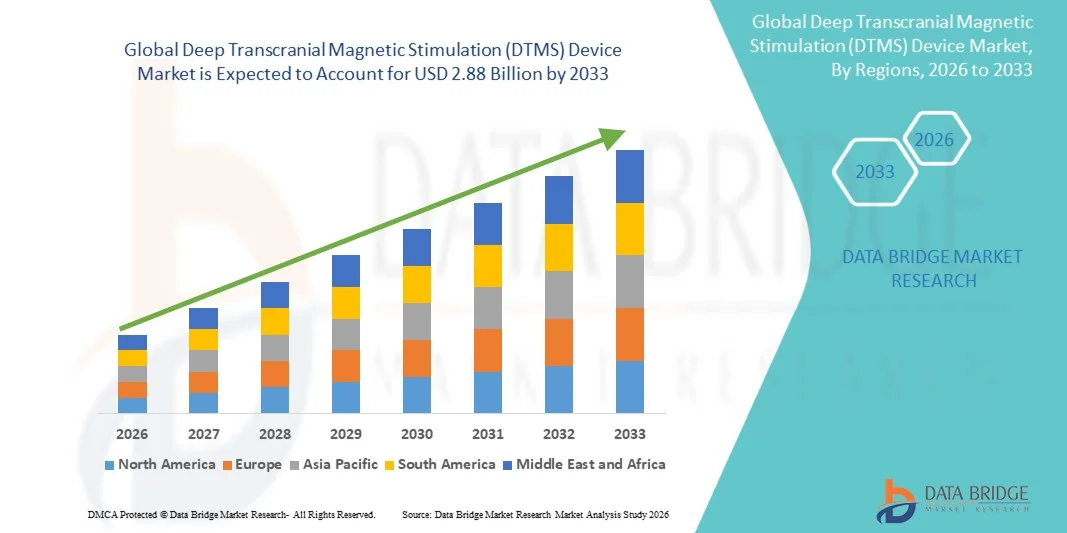
As per Data Bridge Market Research Analysis the Deep Transcranial Magnetic Stimulation (DTMS) Device Market was valued at USD 1.46 billion in 2025 and is projected to reach USD 2.88 billion by 2033, growing at a CAGR of 8.90% from 2026 to 2033. The market is witnessing steady growth driven by the rising prevalence of neurological and psychiatric disorders, increasing adoption of non-invasive brain stimulation therapies, and continuous advancements in neurotechnology and device precision.
The growing burden of treatment-resistant depression, obsessive-compulsive disorder, and other neuropsychiatric conditions, along with increasing awareness of alternative neuromodulation therapies, is significantly supporting market expansion. In addition, favorable regulatory approvals, expanding clinical evidence supporting dTMS efficacy, and increasing integration of these systems in hospitals, psychiatric clinics, and research institutions are further accelerating adoption across developed and emerging healthcare markets.
Market Size & Forecast
- Global Market Value (2025): USD 1.46 Billion
- Expected Market Value (2033): USD 2.88 Billion
- Forecast CAGR (2026–2033): 8.90%
- Leading Region in 2025: North America
- Fastest Growing Region: Asia Pacific
Key Market Trends & Insights
- North America dominated the Deep Transcranial Magnetic Stimulation (DTMS) Device Market with the largest revenue share of 40.94% in 2025, supported by early clinical adoption, strong mental healthcare infrastructure, and favorable regulatory approvals for neuromodulation therapies.
- The Deep Transcranial Magnetic Stimulator (dTMS) segment led the market with a 55.60% share in 2025, driven by its superior ability to reach deeper brain structures involved in mood regulation and treatment-resistant psychiatric disorders.
- Asia-Pacific is expected to be the fastest-growing region at a CAGR of 9.7% from 2026 to 2033, fueled by rising mental health awareness, increasing healthcare investments, and expanding access to advanced psychiatric treatment technologies in emerging economies.
- Repetitive Transcranial Magnetic Stimulator (rTMS) are the fastest-growing type, projected to register a CAGR of 7.9%, reflecting the surge in lower cost, wider clinical availability, and established therapeutic usage.
- The Stationary Systems segment dominated the technology category with a 65.70% revenue share in 2025, led by widespread deployment in hospitals, psychiatric centers, and neuromodulation clinics.
- Depression accounted for 60.65% of the market, preferred by the high global prevalence of major depressive disorder and increasing cases of treatment-resistant depression.
- The Alzheimer’s disease segment is the fastest-growing application category, with a CAGR of 10.1%, driven by increasing aging populations and rising neurodegenerative disease burden globally.
Report Scope and Deep Transcranial Magnetic Stimulation (DTMS) Device Market Segmentation
|
Attributes |
Deep Transcranial Magnetic Stimulation (DTMS) Device Key Market Insights |
|
Segments Covered |
|
|
Countries Covered |
North America
Europe
Asia-Pacific
Middle East and Africa
South America
|
|
Key Market Players |
|
|
Market Opportunities |
|
|
Value Added Data Infosets |
In addition to the insights on market scenarios such as market value, growth rate, segmentation, geographical coverage, and major players, the market reports curated by the Data Bridge Market Research also include in-depth expert analysis, patient epidemiology, pipeline analysis, pricing analysis, and regulatory framework. |
Deep Transcranial Magnetic Stimulation (DTMS) Device Market Trends
Trend: Expansion of Neuromodulation in Treatment-Resistant Depression Management
The adoption of dTMS is expanding rapidly as mental healthcare systems increasingly focus on treatment-resistant depression, where conventional antidepressant drugs and psychotherapy often show limited effectiveness. dTMS offers a non-invasive method that stimulates deeper cortical and subcortical brain regions involved in mood regulation, making it a preferred option in advanced psychiatric care. Hospitals and specialized neuropsychiatric centers are integrating dTMS into structured treatment pathways, particularly for patients who have not responded to multiple prior therapies. For instance, growing utilization of H-coil based deep stimulation protocols in clinical neuromodulation centers reflects its increasing acceptance as a mainstream adjunct therapy for refractory depression cases.
Deep Transcranial Magnetic Stimulation (DTMS) Device Market Dynamics
Key Market Driver: Rising Prevalence of Neuropsychiatric Disorders and Non-Invasive Therapy Demand
The global rise in mental health disorders, particularly depression, anxiety-related conditions, and obsessive-compulsive disorder, is a major factor accelerating demand for DTMS devices. At the same time, there is increasing patient preference for non-pharmacological and non-invasive treatment alternatives due to concerns about long-term medication side effects and treatment resistance. Healthcare providers are therefore adopting brain stimulation technologies as part of integrated psychiatric treatment plans. The growing clinical validation of neuromodulation therapies has also improved physician confidence in prescribing DTMS. For instance, expanding deployment of DTMS systems in specialized psychiatric hospitals for patients with chronic, treatment-resistant depression highlights its growing clinical importance in modern neurotherapeutic practice.
Key Restraint/Challenge: High Device Cost and Limited Access in Emerging Markets
Despite its clinical advantages, the adoption of DTMS technology is significantly limited by its high capital cost, complex installation requirements, and need for trained neuro-specialists to operate the system. These factors make it less accessible for small and mid-sized hospitals, especially in developing economies where healthcare budgets are constrained. In addition, reimbursement limitations in several regions further restrict widespread adoption. Maintenance costs and periodic software and hardware upgrades also increase the total cost of ownership, discouraging smaller psychiatric clinics from investing in the technology. For instance, installation of advanced DTMS systems in only large tertiary care hospitals and specialized neuromodulation centers highlights the gap between high-income and resource-limited healthcare settings in accessing this technology.
Key Market Opportunity: Integration of AI-Based Precision Psychiatry and Personalized Brain Stimulation
A major emerging opportunity in the DTMS market is the integration of artificial intelligence, neuroimaging, and data-driven treatment planning to enable precision psychiatry. AI-enabled systems can analyze patient brain activity patterns and optimize stimulation parameters in real time, improving treatment efficacy and reducing variability in outcomes. This shift toward personalized neuromodulation is expected to significantly enhance clinical success rates and expand the range of treatable conditions. In addition, cloud-based treatment analytics and digital monitoring tools are making it possible to track patient response over time and adjust therapy dynamically. For instance, research hospitals deploying AI-assisted neuro-navigation systems to refine coil placement and stimulation intensity demonstrate how intelligent technologies are shaping the future of targeted brain stimulation therapies.
Deep Transcranial Magnetic Stimulation (DTMS) Device Market Scope
The Deep Transcranial Magnetic Stimulation (DTMS) device market is segmented on the basis of type, technology, application, and end use.
- By Type
On the basis of type, the Deep Transcranial Magnetic Stimulation (DTMS) Device Market is segmented into Deep Transcranial Magnetic Stimulator (dTMS), Repetitive Transcranial Magnetic Stimulator (rTMS), and Others. The Deep Transcranial Magnetic Stimulator (dTMS) segment dominated the market with the largest share of 55.60% in 2025, owing to its superior ability to reach deeper brain structures involved in mood regulation and treatment-resistant psychiatric disorders. It is widely used in hospitals and specialized psychiatric clinics for major depressive disorder cases where conventional therapies fail. Strong clinical validation and regulatory approvals have significantly strengthened physician confidence in its use. Increasing integration into structured neuromodulation treatment pathways is further reinforcing adoption. Continuous improvements in coil design and stimulation depth are enhancing therapeutic outcomes. Growing demand for non-invasive brain stimulation therapies is sustaining its leadership position.
The Repetitive Transcranial Magnetic Stimulator (rTMS) segment is expected to witness the fastest growth with a CAGR of 7.9% from 2026 to 2033, driven by its lower cost, wider clinical availability, and established therapeutic usage. rTMS is increasingly used for depression and is being explored for anxiety disorders, PTSD, and neurorehabilitation applications. Its simpler system design enables adoption in outpatient clinics and mid-sized healthcare facilities. Expanding reimbursement support in several regions is further accelerating uptake. Continuous refinement of stimulation protocols is improving treatment outcomes. Growing awareness of neuromodulation therapies is also expanding global adoption.
- By Technology
On the basis of technology, the global DTMS device market is segmented into stationary systems, portable systems, and navigation-guided systems. The Stationary Systems segment dominated the market with the largest share of 65.70% in 2025, due to widespread deployment in hospitals, psychiatric centers, and neuromodulation clinics. These systems provide high stability, consistent stimulation accuracy, and suitability for repeated treatment sessions. They are preferred for structured clinical environments treating depression and OCD. Integration with advanced software platforms further enhances monitoring and treatment control. Strong reimbursement frameworks in developed regions support continued dominance. Their established presence in healthcare infrastructure ensures market leadership.
The Navigation-Guided Systems segment is expected to witness the fastest growth with a CAGR of 9.1% from 2026 to 2033, driven by rising demand for precision psychiatry and personalized neuromodulation therapies. These systems use neuroimaging and AI-assisted targeting to improve stimulation accuracy. Increasing adoption in advanced neurology hospitals and research centers is accelerating demand. They reduce variability in coil placement, improving treatment consistency and outcomes. Growing investment in brain mapping and imaging technologies is further supporting expansion. Expanding clinical trials using advanced targeting systems is also boosting adoption.
- By Application
On the basis of application, the global DTMS device market is segmented into Alzheimer’s disease, depression, Parkinson’s disease, epilepsy, and others. The Depression segment dominated the market with the largest share of 60.65% in 2025, due to the high global prevalence of major depressive disorder and increasing cases of treatment-resistant depression. DTMS is widely used as a non-invasive therapy for patients who do not respond to antidepressants or psychotherapy. Strong clinical evidence has reinforced its inclusion in psychiatric treatment protocols. Rising mental health awareness is increasing patient diagnosis and treatment rates. Expanding reimbursement coverage in developed healthcare systems is further supporting adoption. Continuous integration into clinical guidelines is strengthening its dominant position.
The Alzheimer’s disease segment is expected to witness the fastest growth with a CAGR of 10.1% from 2026 to 2033, driven by increasing aging populations and rising neurodegenerative disease burden globally. dTMS is being actively researched for its potential role in improving cognitive function and slowing disease progression. Limited effectiveness of existing Alzheimer’s treatments is increasing interest in neuromodulation approaches. Growing clinical trials and neuroscience research funding are accelerating development. Advances in brain stimulation targeting and neuroimaging are improving feasibility. Expanding academic-industry collaborations are further supporting innovation in this segment.
- By End Use
On the basis of end use, the global dTMS device market is segmented into research, diagnostics, and therapeutics. The Therapeutics segment dominated the market with the largest share of 70.75% in 2025, due to widespread clinical use in treating depression, OCD, and other neuropsychiatric disorders. Hospitals and psychiatric clinics remain the primary users of therapeutic dTMS systems. Increasing demand for non-invasive and drug-free treatment options is driving adoption. Strong clinical validation and regulatory approvals have supported integration into standard care pathways. Rising patient preference for neuromodulation therapies is further strengthening demand. Continuous expansion of mental healthcare infrastructure is reinforcing dominance.
The Research segment is expected to witness the fastest growth with a CAGR of 9.1% from 2026 to 2033, driven by increasing clinical studies exploring new applications of brain stimulation technology. Academic institutions and neuroscience research centers are expanding investigations into cognitive and behavioral applications of dTMS. Growing funding for brain research initiatives is accelerating adoption. Integration of AI and neuroimaging tools is improving research precision and efficiency. Expanding collaboration between universities and medical device companies is fostering innovation. Increasing focus on precision psychiatry is further boosting research-driven demand.
Deep Transcranial Magnetic Stimulation (DTMS) Device Market Regional Analysis
North America dominated the Deep Transcranial Magnetic Stimulation (DTMS) Device Market with the largest revenue share of 40.94% in 2025, supported by early clinical adoption, strong mental healthcare infrastructure, and favorable regulatory approvals for neuromodulation therapies. The region benefits from high prevalence of depression and other neuropsychiatric disorders, well-established reimbursement frameworks, and widespread availability of specialized mental health clinics. Increasing integration of dTMS systems into hospital-based treatment protocols and growing investments in brain stimulation research are further strengthening regional dominance. Continuous advancements in precision psychiatry and expanding awareness of non-invasive treatment options continue to reinforce North America’s leadership position in the global market.
U.S. Deep Transcranial Magnetic Stimulation (DTMS) Device Market Insight
The U.S. deep transcranial magnetic stimulation (dTMS) device market is witnessing strong growth due to rising prevalence of depression, anxiety disorders, and treatment-resistant psychiatric conditions, along with increasing adoption of advanced neuromodulation therapies. The country’s well-developed mental healthcare infrastructure, early regulatory approvals, and strong presence of leading neurotechnology providers are driving demand across hospitals and specialized psychiatric clinics. In addition, growing insurance coverage for brain stimulation therapies and increasing integration of dTMS into clinical treatment protocols are accelerating adoption. Expanding investments in neuroscience research and precision psychiatry continue to strengthen the U.S. as the leading market for dTMS devices globally.
Europe Deep Transcranial Magnetic Stimulation (DTMS) Device Market Insight
The Europe dTMS device market remains a significant contributor to global revenue, driven by strong healthcare systems, increasing mental health awareness, and supportive regulatory frameworks for non-invasive brain stimulation therapies. The region benefits from rising adoption of dTMS in psychiatric hospitals, research institutions, and neuromodulation centers across major economies. Increasing focus on treatment-resistant depression and expanding clinical evidence supporting dTMS efficacy are supporting market growth. In addition, growing investments in neuroscience research and structured mental health programs are enhancing adoption. Continuous advancement in neuromodulation technologies and integration into standardized care pathways continue to strengthen Europe’s position in the global market.
U.K. Deep Transcranial Magnetic Stimulation (DTMS) Device Market Insight
The U.K. dTMS device market is experiencing steady growth, supported by increasing demand for advanced mental health treatments and rising adoption of non-invasive neuromodulation therapies in psychiatric care. Growing prevalence of depression and anxiety disorders, along with strong public healthcare support through the NHS, is driving clinical adoption. Hospitals and specialized mental health centers are increasingly integrating dTMS into treatment pathways for resistant cases. In addition, growing research activity in neuroscience and expanding awareness of brain stimulation therapies are supporting market expansion. Continuous technological integration and focus on improving mental health outcomes are further strengthening the U.K. market.
Germany Deep Transcranial Magnetic Stimulation (DTMS) Device Market Insight
The Germany dTMS device market is expanding steadily due to strong healthcare infrastructure, high awareness of mental health disorders, and increasing adoption of advanced neuromodulation technologies. Hospitals, psychiatric clinics, and research institutions are increasingly using dTMS for treating depression and other neuropsychiatric conditions. The country’s strong focus on medical innovation and neuroscience research is supporting clinical adoption. Rising prevalence of treatment-resistant depression and growing interest in non-pharmacological therapies are further driving demand. Continuous advancements in medical device technology and integration of dTMS into structured psychiatric treatment programs are strengthening market growth in Germany.
Asia-Pacific Deep Transcranial Magnetic Stimulation (DTMS) Device Market Insight
The Asia-Pacific dTMS device market is expected to witness rapid growth, driven by rising mental health awareness, increasing healthcare investments, and expanding access to advanced psychiatric treatments across countries such as China, India, and Japan. Growing prevalence of depression and other neuropsychiatric disorders is supporting demand for non-invasive neuromodulation therapies. Increasing adoption of advanced medical technologies and expansion of psychiatric care infrastructure are further accelerating market growth. In addition, rising investments in neuroscience research and growing clinical acceptance of brain stimulation therapies are contributing to regional expansion. The presence of a large patient pool continues to position Asia-Pacific as the fastest-growing regional market.
Japan Deep Transcranial Magnetic Stimulation (DTMS) Device Market Insight
The Japan dTMS device market is witnessing steady growth due to rising focus on advanced mental healthcare solutions, increasing aging population, and growing prevalence of depression-related disorders. Hospitals, research institutes, and specialized neurology centers are increasingly adopting dTMS for non-invasive treatment of neuropsychiatric conditions. Strong emphasis on medical innovation and integration of advanced technologies such as neuroimaging and AI-based targeting is supporting adoption. In addition, Japan’s focus on improving cognitive health and neurological care in elderly populations is further driving demand. Continuous clinical research and technological advancement are strengthening market growth in the country.
China Deep Transcranial Magnetic Stimulation (DTMS) Device Market Insight
The China dTMS device market is growing rapidly, driven by increasing burden of mental health disorders, rising healthcare investments, and expanding adoption of advanced neuromodulation therapies. Growing awareness of depression and anxiety-related conditions is supporting demand for non-invasive treatment options. The expansion of psychiatric hospitals and specialized mental health centers is further accelerating adoption. Increasing investments in neuroscience research and medical technology development are also contributing to market growth. In addition, rising integration of AI-driven healthcare solutions and expanding clinical acceptance of brain stimulation therapies are positioning China as one of the fastest-growing dTMS markets globally.
Deep Transcranial Magnetic Stimulation (DTMS) Device Market Share
The Deep Transcranial Magnetic Stimulation (DTMS) Device industry is primarily led by well-established companies, including:
- BrainsWay Ltd. (Israel)
- MagVenture A/S (Denmark)
- Nexstim Plc (Finland)
- Deymed Diagnostic s.r.o. (Czech Republic)
- Magstim Company Ltd. (U.K.)
- NeuroStar Advanced Therapy (U.S.)
- TMS Neuro Solutions, Inc. (U.S.)
- eNeura Inc. (U.S.)
- Mag & More GmbH (Germany)
- Neurosoft S.A. (Greece)
- ANT Neuro B.V. (Netherlands)
- Rogue Research Inc. (Canada)
- Soterix Medical Inc. (U.S.)
- NeuroCare Group GmbH (Germany)
- EB Neuro S.p.A. (Italy)
- NeuroSigma, Inc. (U.S.)
- CloudTMS (U.S.)
- Brainbox Ltd. (U.K.)
- Medtronic (Ireland)
- Abbott (U.S.)
Latest Developments in Deep Transcranial Magnetic Stimulation (DTMS) Device Market
- In May 2024, BrainsWay Ltd. announced U.S. FDA clearance for its Deep Transcranial Magnetic Stimulation (Deep TMS) system for the treatment of adolescents with obsessive-compulsive disorder (OCD), expanding the therapy’s approved patient population beyond adults. This development significantly strengthened the clinical reach of dTMS in pediatric and adolescent psychiatry, addressing a critical unmet need in early-onset OCD treatment. The approval reflects growing clinical confidence in non-invasive neuromodulation therapies for younger patients and supports broader adoption across specialized mental health centers
- In November 2023, BrainsWay reported continued expansion of global adoption of its Deep TMS systems, supported by increasing utilization across psychiatric clinics and hospitals worldwide, highlighting strong commercial and clinical traction of the technology. The company emphasized rising demand for non-invasive neuromodulation in treatment-resistant depression and OCD cases. This development reflects accelerating acceptance of Deep TMS as a standard adjunct therapy in mental healthcare systems, particularly in North America and Europe
- In June 2023, clinical and real-world evidence publications reinforced the long-term efficacy of Deep TMS therapy for major depressive disorder, demonstrating sustained symptom reduction in treatment-resistant patients. These findings contributed to stronger physician confidence in integrating dTMS into structured psychiatric treatment pathways. The results further supported the expansion of neuromodulation-based therapies as viable alternatives to pharmacological interventions in chronic depression management
- In September 2022, growing insurance and reimbursement support for transcranial magnetic stimulation therapies, including Deep TMS in select markets, helped improve patient access to advanced neuromodulation treatments, particularly in the United States. This development reduced financial barriers for patients undergoing repeated treatment sessions, which are typically required for effective outcomes. It also encouraged wider adoption of dTMS in outpatient psychiatric clinics and hospital-based neuromodulation units
- In March 2021, increasing clinical adoption of Deep TMS systems was reported across psychiatric treatment centers, driven by rising mental health burden during the post-pandemic period and growing demand for non-invasive depression therapies. Healthcare providers increasingly integrated neuromodulation into treatment protocols for patients with treatment-resistant depression and anxiety disorders. This period marked a significant acceleration in awareness and utilization of brain stimulation technologies within mainstream psychiatric care

- Interactive Data Analysis Dashboard
- Company Analysis Dashboard for high growth potential opportunities
- Research Analyst Access for customization & queries
- Competitor Analysis with Interactive dashboard
- Latest News, Updates & Trend analysis
- Harness the Power of Benchmark Analysis for Comprehensive Competitor Tracking
Data collection and base year analysis are done using data collection modules with large sample sizes. The stage includes obtaining market information or related data through various sources and strategies. It includes examining and planning all the data acquired from the past in advance. It likewise envelops the examination of information inconsistencies seen across different information sources. The market data is analysed and estimated using market statistical and coherent models. Also, market share analysis and key trend analysis are the major success factors in the market report. To know more, please request an analyst call or drop down your inquiry.
The key research methodology used by DBMR research team is data triangulation which involves data mining, analysis of the impact of data variables on the market and primary (industry expert) validation. Data models include Vendor Positioning Grid, Market Time Line Analysis, Market Overview and Guide, Company Positioning Grid, Patent Analysis, Pricing Analysis, Company Market Share Analysis, Standards of Measurement, Global versus Regional and Vendor Share Analysis. To know more about the research methodology, drop in an inquiry to speak to our industry experts.
Data Bridge Market Research is a leader in advanced formative research. We take pride in servicing our existing and new customers with data and analysis that match and suits their goal. The report can be customized to include price trend analysis of target brands understanding the market for additional countries (ask for the list of countries), clinical trial results data, literature review, refurbished market and product base analysis. Market analysis of target competitors can be analyzed from technology-based analysis to market portfolio strategies. We can add as many competitors that you require data about in the format and data style you are looking for. Our team of analysts can also provide you data in crude raw excel files pivot tables (Fact book) or can assist you in creating presentations from the data sets available in the report.













