Global Crigler–Najjar Syndrome Market Segmentation, By Drugs (Bilirubin Chelators, Ursodeoxycholic Acid, and Others),Treatment (Surgery, Drugs, and Others), Mode of Administration (Injectable, Oral, and Others), Distribution Channel (Hospital Pharmacies, Retail Pharmacies, and Online Pharmacies), End User (Hospitals, Homecare, Specialty Clinics, and Others) – Industry Trends and Forecast to 2032
Crigler–Najjar Syndrome Market Analysis
The crigler–najjar syndrome market analysis focuses on this rare genetic disorder characterized by the absence or deficiency of the enzyme UDP-glucuronosyltransferase, leading to severe hyperbilirubinemia. The market is driven by the need for innovative therapies, including bilirubin chelators, ursodeoxycholic acid, and gene therapies, as well as advancements in liver transplantation techniques. Recent developments emphasize gene-editing technologies, such as CRISPR, offering potential curative solutions. The market is supported by a growing focus on orphan drug development and regulatory incentives for rare diseases. Key players, including pharmaceutical and biotech firms, are investing in research to address unmet clinical needs. Distribution is facilitated through hospital pharmacies, retail channels, and online platforms. The end-users include hospitals, specialty clinics, and homecare settings. With ongoing clinical trials and partnerships, the market is poised for growth, fostering hope for improved management and potential cures for this life-threatening condition.
Crigler–Najjar Syndrome Market Size
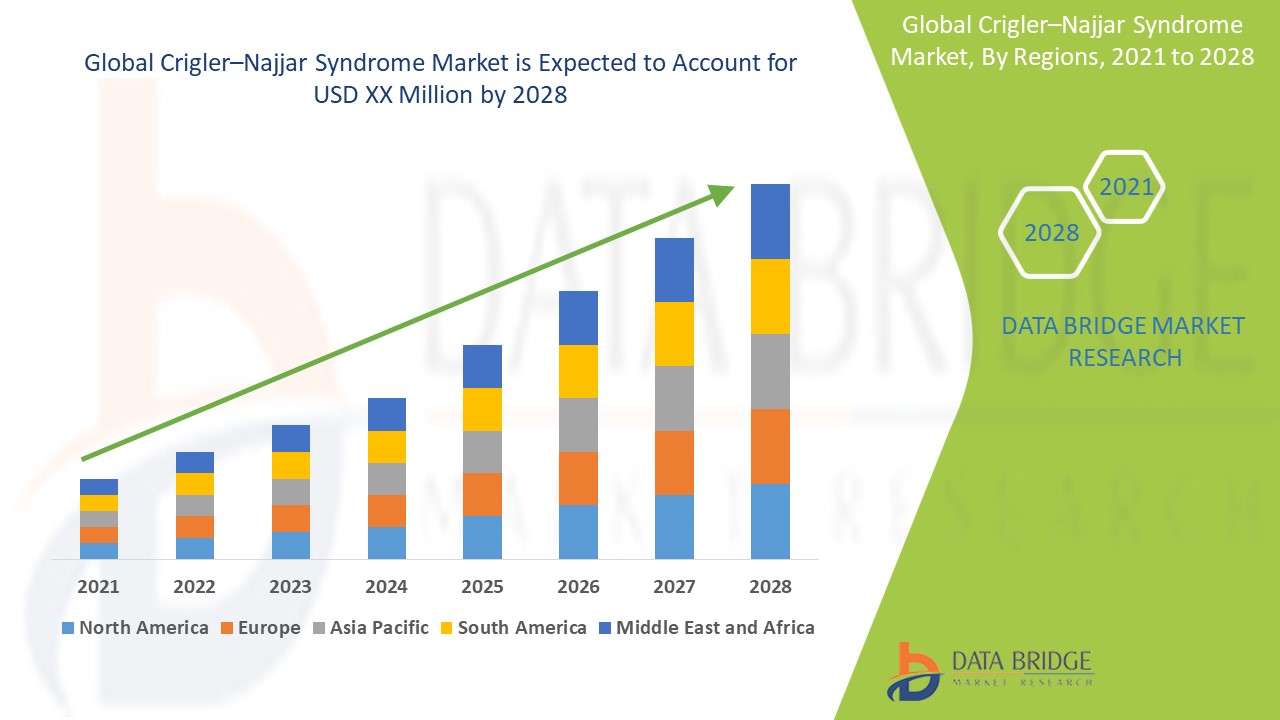
The global crigler–najjar syndrome market size was valued at USD 1.05 billion in 2024 and is projected to reach USD 1.93 billion by 2032, with a CAGR of 7.84% during the forecast period of 2025 to 2032. In addition to the insights on market scenarios such as market value, growth rate, segmentation, geographical coverage, and major players, the market reports curated by the Data Bridge Market Research also include depth expert analysis, patient epidemiology, pipeline analysis, pricing analysis, and regulatory framework.
Crigler–Najjar Syndrome Market Trends
“Innovations in Gene Therapies”
The crigler–najjar syndrome market focuses on addressing a rare genetic disorder caused by the deficiency of the enzyme UDP-glucuronosyltransferase, leading to toxic bilirubin accumulation. Innovations in gene therapies, particularly CRISPR-Cas9 and other genome-editing tools, are driving breakthroughs, offering potential curative solutions. A notable trend in the market is the growing emphasis on developing orphan drugs, supported by regulatory incentives and fast-track designations. Advances in bilirubin-lowering therapies and liver transplant technologies further expand treatment options. Key stakeholders, including biopharmaceutical companies and research institutions, are collaborating to enhance therapeutic efficacy and accessibility. The market is poised for growth as ongoing clinical trials and partnerships aim to address the unmet needs of this life-threatening condition effectively.
Report Scope and Crigler–Najjar Syndrome Market Segmentation
|
Attributes |
Crigler–Najjar Syndrome Key Market Insights |
|
Segments Covered |
|
|
Countries Covered |
U.S., Canada and Mexico, Germany, France, U.K., Netherlands, Switzerland, Belgium, Russia, Italy, Spain, Turkey, Rest of Europe, China, Japan, India, South Korea, Singapore, Malaysia, Australia, Thailand, Indonesia, Philippines, Rest of Asia-Pacific, Saudi Arabia, U.A.E., South Africa, Egypt, Israel, Rest of Middle East and Africa , Brazil, Argentina and Rest of South America |
|
Key Market Players |
International Stem Cell Corporation (U.S.), Cartesian Therapeutics, Inc (U.S.), AstraZeneca (U.S.), Genethon (France), Astellas Pharma Inc. (U.S.), Teva Pharmaceutical Industries Ltd. (Israel), Zydus Group (India), Endo, Inc. (Ireland), ANI Pharmaceuticals, Inc. (U.S.), Viatris Inc. (Netherlands), Glenmark Pharmaceuticals Ltd. (India), Amneal Pharmaceuticals LLC. (U.S.), and Epic Pharma, LLC (U.S.) |
|
Market Opportunities |
|
|
Value Added Data Infosets |
In addition to the insights on market scenarios such as market value, growth rate, segmentation, geographical coverage, and major players, the market reports curated by the Data Bridge Market Research also include depth expert analysis, patient epidemiology, pipeline analysis, pricing analysis, and regulatory framework. |
Crigler–Najjar Syndrome Market Definition
Crigler–najjar syndrome is a rare genetic disorder caused by mutations in the UGT1A1 gene, leading to a deficiency or complete absence of the enzyme UDP-glucuronosyltransferase. This enzyme is essential for converting bilirubin, a byproduct of red blood cell breakdown, into a water-soluble form for excretion. The disorder results in severe hyperbilirubinemia, which can lead to jaundice, neurological damage, and life-threatening complications if untreated. It is typically classified into two types: Type I, characterized by a complete enzyme deficiency, and Type II, with partial enzyme activity. Early diagnosis and management are critical, often involving phototherapy, liver transplantation, or emerging gene therapies.
Crigler–Najjar Syndrome Market Dynamics
Drivers
- Rising Awareness and Early Diagnosis
Increasing awareness among healthcare professionals about crigler–najjar syndrome, coupled with advancements in diagnostic tools, has significantly improved the early detection and management of this rare genetic disorder. Initiatives such as medical education programs, rare disease awareness campaigns, and access to genetic testing are empowering clinicians to identify the condition promptly. Enhanced diagnostic capabilities, including advanced biochemical assays and genetic screening technologies, ensure accurate and timely diagnosis, reducing the risk of complications. This trend is driving the market by fostering demand for effective therapies and encouraging pharmaceutical companies to develop targeted treatments, ultimately improving patient outcomes and expanding market opportunities.
- Growing Demand for Personalized Medicine
Advances in genetic testing and personalized treatment approaches are playing a pivotal role in driving the expansion of the crigler–najjar syndrome market. Cutting-edge genetic screening techniques allow precise identification of the UGT1A1 gene mutations responsible for the disorder, enabling tailored therapeutic strategies. Personalized medicine, driven by these advancements, optimizes treatment efficacy and minimizes side effects, addressing individual patient needs. The growing integration of genetic counseling further supports informed decision-making for patients and families. These innovations enhance patient care and encourage pharmaceutical companies to invest in targeted therapies, thereby fueling market growth and expanding treatment accessibility.
Opportunities
- Gene Therapy Development
Advancements in gene-editing technologies, particularly CRISPR, have opened up significant opportunities in the crigler–najjar syndrome market. These technologies offer the potential for curative treatments by directly targeting and correcting the underlying genetic mutations responsible for the disorder. Gene therapies aim to restore the function of the deficient UDP-glucuronosyltransferase enzyme, which is key to reducing hyperbilirubinemia. As research progresses, these therapies could eliminate the need for lifelong treatments such as phototherapy or liver transplants. The development of gene therapies presents a transformative market opportunity, attracting investment and creating new avenues for treatment, ultimately improving patient outcomes and market expansion.
- Emerging Biopharmaceutical Solutions
The development of novel drugs, such as bilirubin-lowering agents and enzyme replacement therapies, offers a significant market opportunity in the management of crigler–najjar syndrome. These therapeutic innovations provide an alternative treatment option, particularly for patients who are not ideal candidates for liver transplants due to age, health complications, or lack of donor availability. Bilirubin-lowering agents can help manage hyperbilirubinemia by promoting the elimination of excess bilirubin, while enzyme replacement therapies can supplement the deficient UDP-glucuronosyltransferase enzyme. As these treatments become more effective, they will address unmet clinical needs, expand market opportunities, and offer improved quality of life for patients.
Restraints/Challenges
- Lack of Standardized Treatment Protocols
One of the key challenges in the crigler–najjar syndrome market is the lack of a widely accepted cure and standardized management protocols. Treatment options vary significantly, with approaches such as phototherapy, liver transplantation, and experimental therapies being employed depending on patient-specific factors. This lack of uniformity in treatment strategies can lead to inconsistent patient care and varying outcomes. The absence of established treatment guidelines also complicates the decision-making process for healthcare providers, potentially delaying optimal care. As a result, the market faces obstacles in improving the overall standard of care, making it harder to meet patient needs effectively and driving uncertainty in treatment approaches.
- High Treatment Costs
A significant restraint in the crigler–najjar syndrome market is the high cost of developing and administering innovative therapies, particularly gene therapies and enzyme replacement treatments. These advanced therapies require extensive research, development, and regulatory approval processes, making them expensive to produce. As a result, the high treatment costs could limit their accessibility, especially for patients in low-income regions or countries with underdeveloped healthcare systems. This financial barrier can hinder widespread adoption and treatment availability, creating disparities in healthcare access. Consequently, the market faces challenges in achieving global reach and ensuring that all patients receive timely, effective care.
This market report provides details of new recent developments, trade regulations, import-export analysis, production analysis, value chain optimization, market share, impact of domestic and localized market players, analyses opportunities in terms of emerging revenue pockets, changes in market regulations, strategic market growth analysis, market size, category market growths, application niches and dominance, product approvals, product launches, geographic expansions, technological innovations in the market. To gain more info on the market contact Data Bridge Market Research for an Analyst Brief, our team will help you take an informed market decision to achieve market growth.
Crigler–Najjar Syndrome Market Scope
The market is segmented on the basis of drugs, treatment, mode of administration, distribution channel, and end-user. The growth amongst these segments will help you analyse meagre growth segments in the industries and provide the users with a valuable market overview and market insights to help them make strategic decisions for identifying core market applications.
Drugs
- Bilirubin chelators
- Ursodeoxycholic acid
- Others
Treatment
- Surgery
- Drugs
- Others
Mode of Administration
- Injectable
- Oral
- Others
Distribution Channel
- Hospital pharmacies
- Retail pharmacies
- Online pharmacies
End User
- Hospitals
- Homecare
- Specialty clinics
- Others
Crigler–Najjar Syndrome Market Regional Analysis
The market is analysed and market size insights and trends are provided by country, drugs, treatment, mode of administration, distribution channel, and end-user as referenced above.
The countries covered in the market report are U.S., Canada and Mexico, Germany, France, U.K., Netherlands, Switzerland, Belgium, Russia, Italy, Spain, Turkey, rest of Europe, China, Japan, India, South Korea, Singapore, Malaysia, Australia, Thailand, Indonesia, Philippines, rest of Asia-Pacific, Saudi Arabia, U.A.E., South Africa, Egypt, Israel, rest of Middle East and Africa , Brazil, Argentina and rest of South America.
North America dominates crigler–najjar syndrome market due to its advanced healthcare infrastructure. The region boasts cutting-edge medical facilities, renowned research institutions, and access to state-of-the-art treatments, making it a key hub for managing rare genetic disorders. These factors ensure that patients in North America have the best possible care and support.
Asia-Pacific region is anticipated to experience significant growth in the crigler–najjar syndrome market, driven by the expansion of healthcare infrastructure and its large population. This growth opens up opportunities to enhance diagnostic capabilities, treatment options, and awareness initiatives for rare genetic disorders. As healthcare access improves, more patients in the region will benefit from better care and management of the condition.
The country section of the report also provides individual market impacting factors and changes in regulation in the market domestically that impacts the current and future trends of the market. Data points such as down-stream and upstream value chain analysis, technical trends and porter's five forces analysis, case studies are some of the pointers used to forecast the market scenario for individual countries. Also, the presence and availability of global brands and their challenges faced due to large or scarce competition from local and domestic brands, impact of domestic tariffs and trade routes are considered while providing forecast analysis of the country data.
Crigler–Najjar Syndrome Market Share
The market competitive landscape provides details by competitor. Details included are company overview, company financials, revenue generated, market potential, investment in research and development, new market initiatives, global presence, production sites and facilities, production capacities, company strengths and weaknesses, product launch, product width and breadth, application dominance. The above data points provided are only related to the companies' focus related to market.
Crigler–Najjar Syndrome Market Leaders Operating in the Market Are:
- International Stem Cell Corporation (U.S.)
- Cartesian Therapeutics, Inc (U.S.)
- AstraZeneca (U.S.)
- Genethon (France)
- Astellas Pharma Inc. (U.S.)
- Teva Pharmaceutical Industries Ltd. (Israel)
- Zydus Group (India)
- Endo, Inc. (Ireland)
- ANI Pharmaceuticals, Inc. (U.S.)
- Viatris Inc. (Netherlands )
- GLENMARK PHARMACEUTICALS LTD. (India)
- Amneal Pharmaceuticals LLC. (U.S.)
- Epic Pharma, LLC (U.S.)
Latest Developments in Crigler–Najjar Syndrome Market
- In August 2022, KSL Beutner Laboratories (Beutner) introduced a blood test aimed at detecting an antigen linked to mucous membrane pemphigoid (MMP), a challenging autoimmune blistering disorder that causes lesions in the oral cavity. This breakthrough offers enhanced diagnostic precision and the potential for earlier detection of MMP, allowing for more effective patient management. The innovation is expected to significantly improve care by facilitating timely intervention and better monitoring of the disease
SKU-
세계 최초의 시장 정보 클라우드 보고서에 온라인으로 접속하세요
- 대화형 데이터 분석 대시보드
- 높은 성장 잠재력 기회를 위한 회사 분석 대시보드
- 사용자 정의 및 질의를 위한 리서치 분석가 액세스
- 대화형 대시보드를 통한 경쟁자 분석
- 최신 뉴스, 업데이트 및 추세 분석
- 포괄적인 경쟁자 추적을 위한 벤치마크 분석의 힘 활용
연구 방법론
데이터 수집 및 기준 연도 분석은 대규모 샘플 크기의 데이터 수집 모듈을 사용하여 수행됩니다. 이 단계에는 다양한 소스와 전략을 통해 시장 정보 또는 관련 데이터를 얻는 것이 포함됩니다. 여기에는 과거에 수집한 모든 데이터를 미리 검토하고 계획하는 것이 포함됩니다. 또한 다양한 정보 소스에서 발견되는 정보 불일치를 검토하는 것도 포함됩니다. 시장 데이터는 시장 통계 및 일관된 모델을 사용하여 분석하고 추정합니다. 또한 시장 점유율 분석 및 주요 추세 분석은 시장 보고서의 주요 성공 요인입니다. 자세한 내용은 분석가에게 전화를 요청하거나 문의 사항을 드롭하세요.
DBMR 연구팀에서 사용하는 주요 연구 방법론은 데이터 마이닝, 시장에 대한 데이터 변수의 영향 분석 및 주요(산업 전문가) 검증을 포함하는 데이터 삼각 측량입니다. 데이터 모델에는 공급업체 포지셔닝 그리드, 시장 타임라인 분석, 시장 개요 및 가이드, 회사 포지셔닝 그리드, 특허 분석, 가격 분석, 회사 시장 점유율 분석, 측정 기준, 글로벌 대 지역 및 공급업체 점유율 분석이 포함됩니다. 연구 방법론에 대해 자세히 알아보려면 문의를 통해 업계 전문가에게 문의하세요.
사용자 정의 가능
Data Bridge Market Research는 고급 형성 연구 분야의 선두 주자입니다. 저희는 기존 및 신규 고객에게 목표에 맞는 데이터와 분석을 제공하는 데 자부심을 느낍니다. 보고서는 추가 국가에 대한 시장 이해(국가 목록 요청), 임상 시험 결과 데이터, 문헌 검토, 재생 시장 및 제품 기반 분석을 포함하도록 사용자 정의할 수 있습니다. 기술 기반 분석에서 시장 포트폴리오 전략에 이르기까지 타겟 경쟁업체의 시장 분석을 분석할 수 있습니다. 귀하가 원하는 형식과 데이터 스타일로 필요한 만큼 많은 경쟁자를 추가할 수 있습니다. 저희 분석가 팀은 또한 원시 엑셀 파일 피벗 테이블(팩트북)로 데이터를 제공하거나 보고서에서 사용 가능한 데이터 세트에서 프레젠테이션을 만드는 데 도움을 줄 수 있습니다.