


Global Seed Treatment Nematicides Market, By Type (Fumigants, Organophosphates, Carbamates, Bionematicides, Others), Crop Type (Field Crops, Fruits and Nuts, Vegetables, Others), Form (Granular, Liquid), Nematode Type (Root-knot Nematode, Cyst, Others) – Industry Trends and Forecast to 2029.
Global Seed Treatment Nematicides Market Analysis and Size
Nematicide is a type of chemical pesticide used to eliminate plant-parasitic nematodes. These pesticides are known to be highly toxic and should only be applied by trained professionals who understand how to minimise the risks. These chemicals, as well as formulations and application techniques, are available for controlling nematode population and infestation.
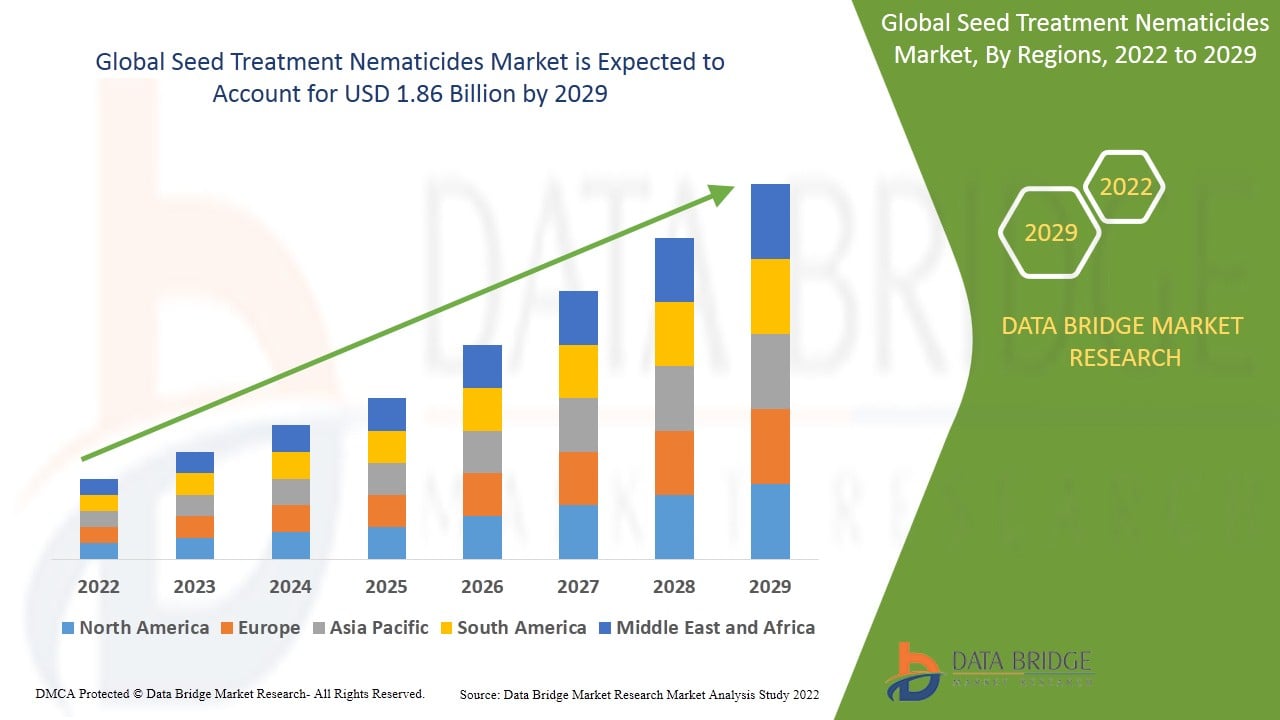
- Data Bridge Market Research analyses that the seed treatment nematicides market which was valued at a value of USD 1.23 billion in 2021 is expected to reach the value of USD 1.86 billion by 2029, at a CAGR of 4.0% during the forecast period of 2022 to 2029. The rising demand for high-value crops will drive the growth of the seed treatment nematicides market.
Global Seed Treatment Nematicides Market Definition
Seed treatment products are chemicals that are used to coat or treat seeds prior to sowing in order to increase germination percentage. Nematicide applied as a seed treatment is a striking approach to nematode management in cotton due to its suitability and relatively low risk.
Report Scope and Market Segmentation
|
Report Metric |
Details |
|
Forecast Period |
2022 to 2029 |
|
Base Year |
2021 |
|
Historic Years |
2020 (Customizable to 2019 - 2014) |
|
Quantitative Units |
Revenue in USD Billion, Volumes in Units, Pricing in USD |
|
Segments Covered |
By Type (Fumigants, Organophosphates, Carbamates, Bionematicides, Others), Crop Type (Field Crops, Fruits and Nuts, Vegetables, Others), Form (Granular, Liquid), Nematode Type (Root-knot Nematode, Cyst, Others), |
|
Countries Covered |
U.S., Canada and Mexico in North America, Germany, France, U.K., Netherlands, Switzerland, Belgium, Russia, Italy, Spain, Turkey, Rest of Europe in Europe, China, Japan, India, South Korea, Singapore, Malaysia, Australia, Thailand, Indonesia, Philippines, Rest of Asia-Pacific (APAC) in the Asia-Pacific (APAC), Saudi Arabia, U.A.E, South Africa, Egypt, Israel, Rest of Middle East and Africa (MEA) as a part of Middle East and Africa (MEA), Brazil, Argentina and Rest of South America as part of South America. |
|
Market Players Covered |
Bayer AG (Germany), Syngenta Crop Protection AG (Switzerland), Corteva (US), BASF SE (Germany), ADAMA (Israel), FMC Corporation (US), Nufarm (Australia), UPL Limited (India), Isagro Group (Italy), Valent USA (US), Chr. Hansen (Denmark), Certis USA LLC (US), Marrone Bio Innovations (US), AMVAC Chemical Corporation (US), Crop IQ Technology (UK), Real IPM Kenya (Kenya), Horizon Group (India), Agri Life (India), Crop IQ Technology Ltd (UK), T. Stanes & Company Limited (India) |
|
Opportunities |
|
Seed Treatment Nematicides Market Dynamics
Drivers
-
Rising Adoption of Integrated Pest Management
Growing nematode infestation on crops, rising adoption of integrated pest management across the globe, and increased awareness about the benefits of nematicides are some of the factors expected to drive the growth of the seed treatment nematicides market
-
Increased Organic Farming
Growing demand for crop yield and efficiency, as well as increased organic farming, will create several opportunities for the seed treatment nematicides market to grow during the aforementioned period.
Opportunity
The emergence of new food and beverage-related markets, an increase in demand for organic ingredients and extracts, and the growing popularity of organic product all contribute to the expansion of profitable opportunities.
Restraints/Challenges Global Seed Treatment Nematicides Market
The harmful effects of synthetic nematicides on soil, on the other hand, will act as a restraint and may impede the growth of the seed treatment nematicides market during the aforementioned period.
This seed treatment nematicides market report provides details of new recent developments, trade regulations, import-export analysis, production analysis, value chain optimization, market share, impact of domestic and localized market players, analyses opportunities in terms of emerging revenue pockets, changes in market regulations, strategic market growth analysis, market size, category market growths, application niches and dominance, product approvals, product launches, geographic expansions, technological innovations in the market. To gain more info on the seed treatment nematicides market contact Data Bridge Market Research for an Analyst Brief, our team will help you take an informed market decision to achieve market growth.
COVID-19 Impact on Seed Treatment Nematicides Market
The COVID-19 pandemic has had little impact on the seed treatment market, owing primarily to transportation constraints. The government has exempted all types of agricultural activities from the impact of lockdowns or disruptions, so there has been no such effect of the corona outbreak. Indeed, agrochemical companies have made double-digit profits compared to last year, owing to farmers' panic buying. Growing farmer awareness of the benefits of seed treatment has resulted in government support. Multiple seed banks are managed by developing-country governments at the national and village levels in order to store seeds that have been properly treated with seed treatment chemicals and preventing seed rotting.
Recent Development
- Syngenta announced the TYMIRIUM TM technology brand in May 2020, with a new active ingredient for seed treatment and soil applications with an improved sustainability profile. It's a cutting-edge nematicide and fungicide technology.
- The Environmental Protection Agency approved BASF's new Velondis brand biofungicide seed treatment formulations in January 2018. (EPA). It has potential applications in agriculture, horticulture, and forestry; the products are intended to improve seedling and plant protection against key soil-borne diseases.
Global Seed Treatment Nematicides Market Scope
The seed treatment nematicides market is segmented on the basis of type, crop type, form, and nematode type. The growth amongst these segments will help you analyze meagre growth segments in the industries and provide the users with a valuable market overview and market insights to help them make strategic decisions for identifying core market applications.
Type
- Fumigants
- Organophosphates
- Carbamates
- Bionematicides
- Others
On the basis of type, the seed treatment nematicides market is segmented into fumigants, organophosphates, carbamates, bionematicides, and others. Others have been further segmented into plantation, turf & grasses, and ornamental crops.
Crop Type
- Field crops
- Fruits and nuts
- Vegetables
- Others
On the basis of crop type, the seed treatment nematicides market is segmented into field crops, fruits and nuts, vegetables, and others. Others have been further segmented into lesion nematodes, stubby root nematodes, and stem nematodes.
Form
- Granular
- Liquid
On the basis of form, the seed treatment nematicides market is segmented into granular and liquid.
Nematode Type
- Root-knot nematode
- Cyst
- Other
On the basis of nematode type, the seed treatment nematicides market is segmented into root-knot nematode, cyst, and others.
Seed Treatment Nematicides Market Regional Analysis/Insights
The seed treatment nematicides market is analysed and market size insights and trends are provided by country, type, crop type, form, and nematode type as referenced above.
The countries covered in the seed treatment nematicides market report are U.S., Canada and Mexico in North America, Germany, France, U.K., Netherlands, Switzerland, Belgium, Russia, Italy, Spain, Turkey, Rest of Europe in Europe, China, Japan, India, South Korea, Singapore, Malaysia, Australia, Thailand, Indonesia, Philippines, Rest of Asia-Pacific (APAC) in the Asia-Pacific (APAC), Saudi Arabia, U.A.E, South Africa, Egypt, Israel, Rest of Middle East and Africa (MEA) as a part of Middle East and Africa (MEA), Brazil, Argentina and Rest of South America as part of South America.
North America dominates the seed treatment nematicides market due to decreasing access to arable land and increasing adoption of modern agricultural practises, while Asia-Pacific is expected to grow during the forecast period of 2022-2029 due to rising population and growing demand for food.
The country section of the report also provides individual market impacting factors and changes in market regulation that impact the current and future trends of the market. Data points like down-stream and upstream value chain analysis, technical trends and porter's five forces analysis, case studies are some of the pointers used to forecast the market scenario for individual countries. Also, the presence and availability of global brands and their challenges faced due to large or scarce competition from local and domestic brands, impact of domestic tariffs and trade routes are considered while providing forecast analysis of the country data.
Competitive Landscape and Seed Treatment Nematicides Market Share Analysis
The seed treatment nematicides market competitive landscape provides details by competitor. Details included are company overview, company financials, revenue generated, market potential, investment in research and development, new market initiatives, global presence, production sites and facilities, production capacities, company strengths and weaknesses, product launch, product width and breadth, application dominance. The above data points provided are only related to the companies' focus related to seed treatment nematicides market.
Some of the major players operating in the seed treatment nematicides market are:
- Bayer AG (Germany)
- Syngenta Crop Protection AG (Switzerland)
- Corteva (US)
- BASF SE (Germany)
- ADAMA (Israel)
- FMC Corporation (US)
- Nufarm (Australia)
- UPL Limited (India)
- Isagro S.p.A(Italy)
- Valent USA (US)
- Chr. Hansen (Denmark)
- Certis USA LLC (US)
- Marrone Bio Innovations (US)
- AMVAC Chemical Corporation (US)
- Crop IQ Technology (UK)
- Real IPM Kenya (Kenya)
- Horizon Group (India)
- Agri Life (India)
- Crop IQ Technology Ltd (UK)
- T. Stanes & Company Limited (India)
SKU-
세계 최초의 시장 정보 클라우드 보고서에 온라인으로 접속하세요

- 대화형 데이터 분석 대시보드
- 높은 성장 잠재력 기회를 위한 회사 분석 대시보드
- 사용자 정의 및 질의를 위한 리서치 분석가 액세스
- 대화형 대시보드를 통한 경쟁자 분석
- 최신 뉴스, 업데이트 및 추세 분석
- 포괄적인 경쟁자 추적을 위한 벤치마크 분석의 힘 활용
연구 방법론
데이터 수집 및 기준 연도 분석은 대규모 샘플 크기의 데이터 수집 모듈을 사용하여 수행됩니다. 이 단계에는 다양한 소스와 전략을 통해 시장 정보 또는 관련 데이터를 얻는 것이 포함됩니다. 여기에는 과거에 수집한 모든 데이터를 미리 검토하고 계획하는 것이 포함됩니다. 또한 다양한 정보 소스에서 발견되는 정보 불일치를 검토하는 것도 포함됩니다. 시장 데이터는 시장 통계 및 일관된 모델을 사용하여 분석하고 추정합니다. 또한 시장 점유율 분석 및 주요 추세 분석은 시장 보고서의 주요 성공 요인입니다. 자세한 내용은 분석가에게 전화를 요청하거나 문의 사항을 드롭하세요.
DBMR 연구팀에서 사용하는 주요 연구 방법론은 데이터 마이닝, 시장에 대한 데이터 변수의 영향 분석 및 주요(산업 전문가) 검증을 포함하는 데이터 삼각 측량입니다. 데이터 모델에는 공급업체 포지셔닝 그리드, 시장 타임라인 분석, 시장 개요 및 가이드, 회사 포지셔닝 그리드, 특허 분석, 가격 분석, 회사 시장 점유율 분석, 측정 기준, 글로벌 대 지역 및 공급업체 점유율 분석이 포함됩니다. 연구 방법론에 대해 자세히 알아보려면 문의를 통해 업계 전문가에게 문의하세요.
사용자 정의 가능
Data Bridge Market Research는 고급 형성 연구 분야의 선두 주자입니다. 저희는 기존 및 신규 고객에게 목표에 맞는 데이터와 분석을 제공하는 데 자부심을 느낍니다. 보고서는 추가 국가에 대한 시장 이해(국가 목록 요청), 임상 시험 결과 데이터, 문헌 검토, 재생 시장 및 제품 기반 분석을 포함하도록 사용자 정의할 수 있습니다. 기술 기반 분석에서 시장 포트폴리오 전략에 이르기까지 타겟 경쟁업체의 시장 분석을 분석할 수 있습니다. 귀하가 원하는 형식과 데이터 스타일로 필요한 만큼 많은 경쟁자를 추가할 수 있습니다. 저희 분석가 팀은 또한 원시 엑셀 파일 피벗 테이블(팩트북)로 데이터를 제공하거나 보고서에서 사용 가능한 데이터 세트에서 프레젠테이션을 만드는 데 도움을 줄 수 있습니다.











