


What is the Polycystic Ovarian Syndrome (PCOS) Market Size and Growth Rate?
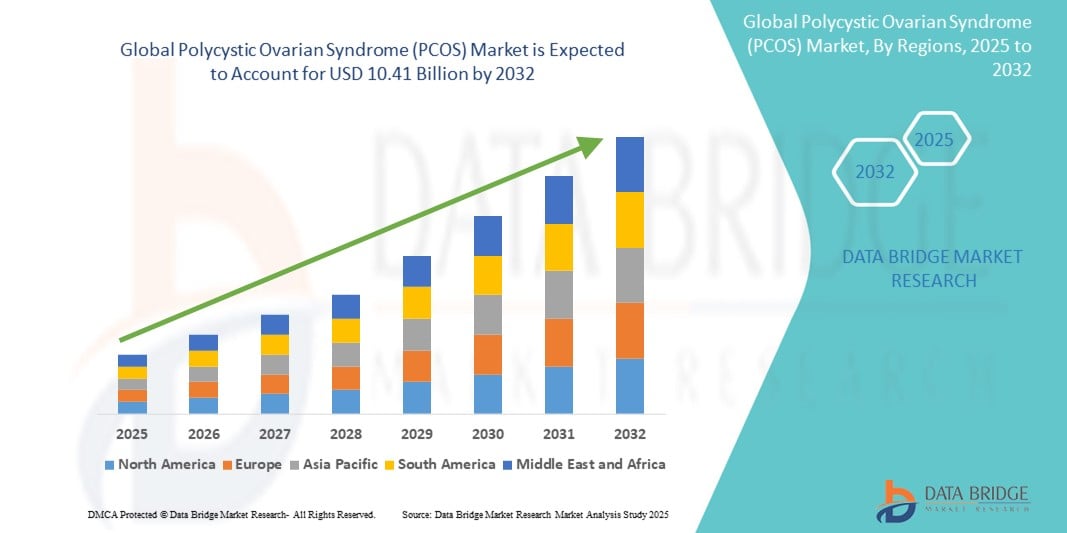
- As per Data Bridge Market Research Analysis the global polycystic ovarian syndrome (PCOS) market size was valued at USD 6.53 billion in 2024 and is expected to reach USD 10.41 billion by 2032, at a CAGR of 6.00% during the forecast period
- The market growth is largely fueled by the rising prevalence of PCOS among women of reproductive age globally, increasing awareness about the condition, and advancements in diagnostic technologies and treatment options
- Furthermore, rising healthcare expenditure, a growing focus on women's health, and the increasing incidence of lifestyle-related factors such as obesity and diabetes which are linked to PCOS, are propelling the demand for effective management and treatment solutions. These converging factors are accelerating the uptake of PCOS treatments, thereby significantly boosting the industry's growth
Market Size & Forecast
- Global Market Value (2024): USD 6.53 Billion
- Expected Market Value (2032): USD 10.41 Billion
- Forecast CAGR (2025–2032): 6.00%
Polycystic Ovarian Syndrome (PCOS) Market Analysis
- Polycystic ovarian syndrome (PCOS) treatments, encompassing various drug classes and surgical interventions, are increasingly vital for managing the complex symptoms and long-term health risks associated with this common hormonal disorder in women of reproductive age, due to their ability to address hormonal imbalances, metabolic dysfunction, and fertility issues
- The escalating demand for PCOS treatments is primarily fueled by the rising global prevalence of the condition, growing awareness among patients and healthcare providers, and advancements in diagnostic technologies and therapeutic approaches
- North America dominates the PCOS treatment market with a significant revenue share, estimated at approximately 45.1% in 2024, characterized by a high incidence rate of PCOS, advanced healthcare infrastructure, strong research and development activities by pharmaceutical companies, and high consumer awareness and healthcare expenditure. The U.S., in particular, accounts for a large portion of this share due to increased disposable income and focus on women's health
- Asia-Pacific is expected to be the fastest-growing region in the PCOS treatment market during the forecast period due to increasing urbanization, rising disposable incomes, and government initiatives to raise awareness about PCOS symptoms and diagnosis
- The Insulin-sensitizing agents segment is expected to dominate the PCOS treatment market. For instance, in 2024, insulin-sensitizing agents accounted for a share of 36.2% of the market, driven by the widespread recognition of insulin resistance as a key underlying factor in PCOS pathophysiology and their role in managing related metabolic issues like diabetes
Report Scope and Polycystic Ovarian Syndrome (PCOS) Market Segmentation
|
Attributes |
Polycystic Ovarian Syndrome (PCOS) Key Market Insights |
|
Segments Covered |
|
|
Countries Covered |
North America
Europe
Asia-Pacific
Middle East and Africa
South America
|
|
Key Market Players |
|
|
Market Opportunities |
|
|
Value Added Data Infosets |
In addition to the insights on market scenarios such as market value, growth rate, segmentation, geographical coverage, and major players, the market reports curated by the Data Bridge Market Research also include in-depth expert analysis, pricing analysis, brand share analysis, consumer survey, demography analysis, supply chain analysis, value chain analysis, raw material/consumables overview, vendor selection criteria, PESTLE Analysis, Porter Analysis, and regulatory framework. |
What is the Key Trend in the Polycystic Ovarian Syndrome (PCOS) Market?
“Growing Adoption of Digital Health Solutions and Personalized Management”
- A significant and accelerating trend in the global PCOS market is the deepening integration of digital health solutions, including mobile applications, wearable devices, and Artificial Intelligence (AI) for diagnosis and personalized management. This fusion of technologies is significantly enhancing patient engagement, monitoring, and the delivery of tailored care for PCOS
- For instance, digital health platforms like Veera Health offer comprehensive PCOS treatment programs via mobile apps, including personalized meal plans, expert consultations, and community support. Similarly, platforms leveraging AI can analyze patient data from wearables and lab results to predict personalized responses to dietary changes, as seen with some "Digital Twin" technologies aiming to improve metabolic health in PCOS
- AI integration in PCOS management enables features such as learning user patterns from health tracking data to suggest personalized lifestyle interventions and providing more intelligent alerts based on symptom changes or biomarker trends. For instance, AI and machine learning are being increasingly utilized for more accurate and early diagnosis of PCOS by analyzing hormone profiles, ultrasound images, and anthropometric data, potentially reducing diagnostic delays
- The seamless integration of digital tools with healthcare providers facilitates remote monitoring and centralized control over various aspects of PCOS management. Through a single interface, users can track their symptoms, diet, exercise, and medication adherence, creating a unified and more convenient patient experience
- This trend towards more intelligent, intuitive, and interconnected health management systems is fundamentally reshaping patient expectations for PCOS care. Consequently, companies are developing AI-enabled apps with features such as automatic food diary recognition, personalized coaching, and community support to empower women with PCOS
- The demand for PCOS solutions that offer seamless digital integration and personalized care is growing rapidly, as patients increasingly prioritize convenience, self-management, and comprehensive support for their chronic condition
Polycystic Ovarian Syndrome (PCOS) Market Dynamics
Driver
“Rising Prevalence and Increasing Awareness”
- The increasing prevalence of polycystic ovarian syndrome (PCOS) among women of reproductive age globally, coupled with a growing awareness about the condition and its long-term health implications, is a significant driver for the heightened demand for diagnostic and therapeutic solutions in the PCOS market
- For instance, in recent years, numerous public health campaigns and patient advocacy groups have focused on educating women about PCOS symptoms, early diagnosis, and management strategies. Such initiatives by healthcare organizations and patient communities are expected to drive the PCOS market growth in the forecast period
- As individuals become more aware of PCOS symptoms, such as irregular periods, hirsutism, acne, and difficulty conceiving, and seek timely medical intervention, the demand for diagnostic tests, hormonal therapies, insulin-sensitizing agents, and fertility treatments specifically for PCOS is increasing
- Furthermore, the growing understanding of the link between PCOS and other serious health conditions like type 2 diabetes, cardiovascular disease, and endometrial cancer is making comprehensive PCOS management an integral component of women's overall health, encouraging proactive treatment and long-term care
- The advancements in diagnostic tools, the development of more targeted therapeutic options, and the increasing focus on personalized medicine are key factors propelling the adoption of various PCOS treatments. The trend towards lifestyle modifications as a primary management strategy, alongside pharmaceutical interventions, further contributes to market growth
Restraint/Challenge
“Diagnostic Challenges and Side Effects of Current Therapies”
- Concerns surrounding the complexities and delays in diagnosing polycystic ovarian syndrome (PCOS), coupled with the potential side effects and limitations of current treatment modalities, pose a significant challenge to broader market penetration and optimal patient management. As PCOS diagnosis relies on a combination of clinical, biochemical, and imaging criteria, it can often be inconsistent or delayed, leading to untreated or mismanaged cases
- For instance, the varied presentation of PCOS symptoms and the lack of a single definitive diagnostic test can lead to significant delays in diagnosis, with many women seeking care for years before receiving an accurate diagnosis
- Addressing these diagnostic challenges through standardized diagnostic criteria, increased clinician education, and improved access to specialized diagnostic tools (such as advanced hormonal assays and ultrasound) is crucial for accurate and timely intervention.
- Furthermore, current pharmacological treatments for PCOS, such as hormonal birth control and insulin-sensitizing agents, can have various side effects, including weight gain, mood changes, gastrointestinal issues, or may not be suitable for all patients, such as those trying to conceive. This can lead to patient non-adherence or a search for alternative, unproven therapies
- While newer therapeutic approaches and lifestyle interventions are emerging, the perceived limitations and potential adverse effects of existing treatments can still hinder widespread and consistent patient adherence, especially for those seeking long-term management
- Overcoming these challenges through enhanced diagnostic clarity, the development of more targeted and side-effect-friendly therapies, and comprehensive patient education on the benefits and risks of treatment options will be vital for sustained market growth and improved patient outcomes
Polycystic Ovarian Syndrome (PCOS) Market Scope
The market is segmented on the basis of drugs, surgery, and end user.
- By Drugs
On the basis of drugs, the PCOS market is segmented into oral contraceptives, antiandrogens, insulin-sensitizing agents, antidepressants, and anti-obesity. The insulin-sensitizing agents segment is expected to dominate the largest market revenue share, accounting for approximately 36.2%, driven by the widespread recognition of insulin resistance as a core pathological feature of PCOS and the efficacy of these agents, particularly metformin, in managing metabolic aspects of the syndrome. Insulin-sensitizing agents are frequently prescribed as a first-line treatment for anovulatory infertility in women with PCOS.
The oral contraceptives segment is anticipated to witness a significant growth rate, fueled by their common use in regulating menstrual cycles, reducing androgen excess symptoms like hirsutism and acne, and providing contraception for women with PCOS. They are often a preferred first-line therapy due to their availability and multi-symptom management.
- By Surgery
On the basis of surgery, the PCOS market is segmented into wedge resection and laparoscopic drilling. The laparoscopic drilling segment accounted for the largest market revenue share, approximately 68.7%, driven by its effectiveness in inducing ovulation in women with anovulatory PCOS who do not respond to medical therapies. This minimally invasive procedure offers a favorable success rate for fertility issues and is often preferred due to its cost-effectiveness and generally lower risks compared to open surgery.
- By End User
On the basis of end user, the PCOS market is segmented into hospitals, ambulatory surgical centers, and others. The hospital segment accounted for the largest market revenue share, estimated at approximately 65.0%, driven by the comprehensive diagnostic and treatment facilities available in hospitals, including specialized endocrinology and gynecology departments. Hospitals are often the primary point of care for complex PCOS cases, fertility treatments, and surgical interventions.
The ambulatory surgical centers segment is expected to witness the fastest growth rate, fueled by the increasing preference for outpatient procedures, particularly for laparoscopic ovarian drilling, due to their cost-effectiveness and convenience for patients. As surgical techniques become less invasive, a greater number of procedures are being performed in these centers.
Polycystic Ovarian Syndrome (PCOS) Market Regional Analysis
- North America dominates the polycystic ovarian syndrome (PCOS) treatment market with the largest revenue share, accounting for approximately 45.1%, driven by a high prevalence of PCOS, advanced healthcare infrastructure, and significant patient awareness.
- Consumers and healthcare providers in the region highly prioritize early diagnosis and comprehensive management of PCOS, valuing innovative treatment options and access to specialized care.
- This widespread adoption is further supported by high disposable incomes, substantial investment in research and development by pharmaceutical companies, and the growing focus on women's health initiatives, establishing North America as a leading market for both established and emerging PCOS therapies.
U.S. Polycystic Ovarian Syndrome (PCOS) Market Insight
The U.S. polycystic ovarian syndrome (PCOS) market is a dominant force within North America, expected to capture a significant revenue share in 2024, driven by the high prevalence of PCOS and a robust healthcare system. Consumers and healthcare providers in the U.S. are increasingly prioritizing early diagnosis, comprehensive management, and access to a wide range of treatment options for PCOS. The growing awareness campaigns, coupled with substantial research and development in pharmaceuticals and medical devices, further propels the PCOS treatment industry. Moreover, the increasing adoption of personalized medicine approaches and digital health solutions for managing PCOS symptoms is significantly contributing to the market's expansion.
Europe Polycystic Ovarian Syndrome (PCOS) Market Insight
The European polycystic ovarian syndrome (PCOS) market is projected to expand at a substantial CAGR throughout the forecast period, primarily driven by increasing awareness of the condition, advancements in diagnostic capabilities, and a well-developed healthcare infrastructure. The increase in the prevalence of PCOS, coupled with a focus on women's health, is fostering the adoption of various treatment modalities. European consumers and healthcare systems are also drawn to integrated care pathways and innovative therapies for managing the diverse symptoms of PCOS. The region is experiencing significant growth across different healthcare settings, with a focus on both pharmacological and lifestyle-based interventions for PCOS.
U.K. Polycystic Ovarian Syndrome (PCOS) Market Insight
The U.K. polycystic ovarian syndrome (PCOS) market is anticipated to grow at a noteworthy CAGR during the forecast period, driven by increasing awareness of the condition among both patients and healthcare professionals, alongside an emphasis on improving women's health outcomes. Additionally, the well-established National Health Service (NHS) and a robust pharmaceutical sector are facilitating access to diagnosis and treatment. The U.K.'s embrace of advancements in medical diagnostics and therapeutic options, alongside a growing focus on personalized care, is expected to continue to stimulate market growth.
Germany Polycystic Ovarian Syndrome (PCOS) Market Insight
The Germany polycystic ovarian syndrome (PCOS) market is expected to expand at a considerable CAGR during the forecast period, fueled by increasing awareness of the condition and a strong emphasis on precise diagnostics and evidence-based treatments. Germany's well-developed healthcare infrastructure, combined with its focus on medical innovation and patient-centric care, promotes the adoption of comprehensive PCOS management, particularly in specialized clinics and university hospitals. The integration of advanced diagnostic tools and a preference for highly effective, well-researched therapeutic solutions are also becoming increasingly prevalent, aligning with local consumer and healthcare professional expectations.
Asia-Pacific Polycystic Ovarian Syndrome (PCOS) Market Insight
The Asia-Pacific polycystic ovarian syndrome (PCOS) market is poised to grow at the fastest CAGR, driven by increasing urbanization, rising disposable incomes, and a growing awareness about women's health conditions in countries such as China, Japan, and India. The region's growing emphasis on improving healthcare access and diagnostic capabilities, supported by government initiatives promoting public health, is driving the adoption of PCOS treatments. Furthermore, as APAC emerges as a significant hub for pharmaceutical manufacturing and healthcare innovation, the affordability and accessibility of PCOS management solutions are expanding to a wider patient base.
Japan Polycystic Ovarian Syndrome (PCOS) Market Insight
The Japan polycystic ovarian syndrome (PCOS) market is gaining momentum due to the country's advanced healthcare system, increasing awareness of women's health issues, and a demand for precise diagnostic and therapeutic approaches. The Japanese market places a significant emphasis on technological advancements in medicine, and the adoption of PCOS treatments is driven by an increasing focus on specialized care and personalized medicine. The integration of advanced diagnostics and innovative therapeutic options is fueling growth. Moreover, Japan's emphasis on preventive healthcare and a growing understanding of the long-term health implications of PCOS are likely to spur demand for effective management solutions in both residential and commercial sectors.
China Polycystic Ovarian Syndrome (PCOS) Market Insight
The China polycystic ovarian syndrome (PCOS) market accounts for a significant market revenue share in Asia-Pacific, attributed to the country's vast population, expanding middle class, and increasing healthcare expenditure. China stands as one of the largest markets for women's health products, and PCOS diagnosis and treatment are becoming increasingly prioritized in hospitals, clinics, and through digital health platforms. The push towards improving public health services and the availability of diverse treatment options, alongside strong domestic pharmaceutical and medical device manufacturers, are key factors propelling the market in China.
Polycystic Ovarian Syndrome (PCOS) Market Share
The polycystic ovarian syndrome (PCOS) industry is primarily led by well-established companies, including:
- Bayer AG (Germany)
- Allergan (Ireland)
- Merck & Co (U.S.)
- Pfizer Inc (U.S.)
- Amgen (U.S.)
- Agile Therapeutics (U.S.)
- Ferring B.V. (U.S.)
- Addex Therapeutics (Switzerland)
- Mylan N.V. (U.S.)
- Lupin (India)
- Blairex Laboratories Inc (U.S.)
- Apothecus Pharmaceutical Corp (U.S.)
- Eli Lilly And Company (U.S.)
- Novartis AG (Switzerland)
- BIOCAD Global (Russia)
- Teva Pharmaceutical Industries Ltd (Israel)
- Johnson & Johnson Services, Inc (U.S.)
Latest Developments in Global Polycystic Ovarian Syndrome (PCOS) Market
- In December 2024, researchers introduced an AI-powered diagnostic tool leveraging the InceptionV3 architecture to classify Polycystic Ovary Syndrome (PCOS) from ultrasound images. This innovative model achieved an impressive 90.52% accuracy, demonstrating the potential of artificial intelligence in advancing medical diagnostics. The study focused on refining AI-driven classification techniques, ensuring precise detection of PCOS while enhancing interpretability through methods like LIME and saliency maps. This breakthrough underscores AI’s transformative role in healthcare, offering reliable and scalable solutions for complex medical conditions
- In December 2024, Gytree launched India’s first PCOS-specific protein supplement, designed to support hormonal balance and overall well-being in women managing Polycystic Ovary Syndrome (PCOS). This innovative formula is enriched with inositol, a key ingredient known for its effectiveness in PCOS management, along with over 16 superfoods that promote metabolic health and energy levels. The supplement reflects a growing shift toward nutraceutical solutions, offering a natural approach to addressing PCOS symptoms. Gytree’s commitment to women’s health continues to drive advancements in wellness products
- In June 2024, Spruce Biosciences announced promising Phase II clinical trial results for Tildacerfont, a CRF1 receptor antagonist, in the treatment of Polycystic Ovary Syndrome (PCOS). The drug targets the hypothalamic-pituitary-adrenal (HPA) axis, offering a novel mechanism of action for PCOS therapy. The POWER study, presented at ENDO 2024, demonstrated significant reductions in dehydroepiandrosterone sulfate (DHEAS) levels and an increase in serum sex hormone-binding globulin (SHBG), suggesting potential benefits in managing hyperandrogenism. Tildacerfont was well-tolerated, with no major safety concerns reported
- In May 2024, May Health, a clinical-stage medical device company, secured $25 million in Series B funding to advance its Ovarian Rebalancing™ therapy for Polycystic Ovary Syndrome (PCOS). The financing round, co-led by Bpifrance and Trill Impact, reflects strong investor confidence in innovative solutions for PCOS management. The company aims to refine its radiofrequency-based ovarian ablation technique, designed to restore natural ovulation in women with PCOS-related infertility. The funding will support ongoing clinical trials, including the REBALANCE Study, which evaluates the therapy’s effectiveness

- Interactive Data Analysis Dashboard
- Company Analysis Dashboard for high growth potential opportunities
- Research Analyst Access for customization & queries
- Competitor Analysis with Interactive dashboard
- Latest News, Updates & Trend analysis
- Harness the Power of Benchmark Analysis for Comprehensive Competitor Tracking
Data collection and base year analysis are done using data collection modules with large sample sizes. The stage includes obtaining market information or related data through various sources and strategies. It includes examining and planning all the data acquired from the past in advance. It likewise envelops the examination of information inconsistencies seen across different information sources. The market data is analysed and estimated using market statistical and coherent models. Also, market share analysis and key trend analysis are the major success factors in the market report. To know more, please request an analyst call or drop down your inquiry.
The key research methodology used by DBMR research team is data triangulation which involves data mining, analysis of the impact of data variables on the market and primary (industry expert) validation. Data models include Vendor Positioning Grid, Market Time Line Analysis, Market Overview and Guide, Company Positioning Grid, Patent Analysis, Pricing Analysis, Company Market Share Analysis, Standards of Measurement, Global versus Regional and Vendor Share Analysis. To know more about the research methodology, drop in an inquiry to speak to our industry experts.
Data Bridge Market Research is a leader in advanced formative research. We take pride in servicing our existing and new customers with data and analysis that match and suits their goal. The report can be customized to include price trend analysis of target brands understanding the market for additional countries (ask for the list of countries), clinical trial results data, literature review, refurbished market and product base analysis. Market analysis of target competitors can be analyzed from technology-based analysis to market portfolio strategies. We can add as many competitors that you require data about in the format and data style you are looking for. Our team of analysts can also provide you data in crude raw excel files pivot tables (Fact book) or can assist you in creating presentations from the data sets available in the report.













