What is the Bionematicides Market Size and Overview?
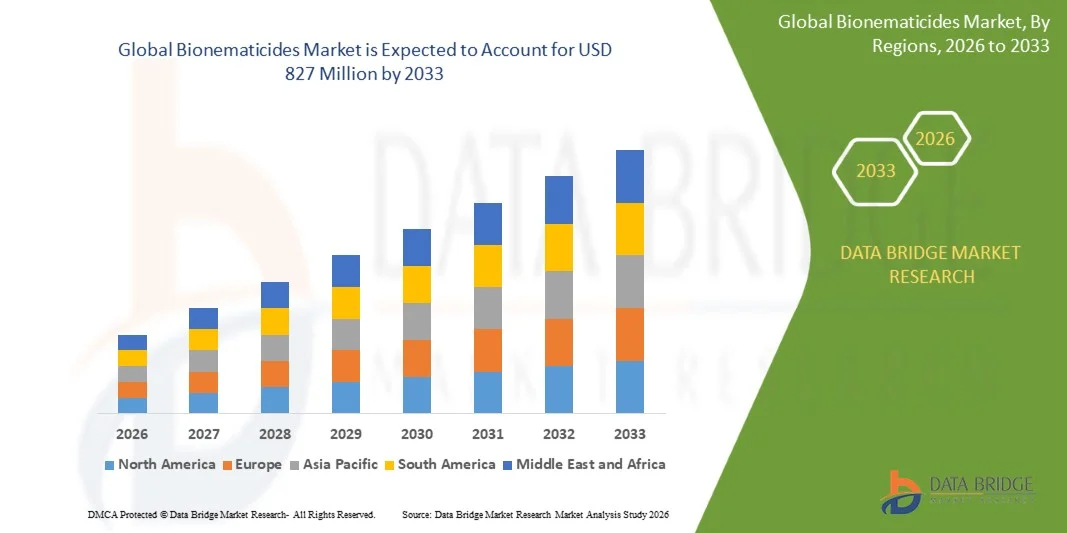
As per Data Bridge Market Research Analysis the Bionematicides Market was valued at USD 437 Million in 2025 and is projected to reach USD 827 Million by 2033, growing at a CAGR of 8.30% from 2026 to 2033. The market is experiencing consistent growth driven by increasing demand for sustainable crop protection solutions, rising adoption of biological pest management practices, and growing concerns regarding the environmental impact of chemical nematicides. The expansion of organic farming, advancements in microbial-based biocontrol technologies, and increasing focus on improving soil health are supporting the growth of the Bionematicides Market.
Market Size & Forecast
- Global Market Value (2025): USD 437 Million
- Expected Market Value (2033): USD 827 Million
- Forecast CAGR (2026–2033): 8.30%
The increasing prevalence of plant-parasitic nematode infestations, combined with stricter regulations on chemical pesticide usage, is encouraging farmers, agricultural companies, and research organizations to adopt biological nematicide solutions. Products based on beneficial microorganisms such as bacteria and fungi are gaining traction due to their ability to suppress nematode populations, enhance plant growth, and improve crop productivity while supporting sustainable agriculture. In addition, rising investments in agricultural biotechnology, growing demand for residue-free food production, and expanding applications across high-value crops are further accelerating the adoption of bionematicides across global markets.
What are the Major Takeaways of Bionematicides Market?
- North America dominated the Bionematicides Market with the largest revenue share of 34.7% in 2025, supported by advanced agricultural practices, strong adoption of biological crop protection solutions, presence of leading biotechnology companies, and increasing demand for sustainable alternatives to chemical nematicides. The region benefits from growing investments in precision agriculture, regulatory support for biological inputs, and rising adoption of microbial and biochemical bionematicides to improve crop health and reduce soil degradation.
- The Microbials segment dominated the market with a 64.25% share in 2025, owing to increasing adoption of beneficial microorganisms such as bacteria and fungi for sustainable nematode management.
- Asia-Pacific is expected to be the fastest-growing region at a CAGR of 8.3% from 2026 to 2033, fueled by rising adoption of sustainable farming practices, increasing awareness of biological pest management solutions, expanding agricultural production, and growing government initiatives promoting reduced chemical usage across China, India, and Southeast Asian countries.
- The soil treatment segment dominated the market by Mode of Application with a 44.8% revenue share in 2025, driven by its effectiveness in targeting nematodes directly in the soil environment, improving root protection, and supporting healthier crop establishment. Increasing adoption among commercial farmers is further strengthening segment growth.
Report Scope and Bionematicides Market Segmentation
|
Attributes |
Bionematicides Key Market Insights |
|
Segments Covered |
|
|
Countries Covered |
North America
Europe
Asia-Pacific
Middle East and Africa
South America
|
|
Key Market Players |
|
|
Market Opportunities |
|
|
Value Added Data Infosets |
In addition to the insights on market scenarios such as market value, growth rate, segmentation, geographical coverage, and major players, the market reports curated by the Data Bridge Market Research also include in-depth expert analysis, geographically represented company-wise production and capacity, network layouts of distributors and partners, detailed and updated price trend analysis and deficit analysis of supply chain and demand. |
What is the Key Trend in the Bionematicides Market?
Trend: Rising Adoption of Biological Solutions for Sustainable Nematode Management
The Bionematicides Market is witnessing a significant shift toward biological and environmentally friendly nematode control solutions as farmers increasingly seek alternatives to synthetic chemical nematicides. Microbial and biochemical bionematicides are gaining traction due to their ability to suppress harmful nematode populations, improve soil health, enhance root development, and support sustainable crop production. The growing focus on regenerative agriculture, reduced chemical residues, and integrated pest management (IPM) practices is encouraging agricultural biotechnology companies to develop advanced biological formulations. Recent innovations in microbial strains, natural compounds, and improved delivery systems are expanding the application of bionematicides across high-value crops such as fruits, vegetables, cereals, and oilseeds.
Bionematicides Market Dynamics
Key Market Driver: Increasing Demand for Sustainable Crop Protection and Improved Agricultural Productivity
The rising global demand for food production, combined with the need to maintain crop yields sustainably, is driving adoption of bionematicides. Farmers are increasingly adopting microbial-based solutions containing beneficial bacteria and fungi to manage nematode infestations while improving soil microbial activity and plant resilience. Government initiatives promoting reduced pesticide usage and sustainable farming practices are further supporting market growth. For example, agricultural regions across North America and Europe are witnessing increased adoption of biological crop protection products due to regulatory support and growing consumer demand for residue-free agricultural products, while emerging markets in Asia-Pacific are expanding usage to improve productivity and reduce dependence on chemical inputs.
Key Restraint/Challenge: Limited Awareness and Variable Field Performance of Bionematicide Products
A major challenge for the Bionematicides Market is the variability in product performance under different soil, climate, and farming conditions. Biological nematode control solutions depend on factors such as microbial survival, soil composition, application timing, and crop type, which can influence effectiveness. In addition, limited awareness among farmers, higher costs compared with conventional chemical nematicides, and challenges related to product storage and shelf stability can restrict adoption in some regions. Manufacturers are focusing on extensive field trials, farmer education programs, and improved formulations to enhance reliability and market acceptance.
Key Market Opportunity: Integration of Biotechnology and Precision Agriculture for Advanced Nematode Control
The integration of biotechnology, microbial research, and precision agriculture presents significant growth opportunities for the Bionematicides Market. Advances in microbial discovery, biological formulations, and targeted application technologies are enabling the development of more effective and crop-specific nematode management solutions. Companies are increasingly investing in microbial and biochemical products that provide both pest control and soil health benefits, supporting improved crop productivity and sustainable farming outcomes. For instance, leading agricultural biotechnology companies are expanding portfolios of biological crop protection products, including microbial-based nematicides, to address increasing demand for sustainable agriculture. The continued growth of sustainable farming initiatives across North America, Europe, and Asia-Pacific is expected to accelerate commercialization and adoption of advanced bionematicide solutions through 2033.
How is the Bionematicides Market Segmented?
The bionematicides market is segmented on the basis of type, crop type, form, mode of application, and infestation.
- By Type
On the basis of type, the Bionematicides Market is segmented into microbials and biochemicals. The Microbials segment dominated the market with a 64.25% share in 2025, owing to increasing adoption of beneficial microorganisms such as bacteria and fungi for sustainable nematode management. Microbial bionematicides are widely preferred due to their ability to suppress plant-parasitic nematodes, improve soil biological activity, and enhance overall crop health. The rising demand for chemical-free agricultural inputs, increasing regulatory restrictions on synthetic nematicides, and growing awareness regarding soil health are driving the adoption of microbial solutions. In addition, advancements in microbial formulation technologies, improved shelf stability, and increasing investments by agricultural biotechnology companies are further strengthening the dominance of this segment across global markets.
The biochemicals segment is expected to witness the fastest growth at a CAGR of 8.5% from 2026 to 2033, driven by increasing demand for naturally derived nematode control solutions with improved efficacy and environmental compatibility. Biochemical products based on plant extracts, natural compounds, and bioactive molecules are gaining traction due to their ability to provide targeted pest management while supporting sustainable farming practices. The expansion of organic agriculture, rising consumer preference for residue-free food products, and continuous research into novel biochemical formulations are accelerating segment growth. Furthermore, increasing adoption of integrated pest management programs is creating new opportunities for biochemical-based bionematicide solutions.
- By Crop Type
On the basis of crop type, the Bionematicides Market is segmented into cereals & grains, oilseeds & pulses, and fruits & vegetables. The fruits & vegetables segment dominated the market with a 42.18% share in 2025, supported by high susceptibility of horticultural crops to nematode infestations and increasing demand for premium-quality agricultural produce. Farmers growing fruits and vegetables are increasingly adopting bionematicides to improve crop yield, maintain soil health, and reduce dependency on chemical pest control products. The growing expansion of protected cultivation, greenhouse farming, and organic vegetable production is further supporting segment growth. In addition, increasing consumer demand for chemical-free food products and stricter regulations on pesticide residues are encouraging wider adoption of biological nematode management solutions in horticultural crops.
The oilseeds & pulses segment is projected to register the fastest growth at a CAGR of 8.7% from 2026 to 2033, driven by increasing cultivation of soybean, pulses, and other oilseed crops affected by nematode-related yield losses. Rising global demand for plant-based proteins, edible oils, and sustainable crop production is encouraging farmers to adopt biological nematode control solutions. Bionematicides help improve root development, nutrient absorption, and crop resilience, making them valuable for oilseed and pulse production. Furthermore, growing adoption of regenerative agriculture practices and government initiatives supporting sustainable farming are expected to accelerate segment expansion.
- By Form
On the basis of form, the Bionematicides Market is segmented into dry and liquid. The liquid segment dominated the market with a 58.36% share in 2025, due to its advantages including easy application, better microbial dispersion, and compatibility with modern agricultural spraying systems. Liquid formulations are widely adopted in seed treatment, soil application, and irrigation-based delivery methods due to their improved handling and faster application efficiency. The increasing use of precision farming technologies and demand for convenient biological crop protection solutions are supporting the growth of liquid bionematicides. In addition, manufacturers are focusing on developing stable liquid formulations with longer shelf life and enhanced field performance, reinforcing the dominance of this segment.
The dry segment is expected to witness the fastest growth at a CAGR of 8.3% from 2026 to 2033, driven by increasing demand for products with improved storage stability, transportation efficiency, and longer shelf life. Dry formulations such as powders and granules are gaining adoption among farmers due to easier handling and suitability for large-scale agricultural applications. Advancements in microbial preservation technologies and formulation techniques are improving the effectiveness of dry bionematicides. Moreover, increasing adoption in emerging agricultural markets where storage and distribution efficiency are critical is further accelerating segment growth.
- By Mode of Application
On the basis of mode of application, the Bionematicides Market is segmented into seed treatment, soil treatment, foliar spray, and others. The soil treatment segment dominated the market with a 45.72% share in 2025, owing to its effectiveness in directly targeting nematode populations present in the soil environment. Soil application enables better interaction between biological agents and nematode populations, improving crop protection and supporting healthier root development. Increasing adoption of integrated pest management practices, rising awareness regarding soil health, and widespread use in high-value crops are driving the dominance of this segment. In addition, agricultural producers are increasingly adopting soil-applied biological solutions to reduce chemical dependency and improve long-term crop sustainability.
The seed treatment segment is expected to witness the fastest growth at a CAGR of 9.1% from 2026 to 2033, driven by increasing demand for preventive crop protection solutions and improved seed performance. Seed treatment allows early-stage protection against nematode damage while requiring lower application volumes and reducing input costs. The rising adoption of precision agriculture, increasing demand for enhanced germination, and growing preference for sustainable farming practices are accelerating segment expansion. Furthermore, advancements in microbial seed coating technologies and increasing integration with biological seed treatment solutions are creating significant growth opportunities.
- By Infestation
On the basis of infestation, the Bionematicides Market is segmented into root-knot nematodes, cyst nematodes, lesion nematodes, and others. The root-knot nematodes segment dominated the market with a 49.65% share in 2025, due to its widespread impact on agricultural productivity across various crops including vegetables, cereals, and oilseeds. Root-knot nematodes cause significant yield losses by affecting plant root systems, increasing the need for effective biological management solutions. The growing adoption of sustainable pest control methods and increasing restrictions on chemical nematicides are driving demand for bionematicide solutions targeting root-knot nematodes. In addition, extensive research on microbial strains and biological compounds specifically designed for root-knot nematode suppression is strengthening segment growth.
The lesion nematodes segment is expected to witness the fastest growth at a CAGR of 8.9% from 2026 to 2033, driven by increasing awareness regarding soil-borne nematode damage and the need for sustainable crop protection solutions. Lesion nematodes affect a wide range of crops by damaging root tissues and reducing nutrient uptake efficiency. Rising adoption of biological soil management practices, expansion of sustainable agriculture, and increasing research into targeted microbial solutions are supporting segment growth. Furthermore, growing demand for environmentally friendly nematode control methods is expected to accelerate adoption of bionematicides against lesion nematode infestations.
Which Region Holds the Largest Share of the Bionematicides Market?
North America dominated the Bionematicides Market and accounted for the largest revenue share of 34.7% in 2025, supported by advanced agricultural practices, strong adoption of biological crop protection solutions, presence of leading biotechnology companies, and increasing demand for sustainable alternatives to chemical nematicides. The region benefits from growing investments in precision agriculture, regulatory support for biological inputs, and rising adoption of microbial and biochemical bionematicides to improve crop health and reduce soil degradation. Increasing focus on sustainable farming, integrated pest management practices, and residue-free agricultural production is further driving market growth across the U.S. and Canada.
U.S. Bionematicides Market Insight
The U.S. bionematicides market is witnessing strong growth due to increasing adoption of sustainable crop protection technologies, rising demand for biological alternatives to chemical nematicides, and growing investments in agricultural biotechnology. The country’s advanced farming infrastructure, strong presence of biological input manufacturers, and widespread adoption of precision agriculture are supporting market expansion. Farmers are increasingly utilizing microbial and biochemical bionematicides to manage root-knot and other nematode infestations, improve soil health, and enhance crop productivity across crops such as fruits, vegetables, cereals, and oilseeds.
Europe Bionematicides Market Insight
The Europe bionematicides market remains a major contributor to global revenue, driven by strong regulatory support for sustainable agriculture, increasing focus on reducing chemical pesticide usage, and rising demand for environmentally friendly crop protection solutions. The region’s emphasis on integrated pest management, organic farming, and sustainable agricultural practices is encouraging adoption of microbial and biochemical bionematicides. Increasing investments in agricultural research and biological crop protection technologies are further supporting market growth across European countries.
U.K. Bionematicides Market Insight
The U.K. bionematicides market is experiencing steady growth, supported by increasing awareness of sustainable farming practices, growing demand for biological pest management solutions, and rising focus on improving soil health. Farmers are increasingly adopting bionematicides to reduce dependency on conventional chemical nematicides and improve crop resilience. Government initiatives promoting sustainable agriculture and environmentally responsible farming practices are further contributing to market expansion.
Germany Bionematicides Market Insight
The Germany bionematicides market is expanding steadily due to the country’s strong agricultural research capabilities, advanced farming systems, and increasing adoption of biological crop protection products. The growing focus on reducing chemical inputs, maintaining soil biodiversity, and improving sustainable crop production is driving demand for microbial and biochemical bionematicides. Germany’s emphasis on agricultural innovation and environmental sustainability continues to support the adoption of advanced biological nematode management solutions.
Asia-Pacific Bionematicides Market Insight
The Asia-Pacific bionematicides market is expected to witness rapid growth at a CAGR of 8.3% from 2026 to 2033, fueled by rising adoption of sustainable farming practices, increasing awareness of biological pest management solutions, expanding agricultural production, and growing government initiatives promoting reduced chemical usage across China, India, and Southeast Asian countries. The region’s rising food demand, increasing agricultural productivity requirements, and growing investments in biotechnology-based farming solutions are creating significant opportunities for market expansion.
Japan Bionematicides Market Insight
The Japan bionematicides market is witnessing consistent growth due to increasing focus on sustainable agriculture, advanced farming technologies, and demand for environmentally friendly crop protection solutions. The country’s emphasis on high-quality agricultural production, reduced chemical dependency, and efficient resource utilization is supporting adoption of biological nematode management products. Growing investments in agricultural biotechnology and precision farming practices are further strengthening market development in Japan.
China Bionematicides Market Insight
The China bionematicides market is growing rapidly, driven by increasing agricultural modernization, rising demand for sustainable crop protection solutions, and government initiatives supporting reduced chemical usage. Growing awareness of biological pest management, expanding adoption of precision agriculture, and increasing investments in agricultural biotechnology are boosting market demand. The country’s focus on improving crop productivity, enhancing soil health, and reducing environmental impact is positioning China as one of the fastest-growing markets for bionematicides globally.
Which are the Top Companies in Bionematicides Market?
The bionematicides industry is primarily led by well-established companies, including:
- BASF SE (Germany)
- Bayer AG (Germany)
- Syngenta Group (Switzerland)
- Corteva Agriscience Inc. (U.S.)
- UPL Limited (India)
- FMC Corporation (U.S.)
- Novozymes A/S (Denmark)
- Marrone Bio Innovations, Inc. (U.S.)
- Valent BioSciences Corporation (U.S.)
- Koppert Biological Systems (Netherlands)
- Certis Biologicals (U.S.)
- Bioceres Crop Solutions Corp. (Argentina)
- Agrauxine by Lesaffre (France)
- Chr. Hansen Holding A/S (Denmark)
- Lallemand Inc. (Canada)
- Verdesian Life Sciences (U.S.)
- Andermatt Biocontrol AG (Switzerland)
- Isagro S.p.A. (Italy)
- Seipasa S.A. (Spain)
- BioWorks Inc. (U.S.)
- Plant Health Care PLC (United Kingdom)
- BiOWiSH Technologies Inc. (U.S.)
- T. Stanes & Company Limited (India)
- Symborg Inc. (Spain)
- Valent BioSciences India Pvt. Ltd. (India)
- Novozyme Biologicals (Denmark)
- AgBiome Inc. (U.S.)
- Groundwork BioAg Ltd. (Israel)
- Pivot Bio Inc. (U.S.)
- Rizobacter Argentina S.A. (Argentina)
- Lavie Bio Ltd. (Israel)
- Pro Farm Group Inc. (U.S.)
- Ecological Laboratories Inc. (U.S.)
- Bio Huma Netics Inc. (U.S.)
What are Latest Developments in Bionematicides Market?
- In June 2024, Syngenta announced the development of TYMIRIUM technology, a new active ingredient platform designed for nematode and disease protection applications. The technology was introduced as part of Syngenta’s innovation pipeline to provide advanced crop protection solutions, with registration activities progressing across multiple markets. The development highlights increasing industry investment in next-generation nematode management technologies to improve crop health and productivity
- In July 2024, Syngenta Biologicals and Intrinsyx Bio announced a collaboration to introduce advanced biological solutions based on naturally occurring endophytes for agricultural markets. The partnership focuses on improving nutrient-use efficiency by using beneficial microorganisms that colonize plants and enhance nutrient availability. This development supports the broader expansion of biological agricultural inputs, including microbial-based solutions that complement sustainable crop protection and soil health management practices
- In September 2024, Syngenta Biologicals and Provivi announced a partnership to develop and commercialize biological crop protection solutions targeting major agricultural pest challenges in Asia. The collaboration focused on expanding sustainable biological solutions for farmers in countries including India, Indonesia, and Thailand, supporting the industry trend toward safer and more environmentally responsible pest management approaches
- In October 2023, BASF Agricultural Solutions announced the launch of Poncho® Votivo® Precise seed treatment, a solution designed to provide soybean growers with improved protection against nematodes and insects. The product combines biological protection technology with seed treatment capabilities to create a living biological barrier around plant roots, helping protect crops from multiple nematode generations while supporting early-season plant vigor. The launch reflects BASF’s continued focus on integrated biological and sustainable crop protection solutions to improve yield potential and reduce agricultural losses caused by nematode infestations
- In March 2023, BASF highlighted advancements in its agricultural innovation pipeline, including biotechnology-based solutions, improved formulations, and integrated crop protection technologies. The company emphasized the development of sustainable agricultural solutions designed to address evolving pest pressures, climate challenges, and increasing demand for environmentally responsible farming practices

- Interactive Data Analysis Dashboard
- Company Analysis Dashboard for high growth potential opportunities
- Research Analyst Access for customization & queries
- Competitor Analysis with Interactive dashboard
- Latest News, Updates & Trend analysis
- Harness the Power of Benchmark Analysis for Comprehensive Competitor Tracking
Data collection and base year analysis are done using data collection modules with large sample sizes. The stage includes obtaining market information or related data through various sources and strategies. It includes examining and planning all the data acquired from the past in advance. It likewise envelops the examination of information inconsistencies seen across different information sources. The market data is analysed and estimated using market statistical and coherent models. Also, market share analysis and key trend analysis are the major success factors in the market report. To know more, please request an analyst call or drop down your inquiry.
The key research methodology used by DBMR research team is data triangulation which involves data mining, analysis of the impact of data variables on the market and primary (industry expert) validation. Data models include Vendor Positioning Grid, Market Time Line Analysis, Market Overview and Guide, Company Positioning Grid, Patent Analysis, Pricing Analysis, Company Market Share Analysis, Standards of Measurement, Global versus Regional and Vendor Share Analysis. To know more about the research methodology, drop in an inquiry to speak to our industry experts.
Data Bridge Market Research is a leader in advanced formative research. We take pride in servicing our existing and new customers with data and analysis that match and suits their goal. The report can be customized to include price trend analysis of target brands understanding the market for additional countries (ask for the list of countries), clinical trial results data, literature review, refurbished market and product base analysis. Market analysis of target competitors can be analyzed from technology-based analysis to market portfolio strategies. We can add as many competitors that you require data about in the format and data style you are looking for. Our team of analysts can also provide you data in crude raw excel files pivot tables (Fact book) or can assist you in creating presentations from the data sets available in the report.