Global Synthetic Spider Silk Market Size, Share and Trends Analysis Report – Industry Overview and Forecast to 2033

TOC 요청 TOC 요청 분석가에게 문의 분석가에게 문의 무료 샘플 보고서 무료 샘플 보고서 구매하기 전에 문의 구매하기 전에 문의 지금 구매 지금 구매

Global Synthetic Spider Silk Market Size, Share and Trends Analysis Report – Industry Overview and Forecast to 2033

Global Synthetic Spider Silk Market Segmentation, By Product Type (Genetically Modified Yeast Fermentation, Genetically Modified Silkworm, and Genetically Modified E-Coli Fermentation), Application (Automotive, Textile, Healthcare, Defense, and Others) - Industry Trends and Forecast to 2033

  • Chemical and Materials
  • Jul 2021
  • Global
  • 350 Pages
  • 테이블 수: 220
  • 그림 수: 60
  • Author : Varun Juyal

Global Synthetic Spider Silk Market

시장 규모 (USD 10억)

연평균 성장률 :  % Diagram

Chart Image USD 3.46 Billion USD 10.58 Billion 2025 2033
Diagram 예측 기간
2026 –2033
Diagram 시장 규모(기준 연도)
USD 3.46 Billion
Diagram 시장 규모(예측 연도)
USD 10.58 Billion
Diagram 연평균 성장률
%
Diagram 주요 시장 플레이어
  • Kraig Biocraft LaboratoriesInc.
  • AMSilk GmbH
  • Bolt Threads
  • Spiber Inc.
  • Hellenic Silk Company

Global Synthetic Spider Silk Market Segmentation, By Product Type (Genetically Modified Yeast Fermentation, Genetically Modified Silkworm, and Genetically Modified E-Coli Fermentation), Application (Automotive, Textile, Healthcare, Defense, and Others) - Industry Trends and Forecast to 2033

Global Synthetic Spider Silk Marketz

Synthetic Spider Silk Market Size

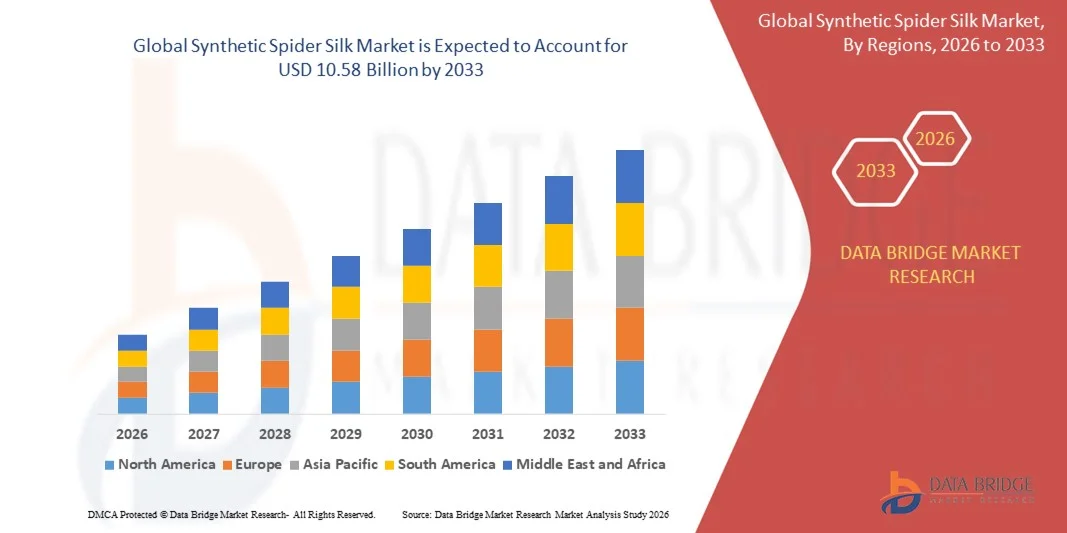
  • The global synthetic spider silk market size was valued at USD 3.46 billion in 2025 and is expected to reach USD 10.58 billion by 2033, at a CAGR of 15% during the forecast period
  • The market growth is largely fueled by rapid advancements in biotechnology and genetic engineering, enabling the efficient production of high-performance synthetic spider silk with enhanced strength, elasticity, and consistency across industrial scales
  • Furthermore, rising demand for sustainable, lightweight, and high-strength materials across textile, healthcare, automotive, and defense sectors is positioning synthetic spider silk as a viable alternative to conventional synthetic fibers. These converging factors are accelerating the adoption of bio-engineered spider silk solutions, thereby significantly boosting overall market growth

Synthetic Spider Silk Market Analysis

  • Synthetic spider silk, produced through bioengineering and fermentation-based processes, is emerging as a critical advanced material due to its exceptional mechanical properties, biocompatibility, and biodegradability across multiple high-value applications
  • The increasing demand for synthetic spider silk is primarily driven by sustainability-focused material innovation, expanding use in medical devices and regenerative medicine, and growing interest from performance textile and defense industries seeking durable yet lightweight materials
  • Asia-Pacific dominated the synthetic spider silk market with a share of 47.01% in 2025, due to rapid advancements in biotechnology, expanding textile manufacturing capabilities, and increasing investments in bio-based and sustainable materials
  • North America is expected to be the fastest growing region in the synthetic spider silk market during the forecast period due to strong biotechnology innovation, high R&D spending, and early adoption of advanced biomaterials
  • Genetically modified yeast fermentation segment dominated the market with a market share of 45.5% in 2025, due to its scalability, consistent protein yield, and suitability for industrial-scale production. Yeast-based fermentation enables precise control over spider silk protein synthesis, ensuring uniform quality and reduced batch variability. Manufacturers favor this method due to its compatibility with existing bioreactor infrastructure and lower contamination risks. The process also supports cost optimization over time, making it attractive for commercial textile and composite applications. In addition, yeast fermentation allows easier regulatory compliance compared to transgenic animal-based methods, strengthening its dominance in the market

Report Scope and Synthetic Spider Silk Market Segmentation

Attributes

Synthetic Spider Silk Key Market Insights

Segments Covered

  • By Product Type: Genetically Modified Yeast Fermentation, Genetically Modified Silkworm, and Genetically Modified E-Coli Fermentation
  • By Application: Automotive, Textile, Healthcare, Defense, and Others

Countries Covered

North America

  • U.S.
  • Canada
  • Mexico

Europe

  • Germany
  • France
  • U.K.
  • Netherlands
  • Switzerland
  • Belgium
  • Russia
  • Italy
  • Spain
  • Turkey
  • Rest of Europe

Asia-Pacific

  • China
  • Japan
  • India
  • South Korea
  • Singapore
  • Malaysia
  • Australia
  • Thailand
  • Indonesia
  • Philippines
  • Rest of Asia-Pacific

Middle East and Africa

  • Saudi Arabia
  • U.A.E.
  • South Africa
  • Egypt
  • Israel
  • Rest of Middle East and Africa

South America

  • Brazil
  • Argentina
  • Rest of South America

Key Market Players

  • Kraig Biocraft Laboratories, Inc. (U.S.)
  • AMSilk GmbH (Germany)
  • Bolt Threads (U.S.)
  • Spiber Inc. (Japan)
  • Hellenic Silk Company (Greece)
  • CHAMUNDI TEXTILES (SILK MILLS) LTD. (India)
  • Anhui Silk (China)
  • ChinaTing Group Holdings Ltd. (China)
  • Ongetta srl unipersonale (Italy)
  • Seevix (U.S.)
  • Zhejiang Jiaxin Silk Co., Ltd. (China)
  • Sichuan Nanchong Liuhe (Group) Co., Ltd. (China)
  • ShengKun Silk Manufacturing Co., Ltd. (China)
  • China Zhongsi Group Co., Ltd. (China)
  • Spiber Technologies (Japan)

Market Opportunities

  • Expansion of Synthetic Spider Silk in Medical Devices and Tissue Engineering
  • Growing Demand from Sustainable and High-Performance Textile Applications

Value Added Data Infosets

In addition to the insights on market scenarios such as market value, growth rate, segmentation, geographical coverage, and major players, the market reports curated by the Data Bridge Market Research also include import export analysis, production capacity overview, production consumption analysis, price trend analysis, climate change scenario, supply chain analysis, value chain analysis, raw material/consumables overview, vendor selection criteria, PESTLE Analysis, Porter Analysis, and regulatory framework.

Synthetic Spider Silk Market Trends

Rising Adoption of Bio-Engineered and Sustainable High-Performance Fibers

  • A significant trend in the synthetic spider silk market is the rising adoption of bio-engineered and sustainable high-performance fibers, driven by growing demand for materials that combine superior strength, elasticity, and environmental compatibility. Industries are increasingly shifting away from petroleum-based synthetic fibers toward biofabricated alternatives that support sustainability goals while maintaining advanced mechanical performance
    • For instance, Bolt Threads has actively developed and promoted engineered spider silk materials for apparel and performance textiles, demonstrating the commercial viability of bio-based fibers in premium markets. These developments are strengthening confidence among manufacturers and brands seeking sustainable material innovations
  • The textile industry is increasingly integrating synthetic spider silk to produce lightweight, durable, and flexible fabrics that align with circular economy principles. This trend is supporting broader adoption in technical and high-end textile segments where performance and sustainability are equally critical
  • Healthcare applications are also contributing to this trend, as bio-engineered spider silk is being explored for sutures, tissue scaffolds, and wound care products due to its biocompatibility and biodegradability. This is expanding the material’s relevance beyond conventional textile uses
  • Research institutions and biotechnology firms are accelerating innovation in spider silk protein engineering to enhance fiber consistency and scalability. These advancements are reinforcing market momentum and supporting long-term adoption across multiple industries
  • Overall, the growing preference for sustainable, bio-engineered high-performance fibers is reinforcing synthetic spider silk as a strategic material, supporting its transition from niche research applications to broader commercial deployment

Synthetic Spider Silk Market Dynamics

Driver

Advancements in Genetic Engineering and Fermentation Technologies

  • Advancements in genetic engineering and fermentation technologies are a primary driver of growth in the synthetic spider silk market, as they enable precise replication and optimization of spider silk proteins at industrial scale. Improvements in gene editing, protein expression, and fermentation control are enhancing yield consistency and material performance. These technological developments are making synthetic spider silk more commercially viable across diverse applications
    • For instance, Kraig Biocraft Laboratories, Inc. has advanced its genetic research by increasing the size and complexity of spider silk gene inserts, directly improving fiber strength and functional properties. Such progress is accelerating product differentiation and expanding potential end-use markets
  • Fermentation-based production methods using genetically modified organisms are allowing manufacturers to achieve scalable and repeatable output while maintaining quality standards. This is particularly important for meeting growing demand from textile and biomedical industries
  • Biotechnology firms are also benefiting from improved bioreactor designs and downstream processing techniques that reduce inefficiencies and support larger batch production. These advancements are lowering technical barriers to commercialization
  • Collectively, ongoing progress in genetic engineering and fermentation technologies is reinforcing production scalability and performance reliability, positioning synthetic spider silk for sustained market growth

Restraint/Challenge

High Production Costs and Scaling Complexity

  • The synthetic spider silk market faces notable challenges related to high production costs and the complexity of scaling biofabrication processes. Manufacturing spider silk proteins requires advanced genetic engineering, controlled fermentation environments, and sophisticated purification processes, all of which increase operational expenses. These factors limit cost competitiveness compared to conventional synthetic fibers
    • For instance, AMSilk GmbH relies on highly controlled fermentation and protein purification systems to produce medical-grade spider silk materials, which demand significant capital investment and specialized expertise. Such requirements elevate production costs and restrict rapid capacity expansion
  • Maintaining consistent quality at scale remains challenging, as minor variations in biological processes can impact fiber performance and yield. This increases the need for rigorous monitoring and quality control systems
  • The reliance on specialized infrastructure and skilled scientific talent further adds to production complexity and operational costs. Smaller players may face difficulties entering the market due to these high entry barriers
  • Scaling from pilot production to mass commercialization while preserving material properties continues to be a key constraint for manufacturers. Overall, high production costs and scaling challenges place pressure on companies to balance innovation, cost efficiency, and commercial feasibility, shaping the pace of market expansion

Synthetic Spider Silk Market Scope

The market is segmented on the basis of product type and application.

  • By Product Type

On the basis of product type, the synthetic spider silk market is segmented into genetically modified yeast fermentation, genetically modified silkworm, and genetically modified E. coli fermentation. The genetically modified yeast fermentation segment dominated the market with the largest revenue share of 45.5% in 2025, driven by its scalability, consistent protein yield, and suitability for industrial-scale production. Yeast-based fermentation enables precise control over spider silk protein synthesis, ensuring uniform quality and reduced batch variability. Manufacturers favor this method due to its compatibility with existing bioreactor infrastructure and lower contamination risks. The process also supports cost optimization over time, making it attractive for commercial textile and composite applications. In addition, yeast fermentation allows easier regulatory compliance compared to transgenic animal-based methods, strengthening its dominance in the market.

The genetically modified silkworm segment is anticipated to witness the fastest growth rate during the forecast period, supported by its ability to produce spider silk fibers with mechanical properties closer to natural spider silk. This method integrates spider silk genes into silkworms, enabling direct fiber spinning without extensive downstream processing. Growing interest from high-performance textile and defense material developers is accelerating adoption. The approach also offers potential reductions in energy-intensive processing steps compared to fermentation-based routes. Advancements in genetic engineering and breeding efficiency are further improving yield consistency. As a result, genetically modified silkworms are gaining traction for premium and specialized end-use applications.

  • By Application

On the basis of application, the synthetic spider silk market is segmented into automotive, textile, healthcare, defense, and others. The textile segment accounted for the largest market revenue share in 2025, driven by rising demand for lightweight, high-strength, and sustainable fibers. Synthetic spider silk offers superior tensile strength, elasticity, and biodegradability compared to conventional synthetic fibers, making it highly attractive for next-generation apparel and technical textiles. Fashion and performance wear brands are increasingly exploring spider silk to meet sustainability goals without compromising durability. The material’s softness and breathability further enhance its suitability for premium textile products. Continuous innovation in fiber spinning and weaving techniques is reinforcing the segment’s leading position.

The healthcare segment is expected to register the fastest growth over the forecast period, fueled by expanding use in sutures, tissue engineering, and regenerative medicine. Synthetic spider silk exhibits excellent biocompatibility and controlled biodegradability, making it suitable for implants and wound care products. Researchers are increasingly adopting spider silk scaffolds for cell growth due to their structural stability and minimal immune response. Rising investments in advanced biomaterials and medical biotechnology are accelerating commercialization. The ability to tailor protein structure for specific medical functions further enhances its adoption. Consequently, healthcare applications are emerging as the most rapidly expanding area for synthetic spider silk.

Synthetic Spider Silk Market Regional Analysis

  • Asia-Pacific dominated the synthetic spider silk market with the largest revenue share of 47.01% in 2025, driven by rapid advancements in biotechnology, expanding textile manufacturing capabilities, and increasing investments in bio-based and sustainable materials
  • The region’s strong fermentation infrastructure, cost-efficient production environment, and growing adoption of high-performance fibers across textile, automotive, and healthcare sectors are accelerating market expansion
  • Supportive government initiatives for bioengineering, availability of skilled researchers, and rising demand for sustainable alternatives to conventional synthetic fibers are contributing to increased consumption of synthetic spider silk

China Synthetic Spider Silk Market Insight

China held the largest share in the Asia-Pacific synthetic spider silk market in 2025, supported by its strong biotechnology ecosystem, large-scale textile manufacturing base, and significant investments in advanced materials research. The country’s focus on sustainable industrial development, combined with its ability to scale fermentation and biofabrication processes, is driving commercial adoption. Growing demand from high-performance textiles, medical materials, and defense-related applications further supports market growth.

India Synthetic Spider Silk Market Insight

India is witnessing the fastest growth in the Asia-Pacific region, fueled by expanding biotechnology research, rising investments in sustainable textiles, and growing collaboration between academic institutions and startups. Government support for bio-based manufacturing and innovation-driven programs is strengthening domestic capabilities. Increasing interest from healthcare and advanced textile manufacturers is further accelerating market expansion.

Europe Synthetic Spider Silk Market Insight

The Europe synthetic spider silk market is expanding steadily, supported by strong emphasis on sustainability, advanced biomaterials research, and strict environmental regulations encouraging bio-based alternatives. The region’s well-established R&D infrastructure and growing demand for high-performance fibers in healthcare and automotive applications are key growth drivers. Continuous innovation in biofabrication technologies is further enhancing regional market development.

Germany Synthetic Spider Silk Market Insight

Germany’s synthetic spider silk market is driven by its leadership in advanced materials engineering, strong biotechnology research landscape, and close collaboration between industry and academic institutions. The country’s focus on precision manufacturing and sustainable material solutions is boosting adoption across automotive, medical, and industrial textile applications. Robust funding for research and innovation continues to support market growth.

U.K. Synthetic Spider Silk Market Insight

The U.K. market is supported by a strong life sciences sector, active research in biomimetic materials, and increasing investments in sustainable manufacturing technologies. Academic-industry partnerships and startup-driven innovation are accelerating the development of synthetic spider silk applications. Demand is particularly growing in healthcare, defense, and specialty textile segments.

North America Synthetic Spider Silk Market Insight

North America is projected to grow at the fastest CAGR from 2026 to 2033, driven by strong biotechnology innovation, high R&D spending, and early adoption of advanced biomaterials. Growing demand from medical devices, tissue engineering, and defense applications is supporting market expansion. The region’s focus on commercialization of bioengineered materials further enhances growth prospects.

U.S. Synthetic Spider Silk Market Insight

The U.S. accounted for the largest share in the North America market in 2025, underpinned by its advanced biotechnology infrastructure, strong presence of research-driven companies, and significant funding for biomaterials innovation. The country’s leadership in medical research, defense applications, and sustainable material development is accelerating adoption. Well-established commercialization pathways and strong investor interest continue to reinforce the U.S.’s leading position.

Synthetic Spider Silk Market Share

The synthetic spider silk industry is primarily led by well-established companies, including:

  • Kraig Biocraft Laboratories, Inc. (U.S.)
  • AMSilk GmbH (Germany)
  • Bolt Threads (U.S.)
  • Spiber Inc. (Japan)
  • Hellenic Silk Company (Greece)
  • CHAMUNDI TEXTILES (SILK MILLS) LTD. (India)
  • Anhui Silk (China)
  • ChinaTing Group Holdings Ltd. (China)
  • Ongetta srl unipersonale (Italy)
  • Seevix (U.S.)
  • Zhejiang Jiaxin Silk Co., Ltd. (China)
  • Sichuan Nanchong Liuhe (Group) Co., Ltd. (China)
  • ShengKun Silk Manufacturing Co., Ltd. (China)
  • China Zhongsi Group Co., Ltd. (China)
  • Spiber Technologies (Japan)

Latest Developments in Global Synthetic Spider Silk Market

  • In April 2025, Kraig Biocraft Laboratories, Inc. strengthened its commercial positioning in the synthetic spider silk market by securing four registered trademarks for its SpydaSilk brand, reinforcing brand protection and supporting its strategy to enter premium apparel segments. This development enhances market visibility, builds consumer trust, and supports long-term revenue generation through branded spider silk products
  • In February 2025, Kraig Biocraft Laboratories, Inc. achieved a major breakthrough in its genetic research program by increasing the size and complexity of its spider silk gene insert package, directly improving material strength and performance characteristics. This advancement accelerates product differentiation and supports broader adoption of synthetic spider silk in high-performance textile and defense applications
  • In June 2024, biomedical start-up PrintyMed announced plans to begin exporting artificial spider silk products, signaling the transition from research-scale development to international commercialization. This move expands global market reach and highlights growing demand for spider silk in biomedical and regenerative medicine applications
  • In March 2024, AMSilk GmbH expanded its focus on industrial-scale production of biofabricated spider silk proteins to meet rising demand from medical and technical textile manufacturers. This development supports market growth by improving production consistency, enabling wider application adoption, and strengthening Europe’s role in advanced biomaterials
  • In January 2024, Bolt Threads advanced the commercialization of its engineered spider silk materials through expanded collaborations with apparel and performance material partners. This progress accelerates market penetration by validating spider silk’s scalability and reinforcing its potential as a sustainable alternative to conventional synthetic fibers


SKU-

세계 최초의 시장 정보 클라우드 보고서에 온라인으로 접속하세요

  • 대화형 데이터 분석 대시보드
  • 높은 성장 잠재력 기회를 위한 회사 분석 대시보드
  • 사용자 정의 및 질의를 위한 리서치 분석가 액세스
  • 대화형 대시보드를 통한 경쟁자 분석
  • 최신 뉴스, 업데이트 및 추세 분석
  • 포괄적인 경쟁자 추적을 위한 벤치마크 분석의 힘 활용
데모 요청

연구 방법론

데이터 수집 및 기준 연도 분석은 대규모 샘플 크기의 데이터 수집 모듈을 사용하여 수행됩니다. 이 단계에는 다양한 소스와 전략을 통해 시장 정보 또는 관련 데이터를 얻는 것이 포함됩니다. 여기에는 과거에 수집한 모든 데이터를 미리 검토하고 계획하는 것이 포함됩니다. 또한 다양한 정보 소스에서 발견되는 정보 불일치를 검토하는 것도 포함됩니다. 시장 데이터는 시장 통계 및 일관된 모델을 사용하여 분석하고 추정합니다. 또한 시장 점유율 분석 및 주요 추세 분석은 시장 보고서의 주요 성공 요인입니다. 자세한 내용은 분석가에게 전화를 요청하거나 문의 사항을 드롭하세요.

DBMR 연구팀에서 사용하는 주요 연구 방법론은 데이터 마이닝, 시장에 대한 데이터 변수의 영향 분석 및 주요(산업 전문가) 검증을 포함하는 데이터 삼각 측량입니다. 데이터 모델에는 공급업체 포지셔닝 그리드, 시장 타임라인 분석, 시장 개요 및 가이드, 회사 포지셔닝 그리드, 특허 분석, 가격 분석, 회사 시장 점유율 분석, 측정 기준, 글로벌 대 지역 및 공급업체 점유율 분석이 포함됩니다. 연구 방법론에 대해 자세히 알아보려면 문의를 통해 업계 전문가에게 문의하세요.

사용자 정의 가능

Data Bridge Market Research는 고급 형성 연구 분야의 선두 주자입니다. 저희는 기존 및 신규 고객에게 목표에 맞는 데이터와 분석을 제공하는 데 자부심을 느낍니다. 보고서는 추가 국가에 대한 시장 이해(국가 목록 요청), 임상 시험 결과 데이터, 문헌 검토, 재생 시장 및 제품 기반 분석을 포함하도록 사용자 정의할 수 있습니다. 기술 기반 분석에서 시장 포트폴리오 전략에 이르기까지 타겟 경쟁업체의 시장 분석을 분석할 수 있습니다. 귀하가 원하는 형식과 데이터 스타일로 필요한 만큼 많은 경쟁자를 추가할 수 있습니다. 저희 분석가 팀은 또한 원시 엑셀 파일 피벗 테이블(팩트북)로 데이터를 제공하거나 보고서에서 사용 가능한 데이터 세트에서 프레젠테이션을 만드는 데 도움을 줄 수 있습니다.


자주 묻는 질문

합성 거미 실크 시장 크기는 2025 년에 USD 3.46 억으로 평가되었습니다.
합성 거미 실크 시장은 2026에서 2033의 예측 기간 동안 15 %의 CAGR에서 성장합니다.
합성 거미 실크 시장은 제품 유형과 신청에 근거를 둔 2개의 주목할만한 세그먼트로 구분됩니다. 제품 유형의 기초에, 시장은 유전자 변형 된 효모 발효, 일반적으로 실크 웜을 수정하고, 일반적으로 E. coli 발효를 수정합니다. 응용 분야의 기초에, 시장은 자동차, 섬유, 의료, 방위 및 다른 사람으로 구분됩니다.
Kraig Biocraft Laboratories, Inc. (미국), AMSilk GmbH (독일), Bolt Threads (미국), Spiber Inc. (일본), Hellenic Silk Company (Greece)와 같은 회사는 합성 거미 실크 시장에서 주요 회사입니다.
합성 거미 실크 시장에서 덮은 국가는 미국, 캐나다, 멕시코, 독일, 프랑스, 미국, 이탈리아, 스페인, 러시아, 터키, 네덜란드, 스위스, 오스트리아, 폴란드, 노르웨이, 아일랜드, 헝가리, 리투아니아, 유럽, 중국, 일본, 인도, 대한민국, 호주, 대만, 필리핀, 태국, 말레이시아, 베트남, 인도네시아, 싱가포르, 아시아 태평양, 브라질, 아르헨티나, 치리, 콜롬비아, 페루, 베네수엘라, 에콰도르, 남아프리카 공화국, 사우디 아라비아, 남아프리카 공화국, 사우디 아라비아, 사우디 아라비아, 남아프리카 공화국, 사우디 아라비아, 남아프리카 공화국, 사우디 아라비아, 남아프리카 공화국, 사우디 아라비아, 남아프리카 공화국, 사우디 아라비아, 남아프리카 공화국, 사우디 아라비아, 남아프리카 공화국, 사우디 아라비아, 사우디 아라비아, 남아프리카 공화국, 사우디 아라비아, 남아프리카 공화국, 사우디 아라비아, 남아프리카 공화국, 남아프리카 공화국, 사우디 아라비아, 사우디 아라비아, 사우디 아라비아, 사우디 아라비아, 사우디 아라비아, 남아프리카 공화국, 남아프리카 공화국, 사우디 아라비아, 사우디 아라비아, 사우디 아라비아, 사우디 아라비아, 사우디 아라비아, 사우디 아라비아, 사우디 아라비아, 사우디 아라비아, 사우디 아라비아, 사우디 아라비아, 사우디 아라비아, 남아프리카 공화국, 사우디 아라비아, 사우디 아라비아, 사우디 아라비아, 사우디 아라비아, 사우디 아라비아, 사우디 아라비아, 사우디 아라비아, 사우디 아라비아, 사우디 아라비아, 사우디 아라비아, 사우디 아라비아,
북미는 강력한 생물 공학 혁신, 높은 R & D 지출 및 고급 바이오 물질의 초기 채택으로 인해 합성 거미 실크 시장에서 가장 빠르게 성장하는 지역입니다.
중국은 아시아 태평양 지역에서 합성 거미 실크 시장을 지배했다. 이 지배는 강한 생명 공학 생태계, 대규모 섬유 제조 기지 및 고급 재료 연구에 상당한 투자에 속성입니다.
Asia-Pacific는 2025년 47.01%의 점유율을 가진 합성 거미 실크 시장을, 생물 공학에 있는 급속한 발전에 의해 몰고, 직물 제조 기능을 확장하고, 생물 근거하고 지속 가능한 물자에 있는 투자를 증가시켰습니다.
Testimonial