



Global Flare Gas Recovery System Market, By Capacity (Small, Medium, Large, Very large), Operating Pressure (Upto 5 bar, 5 to 10 bar, 10 to 20 bar, 20 to 60 bar), Configuration (Modular, Skid Mounted), Technology (Compressor, Ejector Based), Flow Rate (Upto 2 MMSCFD, 2 to 5 MMSCFD, 5 TO 10 MMSCFD), Application (Upstream, Downstream, Others), End User (Oil and Gas, Chemical Plants, Storage Tanks) – Industry Trends and Forecast to 2029
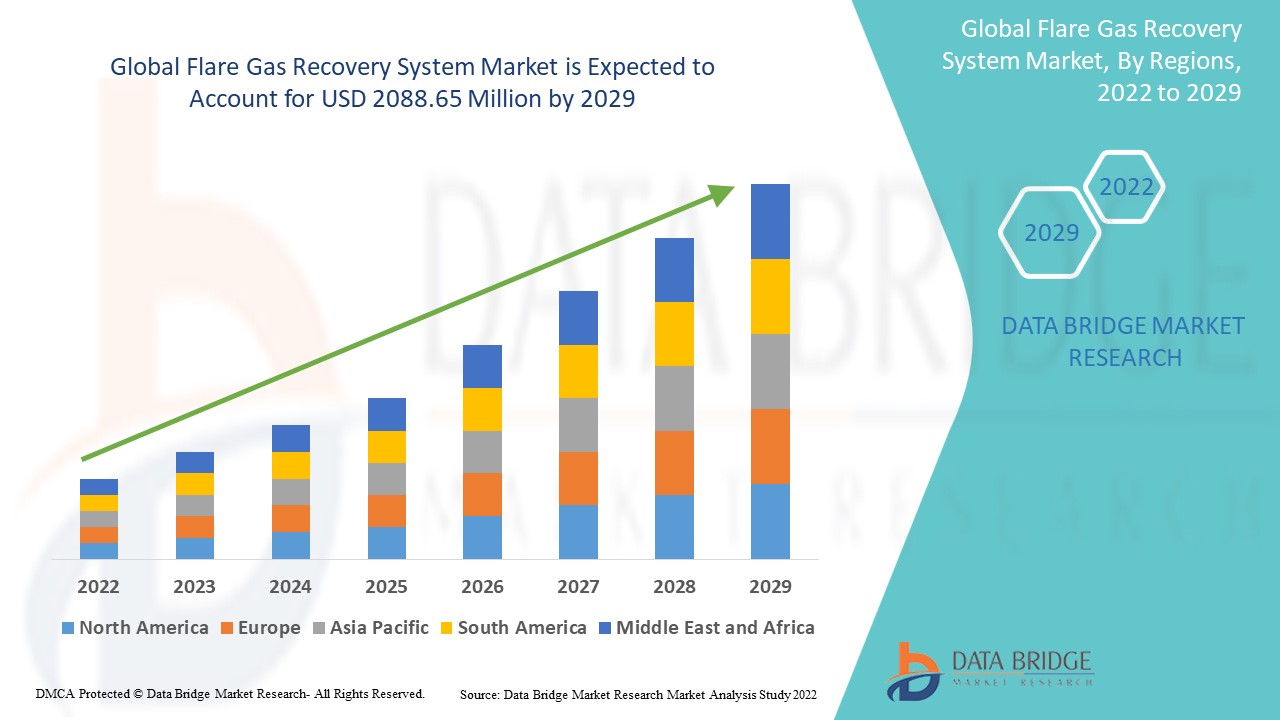
Market Analysis and Size
The flare gas recovery system market has experienced massive growth after the World Bank launched its "Zero Flaring by 2030" project in 2015. The major aim of the effort is to eliminate routine flaring by 2030 by promoting collaboration among stakeholders to discover ways to reduce gas flaring through proper policies, technology adoption, and financial arrangements. Manufacturers of leading flare gas recovery systems are working on developing highly efficient and cost-effective choices with a shorter payback period. Furthermore, manufacturers are investing in flare gas recovery system research and development (R&D) to improve their ability to work in remote oil and gas areas and increase sales. As a result, the market is estimated to flourish largely over the forecast period.
Global Flare Gas Recovery System Market was valued at USD 1,480.0 million in 2021 and is expected to reach USD 2088.65 million by 2029, registering a CAGR of 4.4% during the forecast period of 2022-2029. The market report curated by the Data Bridge Market Research team includes technological advancements, regulatory framework, PESTEL, porter's five forces analysis, industry standards-at a glance, raw material costs/ operational expenditure-overview, supply chain analysis, vendor selection criteria, pricing analysis, production analysis, and climate chain scenario.
Report Scope and Market Segmentation
|
Report Metric |
Details |
|
Forecast Period |
2022 to 2029 |
|
Base Year |
2021 |
|
Historic Years |
2020 (Customizable to 2019 - 2014) |
|
Quantitative Units |
Revenue in USD Million, Volumes in Units, Pricing in USD |
|
Segments Covered |
By Capacity (Small, Medium, Large, Very large), Operating Pressure (Upto 5 bar, 5 to 10 bar, 10 to 20 bar, 20 to 60 bar), Configuration (Modular, Skid Mounted), Technology (Compressor, Ejector Based), Flow Rate (Upto 2 MMSCFD, 2 to 5 MMSCFD, 5 TO 10 MMSCFD), Application (Upstream, Downstream, Others), End User (Oil and Gas, Chemical Plants, Storage Tanks) |
|
Countries Covered |
U.S., Canada, Mexico, Brazil, Argentina, Rest of South America, Germany, France, Italy, U.K., Belgium, Spain, Russia, Turkey, Netherlands, Switzerland, Poland, Norway, Finland, Rest of Europe, Japan, China, India, South Korea, Australia, Singapore, Malaysia, Thailand, Indonesia, Philippines, Rest of Asia-Pacific, U.A.E, Saudi Arabia, Egypt, South Africa, Israel, Nigeria, Algeria, Angola, Ghana, Rest of Middle East and Africa |
|
Market Players Covered |
Zeeco, Inc., (U.S.), Gardner Denver (U.S.), John Zink Hamworthy (U.S.), Honeywell International Inc., (U.S.), Wärtsilä (Finland), SoEnergy (U.S.), Movitherm (U.S.), Aerzen (U.S.), Ingersoll Rand (U.S.), Cimarron Energy, Inc. (U.S.), Koch Industries, Inc. (U.S.), GENERON (U.S.), Ramboll Group A/S (Denmark), Emtivac Vacuum Pump & System Engineers (Australia), Aggreko (UK), MAN Energy Solutions SE (Germany), Transvac Systems Limited (UK) and Sunpower Technology (Jiangsu) Co., Ltd (China) |
|
Market Opportunities |
|
Market Definition
Flares are combustion devices used in facilities to burn waste gases in a safe and efficient manner. They are essentially safety measures that prevent unburned gas from entering the atmosphere. Outside the plant, a flame source might cause these gases to burn or possibly detonate. Flare gas recovery is the term for the process of recycling waste gases. The level of greenhouse gas emissions has risen in recent years as a result of population increase and rising living standards, particularly in emerging countries. To fulfil the growing demand for oil and gas, massive amounts of co-produced gas have been flared as a waste by-product, releasing immense quantities of gas.
Flare Gas Recovery System Market Dynamics
This section deals with understanding the market drivers, advantages, opportunities, restraints and challenges. All of this is discussed in detail as below:
Drivers
- Growing Applications Across End Use Industries
The growth in power generation applications is driving up demand. Over the projection period, the oil and gas industry is expected to generate attractive prospects in the global market. The government rules governing carbon emissions have a significant impact on flare gas recovery system adoption.
- Surging Awareness Regarding Clean Energy
The surging awareness associated with the clean energy is expected to boost market growth largely over forecasted period. Moreover, the surging awareness about the adverse environmental impact of various industrial production processes, carbon emissions and environmental conservation will also drive growth in the global flare gas recovery system market.
Furthermore, the increasing significance of environmental conservation activities is estimated to eventually boost the market growth. Furthermore, a growing number of natural gas and oil firms are looking to deploy flare gas recovery systems in order to maximize energy efficiency. A lot of corporations are considering this as a form of corporate social responsibility, boosting demand in the process.
Opportunities
- Investments and Regulations
The burgeoning investments by leading companies is estimated to further extend profitable opportunities to the market players in the forecast period of 2022 to 2029. Furthermore, the guidelines and regulations set by various environmental organizations are estimated to further provide growth opportunities for the flare gas recovery system market.
Restraints/Challenges
- High Capital Costs
However, the capital costs within the market is basically very high, which serves as a major impediment to the global flare gas recovery system market's growth. Moreover, the expensive catalyst also restraints the market growth over the forecasted period.
- Lower Awareness
Furthermore, the lower awareness regarding the environmental-advantages of flare gas recovery system among end-user industries is expected to impede the growth of the global flare gas recovery system market over the forecast period. This factor is estimated to pose as a serious challenge to the growth of the flare gas recovery system market.
In addition to this, the time-sensitive installation procedure coupled with the dearth of technology in underdeveloped and emerging economies is estimated to impede the market growth.
This flare gas recovery system market report provides details of new recent developments, trade regulations, import-export analysis, production analysis, value chain optimization, market share, impact of domestic and localized market players, analyses opportunities in terms of emerging revenue pockets, changes in market regulations, strategic market growth analysis, market size, category market growths, application niches and dominance, product approvals, product launches, geographic expansions, technological innovations in the market. To gain more info on the flare gas recovery system market contact Data Bridge Market Research for an Analyst Brief, our team will help you take an informed market decision to achieve market growth.
COVID-19 Impact on Flare Gas Recovery System Market
The recent outbreak of coronavirus had an adverse impact on the flare gas recovery system market. The adverse impact can be attributed to the halt and suspension of various production, supply as well as the manufacturing operations of flare gas recovery system due to the lockdown restrictions. The industries were severely hit, with almost no production, resulting in a disaster for the flare gas recovery system market. Moreover, the slow advancement of the industrial sector, particularly the oil and gas industry, during the epidemic appears to have temporarily slowed the market's pace and growth rate. Furthermore, the oil and gas industry is the largest end user of the flare gas recovery technology, which sustained a significant loss during the pandemic due to low to no demand as a result of the global lockdown imposed by various states. The restrictions also largely hampered various industrial operations and disrupted the supply chain, affecting the market largely. Furthermore, import and export activities were severely hampered, negatively impacting industries that use flare gas recovery system and as a result, the global market.
On the plus side, the market is expected to regain its former prominence as the economy has largely picked up the same pace of growth as the pre-pandemic levels. Moreover, the extensive product usage owing to the growing significance of environmental conservation activities and various market strategies followed by the market players are projected to favor industry sustenance will also largely aid the market growth over the forecast period.
Global Flare Gas Recovery System Market Scope
The flare gas recovery system market is segmented on the basis of capacity, operating pressure, configuration, technology, application and end user. The growth amongst these segments will help you analyze meagre growth segments in the industries and provide the users with a valuable market overview and market insights to help them make strategic decisions for identifying core market applications.
Capacity
- Small
- Medium
- Large
- Very large
Operating Pressure
- Upto 5 bar
- 5 to 10 bar
- 10 to 20 bar
- 20 to 60 bar
Configuration
- Modular
- Skid Mounted
Technology
- Compressor
- Ejector Based
Flow Rate
- Upto 2 MMSCFD
- 2 to 5 MMSCFD
- 5 TO 10 MMSCFD
Application
- Upstream
- Downstream
- Others
End User
- Oil and Gas
- Chemical Plants
- Storage Tanks
Flare Gas Recovery System Market Regional Analysis/Insights
The flare gas recovery system market is analyzed and market size insights and trends are provided by country, type, component, product, application and end user as referenced above.
The countries covered in the flare gas recovery system market report are U.S., Canada and Mexico in North America, Germany, France, U.K., Netherlands, Switzerland, Belgium, Russia, Italy, Spain, Turkey, Poland, Norway, Finland, Rest of Europe in Europe, China, Japan, India, South Korea, Singapore, Malaysia, Australia, Thailand, Indonesia, Philippines, Rest of Asia-Pacific (APAC) in the Asia-Pacific (APAC), Saudi Arabia, U.A.E, Israel, Egypt, South Africa, Nigeria, Algeria, Angola, Ghana, Rest of Middle East and Africa (MEA) as a part of Middle East and Africa (MEA), Brazil, Argentina and Rest of South America as part of South America.
North America dominates the flare gas recovery system market in terms of market share and market revenue and will continue to flourish its dominance during the forecast period. The increased growth of the market is attributed to the rising public awareness of carbon emissions and environmental protection, as well as the rapid implementation of flare gas recovery system for power production applications in the forecast period of 2022 to 2029.
Europe on the other hand, is estimated to show lucrative growth over the forecast period of 2022 to 2029 as the government is projected to pursue companies to curb the emissions under the Paris Climate Accord within the region U.K, is the European continent's second-largest flare gas emitter.
The country section of the report also provides individual market impacting factors and changes in market regulation that impact the current and future trends of the market. Data points like down-stream and upstream value chain analysis, technical trends and porter's five forces analysis, case studies are some of the pointers used to forecast the market scenario for individual countries. Also, the presence and availability of global brands and their challenges faced due to large or scarce competition from local and domestic brands, impact of domestic tariffs and trade routes are considered while providing forecast analysis of the country data.
Competitive Landscape and Flare Gas Recovery System Market Share Analysis
The flare gas recovery system market competitive landscape provides details by competitor. Details included are company overview, company financials, revenue generated, market potential, investment in research and development, new market initiatives, global presence, production sites and facilities, production capacities, company strengths and weaknesses, product launch, product width and breadth, application dominance. The above data points provided are only related to the companies' focus related to flare gas recovery system market.
Some of the major players operating in the flare gas recovery system market are
- Zeeco, Inc., (U.S.)
- Gardner Denver (U.S.)
- John Zink Hamworthy (U.S.)
- Honeywell International Inc., (U.S.)
- Wärtsilä (Finland)
- SoEnergy (U.S.)
- Movitherm (U.S.)
- Aerzen (U.S.)
- Ingersoll Rand (U.S.)
- Cimarron Energy, Inc. (U.S.)
- Koch Industries, Inc. (U.S.)
- GENERON (U.S.)
- Ramboll Group A/S (Denmark)
- Emtivac Vacuum Pump & System Engineers (Australia)
- Aggreko (UK)
- MAN Energy Solutions SE (Germany)
- Transvac Systems Limited (UK)
- Sunpower Technology (Jiangsu) Co., Ltd (China)
SKU-
Obtenha acesso online ao relatório sobre a primeira nuvem de inteligência de mercado do mundo

- Painel interativo de análise de dados
- Painel de análise da empresa para oportunidades de elevado potencial de crescimento
- Acesso de analista de pesquisa para personalização e customização. consultas
- Análise da concorrência com painel interativo
- Últimas notícias, atualizações e atualizações Análise de tendências
- Aproveite o poder da análise de benchmark para um rastreio abrangente da concorrência
Metodologia de Investigação
A recolha de dados e a análise do ano base são feitas através de módulos de recolha de dados com amostras grandes. A etapa inclui a obtenção de informações de mercado ou dados relacionados através de diversas fontes e estratégias. Inclui examinar e planear antecipadamente todos os dados adquiridos no passado. Da mesma forma, envolve o exame de inconsistências de informação observadas em diferentes fontes de informação. Os dados de mercado são analisados e estimados utilizando modelos estatísticos e coerentes de mercado. Além disso, a análise da quota de mercado e a análise das principais tendências são os principais fatores de sucesso no relatório de mercado. Para saber mais, solicite uma chamada de analista ou abra a sua consulta.
A principal metodologia de investigação utilizada pela equipa de investigação do DBMR é a triangulação de dados que envolve a mineração de dados, a análise do impacto das variáveis de dados no mercado e a validação primária (especialista do setor). Os modelos de dados incluem grelha de posicionamento de fornecedores, análise da linha de tempo do mercado, visão geral e guia de mercado, grelha de posicionamento da empresa, análise de patentes, análise de preços, análise da quota de mercado da empresa, normas de medição, análise global versus regional e de participação dos fornecedores. Para saber mais sobre a metodologia de investigação, faça uma consulta para falar com os nossos especialistas do setor.
Personalização disponível
A Data Bridge Market Research é líder em investigação formativa avançada. Orgulhamo-nos de servir os nossos clientes novos e existentes com dados e análises que correspondem e atendem aos seus objetivos. O relatório pode ser personalizado para incluir análise de tendências de preços de marcas-alvo, compreensão do mercado para países adicionais (solicite a lista de países), dados de resultados de ensaios clínicos, revisão de literatura, mercado remodelado e análise de base de produtos . A análise de mercado dos concorrentes-alvo pode ser analisada desde análises baseadas em tecnologia até estratégias de carteira de mercado. Podemos adicionar quantos concorrentes necessitar de dados no formato e estilo de dados que procura. A nossa equipa de analistas também pode fornecer dados em tabelas dinâmicas de ficheiros Excel em bruto (livro de factos) ou pode ajudá-lo a criar apresentações a partir dos conjuntos de dados disponíveis no relatório.











