



Global Industrial Hemp Market, By Type (Hemp Seed, Hemp Seed Oil, CBD Hemp Oil, Hemp Fiber), Application (Food, Textiles, Beverages, Personal Care Products, Pharmaceuticals, Others), Source (Conventional, Organic) - Industry Trends & Forecast to 2031.
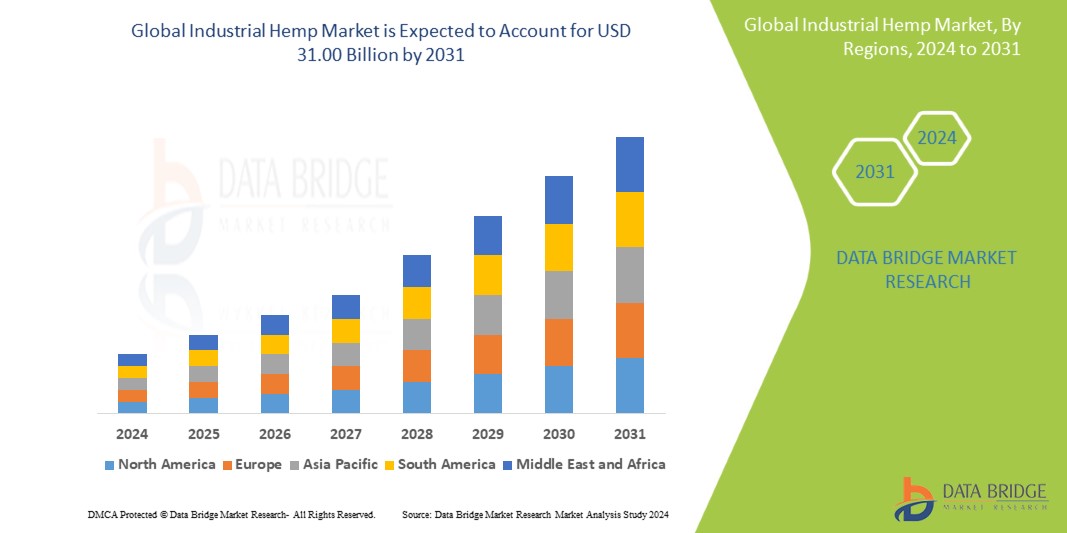
Industrial Hemp Market Analysis and Size
There has been increasing demand for biodegradable and renewable natural materials in various consumer products across the globe. The products in the industrial hemp market are considered to be highly eco-friendly, less harmful, and even renewable. Owing to its ecologically friendly character, this has prompted players in a variety of end-use industry verticals to choose goods from the market, which is projected to aid the market growth. The industrial hemp market is projected to show immense growth over the forecast period.
Data Bridge Market Research analyzes that the global industrial hemp market, which was USD 6.74 billion in 2023, would reach up to USD 31.00 billion by 2031 and is expected to undergo a CAGR of 21.02% during the forecast period. The “conventional” accounts for the largest market share in the source segment in the market due to the greater production volumes it offers for commercial use. In addition to the insights on market scenarios such as market value, growth rate, segmentation, geographical coverage, and major players, the market reports curated by the Data Bridge Market Research also include depth expert analysis, patient epidemiology, pipeline analysis, pricing analysis, and regulatory framework.
Report Scope and Market Segmentation
|
Report Metric |
Details |
|
Forecast Period |
2024 to 2031 |
|
Base Year |
2023 |
|
Historic Years |
2022 (Customizable to 2016-2021) |
|
Quantitative Units |
Revenue in USD Million, Volumes in Units, Pricing in USD |
|
Segments Covered |
Global Industrial Hemp Market, By Type (Hemp Seed, Hemp Seed Oil, CBD Hemp Oil, Hemp Fiber), Application (Food, Textiles, Beverages, Personal Care Products, Pharmaceuticals, Others), Source (Conventional, Organic) |
|
Countries Covered |
U.S., Canada, Mexico, Germany, France, U.K., Belgium, Lithuania, Austria, Ireland, Norway, Poland, Italy, Spain, Russia, Turkey, Netherlands Switzerland, Rest of Europe, Japan, China, South Korea, India, Australia, Singapore, Thailand, Malaysia, Indonesia, Philippines, Rest of Asia-Pacific, Brazil, Argentina, Rest of South America, South Africa, Saudi Arabia, U.A.E., Egypt, Israel, Rest of the Middle East and Africa. |
|
Market Players Covered |
Nhempco (Canada), Ecofibre (Australia), Hemp Inc. (U.S.), GenCanna (U.S.), HempFlax Group B.V., (Netherlands), Konoplex (Russia), Hemp Oil Canada (Canada), Hemp Poland (Poland), Dun Agro (Netherlands), Colorado Hemp Works (U.S.), Canah International (Romania), South Hemp Tecno (Italy), Plains Industrial Hemp Processing (Canada), MH Medical Hemp (Germany) |
|
Market Opportunities |
|
Market Definition
Hemp is a versatile plant belonging to the cannabis sativa species, but it contains negligible amounts of the psychoactive compound THC, unlike its cousin marijuana. Hemp has various industrial uses, including the production of fibers, seeds, and oil. The plant's strong and durable fibers are employed in textiles, ropes, and paper production. Hemp seeds are rich in nutrients and are utilized in food products like oils, protein powder, and snacks. Additionally, hemp can be employed in the construction industry for making eco-friendly building materials. Its fast growth and low environmental impact make hemp a sustainable and valuable resource for a range of industrial applications.
Global Industrial Hemp Market Dynamics
Drivers
- Demand for Sustainable Products
The increasing emphasis on sustainable practices has driven demand for hemp due to its eco-friendly attributes. Hemp cultivation requires fewer pesticides and herbicides compared to traditional crops, reducing environmental impact. As consumers prioritize sustainability, industries seek alternatives like hemp fibers for textiles and hempcrete for construction, contributing to the plant's market growth.
- Expanding Applications
Ongoing research and development efforts have broadened the applications of industrial hemp, making it a versatile resource. Innovations in hemp-based materials, such as bioplastics and sustainable building products, contribute to the plant's appeal across various industries. The continuous exploration of new applications enhances the market's potential, attracting investments and fostering a diverse range of hemp-derived products.
Opportunities
- Diversification of Products
The industrial hemp market offers a prime opportunity for stakeholders to diversify product offerings. Beyond traditional uses like textiles and oils, there's potential for developing innovative hemp-based materials such as biodegradable plastics, sustainable packaging, and even biofuels. This diversification not only taps into emerging markets but also positions hemp as a versatile and sustainable resource with applications across various industries.
- Investment in Research
Increased investment in research is pivotal for unlocking the full potential of industrial hemp. Research initiatives can focus on improving hemp genetics for enhanced yield and quality, optimizing cultivation techniques, and exploring novel applications such as advanced nanomaterials or pharmaceuticals. This investment not only drives innovation but also establishes a foundation for the long-term growth and competitiveness of the hemp industry in a rapidly evolving market.
Restraints/Challenges
- Regulatory Hurdles
The industrial hemp industry contends with regulatory challenges, varying from strict THC content limits to licensing complexities. Navigating this intricate regulatory landscape poses hurdles for businesses, impacting cultivation, processing, and distribution. Standardizing and streamlining regulations across jurisdictions is crucial to fostering a more predictable and supportive environment for the industry's expansion.
- Market Stigma
Persistent societal stigma associated with hemp's botanical cousin, marijuana, presents a challenge for the industrial hemp market. Despite lacking psychoactive properties, hemp products may face resistance from consumers and investors due to this lingering stigma. Overcoming this challenge requires extensive education campaigns to differentiate hemp from marijuana and highlight its diverse industrial uses, emphasizing its economic and environmental benefits.
This Industrial hemp market report provides details of new recent developments, trade regulations, import-export analysis, production analysis, value chain optimization, market share, impact of domestic and localized market players, analyses opportunities in terms of emerging revenue pockets, changes in market regulations, strategic market growth analysis, market size, category market growths, application niches and dominance, product approvals, product launches, geographic expansions, technological innovations in the market. To gain more info on the Industrial hemp market contact Data Bridge Market Research for an Analyst Brief, our team will help you take an informed market decision to achieve market growth.
Global Industrial Hemp Market Scope
The Industrial hemp market is segmented on the basis of type, application, and source. The growth amongst these segments will help you analyze meagre growth segments in the industries and provide the users with a valuable market overview and market insights to help them make strategic decisions for identifying core market applications.
Type
- Hemp Seed
- Hemp Seed Oil
- CBD Hemp Oil
- Hemp Fiber
Application
- Food
- Textiles
- Beverages
- Personal Care Products
- Pharmaceuticals
- Others
Source
- Conventional
- Organic
Industrial Hemp Market Regional Analysis/Insights
The Industrial hemp market is analyzed and market size insights and trends are provided by country, type, application, and source as referenced above.
The countries covered in the market report are the U.S., Canada, Mexico, Germany, U.K., France, Italy, Spain, Russia, Poland, Switzerland, Netherlands, Hungary, Austria, Norway, Ireland, Turkey, Lithuania, rest of Europe, China, Japan, India, Australia, South Korea, Singapore, Thailand, Malaysia, Indonesia, Philippines, Vietnam, rest of Asia-Pacific, Brazil, Argentina, Peru, rest of South America, South Africa, Saudi Arabia, U.A.E., Israel, Egypt, and rest of Middle East & Africa.
Asia-Pacific is expected to dominate the market due to the booming market for cosmetics and personal care products and the increasing consumption of hemp-based food products and supplements in developing economies within the region.
North America is expected to witness significant growth during the forecast period due to the growing geriatric population, high consumer disposable income levels, and rising concerns related to skin diseases and UV protection within the region.
The country section of the report also provides individual market impacting factors and changes in regulation in the market domestically that impacts the current and future trends of the market. Data points like down-stream and upstream value chain analysis, technical trends and porter's five forces analysis, case studies are some of the pointers used to forecast the market scenario for individual countries. Also, the presence and availability of global brands and their challenges faced due to large or scarce competition from local and domestic brands, impact of domestic tariffs and trade routes are considered while providing forecast analysis of the country data.
Healthcare Infrastructure growth Installed base and New Technology Penetration
The Industrial hemp Market also provides you with detailed market analysis for every country growth in healthcare expenditure for capital equipment, installed base of different kind of products for Industrial hemp Market, impact of technology using life line curves and changes in healthcare regulatory scenarios and their impact on the Industrial hemp Market. The data is available for historic period 2010-2020.
Competitive Landscape and Global Industrial Hemp Market Share Analysis
The Industrial hemp market competitive landscape provides details by competitor. Details included are company overview, company financials, revenue generated, market potential, investment in research and development, new market initiatives, global presence, production sites and facilities, production capacities, company strengths and weaknesses, product launch, product width and breadth, application dominance. The above data points provided are only related to the companies' focus related to Industrial hemp market.
Some of the major players operating in the Industrial hemp market are:
- Nhempco (Canada)
- Ecofibre (Australia)
- Hemp Inc. (U.S.)
- GenCanna (U.S.)
- HempFlax Group B.V., (Netherlands)
- Konoplex (Russia)
- Hemp Oil Canada (Canada)
- Hemp Poland (Poland)
- Dun Agro (Netherlands)
- Colorado Hemp Works (U.S.)
- Canah International (Romania)
- South Hemp Tecno (Italy)
- Plains Industrial Hemp Processing (Canada)
- MH Medical Hemp (Germany)
SKU-
Obtenha acesso online ao relatório sobre a primeira nuvem de inteligência de mercado do mundo

- Painel interativo de análise de dados
- Painel de análise da empresa para oportunidades de elevado potencial de crescimento
- Acesso de analista de pesquisa para personalização e customização. consultas
- Análise da concorrência com painel interativo
- Últimas notícias, atualizações e atualizações Análise de tendências
- Aproveite o poder da análise de benchmark para um rastreio abrangente da concorrência
Metodologia de Investigação
A recolha de dados e a análise do ano base são feitas através de módulos de recolha de dados com amostras grandes. A etapa inclui a obtenção de informações de mercado ou dados relacionados através de diversas fontes e estratégias. Inclui examinar e planear antecipadamente todos os dados adquiridos no passado. Da mesma forma, envolve o exame de inconsistências de informação observadas em diferentes fontes de informação. Os dados de mercado são analisados e estimados utilizando modelos estatísticos e coerentes de mercado. Além disso, a análise da quota de mercado e a análise das principais tendências são os principais fatores de sucesso no relatório de mercado. Para saber mais, solicite uma chamada de analista ou abra a sua consulta.
A principal metodologia de investigação utilizada pela equipa de investigação do DBMR é a triangulação de dados que envolve a mineração de dados, a análise do impacto das variáveis de dados no mercado e a validação primária (especialista do setor). Os modelos de dados incluem grelha de posicionamento de fornecedores, análise da linha de tempo do mercado, visão geral e guia de mercado, grelha de posicionamento da empresa, análise de patentes, análise de preços, análise da quota de mercado da empresa, normas de medição, análise global versus regional e de participação dos fornecedores. Para saber mais sobre a metodologia de investigação, faça uma consulta para falar com os nossos especialistas do setor.
Personalização disponível
A Data Bridge Market Research é líder em investigação formativa avançada. Orgulhamo-nos de servir os nossos clientes novos e existentes com dados e análises que correspondem e atendem aos seus objetivos. O relatório pode ser personalizado para incluir análise de tendências de preços de marcas-alvo, compreensão do mercado para países adicionais (solicite a lista de países), dados de resultados de ensaios clínicos, revisão de literatura, mercado remodelado e análise de base de produtos . A análise de mercado dos concorrentes-alvo pode ser analisada desde análises baseadas em tecnologia até estratégias de carteira de mercado. Podemos adicionar quantos concorrentes necessitar de dados no formato e estilo de dados que procura. A nossa equipa de analistas também pode fornecer dados em tabelas dinâmicas de ficheiros Excel em bruto (livro de factos) ou pode ajudá-lo a criar apresentações a partir dos conjuntos de dados disponíveis no relatório.











