


Segmentação do mercado global de sensores de campo magnético por tipo (sensores de efeito Hall, sensores magnetoresistivos, sensores SQUID, sensores fluxgate e outros), faixa (10 gauss (sensores de campo magnético de polarização)), aplicação (detecção de velocidade, detecção de vazão, detecção, detecção de posição, navegação e bússola eletrônica e outros), usuários finais (transporte, eletrônicos de consumo, serviços financeiros, saúde, aeroespacial e defesa, indústria e outros setores) - tendências e previsões do setor até 2033.
Tamanho do mercado de sensores de campo magnético
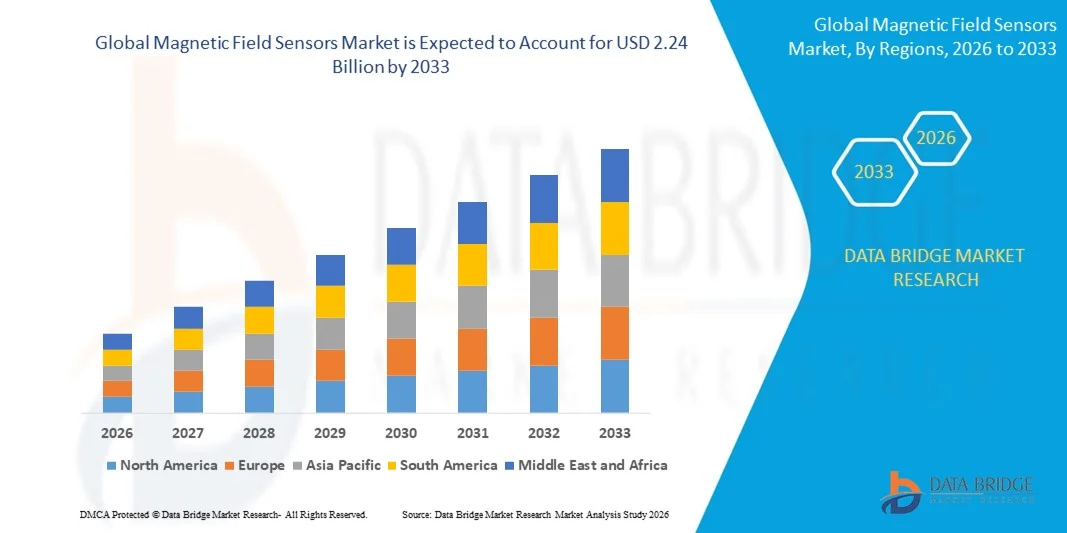
- O mercado global de sensores de campo magnético foi avaliado em US$ 1,20 bilhão em 2025 e deverá atingir US$ 2,24 bilhões até 2033 , com uma taxa de crescimento anual composta (CAGR) de 8,10% durante o período de previsão.
- O crescimento do mercado é impulsionado principalmente pela crescente demanda por aplicações de sensoriamento de posição, detecção de velocidade e medição de corrente nos setores automotivo, de eletrônicos de consumo e de automação industrial.
- A crescente adoção de veículos elétricos, a expansão de dispositivos inteligentes para o consumidor e a integração cada vez maior de tecnologias de sensoriamento habilitadas para a IoT estão acelerando ainda mais a expansão do mercado.
Análise do mercado de sensores de campo magnético
- O mercado está testemunhando um crescimento constante impulsionado pelos avanços tecnológicos nas tecnologias de sensores de efeito Hall, magnetoresistivos e de porta de fluxo, que possibilitam maior sensibilidade, miniaturização e melhoria da eficiência energética em diversas aplicações de uso final.
- A crescente ênfase em automação, sistemas de segurança e dispositivos eletrônicos com eficiência energética, combinada com a expansão da capacidade de fabricação de semicondutores, está fortalecendo o cenário competitivo e apoiando o desenvolvimento industrial a longo prazo.
- A América do Norte dominou o mercado de sensores de campo magnético, com a maior participação na receita em 2025, impulsionada pela forte demanda da eletrificação automotiva, automação industrial e fabricação de eletrônicos de consumo avançados.
- A região Ásia-Pacífico deverá apresentar a maior taxa de crescimento no mercado global de sensores de campo magnético , impulsionada pela rápida expansão da produção automotiva, pela forte fabricação de eletrônicos de consumo e pelo aumento dos investimentos em energias renováveis e sistemas industriais inteligentes.
- O segmento de sensores de efeito Hall detinha a maior participação na receita de mercado em 2025, impulsionado por sua ampla adoção em aplicações automotivas, de eletrônicos de consumo e industriais, devido à sua relação custo-benefício, tamanho compacto e desempenho confiável. Os sensores de efeito Hall são amplamente utilizados para detecção de posição, velocidade e corrente, tornando-os a escolha preferida em setores de manufatura de alto volume.
Escopo do relatório e segmentação do mercado de sensores de campo magnético
|
Atributos |
Principais informações de mercado sobre sensores de campo magnético |
|
Segmentos abrangidos |
|
|
Países abrangidos |
América do Norte
Europa
Ásia-Pacífico
Oriente Médio e África
Ámérica do Sul
|
|
Principais participantes do mercado |
|
|
Oportunidades de mercado |
|
|
Conjuntos de informações de dados de valor agregado |
Além das informações sobre cenários de mercado, como valor de mercado, taxa de crescimento, segmentação, cobertura geográfica e principais participantes, os relatórios de mercado elaborados pela Data Bridge Market Research também incluem análises aprofundadas de especialistas, produção e capacidade das empresas representadas geograficamente, layouts de rede de distribuidores e parceiros, análises detalhadas e atualizadas das tendências de preços e análises de déficits na cadeia de suprimentos e demanda. |
Tendências do mercado de sensores de campo magnético
Adoção crescente de veículos elétricos e sistemas avançados de assistência ao condutor
- A rápida expansão dos veículos elétricos e dos sistemas avançados de assistência ao condutor está moldando significativamente o mercado de sensores de campo magnético, à medida que as montadoras integram cada vez mais tecnologias de sensoriamento para detecção de posição, medição de velocidade e monitoramento de corrente. Os sensores de campo magnético estão ganhando espaço devido à sua alta precisão, durabilidade e capacidade de operar em ambientes automotivos adversos. Essa tendência fortalece sua adoção em sistemas de transmissão, gerenciamento de baterias e segurança, incentivando os fabricantes a desenvolver soluções de sensores compactas e com baixo consumo de energia.
- O crescente foco na eletrificação de veículos, na redução de emissões e em soluções de mobilidade inteligente acelerou a demanda por sensores de efeito Hall e magnetoresistivos em motores de tração, sistemas de freios ABS e detecção do ângulo de direção. As montadoras de veículos estão priorizando componentes de sensoriamento confiáveis para aprimorar a segurança e o desempenho. Isso também levou a colaborações entre empresas de semicondutores e fabricantes de automóveis para melhorar a integração de sensores e a confiabilidade funcional.
- Os avanços tecnológicos em miniaturização, processamento de sinais e integração com microcontroladores estão influenciando a inovação de produtos. Os fabricantes estão priorizando o baixo consumo de energia e a maior sensibilidade para atender aos padrões automotivos em constante evolução. Esses desenvolvimentos estão ajudando as empresas a diferenciar suas ofertas em um mercado competitivo, ao mesmo tempo que dão suporte às plataformas de veículos elétricos e híbridos de próxima geração.
- Por exemplo, em 2024, a Infineon Technologies, na Alemanha, e a Allegro MicroSystems, nos EUA, expandiram seus portfólios de sensores magnéticos automotivos para plataformas de veículos elétricos. Esses lançamentos de produtos focaram na melhoria da precisão da detecção de corrente e na estabilidade térmica, contribuindo para uma maior eficiência da bateria e melhor desempenho do trem de força. As soluções foram introduzidas para fortalecer parcerias com montadoras automotivas globais e fornecedores de primeiro nível.
- Embora a demanda automotiva permaneça forte, o crescimento sustentado do mercado depende do investimento contínuo em P&D, da estabilidade da cadeia de suprimentos de semicondutores e da conformidade com os padrões de segurança veicular em constante evolução. As empresas estão focando em fabricação escalável, otimização de custos e inovação para atender às crescentes metas globais de produção de veículos elétricos.
Dinâmica do mercado de sensores de campo magnético
Motorista
Crescente integração em aplicações de automação automotiva e industrial
- A crescente integração de sensores de campo magnético em veículos elétricos, robôs industriais e máquinas automatizadas é um dos principais impulsionadores do mercado. Os fabricantes estão adotando cada vez mais esses sensores para rastreamento preciso de posição, controle de motores e detecção de corrente, visando melhorar a eficiência e a segurança operacional. Essa tendência também está acelerando a pesquisa em tecnologias magnetoresistivas de alto desempenho e soluções avançadas de encapsulamento.
- A expansão das aplicações em sistemas de energia renovável, eletrônicos de consumo e eletrodomésticos inteligentes está influenciando o crescimento do mercado. Sensores de campo magnético aprimoram a precisão operacional e a confiabilidade em turbinas eólicas, medidores inteligentes e dispositivos vestíveis, permitindo que os fabricantes atendam aos requisitos de desempenho e eficiência energética. A crescente implantação de sistemas habilitados para IoT em todo o mundo reforça ainda mais essa tendência.
- As empresas de semicondutores e eletrônicas estão promovendo ativamente soluções inovadoras em sensores por meio do desenvolvimento de produtos e parcerias estratégicas. Essas iniciativas são impulsionadas pela crescente demanda por sistemas de automação e monitoramento inteligente em diversos setores. A colaboração entre fabricantes de chips e produtores de equipamentos está aprimorando a integração de sistemas e reduzindo o consumo geral de energia.
- Por exemplo, em 2023, a NXP Semiconductors, na Holanda, e a TDK Corporation, no Japão, expandiram suas ofertas de sensores industriais e automotivos para dar suporte à automação e às plataformas de veículos elétricos. Esse desenvolvimento acompanhou o aumento da demanda por sensores de alta precisão em robótica e veículos com baixo consumo de energia, fortalecendo o posicionamento competitivo e a penetração no mercado.
- Embora a expansão das aplicações impulsione o crescimento, a adoção a longo prazo depende da redução de custos, da diferenciação tecnológica e do fornecimento estável de matérias-primas. O investimento em fabricação avançada de semicondutores e em arquiteturas de design eficientes será crucial para sustentar a demanda global.
Restrição/Desafio
Altos custos de produção e restrições na cadeia de suprimentos
- O custo de produção relativamente elevado dos sensores de campo magnético avançados, em comparação com as tecnologias de sensoriamento convencionais, continua sendo um desafio crucial. Os complexos processos de fabricação de semicondutores e a dependência de materiais de terras raras contribuem para os altos custos de produção. Além disso, as flutuações na disponibilidade de matérias-primas podem afetar a estabilidade dos preços e as margens de lucro.
- A limitada conscientização e expertise técnica em certos mercados emergentes também restringem uma adoção mais ampla. Fabricantes de pequena escala podem enfrentar desafios na integração de sensores avançados em sistemas legados. Isso pode retardar a transição tecnológica em regiões em desenvolvimento, onde a automação industrial ainda está em evolução.
- Interrupções na cadeia de suprimentos e incertezas geopolíticas impactam a disponibilidade de semicondutores e o fornecimento de componentes. Fabricantes de sensores de campo magnético precisam gerenciar logística, padrões de qualidade e requisitos de conformidade, aumentando a complexidade operacional. As empresas são obrigadas a investir em estratégias de fornecimento diversificadas e em capacidades de produção localizadas para mitigar os riscos.
- Por exemplo, em 2024, distribuidores de eletrônicos no Sudeste Asiático relataram atrasos no fornecimento que afetaram clientes dos setores automotivo e industrial que utilizam soluções de sensores de empresas como Melexis e ROHM Semiconductor. Esses atrasos foram atribuídos a flutuações no fornecimento de semicondutores e ao aumento da demanda por parte dos fabricantes de veículos elétricos. Como resultado, alguns integradores de sistemas adiaram o lançamento de produtos, impactando temporariamente o ritmo do mercado.
- Para superar esses desafios, será necessário investir em eficiência de fabricação, resiliência da cadeia de suprimentos e expansão da produção regional. O fortalecimento de parcerias com montadoras automotivas, fabricantes de equipamentos industriais e fundições de semicondutores será essencial para desbloquear o potencial de crescimento a longo prazo do mercado global de sensores de campo magnético.
Escopo do mercado de sensores de campo magnético
O mercado está segmentado com base no tipo, gama, aplicação e usuários finais.
- Por tipo
Com base no tipo, o mercado de sensores de campo magnético é segmentado em sensores de efeito Hall, sensores magnetoresistivos, sensores SQUID, sensores fluxgate e outros. O segmento de sensores de efeito Hall detinha a maior participação na receita de mercado em 2025, impulsionado por sua ampla adoção em aplicações automotivas, de eletrônicos de consumo e industriais, devido à sua relação custo-benefício, tamanho compacto e desempenho confiável. Os sensores de efeito Hall são amplamente utilizados para detecção de posição, velocidade e corrente, tornando-os a escolha preferida em setores de manufatura de alto volume.
O segmento de sensores magneto-resistivos deverá apresentar o crescimento mais rápido entre 2026 e 2033, impulsionado pela sua maior sensibilidade e precisão em comparação com as tecnologias de sensoriamento convencionais. Esses sensores são cada vez mais utilizados em sistemas automotivos avançados, robótica e dispositivos de navegação, onde a detecção precisa do campo magnético é crucial. Sua capacidade de operar com eficiência em ambientes de baixo campo magnético reforça ainda mais a crescente demanda.
- Por intervalo
Com base na faixa de medição, o mercado é segmentado em <1 Micro Gauss (Sensores de Campo Magnético Fraco), 1 Micro Gauss–10 Gauss (Sensores de Campo Terrestre) e >10 Gauss (Sensores de Campo Magnético com Polarização). O segmento de 1 Micro Gauss–10 Gauss (Sensores de Campo Magnético Terrestre) detinha a maior participação na receita de mercado em 2025, impulsionado por seu uso extensivo em sistemas de navegação, bússolas eletrônicas e aplicações de monitoramento industrial. Esses sensores são amplamente utilizados para detectar o campo magnético da Terra e possibilitar funções de orientação e posicionamento.
O segmento de sensores de campo magnético de baixa intensidade (<1 microgauss) deverá apresentar o crescimento mais rápido entre 2026 e 2033, impulsionado pela crescente demanda em pesquisa científica, diagnósticos médicos e aplicações de medição de precisão. Os avanços cada vez maiores em imagens médicas e instrumentação laboratorial estão contribuindo para uma maior adoção de tecnologias de detecção de campos magnéticos ultrassensíveis.
- Por meio de aplicação
Com base na aplicação, o mercado é segmentado em Sensores de Velocidade, Sensores de Vazão, Detecção, Sensores de Posição, Navegação e Bússola Eletrônica, e Outros. O segmento de Sensores de Posição detinha a maior participação na receita de mercado em 2025, impulsionado pela crescente integração em veículos elétricos, automação industrial e eletrônicos de consumo. Sensores de campo magnético desempenham um papel crucial para garantir o controle preciso do motor, o monitoramento da bateria e o alinhamento mecânico em diversos sistemas.
O segmento de Navegação e Bússolas Eletrônicas deverá apresentar o crescimento mais rápido entre 2026 e 2033, impulsionado pela crescente adoção em smartphones, dispositivos vestíveis, drones e sistemas de navegação automotiva. A demanda crescente por rastreamento preciso de orientação e recursos de posicionamento em tempo real está acelerando ainda mais a expansão do segmento.
- Por usuários finais
Com base nos usuários finais, o mercado é segmentado em Transporte, Eletrônicos de Consumo, Serviços Financeiros, Bancários e de Seguros (BFSI), Saúde, Aeroespacial e Defesa, Industrial e Outros Setores. O segmento de Transporte detinha a maior participação na receita de mercado em 2025, impulsionado pela rápida eletrificação de veículos, integração de sistemas avançados de assistência ao condutor e expansão das tecnologias de gerenciamento de baterias. Sensores de campo magnético são amplamente utilizados em sistemas de transmissão, componentes de segurança e sistemas de propulsão elétrica.
O segmento de Saúde deverá apresentar o crescimento mais rápido entre 2026 e 2033, impulsionado pela crescente aplicação de tecnologias de sensoriamento magnético em equipamentos de diagnóstico, sistemas de imagem médica e dispositivos de monitoramento de pacientes. Os avanços em instrumentação de precisão para a área da saúde e a crescente demanda por soluções de diagnóstico não invasivas contribuem para o crescimento sustentado desse segmento.
Análise Regional do Mercado de Sensores de Campo Magnético
- A América do Norte dominou o mercado de sensores de campo magnético, com a maior participação na receita em 2025, impulsionada pela forte demanda da eletrificação automotiva, automação industrial e fabricação de eletrônicos de consumo avançados.
- Os usuários finais da região valorizam muito a precisão, a durabilidade e a eficiência energética oferecidas pelos sensores de campo magnético em aplicações como veículos elétricos, robótica e dispositivos inteligentes.
- Essa ampla adoção é ainda mais sustentada por uma infraestrutura robusta de semicondutores, altos investimentos em P&D e a rápida implantação de sistemas avançados de assistência ao condutor, estabelecendo as tecnologias de sensores magnéticos como componentes críticos nos setores de transporte e industrial.
Análise do Mercado de Sensores de Campo Magnético nos EUA
O mercado de sensores de campo magnético dos EUA detinha a maior participação de receita na América do Norte em 2025, impulsionado pela forte inovação em tecnologias de semicondutores e pela rápida expansão da produção de veículos elétricos. Os fabricantes estão integrando cada vez mais sensores magnéticos em sistemas de gerenciamento de baterias, unidades de controle de motores e mecanismos de segurança para aprimorar o desempenho e a confiabilidade. Investimentos crescentes em automação, sistemas aeroespaciais e projetos de energia renovável impulsionam ainda mais o crescimento do mercado. Além disso, a presença de importantes projetistas de chips e montadoras automotivas contribui significativamente para a expansão do setor.
Análise do Mercado Europeu de Sensores de Campo Magnético
O mercado europeu de sensores de campo magnético deverá apresentar o crescimento mais rápido entre 2026 e 2033, impulsionado principalmente pela crescente adoção de veículos elétricos e pelas iniciativas da Indústria 4.0. O aumento da automação industrial, aliado às rigorosas regulamentações de emissões, está fomentando a demanda por tecnologias de sensoriamento de alta precisão. Os fabricantes europeus também estão priorizando componentes eletrônicos sustentáveis e com baixo consumo de energia. A região está experimentando um crescimento notável em aplicações automotivas, industriais e de energias renováveis, com sensores magnéticos cada vez mais integrados a sistemas de controle avançados.
Análise do mercado de sensores de campo magnético no Reino Unido
O mercado de sensores de campo magnético do Reino Unido deverá apresentar o crescimento mais rápido entre 2026 e 2033, impulsionado pelo aumento dos investimentos em mobilidade elétrica e infraestrutura de manufatura inteligente. Além disso, a demanda por sensores de alto desempenho em aplicações aeroespaciais, de defesa e robótica está impulsionando o desenvolvimento do setor. O foco do país em inovação e capacidades de engenharia avançada continua a estimular a adoção em diversos setores.
Análise do mercado de sensores de campo magnético na Alemanha
O mercado alemão de sensores de campo magnético deverá apresentar o crescimento mais rápido entre 2026 e 2033, impulsionado pela forte base de fabricação automotiva do país e pela sua liderança em automação industrial. A ênfase da Alemanha na engenharia de precisão e no desenvolvimento de veículos elétricos promove a integração de tecnologias avançadas de sensoriamento magnético. A crescente implantação em automação de fábricas, robótica e sistemas de energia renovável também contribui para a expansão sustentada do mercado.
Análise do Mercado de Sensores de Campo Magnético na Região Ásia-Pacífico
O mercado de sensores de campo magnético na região Ásia-Pacífico deverá apresentar o crescimento mais rápido entre 2026 e 2033, impulsionado pela rápida industrialização, pela expansão da produção de eletrônicos de consumo e pela crescente adoção de veículos elétricos em países como China, Japão e Índia. A crescente capacidade de fabricação de semicondutores na região e as iniciativas governamentais de apoio à transformação digital estão acelerando a demanda. Além disso, a presença de grandes fabricantes de eletrônicos aumenta a penetração e a acessibilidade do mercado.
Análise do Mercado de Sensores de Campo Magnético no Japão
O mercado japonês de sensores de campo magnético deverá apresentar o crescimento mais rápido entre 2026 e 2033, impulsionado pelos fortes avanços em robótica, eletrônica automotiva e instrumentação de precisão. O mercado japonês prioriza componentes de detecção confiáveis e de alta qualidade, incentivando sua adoção em veículos elétricos, máquinas industriais e dispositivos inteligentes para o consumidor. A integração com sistemas habilitados para IoT e plataformas de automação também contribui para esse crescimento.
Análise do Mercado de Sensores de Campo Magnético na China
O mercado chinês de sensores de campo magnético representou a maior fatia da receita de mercado na região Ásia-Pacífico em 2025, devido à rápida expansão da fabricação de veículos elétricos, à produção em larga escala de eletrônicos de consumo e ao forte apoio governamental ao desenvolvimento de semicondutores. A China representa um dos maiores mercados para sensores automotivos e industriais, com crescente integração em sistemas de manufatura inteligente e energia renovável. A disponibilidade de capacidade de produção com custo-benefício e de fornecedores de componentes nacionais desempenha um papel fundamental na aceleração do crescimento do mercado na China.
Participação de mercado dos sensores de campo magnético
O setor de sensores de campo magnético é liderado principalmente por empresas consolidadas, incluindo:
- LPS ALPINE CO., LTD. (Japão)
- Baumer (Suíça)
- Tecnologia Crocus (EUA)
- Elmos Semiconductor AG (Alemanha)
- HONEYWELL INTERNATIONAL INC. (EUA)
- Corporação de Sensores Magnéticos (EUA)
- Melexis (Bélgica)
- TDK Corporation (Japão)
- Sensitec GmbH (Alemanha)
- Analog Devices, Inc. (EUA)
- Bosch Sensortec GmbH (Alemanha)
- NXP Semicondutores (Países Baixos)
- Corporação NVE (EUA)
- MultiDimension Technology Co., Ltd. (China)
- Allegro MicroSystems, LLC (EUA)
- Diodos Incorporados (EUA)
- Infineon Technologies AG (Alemanha)
- STMicroelectronics (Suíça)
- TE Connectivity (Suíça)
- Asahi Kasei Microdevices Corporation (Japão)
Novidades no mercado global de sensores de campo magnético
- Em janeiro de 2024, a Infineon Technologies AG, expandindo seu portfólio de produtos, ampliou sua linha de sensores magnéticos para aplicações automotivas e industriais, com foco especial em sistemas avançados de assistência ao condutor em veículos elétricos e equipamentos de automação. Os novos sensores foram projetados para oferecer alta precisão, estabilidade térmica aprimorada e baixo consumo de energia para funções críticas de detecção de posição e velocidade. Esse desenvolvimento visa melhorar a confiabilidade do sistema e a eficiência energética em sistemas de propulsão de veículos elétricos e sistemas de manufatura inteligente. A expansão fortalece o posicionamento competitivo da Infineon no segmento de sensores semicondutores e atende à crescente demanda global por soluções de sensores magnéticos de precisão.
SKU-
Obtenha acesso online ao relatório sobre a primeira nuvem de inteligência de mercado do mundo

- Painel interativo de análise de dados
- Painel de análise da empresa para oportunidades de elevado potencial de crescimento
- Acesso de analista de pesquisa para personalização e customização. consultas
- Análise da concorrência com painel interativo
- Últimas notícias, atualizações e atualizações Análise de tendências
- Aproveite o poder da análise de benchmark para um rastreio abrangente da concorrência
Metodologia de Investigação
A recolha de dados e a análise do ano base são feitas através de módulos de recolha de dados com amostras grandes. A etapa inclui a obtenção de informações de mercado ou dados relacionados através de diversas fontes e estratégias. Inclui examinar e planear antecipadamente todos os dados adquiridos no passado. Da mesma forma, envolve o exame de inconsistências de informação observadas em diferentes fontes de informação. Os dados de mercado são analisados e estimados utilizando modelos estatísticos e coerentes de mercado. Além disso, a análise da quota de mercado e a análise das principais tendências são os principais fatores de sucesso no relatório de mercado. Para saber mais, solicite uma chamada de analista ou abra a sua consulta.
A principal metodologia de investigação utilizada pela equipa de investigação do DBMR é a triangulação de dados que envolve a mineração de dados, a análise do impacto das variáveis de dados no mercado e a validação primária (especialista do setor). Os modelos de dados incluem grelha de posicionamento de fornecedores, análise da linha de tempo do mercado, visão geral e guia de mercado, grelha de posicionamento da empresa, análise de patentes, análise de preços, análise da quota de mercado da empresa, normas de medição, análise global versus regional e de participação dos fornecedores. Para saber mais sobre a metodologia de investigação, faça uma consulta para falar com os nossos especialistas do setor.
Personalização disponível
A Data Bridge Market Research é líder em investigação formativa avançada. Orgulhamo-nos de servir os nossos clientes novos e existentes com dados e análises que correspondem e atendem aos seus objetivos. O relatório pode ser personalizado para incluir análise de tendências de preços de marcas-alvo, compreensão do mercado para países adicionais (solicite a lista de países), dados de resultados de ensaios clínicos, revisão de literatura, mercado remodelado e análise de base de produtos . A análise de mercado dos concorrentes-alvo pode ser analisada desde análises baseadas em tecnologia até estratégias de carteira de mercado. Podemos adicionar quantos concorrentes necessitar de dados no formato e estilo de dados que procura. A nossa equipa de analistas também pode fornecer dados em tabelas dinâmicas de ficheiros Excel em bruto (livro de factos) ou pode ajudá-lo a criar apresentações a partir dos conjuntos de dados disponíveis no relatório.











