


Magnetic Field Sensors Market Size
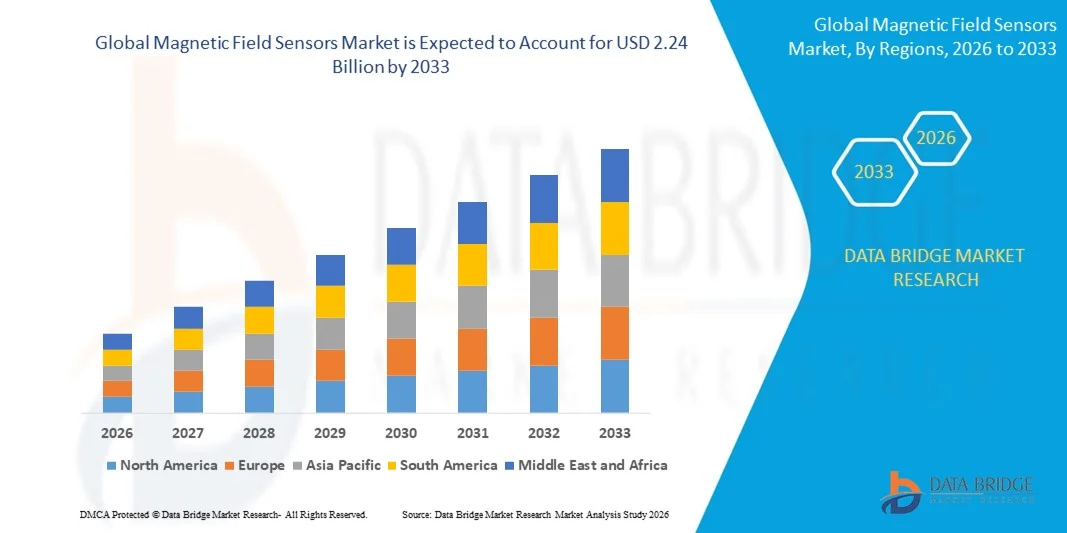
- The global magnetic field sensors market size was valued at USD 1.20 billion in 2025 and is expected to reach USD 2.24 billion by 2033, at a CAGR of 8.10% during the forecast period
- The market growth is largely fuelled by the rising demand for position sensing, speed detection, and current measurement applications across automotive, consumer electronics, and industrial automation sectors
- Increasing adoption of electric vehicles, expansion of smart consumer devices, and growing integration of IoT-enabled sensing technologies are further accelerating market expansion
Magnetic Field Sensors Market Analysis
- The market is witnessing steady growth driven by technological advancements in Hall effect, magnetoresistive, and fluxgate sensor technologies, enabling higher sensitivity, miniaturization, and improved energy efficiency across diverse end-use applications
- Growing emphasis on automation, safety systems, and energy-efficient electronic devices, combined with expanding semiconductor manufacturing capabilities, is strengthening the competitive landscape and supporting long-term industry development
- North America dominated the magnetic field sensors market with the largest revenue share in 2025, driven by strong demand from automotive electrification, industrial automation, and advanced consumer electronics manufacturing
- Asia-Pacific region is expected to witness the highest growth rate in the global magnetic field sensors market, driven by rapid expansion of automotive production, strong consumer electronics manufacturing, and increasing investments in renewable energy and smart industrial systems
- The Hall Effect Sensors segment held the largest market revenue share in 2025 driven by their widespread adoption in automotive, consumer electronics, and industrial applications due to cost-effectiveness, compact size, and reliable performance. Hall effect sensors are extensively used for position, speed, and current sensing, making them a preferred choice across high-volume manufacturing sectors
Report Scope and Magnetic Field Sensors Market Segmentation
|
Attributes |
Magnetic Field Sensors Key Market Insights |
|
Segments Covered |
|
|
Countries Covered |
North America
Europe
Asia-Pacific
Middle East and Africa
South America
|
|
Key Market Players |
|
|
Market Opportunities |
|
|
Value Added Data Infosets |
In addition to the insights on market scenarios such as market value, growth rate, segmentation, geographical coverage, and major players, the market reports curated by the Data Bridge Market Research also include in-depth expert analysis, geographically represented company-wise production and capacity, network layouts of distributors and partners, detailed and updated price trend analysis and deficit analysis of supply chain and demand. |
Magnetic Field Sensors Market Trends
Rising Adoption Of Electric Vehicles And Advanced Driver Assistance Systems
- The rapid expansion of electric vehicles and advanced driver assistance systems is significantly shaping the magnetic field sensors market, as automakers increasingly integrate sensing technologies for position detection, speed measurement, and current monitoring. Magnetic field sensors are gaining traction due to their high precision, durability, and ability to operate in harsh automotive environments. This trend strengthens their adoption across powertrain, battery management, and safety systems, encouraging manufacturers to develop compact and energy-efficient sensor solutions
- Increasing focus on vehicle electrification, emission reduction, and intelligent mobility solutions has accelerated demand for Hall effect and magnetoresistive sensors in traction motors, anti-lock braking systems, and steering angle detection. Automotive OEMs are prioritizing reliable sensing components to enhance safety and performance. This has also led to collaborations between semiconductor companies and automotive manufacturers to improve sensor integration and functional reliability
- Technological advancements in miniaturization, signal processing, and integration with microcontrollers are influencing product innovation. Manufacturers are emphasizing low power consumption and improved sensitivity to meet evolving automotive standards. These developments are helping companies differentiate offerings in a competitive landscape while supporting next-generation electric and hybrid vehicle platforms
- For instance, in 2024, Infineon Technologies in Germany and Allegro MicroSystems in the U.S. expanded their automotive magnetic sensor portfolios for electric vehicle platforms. These product launches focused on enhanced current sensing accuracy and thermal stability, supporting improved battery efficiency and drivetrain performance. The solutions were introduced to strengthen partnerships with global automotive OEMs and Tier 1 suppliers
- While automotive demand remains strong, sustained market growth depends on continued R&D investment, semiconductor supply chain stability, and compliance with evolving vehicle safety standards. Companies are focusing on scalable manufacturing, cost optimization, and innovation to meet increasing global EV production targets
Magnetic Field Sensors Market Dynamics
Driver
Growing Integration In Automotive And Industrial Automation Applications
- Rising integration of magnetic field sensors in electric vehicles, industrial robots, and automated machinery is a major driver for the market. Manufacturers are increasingly adopting these sensors for precise position tracking, motor control, and current sensing to improve efficiency and operational safety. This trend is also accelerating research into high-performance magnetoresistive technologies and advanced packaging solutions
- Expanding applications in renewable energy systems, consumer electronics, and smart appliances are influencing market growth. Magnetic field sensors enhance operational accuracy and reliability in wind turbines, smart meters, and wearable devices, enabling manufacturers to meet performance and energy efficiency requirements. The increasing deployment of IoT-enabled systems globally further reinforces this trend
- Semiconductor and electronics companies are actively promoting innovative sensor solutions through product development and strategic partnerships. These initiatives are supported by growing demand for automation and intelligent monitoring systems across industries. Collaboration between chip manufacturers and equipment producers is improving system integration and reducing overall power consumption
- For instance, in 2023, NXP Semiconductors in the Netherlands and TDK Corporation in Japan expanded their industrial and automotive sensor offerings to support automation and EV platforms. This development followed increased demand for high-precision sensing in robotics and energy-efficient vehicles, strengthening competitive positioning and market penetration
- Although expanding applications support growth, long-term adoption depends on cost reduction, technological differentiation, and stable raw material supply. Investment in advanced semiconductor fabrication and efficient design architectures will be critical for sustaining global demand
Restraint/Challenge
High Production Costs And Supply Chain Constraints
- The relatively high production cost of advanced magnetic field sensors compared to conventional sensing technologies remains a key challenge. Complex semiconductor fabrication processes and reliance on rare earth materials contribute to elevated manufacturing expenses. In addition, fluctuations in raw material availability can affect pricing stability and profit margins
- Limited awareness and technical expertise in certain emerging markets also restrict broader adoption. Small-scale manufacturers may face challenges integrating advanced sensors into legacy systems. This can slow technology transition in developing regions where industrial automation is still evolving
- Supply chain disruptions and geopolitical uncertainties impact semiconductor availability and component sourcing. Magnetic field sensor manufacturers must manage logistics, quality standards, and compliance requirements, increasing operational complexity. Companies are required to invest in diversified sourcing strategies and localized production capabilities to mitigate risks
- For instance, in 2024, electronics distributors in Southeast Asia reported procurement delays affecting automotive and industrial clients using sensor solutions from companies such as Melexis and ROHM Semiconductor. These delays were attributed to semiconductor supply fluctuations and increased demand from EV manufacturers. As a result, some system integrators postponed product rollouts, temporarily impacting market momentum
- Addressing these challenges will require investment in manufacturing efficiency, supply chain resilience, and regional production expansion. Strengthening partnerships with automotive OEMs, industrial equipment manufacturers, and semiconductor foundries will be essential to unlock the long-term growth potential of the global magnetic field sensors market
Magnetic Field Sensors Market Scope
The market is segmented on the basis of type, range, application, and end users.
- By Type
On the basis of type, the magnetic field sensors market is segmented into Hall Effect Sensors, Magneto Resistive Sensors, SQUID Sensors, Fluxgate Sensors, and Others. The Hall Effect Sensors segment held the largest market revenue share in 2025 driven by their widespread adoption in automotive, consumer electronics, and industrial applications due to cost-effectiveness, compact size, and reliable performance. Hall effect sensors are extensively used for position, speed, and current sensing, making them a preferred choice across high-volume manufacturing sectors.
The Magneto Resistive Sensors segment is expected to witness the fastest growth rate from 2026 to 2033, driven by their higher sensitivity and accuracy compared to conventional sensing technologies. These sensors are increasingly adopted in advanced automotive systems, robotics, and navigation devices where precise magnetic field detection is critical. Their ability to operate efficiently in low-field environments further supports their growing demand.
- By Range
On the basis of range, the market is segmented into <1 Micro Gauss (Low-Field Sensors), 1 Micro Gauss–10 Gauss (Earth Field Sensors), and >10 Gauss (BIAS Magnetic Field Sensors) Consoles. The 1 Micro Gauss–10 Gauss (Earth Field Sensors) segment held the largest market revenue share in 2025 driven by its extensive use in navigation systems, electronic compasses, and industrial monitoring applications. These sensors are widely deployed for detecting Earth’s magnetic field and enabling orientation and positioning functions.
The <1 Micro Gauss (Low-Field Sensors) segment is expected to witness the fastest growth rate from 2026 to 2033, driven by increasing demand in scientific research, medical diagnostics, and precision measurement applications. Growing advancements in healthcare imaging and laboratory instrumentation are contributing to higher adoption of ultra-sensitive magnetic field detection technologies.
- By Application
On the basis of application, the market is segmented into Speed Sensing, Flow Rate Sensing, Detection, Position Sensing, Navigation and Electronic Compass, and Others. The Position Sensing segment held the largest market revenue share in 2025 driven by rising integration in electric vehicles, industrial automation, and consumer electronics. Magnetic field sensors play a crucial role in ensuring accurate motor control, battery monitoring, and mechanical alignment across diverse systems.
The Navigation and Electronic Compass segment is expected to witness the fastest growth rate from 2026 to 2033, driven by increasing adoption in smartphones, wearable devices, drones, and automotive navigation systems. Growing demand for precise orientation tracking and real-time positioning capabilities is further accelerating segment expansion.
- By End Users
On the basis of end users, the market is segmented into Transportation, Consumer Electronics, BFSI, Healthcare, Aerospace and Defense, Industrial, and Others Sectors. The Transportation segment held the largest market revenue share in 2025 driven by rapid electrification of vehicles, integration of advanced driver assistance systems, and expansion of battery management technologies. Magnetic field sensors are widely used in powertrain systems, safety components, and electric propulsion systems.
The Healthcare segment is expected to witness the fastest growth rate from 2026 to 2033, driven by increasing application of magnetic sensing technologies in diagnostic equipment, medical imaging systems, and patient monitoring devices. Advancements in precision healthcare instrumentation and growing demand for non-invasive diagnostic solutions are contributing to sustained growth in this segment.
Magnetic Field Sensors Market Regional Analysis
- North America dominated the magnetic field sensors market with the largest revenue share in 2025, driven by strong demand from automotive electrification, industrial automation, and advanced consumer electronics manufacturing
- End users in the region highly value the precision, durability, and energy efficiency offered by magnetic field sensors in applications such as electric vehicles, robotics, and smart devices
- This widespread adoption is further supported by robust semiconductor infrastructure, high R&D investments, and the rapid deployment of advanced driver assistance systems, establishing magnetic sensing technologies as critical components across transportation and industrial sectors
U.S. Magnetic Field Sensors Market Insight
The U.S. magnetic field sensors market captured the largest revenue share in 2025 within North America, fueled by strong innovation in semiconductor technologies and the rapid expansion of electric vehicle production. Manufacturers are increasingly integrating magnetic sensors into battery management systems, motor control units, and safety mechanisms to enhance performance and reliability. Growing investments in automation, aerospace systems, and renewable energy projects further propel market growth. Moreover, the presence of leading chip designers and automotive OEMs significantly contributes to industry expansion.
Europe Magnetic Field Sensors Market Insight
The Europe magnetic field sensors market is expected to witness the fastest growth rate from 2026 to 2033, primarily driven by increasing adoption of electric vehicles and Industry 4.0 initiatives. The rise in industrial automation, combined with strict emission regulations, is fostering demand for high-precision sensing technologies. European manufacturers are also emphasizing energy-efficient and sustainable electronic components. The region is experiencing notable growth across automotive, industrial, and renewable energy applications, with magnetic sensors increasingly integrated into advanced control systems.
U.K. Magnetic Field Sensors Market Insight
The U.K. magnetic field sensors market is expected to witness the fastest growth rate from 2026 to 2033, driven by rising investments in electric mobility and smart manufacturing infrastructure. In addition, demand for high-performance sensors in aerospace, defense, and robotics applications is supporting industry development. The country’s focus on innovation and advanced engineering capabilities continues to stimulate adoption across multiple sectors.
Germany Magnetic Field Sensors Market Insight
The Germany magnetic field sensors market is expected to witness the fastest growth rate from 2026 to 2033, fueled by the country’s strong automotive manufacturing base and leadership in industrial automation. Germany’s emphasis on precision engineering and electric vehicle development promotes the integration of advanced magnetic sensing technologies. Increasing deployment in factory automation, robotics, and renewable energy systems further supports sustained market expansion.
Asia-Pacific Magnetic Field Sensors Market Insight
The Asia-Pacific magnetic field sensors market is expected to witness the fastest growth rate from 2026 to 2033, driven by rapid industrialization, expanding consumer electronics production, and increasing electric vehicle adoption in countries such as China, Japan, and India. The region’s growing semiconductor manufacturing capacity and supportive government initiatives for digital transformation are accelerating demand. In addition, the presence of large-scale electronics manufacturers enhances market penetration and accessibility.
Japan Magnetic Field Sensors Market Insight
The Japan magnetic field sensors market is expected to witness the fastest growth rate from 2026 to 2033 due to strong advancements in robotics, automotive electronics, and precision instrumentation. The Japanese market places significant emphasis on high-quality and reliable sensing components, encouraging adoption in electric vehicles, industrial machinery, and smart consumer devices. Integration with IoT-enabled systems and automation platforms is further fueling growth.
China Magnetic Field Sensors Market Insight
The China magnetic field sensors market accounted for the largest market revenue share in Asia Pacific in 2025, attributed to rapid expansion of electric vehicle manufacturing, large-scale consumer electronics production, and strong government support for semiconductor development. China represents one of the largest markets for automotive and industrial sensors, with increasing integration in smart manufacturing and renewable energy systems. The availability of cost-effective production capabilities and domestic component suppliers plays a key role in accelerating market growth in China.
Magnetic Field Sensors Market Share
The Magnetic Field Sensors industry is primarily led by well-established companies, including:
- LPS ALPINE CO., LTD. (Japan)
- Baumer (Switzerland)
- Crocus Technology (U.S.)
- Elmos Semiconductor AG (Germany)
- HONEYWELL INTERNATIONAL INC. (U.S.)
- Magnetic Sensors Corporation (U.S.)
- Melexis (Belgium)
- TDK Corporation (Japan)
- Sensitec GmbH (Germany)
- Analog Devices, Inc. (U.S.)
- Bosch Sensortec GmbH (Germany)
- NXP Semiconductors (Netherlands)
- NVE Corporation (U.S.)
- MultiDimension Technology Co., Ltd. (China)
- Allegro MicroSystems, LLC (U.S.)
- Diodes Incorporated (U.S.)
- Infineon Technologies AG (Germany)
- STMicroelectronics (Switzerland)
- TE Connectivity (Switzerland)
- Asahi Kasei Microdevices Corporation (Japan)
Latest Developments in Global Magnetic Field Sensors Market
- In January 2024, Infineon Technologies AG, product portfolio expansion, broadened its range of magnetic sensors tailored for automotive and industrial applications, particularly targeting advanced driver assistance systems in electric vehicles and automation equipment. The newly introduced sensors are engineered to deliver high accuracy, enhanced thermal stability, and low power consumption for safety-critical position and speed sensing functions. This development aims to improve system reliability and energy efficiency in EV powertrains and smart manufacturing systems. The expansion strengthens Infineon’s competitive positioning in the semiconductor sensing segment and supports growing global demand for precision magnetic sensing solutions

- Interactive Data Analysis Dashboard
- Company Analysis Dashboard for high growth potential opportunities
- Research Analyst Access for customization & queries
- Competitor Analysis with Interactive dashboard
- Latest News, Updates & Trend analysis
- Harness the Power of Benchmark Analysis for Comprehensive Competitor Tracking
Global Magnetic Field Sensors Market, Supply Chain Analysis and Ecosystem Framework
To support market growth and help clients navigate the impact of geopolitical shifts, DBMR has integrated in-depth supply chain analysis into its Global Magnetic Field Sensors Market research reports. This addition empowers clients to respond effectively to global changes affecting their industries. The supply chain analysis section includes detailed insights such as Global Magnetic Field Sensors Market consumption and production by country, price trend analysis, the impact of tariffs and geopolitical developments, and import and export trends by country and HSN code. It also highlights major suppliers with data on production capacity and company profiles, as well as key importers and exporters. In addition to research, DBMR offers specialized supply chain consulting services backed by over a decade of experience, providing solutions like supplier discovery, supplier risk assessment, price trend analysis, impact evaluation of inflation and trade route changes, and comprehensive market trend analysis.
Data collection and base year analysis are done using data collection modules with large sample sizes. The stage includes obtaining market information or related data through various sources and strategies. It includes examining and planning all the data acquired from the past in advance. It likewise envelops the examination of information inconsistencies seen across different information sources. The market data is analysed and estimated using market statistical and coherent models. Also, market share analysis and key trend analysis are the major success factors in the market report. To know more, please request an analyst call or drop down your inquiry.
The key research methodology used by DBMR research team is data triangulation which involves data mining, analysis of the impact of data variables on the market and primary (industry expert) validation. Data models include Vendor Positioning Grid, Market Time Line Analysis, Market Overview and Guide, Company Positioning Grid, Patent Analysis, Pricing Analysis, Company Market Share Analysis, Standards of Measurement, Global versus Regional and Vendor Share Analysis. To know more about the research methodology, drop in an inquiry to speak to our industry experts.
Data Bridge Market Research is a leader in advanced formative research. We take pride in servicing our existing and new customers with data and analysis that match and suits their goal. The report can be customized to include price trend analysis of target brands understanding the market for additional countries (ask for the list of countries), clinical trial results data, literature review, refurbished market and product base analysis. Market analysis of target competitors can be analyzed from technology-based analysis to market portfolio strategies. We can add as many competitors that you require data about in the format and data style you are looking for. Our team of analysts can also provide you data in crude raw excel files pivot tables (Fact book) or can assist you in creating presentations from the data sets available in the report.













