



Segmentação global do mercado de cremes não lácteos, por tipo (Creme Powdered, Creme Líquido), Fonte (Vegetable Oil-Based (Palm Oil, Óleo de coco, Óleo de soja), Amido, Base de Soja, Outros), Aplicação (Beberagens (Café, Chá), Padaria e Confeitaria, Sobremesas e Sorvete, Sopas e Sauces, Outros), Natureza (Organic, Convencional), Tipo de Embalagem (Pouches, Garrafas/Cans, Sacos/Single-Serve, Cartons), Flavor (Original/Desflavored, Flavored (Vanilla, Hazelnut, Caramel, Outros), Canal de Distribuição (Supermercados/Hypermarkets, Lojas de Conveniência, Varejo Online, Serviço Alimentar/HoReCa), Usuário Final (Household/Retail, Foodservice (Cafes, Restaurantes, QSR), Industrial/Farigtable Industry (Fel)) e Conteúdo (Fold-Fold)
Qual é o tamanho e a taxa de crescimento do mercado de Creamer não lácteos
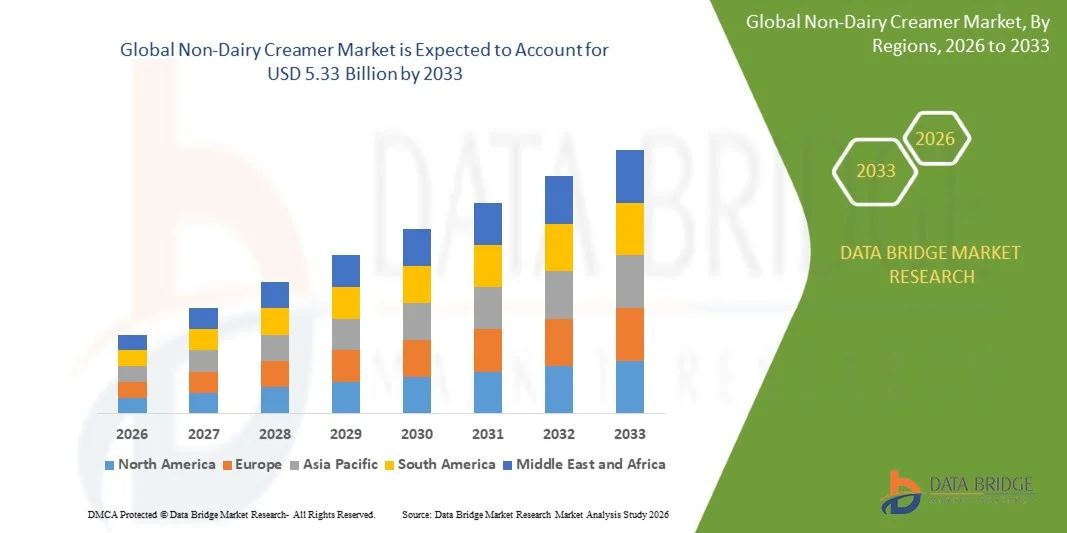
- De acordo com a análise Data Bridge Market Research, o mercado de cremes não lácteos foi avaliado emUSD 2,88 mil milhões em 2025e é projetado para alcançarUSD 5,33 mil milhões até 2033, crescendo emCAGR de 8,00% de 2026 a 2033.
- O mercado vive um crescimento constante impulsionado pelo crescimento globalcafé e cháconsumo, crescimentointolerância à lactosee sensibilização para a alergia láctea, e aumento da preferência dos consumidores pela estabilidade de prateleiras,alternativas leiteirasem ambientes domésticos e de serviços alimentares.
- A crescente cultura de café e a expansão da pegada de restaurante de serviço rápido em economias emergentes, combinada com a crescente demanda de produtos alimentares à base de plantas e vegan, está a obrigar os fabricantes a reformular os cremes não lácteos utilizando bases de coco, aveia e soja como alternativas às formulações convencionais de óleo de palma. Aumentar o escrutínio dos consumidores sobre a transparência dos ingredientes reforça ainda mais a procura de formulações mais limpas e não hidrogenadas de cremes nos canais retalhistas e de serviços alimentares.
- A expansão contínua dos formatos de embalagem mono-servidor e controlado por porção está a permitir aos operadores de serviços alimentares e aos consumidores de conveniência o acesso a cremes não lácteos com uma melhor higiene, portabilidade e redução dos resíduos de produtos em comparação com as embalagens a granel tradicionais.
- O crescente interesse do consumidor em fontes de plantas à base de aveia e outras novas, além das formulações convencionais de coco e soja, está levando os fabricantes a diversificar seus portfólios de ingredientes, abordando a demanda dos consumidores em busca de alternativas conscientes de alergénios tanto aos cremes de leite como aos tradicionais de óleo vegetal.
Tamanho e previsão do mercado
- Valor de Mercado Global (2025): USD 2,88 bilhões
- Valor de mercado esperado (2033): USD 5,33 Bilhões
- Previsões CAGR (2026-2033): 8,00%
- Região líder em 2025: Ásia-Pacífico
- Região de crescimento mais rápido: América do Norte
Quais são as principais takeaways do Mercado de Creamer Não-Dairy
- A Ásia-Pacífico dominou o mercado global de cremes não lácteos com a maior quota de receita de 41,72% em 2025, apoiado por altos volumes de consumo de café e chá e forte capacidade de fabricação de creme doméstico em toda a Indonésia, China e Índia.
- Espera-se que a América do Norte seja a região de crescimento mais rápido em um CAGR de 9,6% de 2026 a 2033, alimentado pelo aumento da demanda por alternativas à base de plantas e sem lactose e expansão da cultura de café especializada.
- O segmento de creme em pó liderou o mercado com uma participação de 58,34% em 2025, impulsionada pela sua longa vida útil, facilidade de transporte e uso generalizado em aplicações domésticas e de serviços alimentares.
- O segmento de fonte de óleo vegetal é a categoria de fonte de crescimento mais rápido, projetada para registrar um CAGR de 9,2%, refletindo a adoção crescente de formulações de coco e outras de óleo vegetal como alternativas aos cremes convencionais à base de óleo de palma.
- O segmento de aplicação de bebidas dominou a categoria de aplicação com uma quota de receita de 68,43% em 2025, liderada pela demanda global sustentada por branqueadores de café e chá em todos os canais de varejo e de serviço alimentar.
- O canal de distribuição foodservice/HoReCa representou 34,86% do market share em 2025, preferido pela sua eficiência de compra a granel e desempenho consistente do produto na preparação de bebidas de alto volume.
- O segmento de natureza orgânica é a categoria de crescimento mais rápido, com um CAGR de 10,4%, impulsionado pela crescente demanda do consumidor por formulações limpas e não-GMO cremes em todos os segmentos de consumo conscientes da saúde.
Alcance do relatório e segmentação do mercado não-dairy Creamer
|
Atributos |
Insights de Mercado Chave Creme Não-Lactantes |
|
Segmentos Cobertos |
|
|
Países abrangidos |
América do Norte
Europa
Ásia- Pacífico
Médio Oriente e África
América do Sul
|
|
Jogadores do mercado chave |
|
|
Oportunidades de Mercado |
|
|
Informações sobre o Valor Adicionado |
Além dos insights sobre cenários de mercado, como valor de mercado, taxa de crescimento, segmentação, cobertura geográfica e principais atores, os relatórios de mercado curados pela Data Bridge Market Research também incluem análise de especialistas em profundidade, análise de preços, análise de compartilhamento de marca, inquérito ao consumidor, análise demografia, análise da cadeia de suprimentos, análise da cadeia de valor, visão geral da matéria-prima/consumíveis, critérios de seleção de fornecedores, Análise de PESTLE, Análise de Porter e marco regulatório. |
Qual é a tendência chave no mercado Creamer não-dairy
- Os fabricantes estão cada vez mais reformulando cremes não lácteos usando coco, aveia e outros óleos vegetais para substituir formulações convencionais de óleo de palma e gordura hidrogenada em resposta às preocupações de saúde e sustentabilidade dos consumidores.
- Por exemplo, em abril de 2025, a Nestlé expandiu seu portfólio de cremes à base de plantas no Sudeste Asiático com uma formulação baseada em óleo de coco visando consumidores de café e chá conscientes da saúde buscando alternativas mais limpas.
- A adoção crescente de formatos de embalagem mono-servidores e porções controladas está a permitir que os operadores de serviços alimentares e os canais de viagens-retail ofereçam uma melhor higiene e conveniência em comparação com as embalagens tradicionais de cremes para granel.
- Os fabricantes estão cada vez mais investindo em variantes de creme aromatizado, como baunilha, avelã e caramelo para diferenciar produtos e capturar crescente interesse do consumidor em experiências de café premium, estilo café em casa.
- Por exemplo, em janeiro de 2025, a Rich Products introduziu uma linha de creme líquido com sabor expandido visando o segmento de café premium em casa, combinando sabores inspirados em barista com uma longa vida útil refrigerada.
- Uma vez que os consumidores e os operadores de serviços alimentares continuam a priorizar a conveniência, a transparência dos ingredientes e a flexibilidade alimentar, espera-se que a adopção de produtos de nata não lácteos reformulados e premium acelerem, reforçando o seu papel como acompanhamento tradicional do café e do chá nos canais de comércio retalhista e de serviços alimentares.
Quais são os Principais Drivers do Mercado de Creamer Não-Dairy
- O aumento do consumo global de café e chá, combinado com o aumento da intolerância à lactose e a sensibilização para a alergia láctea, tem aumentado significativamente a procura de alternativas de cremes não lácteos rentáveis e estáveis.
- Por exemplo, em março de 2025, Cargill expandiu sua capacidade de produção de ingredientes não lácteos na Ásia para atender à crescente demanda dos fabricantes regionais de alimentos e bebidas.
- Os operadores de serviços alimentares e os fabricantes de bebidas estão cada vez mais incorporando cremes não lácteos em formulações de produtos padrão para reduzir os custos de ingredientes, prolongar o prazo de validade e simplificar a logística da cadeia de abastecimento em comparação com alternativas à base de leite.
- Por exemplo, em outubro de 2024, o Kerry Group anunciou um investimento na capacidade de fabricação adicional de cremes não lácteos para apoiar pedidos crescentes de clientes de restaurante e serviço alimentar de serviço rápido em toda a América do Norte e Europa.
- Com o consumo de café e chá continuando a expandir-se em mercados desenvolvidos e emergentes, os cremes não lácteos permanecerão indispensáveis em aplicações domésticas, de serviços alimentares e industriais de fabricação de alimentos em todo o mundo.
- Por exemplo, em junho de 2024, FrieslandCampina expandiu seu portfólio de ingredientes não lácteos para incluir formulações adicionais à base de soja e amido, apoiando a crescente demanda dos fabricantes de produtos à base de plantas.
- Portanto, o aumento do consumo de café e chá, a crescente consciência da intolerância à lactose e a demanda por alternativas acessíveis e estáveis na prateleira estão conduzindo a adoção de cremes não lácteos. Expandir as ofertas de produtos e a capacidade de produção estão apoiando ainda mais o crescimento em aplicações domésticas, de serviços alimentares e industriais.
Que fatores estão desafiando o crescimento do mercado de Creamer não-dairy
- Cremes convencionais não lácteos formulados com óleo de palma e gorduras hidrogenadas enfrentam um crescente escrutínio do consumidor e regulatório sobre o teor de gordura trans e o fornecimento sustentável de óleo de palma, criando pressão de reformulação em toda a indústria.
- Estes requisitos de reformulação e os custos crescentes dos ingredientes vegetais e petrolíferos alternativos limitam a adopção entre os fabricantes mais pequenos e limitam as margens nos segmentos de creme de produtos sensíveis aos preços.
- Por exemplo, pesquisas publicadas em outubro de 2023 na Food Chemistry: X demonstraram o uso de diacilglicerol à base de óleo de coco como uma gordura alternativa para cremes não lácteos, destacando os desafios técnicos envolvidos no desenvolvimento de formulações trans-gordura-livres com estabilidade e propriedades sensoriais comparáveis.
- O aumento do custo das alternativas planta-óleo de origem sustentável e a complexidade da reformulação associada à remoção de gorduras hidrogenadas continuam a restringir a expansão das margens, particularmente entre os fabricantes menores em mercados emergentes sensíveis aos preços. Essa pressão de custo retarda o ritmo da reformulação do rótulo limpo, apesar da crescente demanda do consumidor por alternativas mais saudáveis.
Como é o Mercado de Creamer Não-Lactantes Segmentado
O mercado de cremes não lácteos é segmentado com base no tipo, fonte, aplicação, natureza, tipo de embalagem, sabor, canal de distribuição, usuário final, teor de gordura e estabilidade de prateleira.
- Por Tipo
Com base no tipo, o mercado global de cremes não lácteos é segmentado em creme em pó e creme líquido. O segmento de creme em pó dominou o mercado com uma participação de 58,34% em 2025, devido ao seu prazo de validade prolongado, facilidade de transporte e uso generalizado em aplicações domésticas e de serviços alimentares. Essas formulações oferecem desempenho confiável sem requisitos de refrigeração, tornando-os a escolha preferida para o serviço de alimentos a granel e distribuição orientada para exportação.
O segmento de creme líquido é projetado para registrar o crescimento mais rápido em um CAGR de 9,4% de 2026 a 2033, impulsionado pela crescente preferência do consumidor por formatos prontos para usar que replicam de perto o sabor e a sensação bucal de creme de leite. Avanços na infra-estrutura refrigerada da cadeia de suprimentos, combinada com cultura de café premium crescente, estão acelerando a expansão do segmento. A comodidade dos formatos líquidos sem reconstituição é especialmente atraente para os consumidores mais jovens habituados à preparação de bebidas em casa.
- Por Fonte
Com base na fonte, o mercado global de cremes não lácteos é segmentado em óleo vegetal (óleo de palma, óleo de coco, óleo de soja), amido, à base de soja, entre outros. O segmento de óleo vegetal liderou o mercado com uma participação de 64,72% em 2025, apoiada pela sua produção econômica, propriedades de textura favoráveis e uso generalizado em formulações de creme em pó e líquido.
O segmento de óleo vegetal também deve experimentar o crescimento mais rápido em um CAGR de 9,2% de 2026 a 2033, impulsionado pelo aumento da reformulação para coco e outras alternativas de óleo vegetal para cremes convencionais à base de óleo de palma.
- Por Aplicação
Com base na aplicação, o mercado global de cremes não lácteos é segmentado em bebidas (café, chá), padaria e confeitaria, sobremesas e sorvetes, sopas e molhos, entre outros. O segmento de bebidas dominou o mercado com uma participação de 68,43% em 2025 devido à sua adoção generalizada como um branqueador de café e chá em aplicações domésticas, de serviços alimentares e de máquinas de venda automática, aumentando o consumo global de café e crescendo a expansão da cafeicultura nos mercados emergentes. Além disso, o foco crescente em acompanhamentos de bebidas convenientes e estáveis na prateleira ainda suporta a adoção forte de cremes não lácteos nesta categoria de aplicação.
O segmento de sobremesas e sorvetes é esperado para testemunhar o CAGR mais rápido de 8,9% de 2026 a 2033, impulsionado pelo uso crescente de bases de cremes não lácteos em formulações de sobremesas à base de plantas e sem lactose. Os fabricantes estão adotando ingredientes creme não lácteos para conduzir a formulação de sobremesa-produto rentável, escalável e repetivel. Além disso, a integração de cremes não lácteos em linhas de produtos de sobremesa vegan e sem lactose está aumentando a flexibilidade da formulação, impulsionando o crescimento do segmento.
- Por Natureza
Com base na natureza, o mercado global de cremes não lácteos é segmentado em orgânico e convencional. O segmento convencional dominou o mercado com uma participação de 83,67% em 2025 devido à sua adoção generalizada em aplicações de serviços domésticos e alimentares sensíveis aos custos, onde o preço continua a ser a principal consideração de compra. A ampla disponibilidade de formulações convencionais de cremes nos principais canais de varejo e foodservice está impulsionando forte demanda por esta categoria de natureza.
Espera-se que o segmento orgânico testemunhe o CAGR mais rápido de 10,4%, de 2026 a 2033, impulsionado pela crescente demanda do consumidor por formulações de cremes de marca limpa e não-GMO entre compradores conscientes da saúde e com foco premium. Os fabricantes estão cada vez mais certificando os processos de fornecimento e produção de ingredientes orgânicos. Além disso, a crescente ênfase na transparência de ingredientes no varejo de café especializado está acelerando ainda mais a adoção desta categoria de natureza. Cadeias de café Premium também estão cada vez mais apresentando opções de creme orgânico como um diferenciador em seus menus de bebidas, reforçando ainda mais o crescimento da categoria.
- Por tipo de embalagem
Com base no tipo de embalagem, o mercado global de cremes não lácteos é segmentado em bolsas, garrafas / latas, saquetas / serviço único, e caixas. O segmento de bolsas dominou o mercado com uma participação de 39,72% em 2025 devido ao seu papel crítico na oferta de embalagens a granel rentáveis e ressealáveis para aplicações caseiras e alimentícias em pó. A alta adoção é impulsionada pela crescente necessidade de armazenamento estendido estável em prateleiras, integração com formatos de visualização de prateleiras de varejo e maior eficiência de custo de produto. Além disso, o crescente investimento de fabricantes e varejistas para otimizar os custos de material de embalagem está reforçando a posição de liderança desse segmento no mercado.
Espera-se que o segmento de saquetas/single-serve testemunhe o CAGR mais rápido de 9,8% de 2026 a 2033, impulsionado pelo aumento da demanda por formatos de embalagem higiênicos e controlados por porção em aplicações de serviço alimentar, hospitalidade e retorno de viagens. A adoção crescente de pacotes de creme de serviço único em restaurantes de serviço rápido e cadeias de hotéis está acelerando ainda mais a expansão do mercado neste segmento.
- Por Sabor
Com base no sabor, o mercado global de cremes não lácteos é segmentado em original / sem sabor e sabor (vanilla, avelã, caramelo, outros). O segmento original/desaprovado dominou o mercado com uma participação de 71,28% em 2025 devido ao seu uso generalizado como o formato padrão de creme em aplicações domésticas e de serviço de alimentos que exigem compatibilidade sabor neutro com uma ampla gama de bebidas. A adoção crescente de cremes em pó e líquidos sem sabor em todo o varejo principal e canais institucionais está impulsionando forte demanda para esta categoria de sabor.
O segmento aromatizado é esperado para testemunhar o CAGR mais rápido de 9,6% de 2026 a 2033, impulsionado pelo crescente interesse do consumidor em premium, café-estilo em casa café experiências com baunilha, avelã, caramelo e variantes de sabor sazonal. Os fabricantes estão expandindo cada vez mais linhas de produtos aromatizados para diferenciar ofertas. Além disso, a ênfase crescente na prémio na categoria de café em casa está acelerando ainda mais a adoção desta categoria sabor.
- Por Canal de Distribuição
Com base no canal de distribuição, o mercado global de cremes não lácteos é segmentado em supermercados/hipermercados, lojas de conveniência, varejo online e foodservice/HoReCa. O segmento de supermercados/hipermercados dominou o mercado com uma participação de 42,63% em 2025 devido à sua adoção generalizada como principal canal de varejo para compras de cremes domésticos, oferecendo ampla visibilidade de produto-assorte e preços competitivos. A alta adoção é apoiada por cadeias de varejo e fabricantes que dependem de relações de supermercado estabelecidas para garantir consistência, visibilidade de prateleira e resultados de vendas mensuráveis. Além disso, o aumento da integração com programas de fidelidade e promoção de varejo aumenta a acessibilidade ao consumidor e reforça o domínio do segmento supermercados/hipermercados.
Espera-se que o segmento de varejo on-line testemunhe o CAGR mais rápido de 10,7% de 2026 a 2033, impulsionado pela crescente preferência do consumidor pela compra de mercearia conveniente e baseada em assinaturas e alimentos especiais através de plataformas de comércio eletrônico. Ao oferecer um fornecimento acessível e econômico direto ao consumidor, este canal melhora a descoberta do produto, a compra de conveniência e a consistência de compra repetida, tornando-o altamente atraente para as marcas tradicionais e especiais de cremes não lácteos.
- Por Usuário Final
Com base no usuário final, o mercado global de cremes não lácteos é segmentado em casa / varejo, serviço de alimentos (cafés, restaurantes, QSR), e fabricantes industriais / alimentos. O segmento doméstico/retalho dominou o mercado com uma participação de 46,85% em 2025 devido à sua adoção generalizada entre consumidores individuais, buscando café conveniente e estável e branqueador de chá para consumo domiciliar diário. Além disso, redes de distribuição de varejo estabelecidas, reconhecimento de marcas amplas e ampla disponibilidade de produtos estão facilitando a adoção continuada de cremes não lácteos entre consumidores domésticos, enquanto redes de suporte de varejo fortes estão melhorando a acessibilidade, confiabilidade e confiança, reforçando ainda mais a posição líder deste segmento no mercado.
Espera-se que o segmento de serviços alimentares (cafes, restaurantes, QSR) testemunhe o CAGR mais rápido de 9,3% de 2026 a 2033, impulsionado pela expansão da cultura de café global e pela rápida pegada de restaurante que requer ingredientes consistentes e econômicos para preparar bebidas. Os operadores de serviços alimentares estão alavancando a aquisição de cremes a granel para melhorar o controle de custos, garantir a consistência das bebidas e apoiar operações diárias de alto volume, acelerando assim a adoção em todo o setor mundial de serviços alimentares em expansão.
- Por teor de gordura
Com base no teor de gordura, o mercado global de cremes não lácteos é segmentado em gordura total, baixo teor de gordura e sem gordura. O segmento de gordura integral dominou o mercado com uma parcela de 54,36% em 2025 devido à sua preferência entre consumidores e operadores de serviços alimentares em busca de sabor rico, laticínios e boca em preparação de café e chá. Além disso, os processos de formulação estabelecidos, a ampla familiaridade do fabricante e o extenso histórico de desempenho do produto estão facilitando a adoção continuada de cremes de gordura integral, enquanto a forte preferência pelo gosto do consumidor está melhorando a confiabilidade da compra repetida, reforçando ainda mais a posição de mercado deste segmento.
Espera-se que o segmento de baixa gordura testemunhe o CAGR mais rápido de 9,1% de 2026 a 2033, impulsionado pelo crescente foco do consumidor nas escolhas alimentares consciente de calorias e orientadas para a saúde, sem sacrificar totalmente os benefícios de sabor e textura dos produtos tradicionais de creme. Os fabricantes estão alavancando tecnologias reformuladas de redução de gordura para melhorar o apelo nutricional, permitir um posicionamento mais saudável e apoiar segmentos crescentes de consumidores focados no bem-estar.
- Por Estabilidade da prateleira
Com base na estabilidade da prateleira, o mercado global de cremes não lácteos é segmentado em prateleira-estável/ambiente e refrigerado. O segmento estável/ambiente de prateleira dominou o mercado com uma participação de 76,42% em 2025 devido ao seu papel crítico em oferecer flexibilidade de armazenamento estendida, logística simplificada e amplo alcance de distribuição em mercados desenvolvidos e emergentes sem requisitos de infraestrutura de cadeia fria. Além disso, os processos de fabricação e embalagem estabelecidos, a ampla familiaridade do distribuidor e a ampla compatibilidade do mercado de exportação estão facilitando a adoção continuada de cremes estáveis em prateleiras em mercados globais.
Espera-se que o segmento refrigerado testemunhe o CAGR mais rápido de 8,7% de 2026 a 2033, impulsionado pela crescente preferência do consumidor por produtos frescos de creme líquido tipo laticínio em mercados desenvolvidos com infraestrutura de varejo de cadeia fria estabelecida. Os fabricantes estão alavancando redes de distribuição refrigeradas para melhorar a frescura do produto, permitir o posicionamento premium e apoiar o crescimento do consumo de café especializado em casa, acelerando assim a adoção em mercados de varejo desenvolvidos.
Qual é a região que detém a maior parte do mercado de cremes não lácteos
- A Ásia-Pacífico dominou o mercado de cremes não lácteos e representou a maior parte de receita de 41,72% em 2025, apoiada por altos volumes de consumo de café e chá, forte capacidade de fabricação de cremes domésticos, e a presença de produtores regionais estabelecidos em toda a Indonésia, China e Índia.
- A região também se beneficia da disponibilidade competitiva de matéria-prima de óleo de palma, da alta adoção de formatos de creme em pó adequados para climas quentes sem infraestrutura de cadeia fria e da crescente utilização de cremes não lácteos em aplicações domésticas e de serviços alimentares. O foco crescente na indústria transformadora orientada para a exportação e o aumento da expansão da cafeicultura doméstica continuam a fortalecer a posição de liderança da Ásia-Pacífico no mercado global.
China Creamer não-dairy Market Insight
O mercado de cremes não lácteos da China está se expandindo constantemente, apoiado pelo aumento do consumo urbano de café e chá, aumento da capacidade de fabricação de alimentos domésticos e aumento dos investimentos no desenvolvimento de produtos cremosos aromatizados e premium. Os fabricantes e operadores de serviços alimentares estão cada vez mais incorporando cremes não lácteos em aplicações tradicionais de chá-beberage e modernas cafeterias. A expansão contínua da infraestrutura de produção nacional e o aumento do consumo urbano de classe média estão impulsionando ainda mais o crescimento do mercado na China.
Índia Creamer não-dairy Market Insight
O mercado indiano de cremes não lácteos está se expandindo constantemente, apoiado pelo aumento do consumo de chá e café, aumento do serviço de alimentos organizado e penetração de restaurante de serviço rápido, e aumento da capacidade de fabricação doméstica. Os operadores de serviços alimentares e os consumidores domésticos estão cada vez mais a integrar os cremes não lácteos na preparação diária de bebidas. Avanços contínuos nos processos de fabricação otimizados por custos, juntamente com forte crescimento da demanda interna, estão impulsionando o crescimento do mercado na Índia.
Europe Non-Dairy Creamer Market Insight
O mercado europeu de cremes não lácteos está a expandir-se à medida que os consumidores adoptam cada vez mais dietas de base vegetal, isentas de lactose e flexitárias. A procura é apoiada pela forte cultura do café na Europa, pela crescente sensibilização para a saúde e pela preferência por alternativas de produtos lácteos convenientes. Aveia, amêndoa, soja e cremes à base de coco estão ganhando atenção, enquanto formulações limpas, fortificadas e aromatizadas estão apoiando a inovação do produto. A Alemanha, o Reino Unido, a França e a Itália representam mercados importantes, com os serviços alimentares e os canais retalhistas a criar novas oportunidades. Preços premium, gosto, textura e concorrência de laticínios convencionais continuam a ser desafios fundamentais.
Alemanha Não-Lacticínios Mercado Insight
O mercado alemão de cremes não lácteos está a assistir a um crescimento constante devido à forte cultura de café do país, ao crescente interesse do consumidor em produtos alimentares à base de plantas e sem lactose, e ao aumento da adopção de cremes não lácteos em aplicações de retalho e de serviços alimentares. Os fabricantes de alimentos, os varejistas e os operadores de serviços alimentares estão cada vez mais padronizando a aquisição de cremes para atender às preferências alimentares em evolução. Os avanços contínuos na reformulação do rótulo limpo e na inovação em embalagens estão apoiando ainda mais o crescimento do mercado na Alemanha.
França Creamer não-dairy Market Insight
O mercado francês de cremes não lácteos é apoiado pelo crescente interesse do consumidor em alternativas de produtos lácteos à base de plantas, particularmente entre consumidores flexionistas que procuram escolhas diversas e sustentáveis. A demanda por formulações à base de aveia, amêndoa, soja e coco está se expandindo em aplicações de varejo, café e serviço alimentar. O ecossistema alimentar de base vegetal estabelecido pela França e a crescente disponibilidade de produtos lácteos alternativos criam oportunidades para os fabricantes de cremes não lácteos. No entanto, os preços premium, as expectativas de gosto e a concorrência dos produtos lácteos convencionais continuam a ser os principais desafios do mercado.
Quais são as principais empresas no mercado de cremes não lácteos
A indústria não leiteira é liderada principalmente por empresas bem estabelecidas, incluindo:
- Nestlé S.A.(Suíça)
- FrieslandCampina(Países Baixos)
- Grupo Kerry plc(Irlanda)
- Corporação de produtos ricos(EUA)
- Tate & Lyle PLC (U.K.)
- Cargill, Incorporated (EUA)
- Archer-Daniels-Midland Company (EUA)
- Grupo Cooperativo Fonterra Limited (Nova Zelândia)
- PT Santos Premium Krimer (Indonésia)
- PT Sukanda Djaya (Indonésia)
- PT Indofood Sukses Makmur Tbk (Indonésia)
- Super Coffeemix Manufacturing Ltd (Malásia)
- Zhongshan Huifeng Food Co., Ltd. (China)
- Shandong Tianjiao Biotech Co., Ltd. (China)
- Uniferm GmbH & Co. KG (Alemanha)
- Custom Food Group Pty Ltd (Austrália)
- Danone S.A. (França)
- Fazendas Califia, LLC (EUA)
- Comidas Delta Wing (EUA)
- Nestlé Professional (Suíça)
- Super Group Ltd. (Singapura)
- Panda Nutraceuticals Sdn. Bhd. (Malásia)
- Angel Levest Co., Ltd. (China)
- Vandemoortele NV (Bélgica)
- Grupo dos Puratos (Bélgica)
- Roquette Frères (França)
Quais são as últimas evoluções no mercado de Creamer não lácteos
- Em setembro de 2025, a Nestlé lançou uma linha ampliada de cremes à base de óleo de coco nos mercados do Sudeste Asiático, fortalecendo sua posição no segmento de cremes à base de plantas da região.
- Em Fevereiro de 2025, a PT Santos Premium Krimer expandiu a sua capacidade de produção na Indonésia para satisfazer a crescente procura interna e de exportação de produtos não lácteos em pó.
- Em novembro de 2025, a Rich Products introduziu uma plataforma de cremes líquidos refrigerados com tecnologia de prateleira estendida, melhorando a frescura do produto e reduzindo os resíduos de distribuição para clientes de serviços alimentares. Este desenvolvimento reforça a posição da Rich Products no mercado de creme líquido premium, oferecendo aos operadores de serviços alimentares uma maior consistência do produto e uma redução da deterioração.
- Em outubro de 2024, o Kerry Group expandiu seu portfólio de ingredientes não lácteos na Europa para incluir formulações adicionais à base de aveia e à base de soja adaptadas para o segmento crescente de alimentos à base de plantas.
- Em junho de 2023, a Cargill fez parceria com um fabricante regional de alimentos para co-desenvolver ingredientes de cremes alternativos ao óleo de palma reformulados, combinando sua experiência de fornecimento de ingredientes com as capacidades de fabricação e distribuição regionais do parceiro para apoiar o acesso mais amplo a formulações de cremes de origem sustentável.
- Em março de 2023, Tate & Lyle receberam certificação para uma linha de produção de cremes à base de amido expandido na Europa, permitindo que a empresa atendesse a crescente demanda de fabricantes que buscassem alternativas de formulação alergênicas para cremes à base de soja e coco.
SKU-
Obtenha acesso online ao relatório sobre a primeira nuvem de inteligência de mercado do mundo

- Painel interativo de análise de dados
- Painel de análise da empresa para oportunidades de elevado potencial de crescimento
- Acesso de analista de pesquisa para personalização e customização. consultas
- Análise da concorrência com painel interativo
- Últimas notícias, atualizações e atualizações Análise de tendências
- Aproveite o poder da análise de benchmark para um rastreio abrangente da concorrência
Metodologia de Investigação
A recolha de dados e a análise do ano base são feitas através de módulos de recolha de dados com amostras grandes. A etapa inclui a obtenção de informações de mercado ou dados relacionados através de diversas fontes e estratégias. Inclui examinar e planear antecipadamente todos os dados adquiridos no passado. Da mesma forma, envolve o exame de inconsistências de informação observadas em diferentes fontes de informação. Os dados de mercado são analisados e estimados utilizando modelos estatísticos e coerentes de mercado. Além disso, a análise da quota de mercado e a análise das principais tendências são os principais fatores de sucesso no relatório de mercado. Para saber mais, solicite uma chamada de analista ou abra a sua consulta.
A principal metodologia de investigação utilizada pela equipa de investigação do DBMR é a triangulação de dados que envolve a mineração de dados, a análise do impacto das variáveis de dados no mercado e a validação primária (especialista do setor). Os modelos de dados incluem grelha de posicionamento de fornecedores, análise da linha de tempo do mercado, visão geral e guia de mercado, grelha de posicionamento da empresa, análise de patentes, análise de preços, análise da quota de mercado da empresa, normas de medição, análise global versus regional e de participação dos fornecedores. Para saber mais sobre a metodologia de investigação, faça uma consulta para falar com os nossos especialistas do setor.
Personalização disponível
A Data Bridge Market Research é líder em investigação formativa avançada. Orgulhamo-nos de servir os nossos clientes novos e existentes com dados e análises que correspondem e atendem aos seus objetivos. O relatório pode ser personalizado para incluir análise de tendências de preços de marcas-alvo, compreensão do mercado para países adicionais (solicite a lista de países), dados de resultados de ensaios clínicos, revisão de literatura, mercado remodelado e análise de base de produtos . A análise de mercado dos concorrentes-alvo pode ser analisada desde análises baseadas em tecnologia até estratégias de carteira de mercado. Podemos adicionar quantos concorrentes necessitar de dados no formato e estilo de dados que procura. A nossa equipa de analistas também pode fornecer dados em tabelas dinâmicas de ficheiros Excel em bruto (livro de factos) ou pode ajudá-lo a criar apresentações a partir dos conjuntos de dados disponíveis no relatório.











