


What is the Non-Dairy Creamer Market Size and Growth Rate?
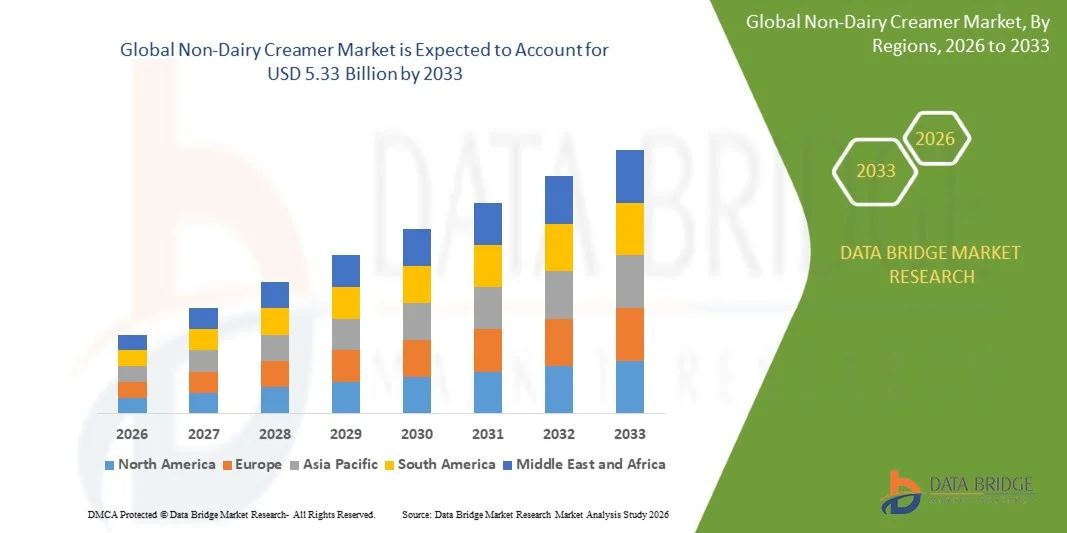
- As per Data Bridge Market Research analysis, the non-dairy creamer market was valued at USD 2.88 billion in 2025 and is projected to reach USD 5.33 billion by 2033, growing at a CAGR of 8.00% from 2026 to 2033.
- The market is experiencing steady growth driven by rising global coffee and tea consumption, growing lactose intolerance and dairy-allergy awareness, and increasing consumer preference for shelf-stable, cost-effective dairy alternatives across both household and foodservice settings.
- The growing café culture and expanding quick-service restaurant footprint across emerging economies, combined with increasing demand for plant-based and vegan-friendly food products, is compelling manufacturers to reformulate non-dairy creamers using coconut, oat, and soy bases as alternatives to conventional palm-oil formulations. Rising consumer scrutiny of ingredient transparency is further reinforcing demand for cleaner-label, non-hydrogenated creamer formulations across retail and foodservice channels.
- Continued expansion of single-serve and portion-controlled packaging formats is enabling foodservice operators and convenience-focused consumers to access non-dairy creamers with improved hygiene, portability, and reduced product waste compared to traditional bulk packaging.
- Growing consumer interest in oat-based and other novel plant sources beyond conventional coconut and soy formulations is prompting manufacturers to diversify their ingredient portfolios, addressing demand from consumers seeking allergen-conscious alternatives to both dairy and traditional plant-oil creamers.
Market Size & Forecast
- Global Market Value (2025): USD 2.88 Billion
- Expected Market Value (2033): USD 5.33 Billion
- Forecast CAGR (2026–2033): 8.00%
- Leading Region in 2025: Asia-Pacific
- Fastest Growing Region: North America
What are the Major Takeaways of the Non-Dairy Creamer Market?
- Asia-Pacific dominated the global non-dairy creamer market with the largest revenue share of 41.72% in 2025, supported by high coffee and tea consumption volumes and strong domestic creamer manufacturing capacity across Indonesia, China, and India.
- North America is expected to be the fastest-growing region at a CAGR of 9.6% from 2026 to 2033, fueled by rising demand for plant-based and lactose-free alternatives and expanding specialty coffee culture.
- The powdered creamer type segment led the market with a 58.34% share in 2025, driven by its extended shelf life, ease of transport, and widespread use across both household and foodservice applications.
- The vegetable oil-based source segment is the fastest-growing source category, projected to register a CAGR of 9.2%, reflecting rising adoption of coconut and other plant-oil formulations as alternatives to conventional palm-oil-based creamers.
- The beverages application segment dominated the application category with a 68.43% revenue share in 2025, led by sustained global demand for coffee and tea whiteners across both retail and foodservice channels.
- The foodservice/HoReCa distribution channel accounted for 34.86% of the market share in 2025, preferred for its bulk-purchasing efficiency and consistent product performance in high-volume beverage preparation.
- The organic nature segment is the fastest-growing category, with a CAGR of 10.4%, driven by rising consumer demand for clean-label, non-GMO creamer formulations across health-conscious consumer segments.
Report Scope and Non-Dairy Creamer Market Segmentation
|
Attributes |
Non-Dairy Creamer Key Market Insights |
|
Segments Covered |
|
|
Countries Covered |
North America
Europe
Asia-Pacific
Middle East and Africa
South America
|
|
Key Market Players |
|
|
Market Opportunities |
|
|
Value Added Data Infosets |
In addition to the insights on market scenarios such as market value, growth rate, segmentation, geographical coverage, and major players, the market reports curated by the Data Bridge Market Research also include in-depth expert analysis, pricing analysis, brand share analysis, consumer survey, demography analysis, supply chain analysis, value chain analysis, raw material/consumables overview, vendor selection criteria, PESTLE Analysis, Porter Analysis, and regulatory framework. |
What is the Key Trend in the Non-Dairy Creamer Market?
- Manufacturers are increasingly reformulating non-dairy creamers using coconut, oat, and other plant-based oils to replace conventional palm-oil and hydrogenated-fat formulations in response to consumer health and sustainability concerns.
- For instance, in April 2025, Nestlé expanded its plant-based creamer portfolio in Southeast Asia with a coconut-oil-based formulation targeting health-conscious coffee and tea consumers seeking cleaner-label alternatives.
- Rising adoption of single-serve and portion-controlled packaging formats is enabling foodservice operators and travel-retail channels to offer improved hygiene and convenience compared to traditional bulk creamer packaging.
- Manufacturers are increasingly investing in flavored creamer variants such as vanilla, hazelnut, and caramel to differentiate products and capture growing consumer interest in premium, café-style at-home coffee experiences.
- For instance, in January 2025, Rich Products introduced an expanded flavored liquid creamer line targeting the at-home premium coffee segment, combining barista-inspired flavors with extended refrigerated shelf life.
- As consumers and foodservice operators continue to prioritize convenience, ingredient transparency, and dietary flexibility, the adoption of reformulated and premium non-dairy creamer products is expected to accelerate, reinforcing their role as a mainstream coffee and tea accompaniment across both retail and foodservice channels.
What are the Key Drivers of the Non-Dairy Creamer Market?
- Rising global coffee and tea consumption, combined with increasing lactose intolerance and dairy-allergy awareness, has significantly increased demand for cost-effective, shelf-stable non-dairy creamer alternatives.
- For instance, in March 2025, Cargill expanded its non-dairy creamer ingredient production capacity in Asia to meet rising demand from regional food and beverage manufacturers.
- Foodservice operators and beverage manufacturers are increasingly incorporating non-dairy creamers into standard product formulations to reduce ingredient costs, extend shelf life, and simplify supply-chain logistics compared to dairy-based alternatives.
- For instance, in October 2024, Kerry Group announced an investment in additional non-dairy creamer manufacturing capacity to support rising orders from quick-service restaurant and foodservice customers across North America and Europe.
- With coffee and tea consumption continuing to expand across both developed and emerging markets, non-dairy creamers will remain indispensable across household, foodservice, and industrial food-manufacturing applications worldwide.
- For instance, in June 2024, FrieslandCampina expanded its non-dairy creamer ingredient portfolio to include additional soy-based and starch-based formulations, supporting growing demand from plant-based product manufacturers.
- Therefore, rising coffee and tea consumption, growing awareness of lactose intolerance, and demand for affordable, shelf-stable alternatives are driving non-dairy creamer adoption. Expanding product offerings and production capacity are further supporting growth across household, foodservice, and industrial applications.
Which Factors are Challenging the Growth of the Non-Dairy Creamer Market?
- Conventional non-dairy creamers formulated with palm oil and hydrogenated fats face increasing consumer and regulatory scrutiny regarding trans-fat content and sustainable palm-oil sourcing, creating reformulation pressure across the industry.
- These reformulation requirements and rising costs of alternative plant-oil ingredients limit adoption among smaller manufacturers and constrain margins in price-sensitive commodity creamer segments.
- For instance, research published in October 2023 in Food Chemistry: X demonstrated the use of coconut oil-based diacylglycerol as an alternative fat for non-dairy creamers, highlighting the technical challenges involved in developing trans-fat-free formulations with comparable stability and sensory properties.
- The rising cost of sustainably sourced plant-oil alternatives and reformulation complexity associated with removing hydrogenated fats continue to restrict margin expansion, particularly among smaller manufacturers in price-sensitive emerging markets. This cost pressure slows the pace of clean-label reformulation despite growing consumer demand for healthier creamer alternatives.
How is the Non-Dairy Creamer Market Segmented?
The non-dairy creamer market is segmented on the basis of type, source, application, nature, packaging type, flavor, distribution channel, end user, fat content and shelf stability.
- By Type
On the basis of type, the global non-dairy creamer market is segmented into powdered creamer and liquid creamer. The powdered creamer segment dominated the market with a 58.34% share in 2025, owing to its extended shelf life, ease of transport, and widespread use across both household and foodservice applications. These formulations deliver reliable performance without refrigeration requirements, making them the preferred choice for bulk foodservice and export-oriented distribution.
The liquid creamer segment is projected to register the fastest growth at a CAGR of 9.4% from 2026 to 2033, driven by rising consumer preference for ready-to-use formats that closely replicate the taste and mouthfeel of dairy creamer. Advances in refrigerated supply-chain infrastructure, combined with growing premium coffee culture, are accelerating segment expansion. The convenience of pour-and-use liquid formats without reconstitution is also proving especially appealing to younger consumers accustomed to café-style beverage preparation at home.
- By Source
On the basis of source, the global non-dairy creamer market is segmented into vegetable oil-based (palm oil, coconut oil, soybean oil), starch-based, soy-based, and others. The vegetable oil-based segment led the market with a 64.72% share in 2025, supported by its cost-effective production, favorable texture properties, and widespread use across both powdered and liquid creamer formulations.
The vegetable oil-based segment is also expected to experience the fastest growth at a CAGR of 9.2% from 2026 to 2033, driven by increasing reformulation toward coconut and other plant-oil alternatives to conventional palm-oil-based creamers.
- By Application
On the basis of application, the global non-dairy creamer market is segmented into beverages (coffee, tea), bakery & confectionery, desserts & ice cream, soups & sauces, and others. The beverages segment dominated the market with a share of 68.43% in 2025 due to its widespread adoption as a coffee and tea whitener across household, foodservice, and vending-machine applications, increasing global coffee consumption, and growing café-culture expansion in emerging markets. Additionally, rising focus on convenient, shelf-stable beverage accompaniments further supports the strong adoption of non-dairy creamers in this application category.
The desserts & ice cream segment is anticipated to witness the fastest CAGR of 8.9% from 2026 to 2033, driven by the increasing use of non-dairy creamer bases in plant-based and lactose-free dessert formulations. Manufacturers are adopting non-dairy creamer ingredients to conduct cost-effective, scalable, and repeatable dessert-product formulation. Additionally, the integration of non-dairy creamers into growing vegan and lactose-free dessert product lines is enhancing formulation flexibility, further driving segment growth.
- By Nature
On the basis of nature, the global non-dairy creamer market is segmented into organic and conventional. The conventional segment dominated the market with a share of 83.67% in 2025 due to its widespread adoption across cost-sensitive household and foodservice applications where price remains the primary purchasing consideration. The widespread availability of conventional creamer formulations across mainstream retail and foodservice channels is driving strong demand for this nature category.
The organic segment is expected to witness the fastest CAGR of 10.4% from 2026 to 2033, driven by the rising consumer demand for clean-label, non-GMO creamer formulations among health-conscious and premium-focused buyers. Manufacturers are increasingly certifying organic ingredient sourcing and production processes. Additionally, the growing emphasis on ingredient transparency in specialty coffee retail is further accelerating adoption of this nature category. Premium coffee shop chains are also increasingly featuring organic creamer options as a differentiator in their beverage menus, further reinforcing category growth.
- By Packaging Type
On the basis of packaging type, the global non-dairy creamer market is segmented into pouches, bottles/cans, sachets/single-serve, and cartons. The pouches segment dominated the market with a share of 39.72% in 2025 due to its critical role in providing cost-effective, resealable bulk packaging for household and foodservice powdered creamer applications. High adoption is driven by the increasing need for extended shelf-stable storage, integration with retail shelf-display formats, and enhanced product-cost efficiency. Additionally, growing investment by manufacturers and retailers to optimize packaging-material costs is reinforcing the leading position of this segment in the market.
The sachets/single-serve segment is expected to witness the fastest CAGR of 9.8% from 2026 to 2033, driven by increasing demand for portion-controlled, hygienic packaging formats across foodservice, hospitality, and travel-retail applications. Growing adoption of single-serve creamer packets across quick-service restaurants and hotel chains is further accelerating market expansion in this segment.
- By Flavor
On the basis of flavor, the global non-dairy creamer market is segmented into original/unflavored and flavored (vanilla, hazelnut, caramel, others). The original/unflavored segment dominated the market with a share of 71.28% in 2025 due to its widespread use as the standard creamer format across household and foodservice applications requiring neutral flavor compatibility with a wide range of beverages. Rising adoption of unflavored powdered and liquid creamers across mainstream retail and institutional channels is driving strong demand for this flavor category.
The flavored segment is expected to witness the fastest CAGR of 9.6% from 2026 to 2033, driven by the rising consumer interest in premium, café-style at-home coffee experiences featuring vanilla, hazelnut, caramel, and seasonal flavor variants. Manufacturers are increasingly expanding flavored product lines to differentiate offerings. Additionally, the growing emphasis on premiumization in the at-home coffee category is further accelerating adoption of this flavor category.
- By Distribution Channel
On the basis of distribution channel, the global non-dairy creamer market is segmented into supermarkets/hypermarkets, convenience stores, online retail, and foodservice/HoReCa. The supermarkets/hypermarkets segment dominated the market with a share of 42.63% in 2025 due to its widespread adoption as the primary retail channel for household creamer purchases, offering broad product-assortment visibility and competitive pricing. High adoption is supported by retail chains and manufacturers that rely on established supermarket relationships to ensure consistency, shelf visibility, and measurable sales outcomes. Additionally, increasing integration with retail loyalty and promotional programs enhances consumer accessibility and reinforces the dominance of the supermarkets/hypermarkets segment.
The online retail segment is expected to witness the fastest CAGR of 10.7% from 2026 to 2033, driven by the increasing consumer preference for convenient, subscription-based grocery and specialty-food purchasing through e-commerce platforms. By offering accessible, cost-effective direct-to-consumer sourcing, this channel enhances product discovery, purchasing convenience, and repeat-purchase consistency, making it highly attractive for both mainstream and specialty non-dairy creamer brands.
- By End User
On the basis of end user, the global non-dairy creamer market is segmented into household/retail, foodservice (cafes, restaurants, QSR), and industrial/food manufacturers. The household/retail segment dominated the market with a share of 46.85% in 2025 due to its widespread adoption among individual consumers seeking convenient, shelf-stable coffee and tea whiteners for daily home consumption. Additionally, established retail distribution networks, broad brand recognition, and extensive product-assortment availability are facilitating continued adoption of non-dairy creamers among household consumers, while strong retail support networks are improving accessibility, reliability, and trust, further reinforcing this segment's leading market position.
The foodservice (cafes, restaurants, QSR) segment is expected to witness the fastest CAGR of 9.3% from 2026 to 2033, driven by the expanding global café culture and quick-service restaurant footprint requiring consistent, cost-effective beverage-preparation ingredients. Foodservice operators are leveraging bulk creamer procurement to enhance cost control, ensure beverage consistency, and support high-volume daily operations, thereby accelerating adoption across the expanding global foodservice sector.
- By Fat Content
On the basis of fat content, the global non-dairy creamer market is segmented into full-fat, low-fat, and fat-free. The full-fat segment dominated the market with a share of 54.36% in 2025 due to its preference among consumers and foodservice operators seeking rich, dairy-like taste and mouthfeel in coffee and tea preparation. Additionally, established formulation processes, broad manufacturer familiarity, and extensive product-performance history are facilitating continued adoption of full-fat creamers, while strong consumer taste preference is improving repeat-purchase reliability, further reinforcing this segment's leading market position.
The low-fat segment is expected to witness the fastest CAGR of 9.1% from 2026 to 2033, driven by the increasing consumer focus on calorie-conscious and health-oriented dietary choices without fully sacrificing the taste and texture benefits of traditional creamer products. Manufacturers are leveraging reformulated fat-reduction technologies to enhance nutritional appeal, enable healthier positioning, and support growing wellness-focused consumer segments.
- By Shelf Stability
On the basis of shelf stability, the global non-dairy creamer market is segmented into shelf-stable/ambient and refrigerated. The shelf-stable/ambient segment dominated the market with a share of 76.42% in 2025 due to its critical role in providing extended storage flexibility, simplified logistics, and broad distribution reach across both developed and emerging markets without cold-chain infrastructure requirements. Additionally, established manufacturing and packaging processes, broad distributor familiarity, and extensive export-market compatibility are facilitating continued adoption of shelf-stable creamers across global markets.
The refrigerated segment is expected to witness the fastest CAGR of 8.7% from 2026 to 2033, driven by the increasing consumer preference for fresh, dairy-like liquid creamer products in developed markets with established cold-chain retail infrastructure. Manufacturers are leveraging refrigerated distribution networks to enhance product freshness, enable premium positioning, and support growing at-home specialty coffee consumption, thereby accelerating adoption across developed retail markets.
Which Region Holds the Largest Share of the Non-Dairy Creamer Market?
- Asia-Pacific dominated the non-dairy creamer market and accounted for the largest revenue share of 41.72% in 2025, supported by high coffee and tea consumption volumes, strong domestic creamer manufacturing capacity, and the presence of established regional producers across Indonesia, China, and India.
- The region also benefits from cost-competitive palm-oil feedstock availability, high adoption of powdered creamer formats suited to warm climates without cold-chain infrastructure, and growing use of non-dairy creamers across both household and foodservice applications. Increasing focus on export-oriented manufacturing and rising domestic coffee-culture expansion continues to strengthen Asia-Pacific's leadership position in the global market.
China Non-Dairy Creamer Market Insight
The China non-dairy creamer market is expanding steadily, supported by rising urban coffee and tea consumption, growing domestic food-manufacturing capacity, and increasing investments in flavored and premium creamer product development. Manufacturers and foodservice operators are increasingly incorporating non-dairy creamers into both traditional tea-beverage and modern coffee-shop applications. Continuous expansion of domestic production infrastructure and rising urban middle-class consumption are further driving market growth in China.
India Non-Dairy Creamer Market Insight
The India non-dairy creamer market is expanding steadily, supported by rising tea and coffee consumption, growing organized foodservice and quick-service restaurant penetration, and increasing domestic manufacturing capacity. Foodservice operators and household consumers are increasingly integrating non-dairy creamers into daily beverage preparation. Continuous advancements in cost-optimized manufacturing processes, along with strong domestic demand growth, are further driving market growth in India.
Europe Non-Dairy Creamer Market Insight
Europe’s non-dairy creamer market is expanding as consumers increasingly adopt plant-based, lactose-free, and flexitarian diets. Demand is supported by Europe’s strong coffee culture, growing health awareness, and preference for convenient dairy alternatives. Oat, almond, soy, and coconut-based creamers are gaining attention, while clean-label, fortified, and flavored formulations are supporting product innovation. Germany, the UK, France, and Italy represent important markets, with foodservice and retail channels creating further opportunities. Premium pricing, taste, texture, and competition from conventional dairy remain key challenges.
Germany Non-Dairy Creamer Market Insight
The Germany non-dairy creamer market is witnessing steady growth due to the country's strong café culture, growing consumer interest in plant-based and lactose-free food products, and increasing adoption of non-dairy creamers across both retail and foodservice applications. Food manufacturers, retailers, and foodservice operators are increasingly standardizing creamer procurement to meet evolving dietary preferences. Continuous advancements in clean-label reformulation and packaging innovation are further supporting market growth in Germany.
France Non-Dairy Creamer Market Insight
France’s non-dairy creamer market is supported by growing consumer interest in plant-based dairy alternatives, particularly among flexitarian consumers seeking diverse and sustainable choices. Demand for oat, almond, soy, and coconut-based formulations is expanding across retail, coffee, and foodservice applications. France’s established plant-based food ecosystem and increasing availability of alternative dairy products create opportunities for non-dairy creamer manufacturers. However, premium pricing, taste expectations, and competition from conventional dairy remain key market challenges.
Which are the Top Companies in Non-Dairy Creamer Market?
The non-dairy creamer industry is primarily led by well-established companies, including:
- Nestlé S.A. (Switzerland)
- FrieslandCampina (Netherlands)
- Kerry Group plc (Ireland)
- Rich Products Corporation (U.S.)
- Tate & Lyle PLC (U.K.)
- Cargill, Incorporated (U.S.)
- Archer-Daniels-Midland Company (U.S.)
- Fonterra Co-operative Group Limited (New Zealand)
- PT Santos Premium Krimer (Indonesia)
- PT Sukanda Djaya (Indonesia)
- PT Indofood Sukses Makmur Tbk (Indonesia)
- Super Coffeemix Manufacturing Ltd (Malaysia)
- Zhongshan Huifeng Food Co., Ltd. (China)
- Shandong Tianjiao Biotech Co., Ltd. (China)
- Uniferm GmbH & Co. KG (Germany)
- Custom Food Group Pty Ltd (Australia)
- Danone S.A. (France)
- Califia Farms, LLC (U.S.)
- Delta Wing Foods (U.S.)
- Nestlé Professional (Switzerland)
- Super Group Ltd. (Singapore)
- Panda Nutraceuticals Sdn. Bhd. (Malaysia)
- Angel Yeast Co., Ltd. (China)
- Vandemoortele NV (Belgium)
- Puratos Group (Belgium)
- Roquette Frères (France)
What are Latest Developments in Non-Dairy Creamer Market?
- In September 2025, Nestlé launched an expanded coconut-oil-based creamer line across Southeast Asian markets, strengthening its position in the region's clean-label plant-based creamer segment.
- In February 2025, PT Santos Premium Krimer expanded its production capacity in Indonesia to meet growing domestic and export demand for powdered non-dairy creamer products.
- In November 2025, Rich Products introduced an upgraded refrigerated liquid creamer platform incorporating extended shelf-life technology, improving product freshness and reducing distribution waste for foodservice customers. This development strengthens Rich Products' position in the premium liquid creamer market by offering foodservice operators improved product consistency and reduced spoilage.
- In October 2024, Kerry Group expanded its non-dairy creamer ingredient portfolio in Europe to include additional oat-based and soy-based formulations tailored for the growing plant-based foodservice segment.
- In June 2023, Cargill partnered with a regional food manufacturer to co-develop reformulated palm-oil-alternative creamer ingredients, combining its ingredient-sourcing expertise with the partner's regional manufacturing and distribution capabilities to support broader access to sustainably sourced creamer formulations.
- In March 2023, Tate & Lyle received certification for an expanded starch-based creamer ingredient production line in Europe, enabling the company to serve growing demand from manufacturers seeking allergen-friendly formulation alternatives to soy- and coconut-based creamers.

- Interactive Data Analysis Dashboard
- Company Analysis Dashboard for high growth potential opportunities
- Research Analyst Access for customization & queries
- Competitor Analysis with Interactive dashboard
- Latest News, Updates & Trend analysis
- Harness the Power of Benchmark Analysis for Comprehensive Competitor Tracking
Global Non Dairy Creamer Market, Supply Chain Analysis and Ecosystem Framework
To support market growth and help clients navigate the impact of geopolitical shifts, DBMR has integrated in-depth supply chain analysis into its Global Non Dairy Creamer Market research reports. This addition empowers clients to respond effectively to global changes affecting their industries. The supply chain analysis section includes detailed insights such as Global Non Dairy Creamer Market consumption and production by country, price trend analysis, the impact of tariffs and geopolitical developments, and import and export trends by country and HSN code. It also highlights major suppliers with data on production capacity and company profiles, as well as key importers and exporters. In addition to research, DBMR offers specialized supply chain consulting services backed by over a decade of experience, providing solutions like supplier discovery, supplier risk assessment, price trend analysis, impact evaluation of inflation and trade route changes, and comprehensive market trend analysis.
Data collection and base year analysis are done using data collection modules with large sample sizes. The stage includes obtaining market information or related data through various sources and strategies. It includes examining and planning all the data acquired from the past in advance. It likewise envelops the examination of information inconsistencies seen across different information sources. The market data is analysed and estimated using market statistical and coherent models. Also, market share analysis and key trend analysis are the major success factors in the market report. To know more, please request an analyst call or drop down your inquiry.
The key research methodology used by DBMR research team is data triangulation which involves data mining, analysis of the impact of data variables on the market and primary (industry expert) validation. Data models include Vendor Positioning Grid, Market Time Line Analysis, Market Overview and Guide, Company Positioning Grid, Patent Analysis, Pricing Analysis, Company Market Share Analysis, Standards of Measurement, Global versus Regional and Vendor Share Analysis. To know more about the research methodology, drop in an inquiry to speak to our industry experts.
Data Bridge Market Research is a leader in advanced formative research. We take pride in servicing our existing and new customers with data and analysis that match and suits their goal. The report can be customized to include price trend analysis of target brands understanding the market for additional countries (ask for the list of countries), clinical trial results data, literature review, refurbished market and product base analysis. Market analysis of target competitors can be analyzed from technology-based analysis to market portfolio strategies. We can add as many competitors that you require data about in the format and data style you are looking for. Our team of analysts can also provide you data in crude raw excel files pivot tables (Fact book) or can assist you in creating presentations from the data sets available in the report.













