


Global Radio Frequency Identification (RFID) Kanban Systems Market, By Type (Single Bin, Multi-Bin), Component (Box, Base, Shelf/Cabinet, Electronic Shelf Displays, Other), Application (Supply Chain Inventory Management, Equipment Identification, Track and Trace Solutions, Other) – Industry Trends and Forecast to 2029
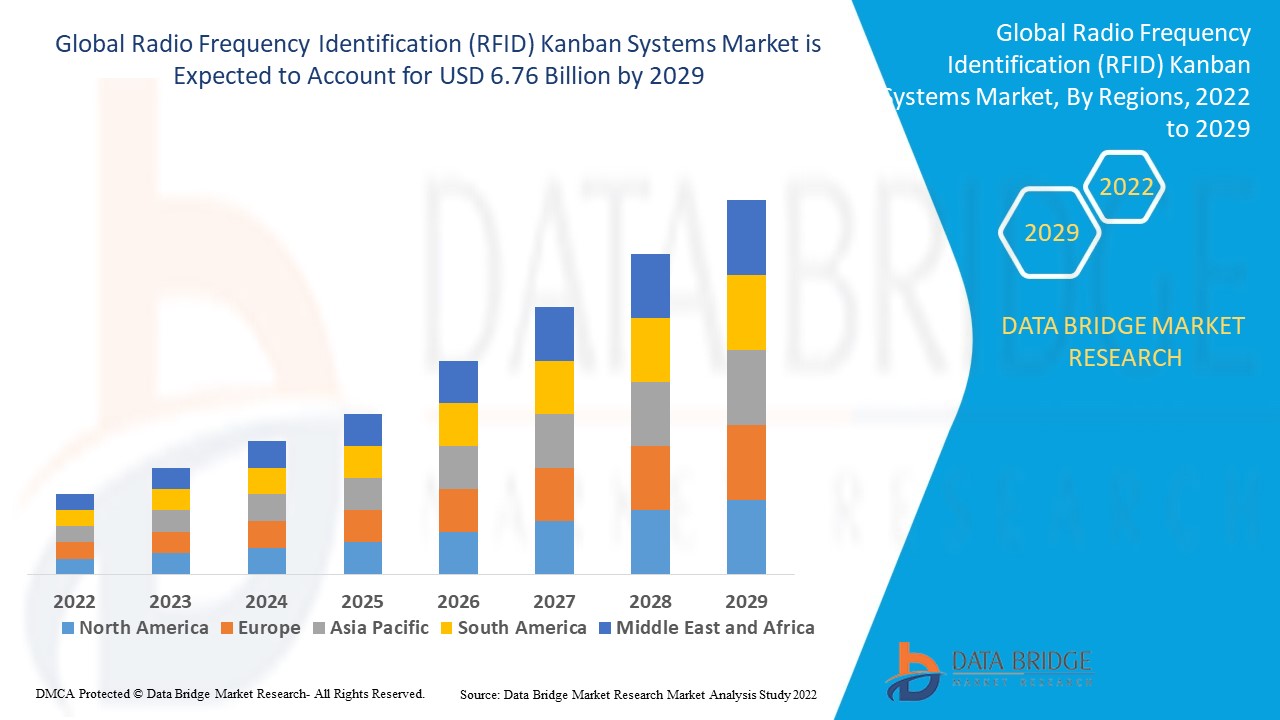
Radio Frequency Identification (RFID) Kanban Systems Market Analysis and Size
Kanban systems with radio frequency identification (RFID) are used in the industry for lean inventory management, automatic mapping of identical orders, and early detection of fluctuations in demand. Increasing demand for domestic and international logistics services due to the growing popularity of e-commerce platforms is one of the key drivers of market growth. RFID Kanban systems help manage large amounts of data generated during warehousing and warehouse management, reducing overall delivery times.
Data Bridge Market Research analyses a growth rate in the radio frequency identification (RFID) kanban systems market in the forecast period 2022-2029. The expected CAGR of radio frequency identification (RFID) kanban systems market is around 22.30% in the mentioned forecast period. The market was valued at USD 1.35 billion in 2021, and it would grow upto USD 6.76 billion by 2029. In addition to the market insights such as market value, growth rate, market segments, geographical coverage, market players, and market scenario, the market report curated by the Data Bridge Market Research team also includes in-depth expert analysis, patient epidemiology, pipeline analysis, pricing analysis, and regulatory framework.
Radio Frequency Identification (RFID) Kanban Systems Market Scope and Segmentation
|
Report Metric |
Details |
|
Forecast Period |
2022 to 2029 |
|
Base Year |
2021 |
|
Historic Years |
2020 (Customizable to 2014 - 2019) |
|
Quantitative Units |
Revenue in USD Million, Volumes in Units, Pricing in USD |
|
Segments Covered |
By Type (Single Bin, Multi-Bin), Component (Box, Base, Shelf/Cabinet, Electronic Shelf Displays, Other), Application (Supply Chain Inventory Management, Equipment Identification, Track and Trace Solutions, Other) |
|
Countries Covered |
U.S., Canada and Mexico in North America, Germany, France, U.K., Netherlands, Switzerland, Belgium, Russia, Italy, Spain, Turkey, Rest of Europe in Europe, China, Japan, India, South Korea, Singapore, Malaysia, Australia, Thailand, Indonesia, Philippines, Rest of Asia-Pacific (APAC) in the Asia-Pacific (APAC), Saudi Arabia, U.A.E, South Africa, Egypt, Israel, Rest of Middle East and Africa (MEA) as a part of Middle East and Africa (MEA), Brazil, Argentina and Rest of South America as part of South America. |
|
Market Players Covered |
BROOKS AUTOMATION (U.S.)., Adolf Würth GmbH & Co. KG (U.S.), Wilhelm Böllhoff GmbH & Co. KG (Germany), Pepperl+Fuchs (Germany), Grifols, S.A. (Spain), Metra Tec GmbH (Germany), MATTTEO (Belgium), AVERY DENNISON CORPORATION (U.S.), Zebra Technologies (U.S.), Honeywell International Inc., (U.S.), NXP Semiconductors (Netherlands), and Impinj, Inc., (U.S.) |
|
Market Opportunities |
|
Market Definition
RFID tags or transponders with antennas are mounted on the kanban shelves. A unique number can usually identify this to increase the security of the data. This allows you to precisely control the flow of goods, automate data transfers, exchange information in real-time, and reduce manual labor. Therefore, companies worldwide rely on RFID kanban systems rather than traditional kanban processing to enhance supply security and manage inventory efficiently.
Global Radio Frequency Identification (RFID) Kanban Systems Market Dynamics
Drivers
- Increased Prevalence for contact-tracing solutions due to COVID-19
After the COVID 19 blockade was lifted, many companies and offices worldwide resumed operations. However, the government has instructed such companies to maintain social distance and low staff capacity. If the criteria are not met, a single case of COVID 19 can lead to the closure of the entire facility and may require decontamination before resuming operations. Large companies are taking various precautions to avoid this situation, including contact tracing solutions. Many RFID solution providers have enhanced new or existing products to meet customer needs during the COVID 19 pandemic to take advantage of the growing need for contact tracing solutions.
- Rising e-commerce Distribution
As e-commerce platforms grow in popularity, increasing demand for domestic and international logistics services is driving market growth. In addition, market growth is expected to be driven by rising costs for expired drugs, and inventory management procedures essential to the deployment of RFID Kanban systems. Implementation of these systems is responsible for faster delivery.
Opportunities
- Technological Advancements
As technology advances, radio frequency identification (RFID) has become more common and widely used in various applications. In addition, RFID has many advantages, such as batch reading, information processing, resilience to harsh environments, and data storage. Value stream mapping analyzes and improves the current process state, and new process states are designed based on insights. Modern RFID solutions can reduce costs and increase sales by rebuilding the store's economy.
- Rising installation of RFID systems in manufacturing units
Manufacturing facilities need to monitor equipment status and performance, process and system failures and ensure predictive maintenance of equipment and systems by integrating dedicated tools and adopting quality control techniques. Using RFID technology to manage a facility's property helps manufacturers achieve this goal. The combination of RFID tags and sensor solutions is ideal for various points in the production facility, including conveyors, cameras, boilers, tanks, pipes, among others, to control and maintain the quality and performance of the manufacturing process.
Restraints/Challenges
- Lack of skilled professionals
The lack of qualified personnel who cannot use these devices could curb the growth of the radio frequency identification (RFID) kanban systems market over a forecast period.
- High Cost
The installation fee of an RFID gadget can variety from USD 2 million to five million for a standard real-time monitoring system. This fee can fluctuate in step with end-use enterprise and set-up area. High setup fee is one of the predominant restraining elements for the implementation of RFID technology. Adoption of RFID structures in any enterprise calls for excessive investments, such as the acquisition fee of RFID tags, readers, and software, and the expenses related to substitute offerings and electricity.
This radio frequency identification (RFID) kanban systems market report provides details of new recent developments, trade regulations, import-export analysis, production analysis, value chain optimization, market share, impact of domestic and localized market players, analyses opportunities in terms of emerging revenue pockets, changes in market regulations, strategic market growth analysis, market size, category market growths, application niches and dominance, product approvals, product launches, geographic expansions, technological innovations in the market. To gain more info on the radio frequency identification (RFID) kanban systems market contact Data Bridge Market Research for an Analyst Brief, our team will help you take an informed market decision to achieve market growth.
Market Developments:
- In January 2022, Stafa introduced a new Kanban service to keep customers in stock when needed. Stafa customers can quickly order new products using state-of-the-art RFID scanners. Empty containers are recognized by the RFID scanner. Delivery times for these items will be agreed. Customers will be notified about the ordering process in the RFID panel. Orders can be tracked on the touch screen from order to shipment, providing additional valuable information in the workshop.
- In May 2022, HID Global announced the acquisition of Vizinex RFID to expand its product portfolio of high-performance passive RFID tags. As a result of HID Global's acquisition of Vizinex RFID, the company will have a stronger presence in major vertical markets such as healthcare / medical, manufacturing, oil and gas, and data centers. It will also allow key technologies to be added to the company's existing industry-renowned RFID tag portfolio.
- In August 2021, HID Global acquired OmniID to extend its RFID capabilities. With the acquisition of OmniID, HID has expanded its portfolio of RAIN-RFID UHF tags and IoT components, further enhancing RFID customization capabilities. This acquisition not only expands the market-leading position in RFID technology, but also expands HID's presence in India and China.
Global Radio Frequency Identification (RFID) Kanban Systems Market Scope
The radio frequency identification (RFID) kanban systems market is segmented on the basis of type, component, and application. The growth amongst these segments will help you analyze meagre growth segments in the industries and provide the users with a valuable market overview and market insights to help them make strategic decisions for identifying core market applications.
Type
- Single Bin
- Multi-Bin
Component
- Box
- Base
- Shelf/Cabinet
- Electronic Shelf Displays
- Other
Application
- Supply Chain Inventory Management
- Equipment Identification
- Track and Trace Solutions
- Other
Radio Frequency Identification (RFID) Kanban Systems Market Regional Analysis/Insights
The radio frequency identification (RFID) kanban systems market is analyzed and market size insights and trends are provided by country, type, component, and application as referenced above.
The major countries covered in the radio frequency identification (RFID) kanban systems market report are the U.S., Canada and Mexico in North America, Germany, France, U.K., Netherlands, Switzerland, Belgium, Russia, Italy, Spain, Turkey, Rest of Europe in Europe, China, Japan, India, South Korea, Singapore, Malaysia, Australia, Thailand, Indonesia, Philippines, Rest of Asia-Pacific (APAC) in the Asia-Pacific (APAC), Saudi Arabia, U.A.E, South Africa, Egypt, Israel, Rest of Middle East and Africa (MEA) as a part of Middle East and Africa (MEA), Brazil, Argentina and Rest of South America as part of South America.
North America dominates the radio frequency identification (RFID) kanban systems market due to the continued economic development, strong demand for process optimization, a growing interest among healthcare providers in RFID Kanban systems, and rising awareness of the advantages associated with technology.
The Asia-Pacific region has shown significant growth during the forecast period of 2022 to 2029. Since the Kanban system was originally developed in Japan, a tremendous amount of development has occurred within the country since then in terms of automating the two-bin Kanban system.
The country section of the report also provides individual market impacting factors and changes in regulation in the market domestically that impacts the current and future trends of the market. Also, the presence and availability of global brands and their challenges faced due to large or scarce competition from local and domestic brands, impact of domestic tariffs and trade routes are considered while providing forecast analysis of the country data.
Competitive Landscape and Global Radio Frequency Identification (RFID) Kanban Systems Market Share Analysis
The radio frequency identification (RFID) kanban systems market competitive landscape provides details by competitor. Details included are company overview, company financials, revenue generated, market potential, investment in research and development, new market initiatives, global presence, production sites and facilities, production capacities, company strengths and weaknesses, product launch, product width and breadth, application dominance. The above data points provided are only related to the companies' focus related to radio frequency identification (RFID) kanban systems market
Key players operating in the global radio frequency identification (RFID) kanban systems market include:
- BROOKS AUTOMATION (U.S.)
- Adolf Würth GmbH & Co. KG (U.S.)
- Wilhelm Böllhoff GmbH & Co. KG (Germany)
- Peperl+Fuchs (Germany)
- Grifols, S.A. (Spain)
- Metra Tec GmbH (Germany)
- MATTTEO (Belgium)
- AVERY DENNISON CORPORATION (U.S.)
- Zebra Technologies (U.S.)
- Honeywell International Inc., (U.S.)
- NXP Semiconductors (Netherlands)
- Impinj, Inc., (U.S.)
SKU-
Obtenha acesso online ao relatório sobre a primeira nuvem de inteligência de mercado do mundo

- Painel interativo de análise de dados
- Painel de análise da empresa para oportunidades de elevado potencial de crescimento
- Acesso de analista de pesquisa para personalização e customização. consultas
- Análise da concorrência com painel interativo
- Últimas notícias, atualizações e atualizações Análise de tendências
- Aproveite o poder da análise de benchmark para um rastreio abrangente da concorrência
Metodologia de Investigação
A recolha de dados e a análise do ano base são feitas através de módulos de recolha de dados com amostras grandes. A etapa inclui a obtenção de informações de mercado ou dados relacionados através de diversas fontes e estratégias. Inclui examinar e planear antecipadamente todos os dados adquiridos no passado. Da mesma forma, envolve o exame de inconsistências de informação observadas em diferentes fontes de informação. Os dados de mercado são analisados e estimados utilizando modelos estatísticos e coerentes de mercado. Além disso, a análise da quota de mercado e a análise das principais tendências são os principais fatores de sucesso no relatório de mercado. Para saber mais, solicite uma chamada de analista ou abra a sua consulta.
A principal metodologia de investigação utilizada pela equipa de investigação do DBMR é a triangulação de dados que envolve a mineração de dados, a análise do impacto das variáveis de dados no mercado e a validação primária (especialista do setor). Os modelos de dados incluem grelha de posicionamento de fornecedores, análise da linha de tempo do mercado, visão geral e guia de mercado, grelha de posicionamento da empresa, análise de patentes, análise de preços, análise da quota de mercado da empresa, normas de medição, análise global versus regional e de participação dos fornecedores. Para saber mais sobre a metodologia de investigação, faça uma consulta para falar com os nossos especialistas do setor.
Personalização disponível
A Data Bridge Market Research é líder em investigação formativa avançada. Orgulhamo-nos de servir os nossos clientes novos e existentes com dados e análises que correspondem e atendem aos seus objetivos. O relatório pode ser personalizado para incluir análise de tendências de preços de marcas-alvo, compreensão do mercado para países adicionais (solicite a lista de países), dados de resultados de ensaios clínicos, revisão de literatura, mercado remodelado e análise de base de produtos . A análise de mercado dos concorrentes-alvo pode ser analisada desde análises baseadas em tecnologia até estratégias de carteira de mercado. Podemos adicionar quantos concorrentes necessitar de dados no formato e estilo de dados que procura. A nossa equipa de analistas também pode fornecer dados em tabelas dinâmicas de ficheiros Excel em bruto (livro de factos) ou pode ajudá-lo a criar apresentações a partir dos conjuntos de dados disponíveis no relatório.











