Global Tyrosine Kinase Inhibitors Market Segmentation, By Type (BCR-ABL Tyrosine Kinase Inhibitor, Epidermal Growth Factor Receptor (EGFR) Tyrosine Kinase Inhibitors, Vascular Endothelial Growth Factor (VEGFR) Tyrosine Kinase Inhibitors, and Others), Application (Chronic Myeloid Leukemia (CML), Lung Cancer, Breast Cancer, and Others), End Users (Hospitals, Homecare, Specialty Clinics, and Others), Distribution Channel (Hospital Pharmacy, Online Pharmacy, Retail Pharmacy, and Others) – Industry Trends and Forecast to 2032
Tyrosine Kinase Inhibitors Market Analysis
The tyrosine kinase inhibitors market is experiencing significant growth due to advancements in targeted therapies for various cancers and chronic diseases. These inhibitors work by blocking the action of specific enzymes known as tyrosine kinases, which play a crucial role in the growth and spread of cancer cells. They are commonly used in the treatment of conditions such as chronic myeloid leukemia (CML), non-small cell lung cancer (NSCLC), and breast cancer, among others. The market is driven by the increasing prevalence of cancer, advancements in drug development, and the growing adoption of personalized medicine. Recent developments, including the approval of new-generation tyrosine kinase inhibitors and ongoing clinical trials, are expected to further boost the market. However, the high cost of these therapies and the risk of resistance to treatment remain key challenges. The growing demand for targeted treatments continues to create significant opportunities in this market, especially in emerging economies.
Tyrosine Kinase Inhibitors Market Size
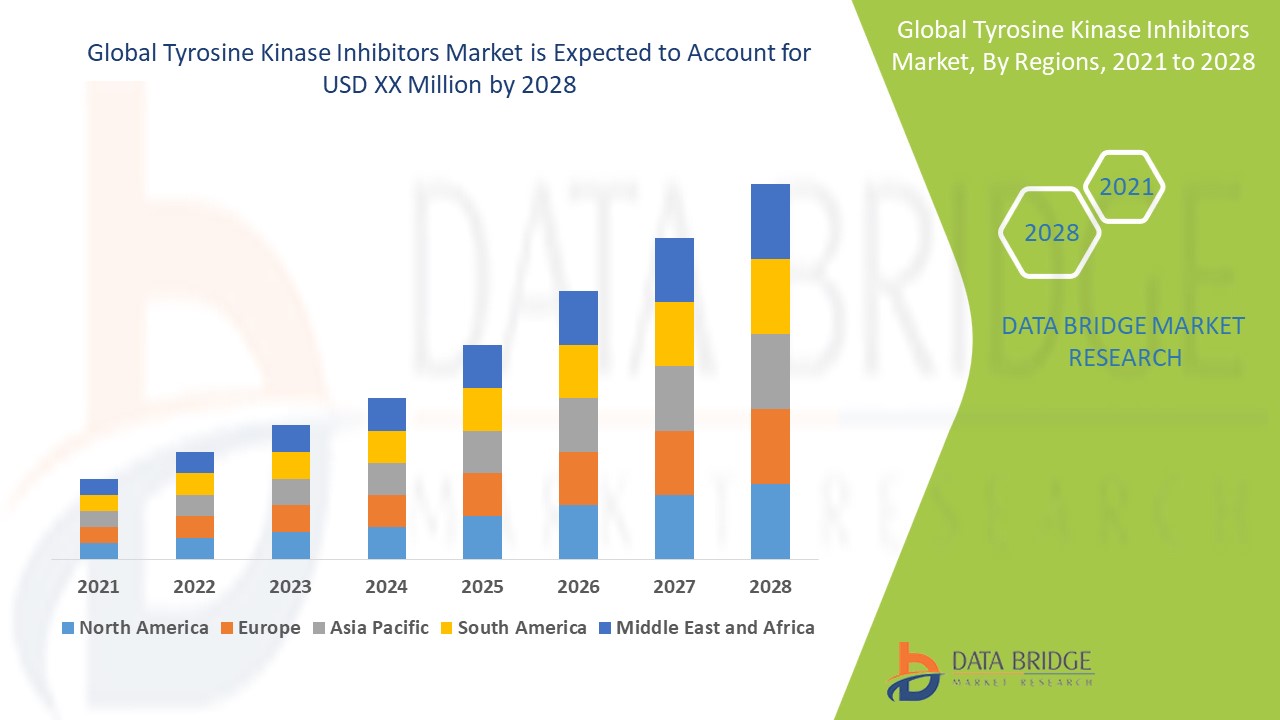
The global tyrosine kinase inhibitors market size was valued at USD 63.58 billion in 2024 and is projected to reach USD 100.57 billion by 2032, with a CAGR of 5.90% during the forecast period of 2025 to 2032. In addition to the insights on market scenarios such as market value, growth rate, segmentation, geographical coverage, and major players, the market reports curated by the Data Bridge Market Research also include depth expert analysis, patient epidemiology, pipeline analysis, pricing analysis, and regulatory framework.
Tyrosine Kinase Inhibitors Market Trends
“Next-Generation Tyrosine Kinase Inhibitors”
A key trend in the tyrosine kinase inhibitors (TKI) market is the growing development of second- and third-generation inhibitors. These newer generations of TKIs are designed to target a wider array of mutations, particularly those that cause resistance to first-generation drugs. They offer improved efficacy by overcoming resistance mechanisms and provide enhanced safety profiles with fewer side effects. As cancers become more genetically diverse, these advanced TKIs are becoming increasingly important in treating a broader range of tumors, including those with uncommon or difficult-to-target mutations. The continuous advancement of these next-generation drugs is expected to significantly impact the market by offering more personalized and effective treatment options, thus improving patient outcomes.
Report Scope and Tyrosine Kinase Inhibitors Market Segmentation
|
Attributes |
Tyrosine Kinase Inhibitors Key Market Insights |
|
Segments Covered |
|
|
Countries Covered |
U.S., Canada and Mexico in North America, Germany, France, U.K., Netherlands, Switzerland, Belgium, Russia, Italy, Spain, Turkey, Rest of Europe in Europe, China, Japan, India, South Korea, Singapore, Malaysia, Australia, Thailand, Indonesia, Philippines, Rest of Asia-Pacific (APAC) in the Asia-Pacific (APAC), Saudi Arabia, U.A.E., South Africa, Egypt, Israel, Rest of Middle East and Africa (MEA) as a part of Middle East and Africa (MEA), Brazil, Argentina and Rest of South America as part of South America. |
|
Key Market Players |
F. Hoffmann-La Roche Ltd (Switzerland), Takeda Pharmaceutical Company Limited (Japan), Ascentage Pharma (China), AstraZeneca (U.K.), Eisai Co., Ltd. (Japan), Novartis AG (Switzerland), Sanofi (France), Bristol-Myers Squibb Company (U.S.), Genentech, Inc. (U.S.), Pfizer Inc. (U.S.), Merck & Co., Inc. (U.S.), Suzhou Zelgen Biopharmaceuticals Co., Ltd. (China), Celldex Therapeutics (U.S.), Exelixis, Inc. (U.S.), Sino Biological Inc. (China), AB Science (France), Bayer AG (Germany), Deciphera Pharmaceuticals, Inc. (U.S.), Johnson & Johnson Services, Inc. (U.S.) |
|
Market Opportunities |
|
|
Value Added Data Infosets |
In addition to the insights on market scenarios such as market value, growth rate, segmentation, geographical coverage, and major players, the market reports curated by the Data Bridge Market Research also include depth expert analysis, patient epidemiology, pipeline analysis, pricing analysis, and regulatory framework. |
Tyrosine Kinase Inhibitors Market Definition
Tyrosine kinase inhibitors are a class of targeted cancer therapies that block the action of enzymes known as tyrosine kinases. Tyrosine kinases play a key role in the signaling pathways that control cell division, survival, and growth. By inhibiting these enzymes, tyrosine kinases inhibitors can prevent or slow the growth of cancer cells, particularly in cancers that involve abnormal tyrosine kinase activity, such as leukemia, lung cancer, and breast cancer. Tyrosine kinases inhibitors can be small molecules or monoclonal antibodies, and they work by either binding directly to the tyrosine kinase or blocking its activation. This targeted approach makes tyrosine kinases inhibitors an effective and more specific treatment compared to traditional chemotherapy, often with fewer side effects.
Tyrosine Kinase Inhibitors Market Dynamics
Drivers
- Increasing Cancer Prevalence
The rising incidence of cancers such as lung, breast, and leukemia is significantly driving the demand for effective targeted therapies, including tyrosine kinase inhibitors (TKIs). As cancer continues to be a leading cause of death worldwide, the need for more efficient and personalized treatments has grown. TKIs are proving essential in offering targeted treatment, as they work by inhibiting specific proteins that promote cancer cell growth, thus improving patient outcomes. This growing need for effective therapies in oncology is expected to propel the tyrosine kinase inhibitors market, as these treatments are increasingly relied upon for their precision and efficacy.
- Advances in Personalized Medicine
The increasing focus on personalized and precision medicine, which tailors treatments to the unique genetic profile of patients and their tumors, is significantly boosting the adoption of tyrosine kinase inhibitors (TKIs). These inhibitors are particularly effective in targeting specific genetic mutations found in various cancers, offering more targeted and less toxic treatment options compared to traditional therapies. With advancements in genetic testing and biomarker identification, the demand for TKIs is growing as they play a crucial role in addressing the specific needs of individual patients. This trend is expected to continue accelerating the growth of the tyrosine kinase inhibitors market.
Opportunities
- Emerging Applications in Other Diseases
The expanding applications of tyrosine kinase inhibitors (TKIs) beyond cancer treatment present a significant market opportunity. While these inhibitors have shown remarkable efficacy in managing various cancers, their potential for treating other conditions such as autoimmune diseases and fibrosis is gaining traction. Ongoing research is exploring the benefits of TKIs in modulating immune responses and fibrotic processes, offering hope for novel treatments in these areas. As these therapies are further developed and validated for broader indications, they will unlock new patient populations, broadening the market scope and accelerating the growth of TKIs in the pharmaceutical industry.
- Expanding Use in Clinical Trials
Ongoing clinical trials are playing a crucial role in expanding the market potential for tyrosine kinase inhibitors (TKIs). These trials are focused on assessing the efficacy of TKIs for various cancers and exploring their use in treating other diseases, such as autoimmune disorders and fibrosis. Positive results from these studies are expected to significantly enhance the market adoption of TKIs, creating new treatment avenues, especially in oncology and specialty areas. As more indications are approved, the growth opportunities for TKIs will increase, further driving demand and market expansion.
Restraints/Challenges
- Lack of Biomarkers
The absence of reliable biomarkers for predicting patient response to tyrosine kinase inhibitors (TKIs) remains a significant market challenge. Without precise biomarkers, it becomes difficult to identify which patients are most likely to benefit from TKI therapies, leading to inefficiencies in treatment planning. This lack of predictability results in trial-and-error approaches, causing potential delays in effective treatment and increased healthcare costs. Moreover, the inability to stratify patients based on their likelihood of response to TKIs limits the overall optimization of these therapies, preventing the market from reaching its full potential and hindering the development of more targeted, personalized treatments.
- High Cost of Therapy
The high cost of tyrosine kinase inhibitors (TKIs) presents a significant market restraint, as these therapies can place a substantial financial burden on both patients and healthcare systems. The pricing of TKIs often exceeds that of other treatment options, making them less accessible, particularly in developing regions or for uninsured patients. For healthcare systems, the expense of long-term TKI therapy can strain budgets, especially when considering the large number of cancer patients requiring ongoing treatment. This financial challenge limits the affordability of these drugs and reduces their widespread adoption, impeding the growth potential of the TKI market.
This market report provides details of new recent developments, trade regulations, import-export analysis, production analysis, value chain optimization, market share, impact of domestic and localized market players, analyses opportunities in terms of emerging revenue pockets, changes in market regulations, strategic market growth analysis, market size, category market growths, application niches and dominance, product approvals, product launches, geographic expansions, technological innovations in the market. To gain more info on the market contact Data Bridge Market Research for an Analyst Brief, our team will help you take an informed market decision to achieve market growth.
Tyrosine Kinase Inhibitors Market Scope
The market is segmented on the basis of type, application, end users, and distribution channel. The growth amongst these segments will help you analyse meagre growth segments in the industries and provide the users with a valuable market overview and market insights to help them make strategic decisions for identifying core market applications.
Type
- BCR-ABL Tyrosine Kinase Inhibitor
- Epidermal Growth Factor Receptor (EGFR) Tyrosine Kinase Inhibitors
- Vascular Endothelial Growth Factor (VEGFR) Tyrosine Kinase Inhibitors
- Others
Application
- Chronic Myeloid Leukemia (CML)
- Lung Cancer
- Breast Cancer
- Others
End Users
- Hospitals
- Homecare
- Specialty Clinics
- Others
Distribution Channel
- Hospital Pharmacy
- Online Pharmacy
- Retail Pharmacy
- Others
Tyrosine Kinase Inhibitors Market Regional Analysis
The market is analysed and market size insights and trends are provided by country, type, application, end users, and distribution channel as referenced above.
The countries covered in the market report are U.S., Canada and Mexico in North America, Germany, France, U.K., Netherlands, Switzerland, Belgium, Russia, Italy, Spain, Turkey, Rest of Europe in Europe, China, Japan, India, South Korea, Singapore, Malaysia, Australia, Thailand, Indonesia, Philippines, Rest of Asia-Pacific (APAC) in the Asia-Pacific (APAC), Saudi Arabia, U.A.E., South Africa, Egypt, Israel, Rest of Middle East and Africa (MEA) as a part of Middle East and Africa (MEA), Brazil, Argentina and Rest of South America as part of South America.
North America dominating the tyrosine kinase inhibitors market due to its advanced and well-established healthcare infrastructure. The region's robust healthcare system enables the effective delivery and accessibility of TKIs, driving market growth. In addition, high levels of healthcare spending and innovation contribute to North America's dominance in this market.
The Asia-Pacific region is anticipated to experience substantial growth in the tyrosine kinase inhibitors market from 2025 to 2032, driven by its large population and the high incidence of cancer. As the demand for advanced cancer treatments rises, the region is poised to become a key market player. The increasing awareness and improving healthcare access further support the market's expansion in this area.
The country section of the report also provides individual market impacting factors and changes in regulation in the market domestically that impacts the current and future trends of the market. Data points such as down-stream and upstream value chain analysis, technical trends and porter's five forces analysis, case studies are some of the pointers used to forecast the market scenario for individual countries. Also, the presence and availability of global brands and their challenges faced due to large or scarce competition from local and domestic brands, impact of domestic tariffs and trade routes are considered while providing forecast analysis of the country data.
Tyrosine Kinase Inhibitors Market Share
The market competitive landscape provides details by competitor. Details included are company overview, company financials, revenue generated, market potential, investment in research and development, new market initiatives, global presence, production sites and facilities, production capacities, company strengths and weaknesses, product launch, product width and breadth, application dominance. The above data points provided are only related to the companies' focus related to market.
Tyrosine Kinase Inhibitors Market Leaders Operating in the Market Are:
- F. Hoffmann-La Roche Ltd (Switzerland)
- Takeda Pharmaceutical Company Limited (Japan)
- Ascentage Pharma (China)
- AstraZeneca (U.K.)
- Eisai Co., Ltd. (Japan)
- Novartis AG (Switzerland)
- Sanofi (France)
- Bristol-Myers Squibb Company (U.S.)
- Genentech, Inc. (U.S.)
- Pfizer Inc. (U.S.)
- Merck & Co., Inc. (U.S.)
- Suzhou Zelgen Biopharmaceuticals Co., Ltd. (China)
- Celldex Therapeutics (U.S.)
- Exelixis, Inc. (U.S.)
- Sino Biological Inc. (China)
- AB Science (France)
- Bayer AG (Germany)
- Deciphera Pharmaceuticals, Inc. (U.S.)
- Johnson & Johnson Services, Inc. (U.S.)
Latest Developments in Tyrosine Kinase Inhibitors Market
- In May 2024, Novartis made significant strides in chronic myeloid leukemia (CML) treatment by introducing a groundbreaking compound targeting the BCR::ABL1 fusion protein. With successful trial outcomes, this advancement promises to offer improved therapy options for CML patients, building on years of research in the field
- In November 2023, leading patent applicants for tyrosine kinase inhibitors included Seattle Children's Hospital, F. Hoffmann-La Roche, Pfizer, and Arog Pharmaceuticals. Among them, Seattle Children's Hospital stood out for its diversity in patent applications and its broad geographic reach, securing the top spot in this domain
- In June 2022, the European Commission approved capmatinib (Tabrecta), a tyrosine kinase inhibitor, for use as a monotherapy in treating patients with MET exon14 skipping (METex14) altered advanced non-small cell lung cancer (NSCLC). This approval targets patients requiring systemic therapy after prior treatments such as immunotherapy and platinum-based chemotherapy
- In February 2022, Merck's once-daily oral tyrosine kinase inhibitor, TEPMETKO (tepotinib), was approved by the European Commission for monotherapy use in treating adult patients with advanced non-small cell lung cancer (NSCLC), offering a new treatment option for this challenging condition
- In May 2020, Pfizer Oncology reported positive Phase 3 trial results from the JAVELIN Renal 101 study. The combination of avelumab and axitinib demonstrated significant improvements in outcomes for patients with advanced renal cell carcinoma, advancing the field of cancer treatment
SKU-
Obtenha acesso online ao relatório sobre a primeira nuvem de inteligência de mercado do mundo
- Painel interativo de análise de dados
- Painel de análise da empresa para oportunidades de elevado potencial de crescimento
- Acesso de analista de pesquisa para personalização e customização. consultas
- Análise da concorrência com painel interativo
- Últimas notícias, atualizações e atualizações Análise de tendências
- Aproveite o poder da análise de benchmark para um rastreio abrangente da concorrência
Metodologia de Investigação
A recolha de dados e a análise do ano base são feitas através de módulos de recolha de dados com amostras grandes. A etapa inclui a obtenção de informações de mercado ou dados relacionados através de diversas fontes e estratégias. Inclui examinar e planear antecipadamente todos os dados adquiridos no passado. Da mesma forma, envolve o exame de inconsistências de informação observadas em diferentes fontes de informação. Os dados de mercado são analisados e estimados utilizando modelos estatísticos e coerentes de mercado. Além disso, a análise da quota de mercado e a análise das principais tendências são os principais fatores de sucesso no relatório de mercado. Para saber mais, solicite uma chamada de analista ou abra a sua consulta.
A principal metodologia de investigação utilizada pela equipa de investigação do DBMR é a triangulação de dados que envolve a mineração de dados, a análise do impacto das variáveis de dados no mercado e a validação primária (especialista do setor). Os modelos de dados incluem grelha de posicionamento de fornecedores, análise da linha de tempo do mercado, visão geral e guia de mercado, grelha de posicionamento da empresa, análise de patentes, análise de preços, análise da quota de mercado da empresa, normas de medição, análise global versus regional e de participação dos fornecedores. Para saber mais sobre a metodologia de investigação, faça uma consulta para falar com os nossos especialistas do setor.
Personalização disponível
A Data Bridge Market Research é líder em investigação formativa avançada. Orgulhamo-nos de servir os nossos clientes novos e existentes com dados e análises que correspondem e atendem aos seus objetivos. O relatório pode ser personalizado para incluir análise de tendências de preços de marcas-alvo, compreensão do mercado para países adicionais (solicite a lista de países), dados de resultados de ensaios clínicos, revisão de literatura, mercado remodelado e análise de base de produtos . A análise de mercado dos concorrentes-alvo pode ser analisada desde análises baseadas em tecnologia até estratégias de carteira de mercado. Podemos adicionar quantos concorrentes necessitar de dados no formato e estilo de dados que procura. A nossa equipa de analistas também pode fornecer dados em tabelas dinâmicas de ficheiros Excel em bruto (livro de factos) ou pode ajudá-lo a criar apresentações a partir dos conjuntos de dados disponíveis no relatório.