


Global X-ray Fluorescence (XRF) Market, By Type (Energy Dispersive XRF, and Wavelength Dispersive XRF), Modularity (Benchtop, Portable, and Handheld), Sample Type (Solid, Powder, Liquid, and Beads), Component (Hardware, Software, and Services), End User (Metal and Mining Industries, Automotive and Aerospace, Environmental Research, Forensic, Research and Academic Institutes, Pharmaceuticals and Biopharmaceuticals, Cement, Glass and Plastic, Rubber and Textiles, Petrochemical, Oil and Gas, Food, Agriculture, Electronic, Art and Archeology, Cosmetics and Body Care Products, Toys, and Others), Application (Heavy Metal, Precious Metal, Alloy and Stainless Steel Analysis, Plating Thickness, Mineral Analysis, ROHS/WEEE Analysis, PCB, Cement, Mortar Fillers and Raw Meal, Oil Analysis, Waste and Effluent Streams, Food, Pet Food and Other Animal Feed, and Others), Detection Limit (5 Ppm-10 Ppm, and Less than 5 Ppm), Sales Channel (Direct, and Indirect) – Industry Trends and Forecast to 2030.
X-ray Fluorescence (XRF) Market Analysis and Size
XRF technology is widely used in various industries, including mining, metals and alloys, pharmaceuticals, environmental monitoring, oil and gas, and electronics. The versatility of XRF systems makes them valuable for elemental analysis, quality control, and material testing in these industries. One of the key advantages of XRF is that it is a non-destructive testing method. This means that samples can be analyzed without damaging or altering them. This feature is particularly important for industries where preserving the integrity of the sample is crucial. Industries such as pharmaceuticals, food and beverages, and environmental monitoring require strict adherence to regulations and quality control standards. XRF technology provides a rapid and accurate way to ensure compliance and verify the quality of products and materials.
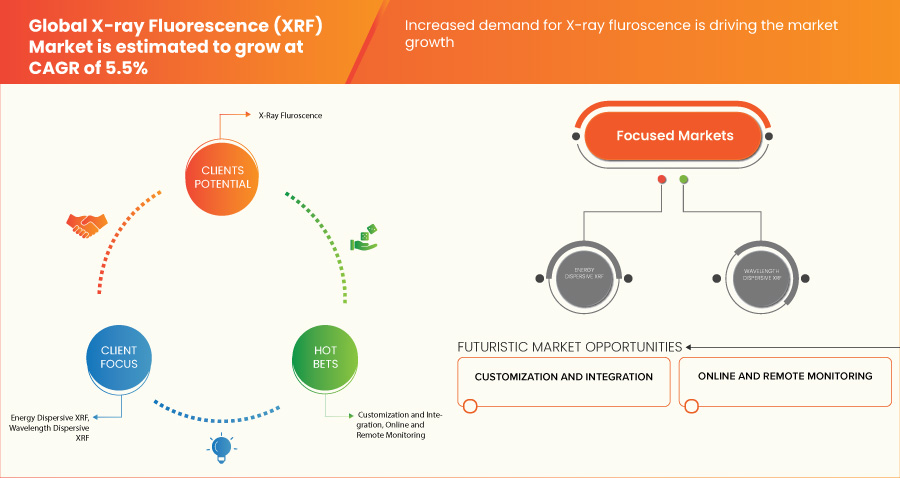
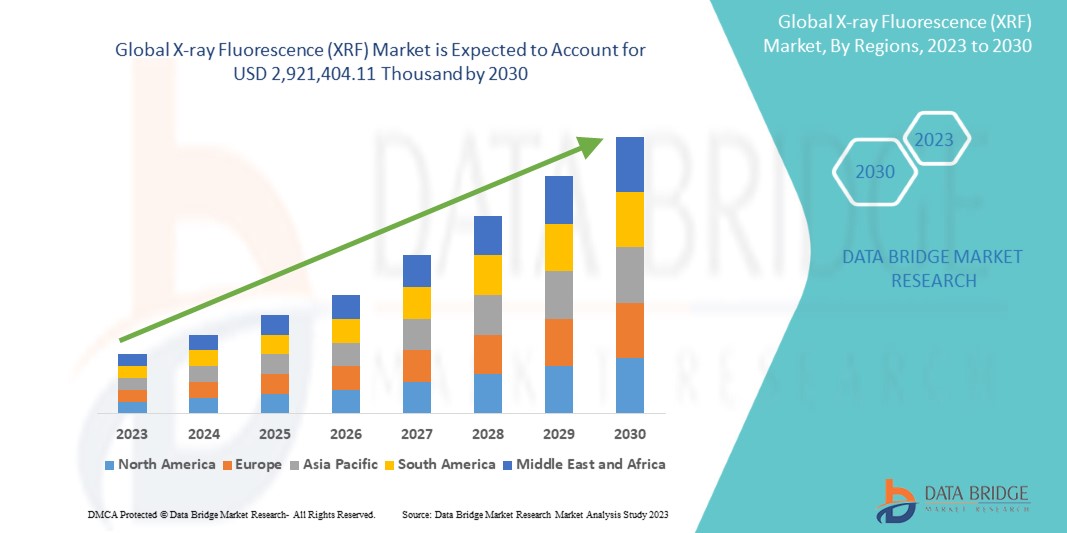
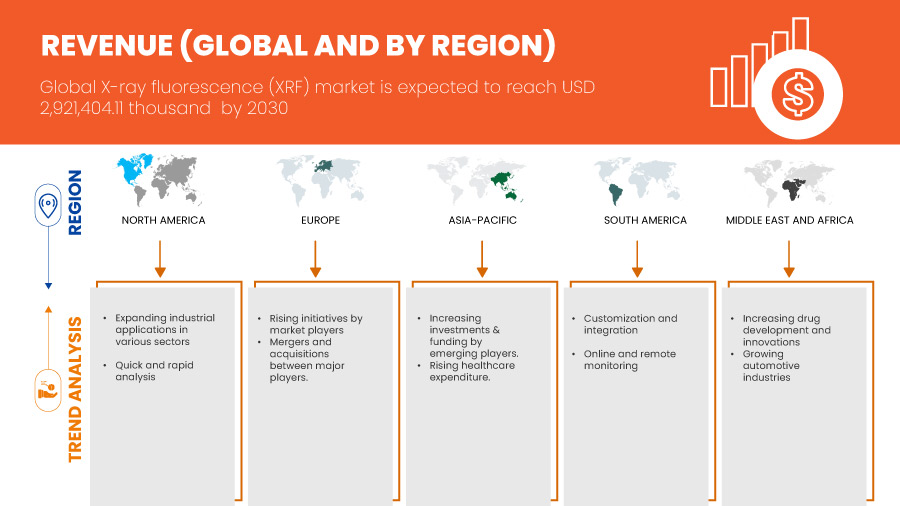
Data Bridge Market Research analyzes that the global X-ray Fluorescence (XRF) Market is expected to reach the value of USD 2,921,404.11 thousand by 2030, at a CAGR of 5.5% during the forecast period. This market report also covers pricing analysis and technological advancements in depth.
|
Report Metric |
Details |
|
Forecast Period |
2023 to 2030 |
|
Base Year |
2022 |
|
Historic Years |
2021 (Customizable to 2015 - 2020) |
|
Quantitative Units |
Revenue in USD Thousand |
|
Segments Covered |
Type (Energy Dispersive XRF, and Wavelength Dispersive XRF), Modularity (Benchtop, Portable, and Handheld), Sample Type (Solid, Powder, Liquid, and Beads), Component (Hardware, Software, and Services), End User (Metal and Mining Industries, Automotive and Aerospace, Environmental Research, Forensic, Research and Academic Institutes, Pharmaceuticals and Biopharmaceuticals, Cement, Glass and Plastic, Rubber and Textiles, Petrochemical, Oil and Gas, Food, Agriculture, Electronic, Art and Archeology, Cosmetics and Body Care Products, Toys, and Others), Application (Heavy Metal, Precious Metal, Alloy and Stainless Steel Analysis, Plating Thickness, Mineral Analysis, ROHS/WEEE Analysis, PCB, Cement, Mortar Fillers and Raw Meal, Oil Analysis, Waste and Effluent Streams, Food, Pet Food and Other Animal Feed, and Others), Detection Limit (5 Ppm-10 Ppm, and Less than 5 Ppm), Sales Channel (Direct, and Indirect) |
|
Countries Covered |
U.S., Canada, Mexico, Germany, U.K., France, Italy, Russia, Turkey, Switzerland, Netherlands, Belgium, Rest of Europe, Japan, China, India, Australia, South Korea, Singapore, Malaysia, Thailand, Indonesia, Philippines, Rest of Asia-Pacific, Brazil, Argentina, Rest of South America, Saudi Arabia, U.A.E., South Africa, Egypt, Israel, and Rest of Middle East and Africa |
|
Market Players Covered |
Shimadzu Corporation (Japan), Thermo Fisher Scientific Inc (U.S.), Bruker (Germany), HORIBA, Ltd.(Japan), Malvern Panalytical Ltd (England), EVIDENT, Rigaku Corporation (Texas), Dandong Aolong Radiative Instrument Group Co., Ltd (China), Hitachi High-Tech Analytical Science (England), Skyray Instruments USA, Inc.(U.S), Hobré Analyzer Solutions (Netherlands), SciAps, Inc. (U.S.), Viken Detection (U.S.), Elvatech Ltd. (Ukraine), LANScientific. (China), FISCHER TECHNOLOGY INC.(U.S), Bourevestnik, and LABOAO (China) among others |
Market Definition
XRF stands for X-ray fluorescence, and the market refers to the worldwide industry involving the manufacturing, distribution, and utilization of XRF technology and instruments. XRF is a non-destructive analytical technique used to determine the elemental composition of materials by measuring the characteristic fluorescent X-rays emitted when a sample is irradiated with X-rays. XRF is used to identify and quantify the elements present in a wide range of materials, including metals, minerals, polymers, ceramics, and more. It helps in quality control, research, and development across industries. XRF is used to analyze geological samples, ores, and minerals to determine their composition and quality, aiding in mineral exploration and resource estimation.
Global X-ray Fluorescence (XRF) Market Dynamics
This section deals with understanding the market drivers, advantages, opportunities, restraints, and challenges. All of this is discussed in detail below:
Drivers
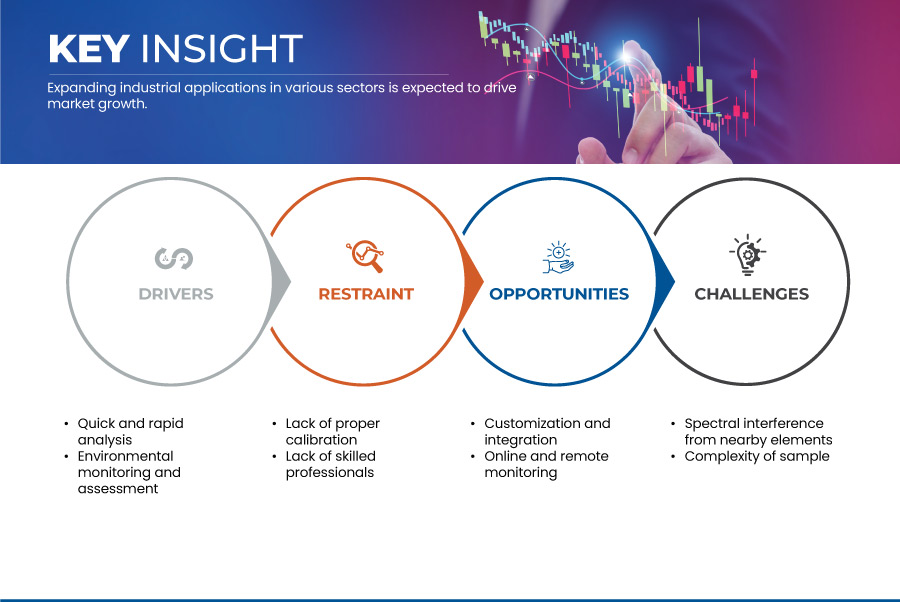
- Expanding Industrial Applications in Various Sectors
XRF technology is widely used for quality control and assurance in industries such as manufacturing, automotive, aerospace, and electronics. Manufacturers rely on XRF to verify the composition of raw materials, components, and finished products, ensuring they meet specifications and regulatory standards. XRF is extensively utilized in the metals and mining industries for ore grade analysis, exploration, and production optimization. It allows miners to quickly determine the composition of ore samples, enabling them to make informed decisions about resource extraction and processing.
In the pharmaceutical industry, XRF is used to verify the elemental composition of drug formulations and analyze the presence of impurities. It also supports research in the medical field, such as studying the distribution of elements in biological tissues.
- Quick and Rapid Analysis
XRF enables fast analysis of materials, reducing the time required for quality control and assurance processes. Manufacturers can quickly assess the composition of raw materials, components, and finished products, ensuring they meet specifications before they are released into the market. Industries with high sample throughput, such as manufacturing and mining, benefit from XRF's rapid analysis capabilities. The ability to analyze a large number of samples quickly enhances overall productivity and operational efficiency.
In industries such as mining and exploration, where real-time decision-making is crucial, XRF provides instant results. Miners can assess ore grades on the spot, optimizing extraction and processing strategies without delays.
Opportunity
- Customization and Integration
Customization allows XRF instruments to be optimized for specific industries, such as mining, pharmaceuticals, electronics, and environmental monitoring. Manufacturers can develop XRF systems with features and capabilities that cater to the unique requirements of each industry. Customizing XRF instruments for specific applications enables users to obtain more accurate and relevant results. For instance, XRF instruments can be configured to analyze certain elements or handle specific types of samples more effectively.
Integrated and customized solutions can enhance the accuracy of XRF analysis by reducing interference from matrix effects and optimizing calibration for specific sample types. Integration with automated sample handling systems streamlines workflows and reduces the need for manual intervention, increasing efficiency and throughput.
Restraint / Challenge
- Lack of Proper Calibration
Calibration is a critical aspect of XRF analysis as it ensures the accuracy and reliability of the results obtained from the instrument. When calibration is not performed correctly or is not maintained, it can lead to inaccurate measurements and undermine the trust in XRF technology. Proper calibration is essential for translating the instrument's raw data into accurate and meaningful elemental concentrations. Without accurate calibration, the results obtained from XRF analysis may not reflect the true composition of the sample, leading to incorrect decisions and actions based on flawed data.
Industries that rely on XRF for quality control and assurance may hesitate to adopt or expand their use of the technology if there are concerns about measurement accuracy. A lack of proper calibration could compromise the integrity of products, leading to product recalls, quality issues, and potential financial losses. XRF instruments are considered reliable tools for material analysis when properly calibrated and maintained. However, instances of inaccurate results due to poor calibration can damage the credibility of XRF technology, leading to a loss of trust among users.
Global X-ray Fluorescence (XRF) Market Scope
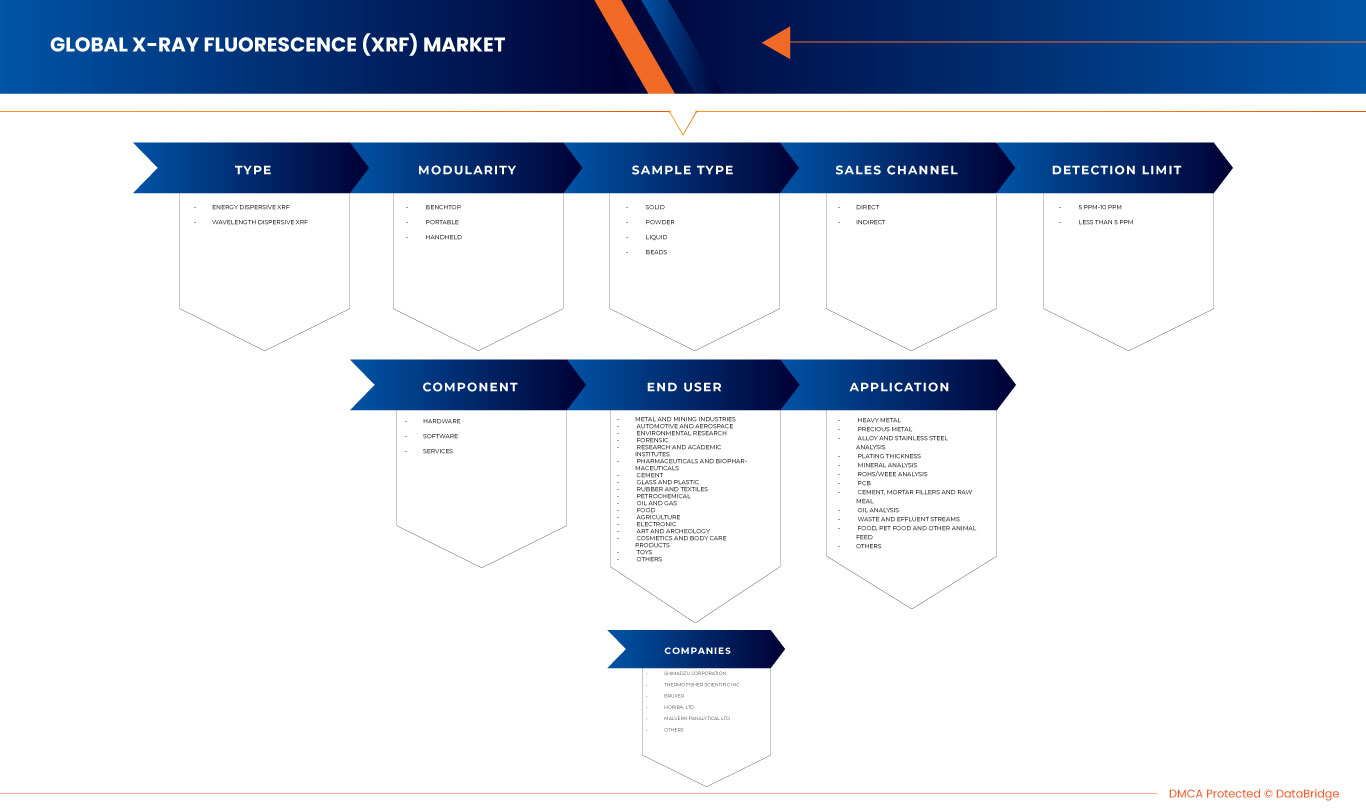
The global x-ray fluorescence (XRF) market is segmented into eight notable segments based on type, modularity, sample type, component, end user, application, detection limit, and sales channel.
The growth amongst these segments will help you analyze meager growth segments in the industries and provide the users with a valuable market overview and market insights to help them make strategic decisions for identifying core market applications.
Type
- Energy Dispersive XRF
- Wavelength Dispersive XRF
On the basis of type, the market is segmented into energy dispersive XRF and wavelength dispersive XRF.
Modularity
- Benchtop
- Portable
- Handheld
On the basis of modularity, the market is segmented into benchtop, portable, and handheld.
Sample Type
- Solid
- Powder
- Liquid
- Beads
On the basis of sample type, the market is segmented into solid, powder, liquid, and beads.
Component
- Hardware
- Software
- Services
On the basis of component, the market is segmented into hardware, software, and services.
End User
- Metal and Mining Industries
- Automotive and Aerospace
- Environmental Research
- Forensic
- Research and Academic Institutes
- Pharmaceuticals and Biopharmaceuticals
- Cement
- Glass and Plastic
- Rubber and Textiles
- Petrochemical
- Oil and Gas
- Food
- Agriculture
- Electronic
- Art and Archeology
- Cosmetics and Body Care Products
- Toys
- Others
On the basis of end user, the market is segmented into metal and mining industries, automotive and aerospace, environmental research, forensic, research and academic institutes, pharmaceuticals and biopharmaceuticals, cement, glass and plastic, rubber and textiles, petrochemical, oil and gas, food, agriculture, electronic, art and archeology, cosmetics and body care products, toys, and others. Application
- Heavy Metal
- Precious Metal
- Alloy and Stainless Steel Analysis
- Plating Thickness
- Mineral Analysis
- ROHS/WEEE Analysis
- PCB
- Cement, Mortar Fillers and Raw Meal
- Oil Analysis
- Waste and Effluent Streams
- Food, Pet Food and Other Animal Feed
- Others
On the basis of application, the market is segmented into heavy metal, precious metal, alloy and stainless steel analysis, plating thickness, mineral analysis, ROHS/WEEE analysis, PCB, cement, mortar fillers and raw meal, oil analysis, waste and effluent streams, food, pet food and other animal feed, and others.
Detection Limit
- 5 ppm-10 ppm
- Less than 5 ppm
On the basis of detection limit, the market is segmented into 5 ppm-10 ppm, and less than 5 ppm.
Sales Channel
- Direct
- Indirect
On the basis of sales channel, the market is segmented into direct, and indirect.
Global X-ray Fluorescence (XRF) Market Regional Analysis/Insights
The global X-ray fluorescence (XRF) market is analyzed and market size insights and trends are provided by country, type, modularity, sample type, component, end user, application, detection limit, and sales channel.
The countries covered in this market report are U.S., Canada, Mexico, Germany, U.K., France, Italy, Russia, Turkey, Switzerland, Netherlands, Belgium, Rest of Europe, Japan, China, India, Australia, South Korea, Singapore, Malaysia, Thailand, Indonesia, Philippines, Rest of Asia-Pacific, Brazil, Argentina, Rest of South America, Saudi Arabia, U.A.E., South Africa, Egypt, Israel, and Rest of Middle East and Africa.
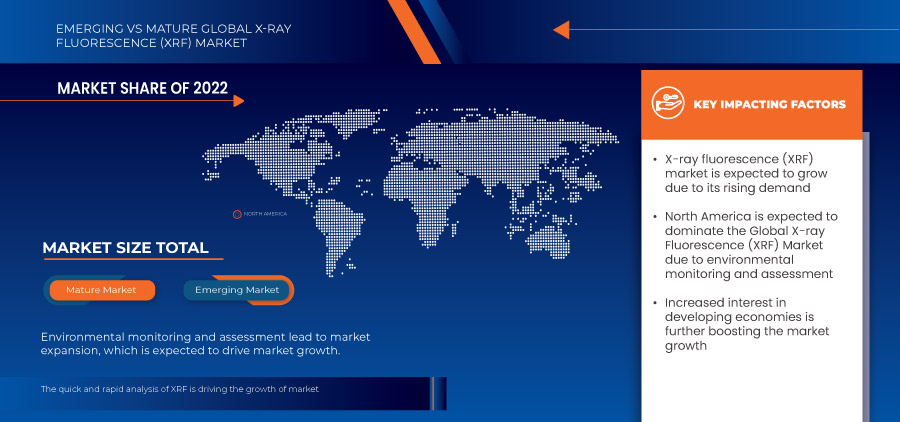
North America is expected to dominate the market with the largest market share due to growing demand for XRF technology. U.S. is the dominating country in North America region due to rising technological advancements in XRF technology is anticipated to fuel the market growth. Europe is the second dominationg region in the market due to rising number of surgeries, and chronic wounds. Germany is dominating the Europe region with the largest market share. Similarly, Japan is dominating the Asia-Pacific region with the largest market share.
The country section of the report also provides individual market-impacting factors and changes in market regulation that impact the current and future trends of the market. Data points like downstream and upstream value chain analysis, technical trends, porter's five forces analysis, and case studies are some of the pointers used to forecast the market scenario for individual countries. Also, the presence and availability of North and South America brands and their challenges faced due to large or scarce competition from local and domestic brands, the impact of domestic tariffs, and trade routes are considered while providing forecast analysis of the country data.
Competitive Landscape and Global X-ray Fluorescence (XRF) Market Share Analysis
The global X-ray fluorescence (XRF) market competitive landscape provides details of the competitors. Details included are company overview, company financials, revenue generated, market potential, new market initiatives, global presence, production sites and facilities, production capacities, company strengths and weaknesses, product launch, product width and breadth, and application dominance. The above data points provided are only related to the companies' focus related to the market.
Some of the major market players operating in the market are Shimadzu Corporation (Japan), Thermo Fisher Scientific Inc (U.S.), Bruker (Germany), HORIBA, Ltd.(Japan), Malvern Panalytical Ltd (England), EVIDENT, Rigaku Corporation (Texas), Dandong Aolong Radiative Instrument Group Co., Ltd (China), Hitachi High-Tech Analytical Science (England), Skyray Instruments USA, Inc.(U.S), Hobré Analyzer Solutions (Netherlands), SciAps, Inc. (U.S.), Viken Detection (U.S.), Elvatech Ltd. (Ukraine), LANScientific. (China), FISCHER TECHNOLOGY INC.(U.S), Bourevestnik, and LABOAO (China) among others.
SKU-
Obtenha acesso online ao relatório sobre a primeira nuvem de inteligência de mercado do mundo

- Painel interativo de análise de dados
- Painel de análise da empresa para oportunidades de elevado potencial de crescimento
- Acesso de analista de pesquisa para personalização e customização. consultas
- Análise da concorrência com painel interativo
- Últimas notícias, atualizações e atualizações Análise de tendências
- Aproveite o poder da análise de benchmark para um rastreio abrangente da concorrência
Metodologia de Investigação
A recolha de dados e a análise do ano base são feitas através de módulos de recolha de dados com amostras grandes. A etapa inclui a obtenção de informações de mercado ou dados relacionados através de diversas fontes e estratégias. Inclui examinar e planear antecipadamente todos os dados adquiridos no passado. Da mesma forma, envolve o exame de inconsistências de informação observadas em diferentes fontes de informação. Os dados de mercado são analisados e estimados utilizando modelos estatísticos e coerentes de mercado. Além disso, a análise da quota de mercado e a análise das principais tendências são os principais fatores de sucesso no relatório de mercado. Para saber mais, solicite uma chamada de analista ou abra a sua consulta.
A principal metodologia de investigação utilizada pela equipa de investigação do DBMR é a triangulação de dados que envolve a mineração de dados, a análise do impacto das variáveis de dados no mercado e a validação primária (especialista do setor). Os modelos de dados incluem grelha de posicionamento de fornecedores, análise da linha de tempo do mercado, visão geral e guia de mercado, grelha de posicionamento da empresa, análise de patentes, análise de preços, análise da quota de mercado da empresa, normas de medição, análise global versus regional e de participação dos fornecedores. Para saber mais sobre a metodologia de investigação, faça uma consulta para falar com os nossos especialistas do setor.
Personalização disponível
A Data Bridge Market Research é líder em investigação formativa avançada. Orgulhamo-nos de servir os nossos clientes novos e existentes com dados e análises que correspondem e atendem aos seus objetivos. O relatório pode ser personalizado para incluir análise de tendências de preços de marcas-alvo, compreensão do mercado para países adicionais (solicite a lista de países), dados de resultados de ensaios clínicos, revisão de literatura, mercado remodelado e análise de base de produtos . A análise de mercado dos concorrentes-alvo pode ser analisada desde análises baseadas em tecnologia até estratégias de carteira de mercado. Podemos adicionar quantos concorrentes necessitar de dados no formato e estilo de dados que procura. A nossa equipa de analistas também pode fornecer dados em tabelas dinâmicas de ficheiros Excel em bruto (livro de factos) ou pode ajudá-lo a criar apresentações a partir dos conjuntos de dados disponíveis no relatório.











