


Middle East and Africa Textile Films Market, By Material (Polyester, Polyurethane, and Others), Type (Breathable and Non-Breathable), Application (Agriculture, Industrial, Infrastructure, Medical, Sports, Transportation, and Others) – Industry Trends and Forecast to 2030.
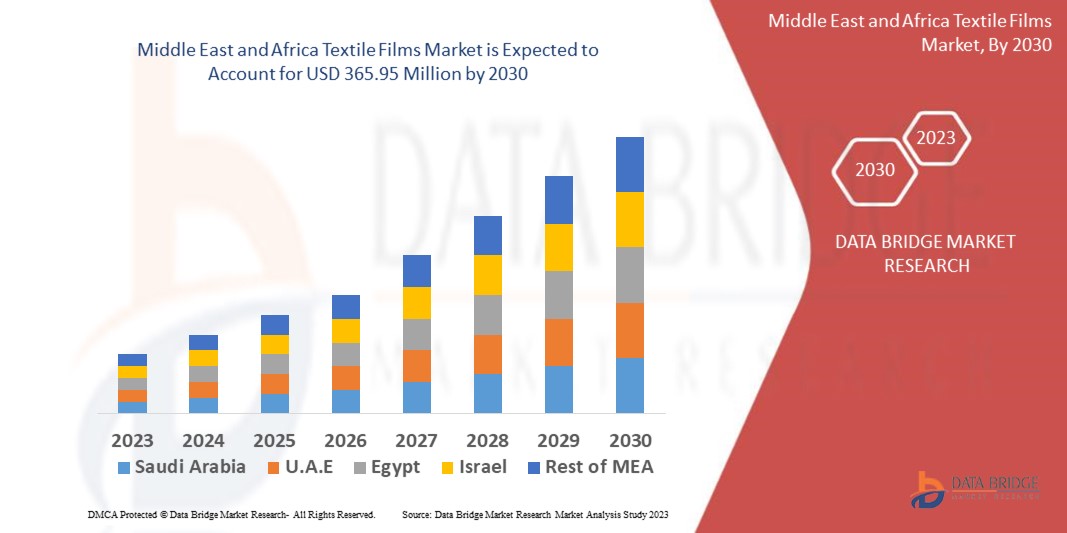
Middle East and Africa Textile Films Market Analysis and Size
Typically, textile films are used for cold laminating and cold films. The two forms of textile films are classified as breathable and non-breathable. The permeable textile films have become extremely important in the hygiene industry. The textile film market has expanded to a wide spectrum due to its high strength and flexibility, and surface characteristics and other mechanical attributes. Textile films are able to accomplish certain mechanical qualities due to the use of polymers and other sophisticated composites. This market for textile films is sure to increase significantly as people become more aware of the use of textile film in the production of hygiene products.
Data Bridge Market Research analyses that the Middle East and Africa textile films market which was USD 249.58 million in 2022, would rocket up to USD 365.95 million by 2030, and is expected to undergo a CAGR of 4.9% during the forecast period of 2023 to 2030. “Breathable” segment in the type segment dominates the market because of its disposable nature and a low response to temperature fluctuations.
In addition to the insights on market scenarios such as market value, growth rate, segmentation, geographical coverage, and major players, the market reports curated by the Data Bridge Market Research also include in-depth expert analysis, geographically represented company-wise production and capacity, network layouts of distributors and partners, detailed and updated price trend analysis and deficit analysis of supply chain and demand.
Middle East and Africa Textile Films Market Scope and Segmentation
|
Report Metric |
Details |
|
Forecast Period |
2023 to 2030 |
|
Base Year |
2022 |
|
Historic Years |
2021 (Customizable to 2015-2020) |
|
Quantitative Units |
Revenue in USD Thousand, Volumes in Tons, Pricing in USD |
|
Segments Covered |
By Material (Polyester, Polyurethane, and Others), Type (Breathable and Non-Breathable), Application (Agriculture, Industrial, Infrastructure, Medical, Sports, Transportation, and Others) |
|
Countries Covered |
South Africa, Egypt, Saudi Arabia, U.A.E., Israel, and Rest of Middle East and Africa |
|
Market Players Covered |
TORAY INDUSTRIES, INC. (Japan), Arkema (France), Covestro AG (Germany), Schweitzer-Mauduit International, Inc. (U.S.), SILON (Czech Republic), Cattaneo Holding s.r.l. (Italy), RKW Group (Germany), Felix (Turkey), Trioplast Industrier AB (Germany), Skymark (U.K.), and Berry Global Inc. (U.S.) among others |
|
Market Opportunities |
|
Market Definition
Textile films employ polymers and advanced composites with novel mechanical characteristics like strength and flexibility as well as surface attributes like hydrophobic and oleophobic. This film helps many businesses, including packaging, medicine, and technical clothing, to satisfy their demands. To improve the dyeing, printing, and bonding processes—which get more challenging as materials become more complex—surface pre-treatments and finishes are crucial procedures. The need for inventive high-performance textile films is rising, which calls for the creation of novel high-efficiency and high-value processing technologies.
Films and fabrics that have two or more layers sandwiched together. The mating surface's melting point needs to be lower than the melting points of the other layers. Thermoplastic materials have been extruded and cast into forms. The component fibers are used to categorize various textiles, including silk, wool, linen, cotton, synthetic fibers such as rayon, nylon, and polyesters, and some inorganic fibers like gold cloth, glass fiber, and asbestos fabric. Various things can be done using plastic films. This includes packaging, plastic bags, labels, architectural and landscape design, electrical fabrication, photographic film, cinema film stock, VHS (video home system), and other products.
Middle East and Africa Textile Films Market Dynamics
Drivers
- A rise in the demand for hygiene products
An increase in the need for high-quality hygiene products is driving the market growth. The demand for sanitary products and increased awareness of the value of cleanliness will likely lead to an increase in the market in the near future. Baby diapers, feminine hygiene items, and adult incontinence products all make extensive use of polypropylene films.
- High Demand for Personal Protective Equipment (PPE)
Healthcare workers who are putting their lives in danger to fight the virus are more susceptible to infection due to their close contact with patients. The danger of COVID-19 hospital transmission is reduced by Personal Protective Equipment (PPE) for frontline healthcare employees. PPE kits are necessary in industries to protect employees' lives. Gloves, goggles, a face shield, a shoe protector, a mask, a head cover, and a gown are often included in a PPE kit. The majority of PPE kits are constructed of polymers. Film composed of polyethylene or polypropylene is used to make head coverings. Nanofibers and non-woven polypropylene are used to make 3-ply masks. Natural rubber latex, nitrile rubber, neoprene, polyvinyl chloride, and polyurethane can all be used to make gloves. A film consisting of polypropylene or polyethylene is used to make disposable gowns.
Opportunities
- New fabrics and processes have been created as a result of an increase in textile film research and development
The rising technical developments by producers of textile films led to the development of new textiles and techniques, the expansion of the market with lower penetration rates, and extended profitable opportunities to the market players. In addition, the market's increasing adoption of organic textile films will further expand future market growth.
Restraints/Challenges
- Concerns regarding waste disposal
Films made of polypropylene, polyethylene, and polyurethane are frequently used in products like infant diapers, sanitary products, and medical textiles (such as surgical gowns, surgical masks, gloves, and PPE kits). Since the pandemic's emergence in 2020, all of these items have seen widespread usage. Although it is extensively used to make PPE kits, polypropylene is not biodegradable. This makes the problem of plastic trash, which already exists, worse. The market may face difficulties as a result of these waste disposal issues.
This market report provides details of new recent developments, trade regulations, import-export analysis, production analysis, value chain optimization, market share, impact of domestic and localized market players, analyses opportunities in terms of emerging revenue pockets, changes in market regulations, strategic market growth analysis, market size, category market growths, application niches and dominance, product approvals, product launches, geographic expansions, technological innovations in the market. To gain more info on this market, contact Data Bridge Market Research for an Analyst Brief, our team will help you take an informed market decision to achieve market growth.
Recent Development
- In June 2022, numerous thermoplastic polyurethane (TPU) films from Covestro's Dureflex product line have now received Standard 100 certification from OEKO-TEX. The films are skin-friendly, breathable, waterproof, and tear-resistant. This makes them the preferred material for sporting goods, outdoor apparel, furniture, and automobile seating
- In April 2021, the purchase of Scapa Group Plc, a UK-based provider of innovation, design, and manufacturing solutions for the healthcare and industrial industries, was completed by Schweitzer-Mauduit International
- In June 2020, Berry Global Inc. established a partnership with Medicom Group, one of the leading producers of medical and respiratory masks, to create innovative product solutions. The alliance has aided in boosting the market's manufacturing of new products.
Middle East and Africa Textile Films Market Scope
The Middle East and Africa textile films market is segmented on the basis of the material, type, and application. The growth amongst these segments will help you analyze meager growth segments in the industries and provide the users with a valuable market overview and market insights to help them make strategic decisions for identifying core market applications.
Type
- Breathable
- Non-breathable
Material
- Polyester
- Polyurethane
- Others
Application
- Agriculture
- Industrial
- Infrastructure
- Medical
- Sports
- Transportation
- Others
Middle East and Africa Textile Films Market Regional Analysis/Insights
The Middle East and Africa textile films market is analyzed and market size insights and trends are provided by country, material, type, and application as referenced above.
The countries covered in this market report are South Africa, Egypt, Saudi Arabia, U.A.E., Israel, and rest of Middle East and Africa.
South Africa dominates the market due to the increasing number of medical devices and equipment which boosts the demand for textile films.
The country section of the report also provides individual market impacting factors and changes in regulation in the market domestically that impacts the current and future trends of the market. Data points like down-stream and upstream value chain analysis, technical trends and porter's five forces analysis, case studies are some of the pointers used to forecast the market scenario for individual countries. Also, the presence and availability of regional brands and their challenges faced due to large or scarce competition from local and domestic brands, impact of domestic tariffs and trade routes are considered while providing forecast analysis of the country data.
Easy availability of raw materials for textile films production
Middle East and Africa textile films market also provides you with detailed market analysis for every country growth in installed base of different kinds of products for the market, impact of technology, the awareness about the hygienic products, change in regulatory scenarios and the impact on the textile films market. The data is available for historic period 2015 to 2020.
Competitive Landscape and Middle East and Africa Textile Films Market Share Analysis
The Middle East and Africa textile films market competitive landscape provides details by competitor. Details included are company overview, company financials, revenue generated, market potential, investment in research and development, new market initiatives, regional presence, production sites and facilities, production capacities, company strengths and weaknesses, product launch, product width and breadth, and application dominance. The above data points provided are only related to the companies' focus related to the market.
Some of the major players operating in the Middle East and Africa textile films market are:
- TORAY INDUSTRIES, INC. (Japan)
- Arkema (France)
- Covestro AG (Germany)
- Schweitzer-Mauduit International, Inc. (U.S.)
- SILON (Czech Republic)
- Cattaneo Holding s.r.l. (Italy)
- RKW Group (Germany)
- Felix (Turkey)
- Trioplast Industrier AB (Germany)
- Skymark (U.K.)
- Berry Global Inc. (U.S.)
SKU-
Obtenha acesso online ao relatório sobre a primeira nuvem de inteligência de mercado do mundo

- Painel interativo de análise de dados
- Painel de análise da empresa para oportunidades de elevado potencial de crescimento
- Acesso de analista de pesquisa para personalização e customização. consultas
- Análise da concorrência com painel interativo
- Últimas notícias, atualizações e atualizações Análise de tendências
- Aproveite o poder da análise de benchmark para um rastreio abrangente da concorrência
Metodologia de Investigação
A recolha de dados e a análise do ano base são feitas através de módulos de recolha de dados com amostras grandes. A etapa inclui a obtenção de informações de mercado ou dados relacionados através de diversas fontes e estratégias. Inclui examinar e planear antecipadamente todos os dados adquiridos no passado. Da mesma forma, envolve o exame de inconsistências de informação observadas em diferentes fontes de informação. Os dados de mercado são analisados e estimados utilizando modelos estatísticos e coerentes de mercado. Além disso, a análise da quota de mercado e a análise das principais tendências são os principais fatores de sucesso no relatório de mercado. Para saber mais, solicite uma chamada de analista ou abra a sua consulta.
A principal metodologia de investigação utilizada pela equipa de investigação do DBMR é a triangulação de dados que envolve a mineração de dados, a análise do impacto das variáveis de dados no mercado e a validação primária (especialista do setor). Os modelos de dados incluem grelha de posicionamento de fornecedores, análise da linha de tempo do mercado, visão geral e guia de mercado, grelha de posicionamento da empresa, análise de patentes, análise de preços, análise da quota de mercado da empresa, normas de medição, análise global versus regional e de participação dos fornecedores. Para saber mais sobre a metodologia de investigação, faça uma consulta para falar com os nossos especialistas do setor.
Personalização disponível
A Data Bridge Market Research é líder em investigação formativa avançada. Orgulhamo-nos de servir os nossos clientes novos e existentes com dados e análises que correspondem e atendem aos seus objetivos. O relatório pode ser personalizado para incluir análise de tendências de preços de marcas-alvo, compreensão do mercado para países adicionais (solicite a lista de países), dados de resultados de ensaios clínicos, revisão de literatura, mercado remodelado e análise de base de produtos . A análise de mercado dos concorrentes-alvo pode ser analisada desde análises baseadas em tecnologia até estratégias de carteira de mercado. Podemos adicionar quantos concorrentes necessitar de dados no formato e estilo de dados que procura. A nossa equipa de analistas também pode fornecer dados em tabelas dinâmicas de ficheiros Excel em bruto (livro de factos) ou pode ajudá-lo a criar apresentações a partir dos conjuntos de dados disponíveis no relatório.











