


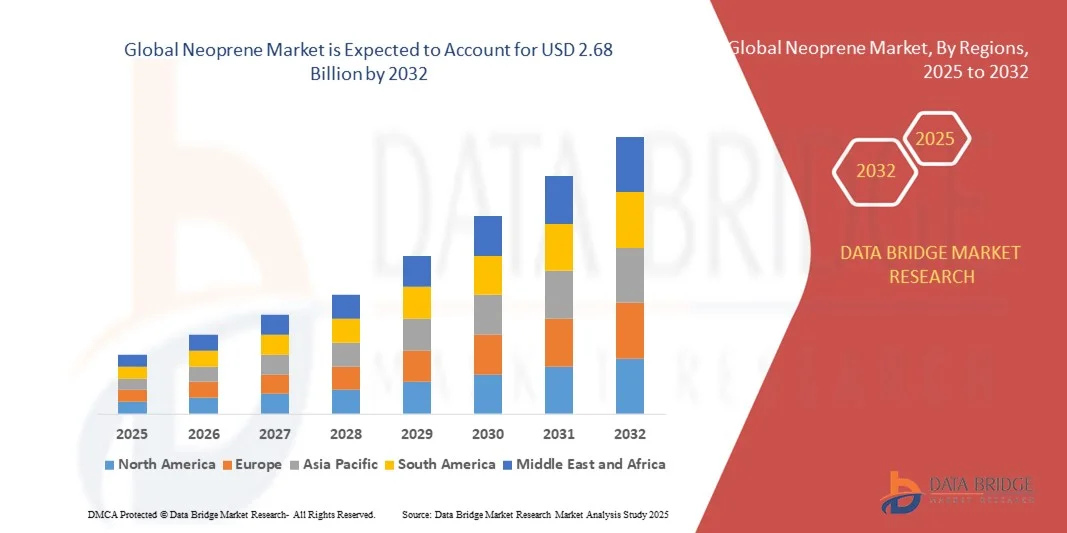
What is the Global Neoprene Market Size and Growth Rate?
- The global neoprene market size was valued at USD 2.24 billion in 2024 and is expected to reach USD 2.68 billion by 2032, at a CAGR of 2.25% during the forecast period
- Rise in the popularity of medical gloves is the vital factor escalating the market growth, also rise in the expansion of chloroprene production capacities, rise in the expansion of electronic and construction industry and rise in the rapidly expanding construction and electronic industry in the developing economies are the major factors among others driving the neoprene market
What are the Major Takeaways of Neoprene Market?
- Rise in the technological advancements and modernization in production techniques and increase in the demand from the emerging economies will further create new opportunities for the neoprene market
- Rise in the strict environmental regulations, increase in the availability of substitute of neoprene and fluctuations in the price of crude oil are the major factor among others acting as a restraint, and will further challenge the growth of neoprene market in the forecast period mentioned above
- Asia-Pacific dominated the neoprene market with the largest revenue share of 42.54% in 2024, driven by strong demand from automotive, construction, and electronics industries, alongside rapid industrialization and urbanization
- North America is projected to grow at the fastest CAGR of 9.97% from 2025 to 2032, fueled by strong demand from automotive, construction, and defense sectors. Rising consumer spending, technological innovation, and increased adoption of neoprene-based products in sports, safety, and protective gear are accelerating market expansion
- The neoprene foam/sponge segment dominated the market with the largest revenue share of 47.5% in 2024, driven by its widespread applications in insulation, cushioning, wetsuits, and orthopedic supports
Report Scope and Neoprene Market Segmentation
|
Attributes |
Neoprene Key Market Insights |
|
Segments Covered |
|
|
Countries Covered |
North America
Europe
Asia-Pacific
Middle East and Africa
South America
|
|
Key Market Players |
|
|
Market Opportunities |
|
|
Value Added Data Infosets |
In addition to the insights on market scenarios such as market value, growth rate, segmentation, geographical coverage, and major players, the market reports curated by the Data Bridge Market Research also include in-depth expert analysis, pricing analysis, brand share analysis, consumer survey, demography analysis, supply chain analysis, value chain analysis, raw material/consumables overview, vendor selection criteria, PESTLE Analysis, Porter Analysis, and regulatory framework. |
What is the Key Trend in the Neoprene Market?
Sustainability and Eco-Friendly Material Innovations
- A significant trend shaping the global neoprene market is the transition towards sustainable and eco-friendly alternatives, driven by rising environmental concerns and regulatory pressures. Manufacturers are increasingly developing bio-based and recycled neoprene to reduce dependence on petroleum-based raw materials
- For instance, Patagonia has pioneered the use of Yulex natural rubber, a plant-based alternative to traditional neoprene, in its wetsuits, setting an instance for eco-conscious product innovation. Similarly, companies such as SHEICO Group are advancing recycled neoprene solutions to minimize industrial waste
- Growing consumer demand for greener products is encouraging automotive, apparel, and industrial end-users to prefer sustainable neoprene variants over conventional ones. Bio-based formulations also appeal to brands targeting environmentally responsible buyers
- This sustainability-driven shift is fostering innovation across the supply chain, pushing companies to balance performance with reduced carbon footprints. Consequently, eco-friendly neoprene is emerging as a disruptive trend that will redefine product development strategies in the coming years
What are the Key Drivers of Neoprene Market?
- The increasing demand from automotive, construction, and electrical & electronics industries is one of the primary drivers of neoprene market growth, as its properties such as resistance to oil, heat, and weathering make it highly versatile
- For instance, in March 2024, Denka Corporation announced advancements in high-performance neoprene grades for automotive sealing systems, aiming to enhance durability in extreme environments. Such product innovations are strengthening market adoption
- The rising use of neoprene in sportswear, wetsuits, and medical supports further drives demand, especially with consumers valuing durability, comfort, and flexibility. The fashion and lifestyle sectors are also contributing by incorporating neoprene into trendy apparel and accessories
- In addition, the global infrastructure development boom is propelling demand for neoprene-based adhesives, coatings, and gaskets. Its role in sustainable construction and renewable energy applications positions neoprene as a critical material for diverse industries
- With expanding applications across multiple end-use sectors, the neoprene market continues to witness robust growth momentum, supported by industrial innovation and lifestyle-driven demand
Which Factor is Challenging the Growth of the Neoprene Market?
- Environmental and health concerns associated with petrochemical-based neoprene production remain a major challenge, as traditional manufacturing releases significant carbon emissions and faces increasing regulatory scrutiny
- For instance, heightened environmental awareness has pushed some global brands, including Patagonia, to actively move away from petroleum-based neoprene, highlighting industry-wide sustainability challenges
- Price volatility of raw materials such as chloroprene also poses risks, making cost predictability difficult for manufacturers and end-users. Dependence on petroleum feedstocks further amplifies market uncertainty
- Moreover, the availability of alternative elastomers such as EPDM and TPE, which offer similar or superior properties at competitive costs, intensifies the challenge for neoprene manufacturers to maintain market share
- To overcome these hurdles, companies are investing in bio-based neoprene innovations, recycling initiatives, and green certifications. While challenges persist, addressing sustainability, cost competitiveness, and consumer awareness will be pivotal to ensuring long-term market expansion
How is the Neoprene Market Segmented?
The market is segmented on the basis of product, end-user, manufacturing route, grade, application, and type.
- By Product
On the basis of product, the neoprene market is segmented into neoprene foam/sponge, neoprene rubber sheet, and neoprene latex. The neoprene foam/sponge segment dominated the market with the largest revenue share of 47.5% in 2024, driven by its widespread applications in insulation, cushioning, wetsuits, and orthopedic supports. Its lightweight, flexible, and shock-absorbing properties make it the most demanded neoprene product across consumer and industrial applications.
In contrast, neoprene latex is anticipated to record the fastest CAGR from 2025 to 2032, owing to its rising adoption in adhesives, coatings, and dipped goods, especially in medical gloves and protective equipment. The surge in demand for latex-based products post-pandemic and increasing preference for lightweight adhesives in construction further propel this growth. Meanwhile, neoprene rubber sheets continue to hold strong utility in gaskets, industrial belts, and automotive parts, supported by their superior oil and chemical resistance.
- By End-User
On the basis of end-user, the neoprene market is segmented into automotive, electrical and electronics, building and construction, textile, elastomers, latex, coatings, and others. The automotive segment held the largest market revenue share of 39.2% in 2024, attributed to neoprene’s extensive use in hoses, belts, seals, and vibration mounts due to its oil, weather, and abrasion resistance.
The electrical and electronics segment is projected to grow at the fastest CAGR during 2025–2032, fueled by the demand for flame-retardant and insulating materials in wire coatings, cable jackets, and circuit board laminates. In addition, building and construction is witnessing increasing demand for neoprene in adhesives, sealants, and waterproofing solutions, particularly in urban infrastructure projects. The textile and apparel industry also contributes significantly, as neoprene finds applications in wetsuits, sportswear, and fashion accessories, driven by lifestyle and recreational activities. Overall, automotive dominance continues, but electronics growth highlights neoprene’s diversification into advanced technology markets.
- By Manufacturing Route
On the basis of manufacturing route, the neoprene market is segmented into butadiene route and acetylene route. The acetylene route dominated the market with a revenue share of 62.8% in 2024, as it is the traditional and most established method for neoprene production, ensuring high performance in industrial-grade applications.
However, the butadiene route is expected to witness the fastest CAGR from 2025 to 2032, owing to its relatively lower cost, better scalability, and reduced environmental impact compared to the acetylene-based process. As industries shift towards sustainable production, butadiene-based neoprene is gaining favor, especially in adhesives and coatings, where cost efficiency and eco-friendliness are prioritized. The acetylene route still finds preference in applications demanding superior thermal stability and strength, particularly in automotive and defense-related products. The gradual transition towards the butadiene route highlights an evolving market dynamic balancing legacy production with innovation and sustainability.
- By Grade
On the basis of grade, the neoprene market is segmented into general-purpose grade neoprene, pre-crosslinked grade neoprene, sulfur-modified grade neoprene, and slow crystallizing grade neoprene. The general-purpose grade segment accounted for the largest market share of 44.6% in 2024, driven by its versatile applications in gaskets, hoses, industrial belts, adhesives, and consumer goods. It serves as the backbone of neoprene demand across industries.
On the other hand, the sulfur-modified grade neoprene segment is expected to record the fastest CAGR during 2025–2032, fueled by its improved crystallization resistance, tensile strength, and heat stability, making it increasingly desirable in high-performance automotive and industrial applications. Pre-crosslinked neoprene is gaining traction in adhesives and coatings, while slow-crystallizing grades are particularly valuable in applications requiring enhanced flexibility at low temperatures. The evolution in grades demonstrates how tailored neoprene solutions are meeting highly specific industrial and consumer needs, driving innovation and market growth.
- By Application
On the basis of application, the neoprene market is segmented into technical rubber, adhesives industry, and latex industry. The technical rubber segment dominated the market with a 48.3% revenue share in 2024, as neoprene’s durability, resistance to oils, and ability to withstand extreme conditions make it essential for automotive, construction, and mechanical uses.
The adhesives industry segment is anticipated to witness the fastest CAGR from 2025 to 2032, driven by growing demand for neoprene-based adhesives in footwear, construction, furniture, and packaging. Its superior bonding strength and flexibility under temperature variations are key attributes fueling this growth. The latex industry also maintains steady adoption, particularly in medical gloves, dipped goods, and protective clothing. Together, these applications showcase neoprene’s balance between industrial utility and consumer-focused end-uses, with adhesives emerging as the most dynamic growth area shaping the future of the market.
- By Type
On the basis of type, the neoprene market is segmented into normal linear grades, pre-cross-linked grades, sulfur-modified grades, and slow crystallizing grades. The normal linear grades segment held the largest revenue share of 41.7% in 2024, primarily due to its wide adoption across general-purpose applications, from automotive components to consumer goods. Its balance of performance and cost-effectiveness ensures high demand globally.
However, the slow crystallizing grades segment is projected to grow at the fastest CAGR during 2025–2032, owing to its superior low-temperature flexibility, making it ideal for applications in cold environments and industries requiring enhanced elasticity. Pre-cross-linked grades continue to see demand in adhesives and coatings, while sulfur-modified grades address high-performance industrial requirements. This segmentation highlights how the neoprene market is diversifying with specialized types to meet varied industry demands, while maintaining strong demand for conventional linear grades as the cornerstone of global consumption.
Which Region Holds the Largest Share of the Neoprene Market?
- Asia-Pacific dominated the neoprene market with the largest revenue share of 42.54% in 2024, driven by strong demand from automotive, construction, and electronics industries, alongside rapid industrialization and urbanization
- The region’s cost-effective production capabilities and the presence of large-scale neoprene manufacturers in China, Japan, and South Korea provide a strong competitive edge
- Rising consumer demand for durable, weather-resistant materials in sportswear, wetsuits, and building applications also contributes significantly to growth, making Asia-Pacific the global hub for neoprene demand and supply
China Neoprene Market Insight
The China neoprene market captured the largest revenue share within Asia-Pacific in 2024, supported by robust demand in automotive, construction, and consumer goods industries. The government’s infrastructure development initiatives and the expansion of the domestic automotive sector have bolstered neoprene consumption. With its strong manufacturing base and affordability of raw materials, China is a leading supplier in global trade, further reinforcing its dominance in the neoprene market.
Japan Neoprene Market Insight
The Japan neoprene market is gaining traction, driven by its advanced technology base, stringent quality standards, and consumer preference for high-performance materials. Neoprene demand in Japan is supported by the sportswear, marine, and electronics sectors, with products such as wetsuits and insulating components witnessing increasing uptake. In addition, Japan’s growing focus on eco-friendly and durable materials contributes to steady market growth.
India Neoprene Market Insight
The India neoprene market is expected to expand rapidly, supported by the booming construction and automotive sectors. Increasing disposable incomes and rising awareness about neoprene’s durability and versatility are fueling adoption in both industrial and consumer applications. Government initiatives focused on manufacturing growth and infrastructure projects further stimulate demand, positioning India as a fast-emerging neoprene consumer in Asia-Pacific.
Which Region is the Fastest Growing Region in the Neoprene Market?
North America is projected to grow at the fastest CAGR of 9.97% from 2025 to 2032, fueled by strong demand from automotive, construction, and defense sectors. Rising consumer spending, technological innovation, and increased adoption of neoprene-based products in sports, safety, and protective gear are accelerating market expansion. In addition, the region’s emphasis on sustainable and high-performance materials is expected to create new opportunities for neoprene manufacturers.
U.S. Neoprene Market Insight
The U.S. accounted for the largest share of the North American neoprene market in 2024, supported by demand across automotive, defense, and outdoor recreation sectors. Neoprene’s widespread use in protective equipment, wetsuits, adhesives, and gaskets underscores its versatility. The growing trend of health and fitness, alongside technological advancements in neoprene processing, further drives growth in the U.S.
Canada Neoprene Market Insight
The Canada neoprene market is expanding steadily, supported by growth in infrastructure projects and increasing demand for durable, weather-resistant materials in construction. Canada’s strong outdoor recreation culture also stimulates demand for neoprene wetsuits, gloves, and protective gear. Rising interest in eco-friendly neoprene alternatives is shaping future market dynamics.
Mexico Neoprene Market Insight
The Mexico neoprene market is witnessing positive momentum, driven by its role as a manufacturing hub for automotive and industrial goods. Demand is particularly strong in adhesives, sealants, and protective equipment, aligning with the country’s expanding industrial base. Competitive production costs and access to raw materials position Mexico as a vital player in the regional neoprene supply chain.
Which are the Top Companies in Neoprene Market?
The neoprene industry is primarily led by well-established companies, including:
- Asahi Kasei Advance Corporation (Japan)
- ZENITH RUBBER (India)
- Versalis (Italy)
- Tosoh (Japan)
- Pidilite Industries Ltd. (India)
- LANXESS (Germany)
- SHOWA DENKO K.K. (Japan)
- Dow (U.S.)
- BRP Manufacturing (U.S.)
- Monmouth Rubber & Plastics Corp (U.S.)
- Pacific Eagle Enterprise Co., Ltd. (Taiwan)
- Huntington Rubber Sales, LLC. (U.S.)
- White Cross Rubber Products Ltd. (U.K.)
- SHEICO Group (Taiwan)
- Neotex Union Industries Co., Ltd. (Taiwan)
- Tata Rubber Corporation (India)
- Minor Rubber Products (U.S.)
- Denka Corporation (Japan)
- Tynorindia (India)
- Star Polymer (India)
- Dongguan Top Neoprene Products Factory (China)
What are the Recent Developments in Global Neoprene Market?
- In January 2025, Mueller Sports Medicine, a global leader in sports medicine, announced the acquisition of the Pro Orthopedic brand, a well-recognized provider of neoprene-based orthopedic products for athletes and active individuals. This move was part of Mueller’s strategy to broaden its product portfolio and strengthen its position in the professional and institutional sports medicine market. This acquisition underscores Mueller’s commitment to innovation and growth in athlete-focused healthcare solutions
- In August 2023, Ansell launched its innovative SENSOPRENE Technology, which enabled the production of surgical gloves up to 30% thinner than traditional neoprene gloves. This advancement provided users with improved sensitivity and comfort while ensuring strong durability and protection against allergies and sensitivities caused by latex or chemical accelerators. This development highlights Ansell’s focus on enhancing performance and safety in the medical sector
- In November 2022, Quanex Building Products completed the acquisition of LMI Custom Mixing, LLC, a move designed to expand its expertise in polymer solutions. This acquisition allowed Quanex to diversify into new industries, enhance its polymer capabilities for existing businesses, and provide a more comprehensive service experience for LMI clients across North America. This step reflects Quanex’s long-term vision to strengthen its materials innovation portfolio
- In January 2022, PAR Group acquired Mountford Rubber & Plastics Ltd., strengthening its standing as one of the U.K.’s leading suppliers of plastic, insulation, and rubber products. The acquisition integrated Mountford’s operations, which aligned well with PAR Group’s core offerings, while also bringing additional plant facilities, tooling resources, and stock. This acquisition demonstrates PAR Group’s strategic approach to expanding its capabilities and market reach

- Interactive Data Analysis Dashboard
- Company Analysis Dashboard for high growth potential opportunities
- Research Analyst Access for customization & queries
- Competitor Analysis with Interactive dashboard
- Latest News, Updates & Trend analysis
- Harness the Power of Benchmark Analysis for Comprehensive Competitor Tracking
Global Neoprene Market, Supply Chain Analysis and Ecosystem Framework
To support market growth and help clients navigate the impact of geopolitical shifts, DBMR has integrated in-depth supply chain analysis into its Global Neoprene Market research reports. This addition empowers clients to respond effectively to global changes affecting their industries. The supply chain analysis section includes detailed insights such as Global Neoprene Market consumption and production by country, price trend analysis, the impact of tariffs and geopolitical developments, and import and export trends by country and HSN code. It also highlights major suppliers with data on production capacity and company profiles, as well as key importers and exporters. In addition to research, DBMR offers specialized supply chain consulting services backed by over a decade of experience, providing solutions like supplier discovery, supplier risk assessment, price trend analysis, impact evaluation of inflation and trade route changes, and comprehensive market trend analysis.
Data collection and base year analysis are done using data collection modules with large sample sizes. The stage includes obtaining market information or related data through various sources and strategies. It includes examining and planning all the data acquired from the past in advance. It likewise envelops the examination of information inconsistencies seen across different information sources. The market data is analysed and estimated using market statistical and coherent models. Also, market share analysis and key trend analysis are the major success factors in the market report. To know more, please request an analyst call or drop down your inquiry.
The key research methodology used by DBMR research team is data triangulation which involves data mining, analysis of the impact of data variables on the market and primary (industry expert) validation. Data models include Vendor Positioning Grid, Market Time Line Analysis, Market Overview and Guide, Company Positioning Grid, Patent Analysis, Pricing Analysis, Company Market Share Analysis, Standards of Measurement, Global versus Regional and Vendor Share Analysis. To know more about the research methodology, drop in an inquiry to speak to our industry experts.
Data Bridge Market Research is a leader in advanced formative research. We take pride in servicing our existing and new customers with data and analysis that match and suits their goal. The report can be customized to include price trend analysis of target brands understanding the market for additional countries (ask for the list of countries), clinical trial results data, literature review, refurbished market and product base analysis. Market analysis of target competitors can be analyzed from technology-based analysis to market portfolio strategies. We can add as many competitors that you require data about in the format and data style you are looking for. Our team of analysts can also provide you data in crude raw excel files pivot tables (Fact book) or can assist you in creating presentations from the data sets available in the report.













