


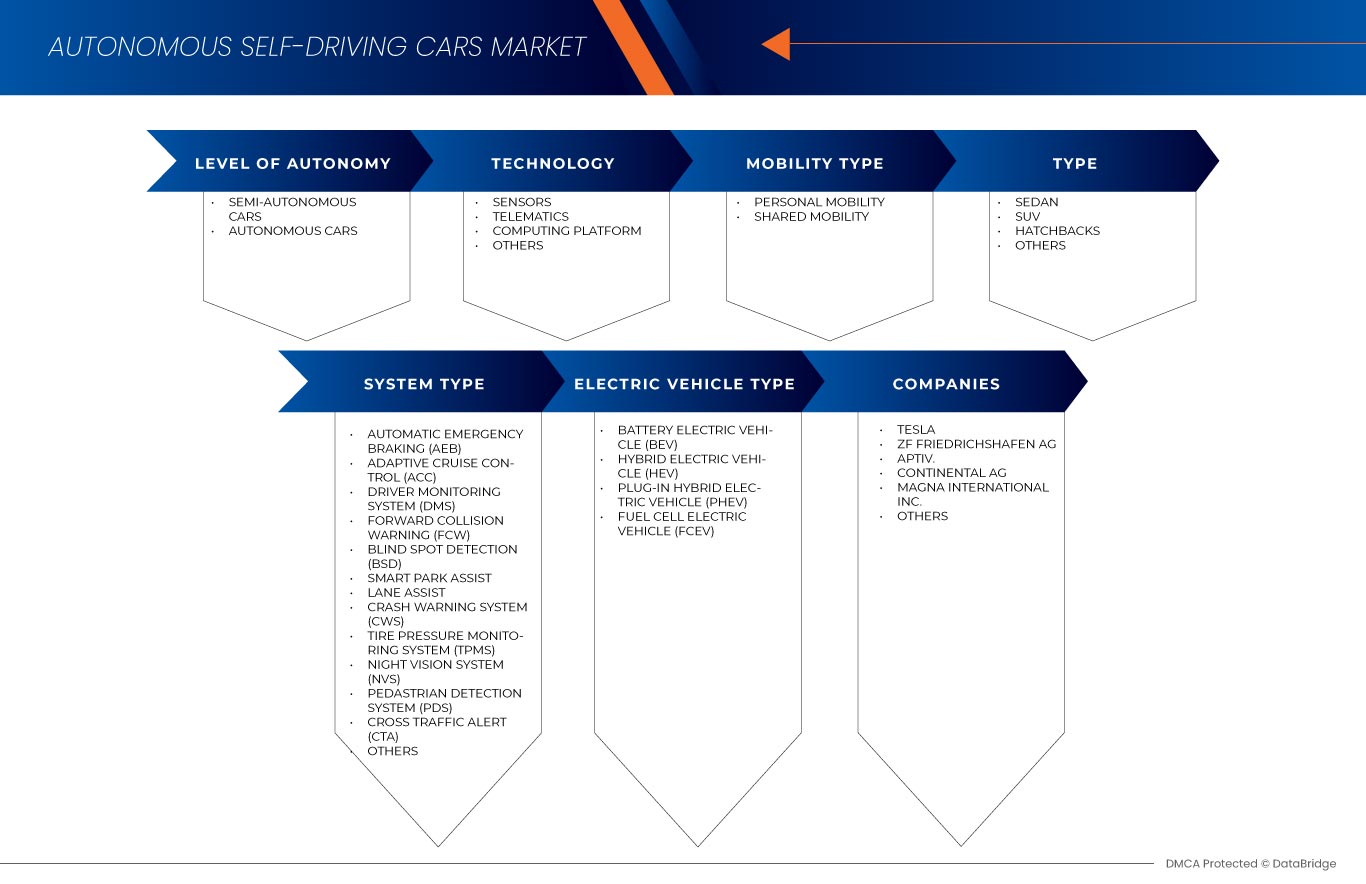
North America Autonomous/Self-Driving Cars Market, By Level of Autonomy (Semi-Autonomous Cars and Autonomous Cars), Technology (Sensor, Telematics, Computing Platform, and Others), Mobility Type (Personal Mobility and Shared Mobility), Type (SUV, Hatchbacks, Sedan, and Others), System Type (Lane Assist, Automatic Emergency Braking (AEB), Smart Park Assist, Crash Warning System (CWS), Adaptive Cruise Control (ACC), Cross Traffic Alert (CTA), Blind Spot Detection (BSD), Forward Collision Warning (FCW), Tire Pressure Monitoring System (TPMS), Night Vision System (NVS), Driver Monitoring System (DMS), Pedestrian Detection System (PDS), and Others), Electric Vehicle Type (Battery Electric Vehicle (BEV), Hybrid Electric Vehicles (HEV), Plug-In Hybrid Electric Vehicles (PHEV), and Fuel Cell Electric Vehicles (FCEV)) - Industry Trends and Forecast to 2030.
North America Autonomous/Self-Driving Cars Market Analysis and Insights
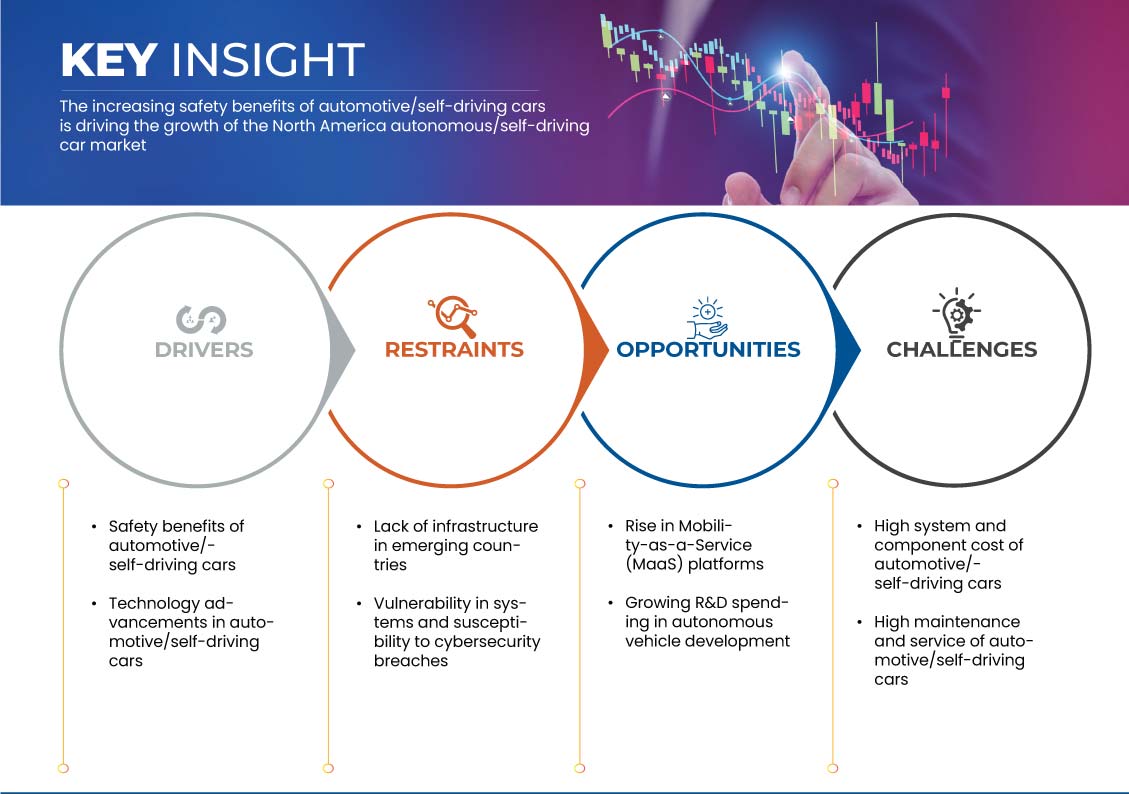
The autonomous/self-driving cars market has been evolving with various factors such as safety benefits and technological advancements is expected to drive market growth. The major restraint that is impacting the market is the lack of infrastructure in emerging countries vulnerability in systems and susceptibility to cybersecurity breaches. The rise in Mobility-as-a-Service (MaaS) platforms and growing R&D spending in autonomous vehicle development are expected to act as opportunities for the market in the future. However, high system and component costs and high maintenance and service are challenges for the market.
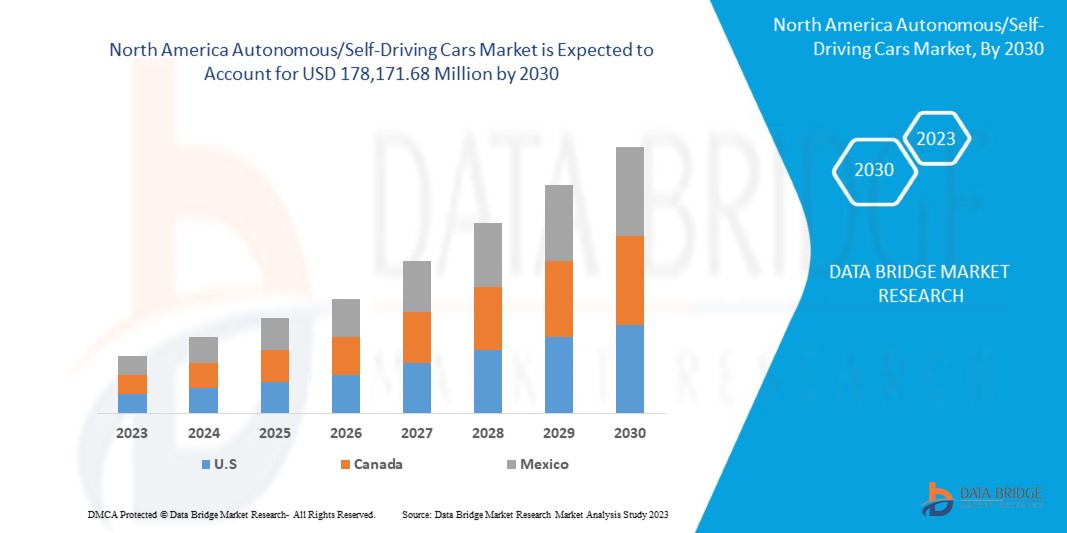
Data Bridge Market Research analyzes that the North America autonomous/self-driving cars market is expected to reach a value of USD 178,171.68 million by 2030, from USD 29,548.86 million in 2022, growing at a CAGR of 26.3% during the forecast period.
|
Report Metric |
Details |
|
Forecast Period |
2023 to 2030 |
|
Base Year |
2022 |
|
Historic Years |
2021 (Customizable to 2015 – 2020) |
|
Quantitative Units |
Revenue in USD Million, Volumes in Thousand Unit |
|
Segments Covered |
Level of Autonomy (Semi-Autonomous Cars and Autonomous Cars), Technology (Sensor, Telematics, Computing Platform, and Others), Mobility Type (Personal Mobility and Shared Mobility), Type (SUV, Hatchbacks, Sedan, and Others), System Type (Lane Assist, Automatic Emergency Braking (AEB), Smart Park Assist, Crash Warning System (CWS), Adaptive Cruise Control (ACC), Cross Traffic Alert (CTA), Blind Spot Detection (BSD), Forward Collision Warning (FCW), Tire Pressure Monitoring System (TPMS), Night Vision System (NVS), Driver Monitoring System (DMS), Pedestrian Detection System (PDS), and Others), Electric Vehicle Type (Battery Electric Vehicle (BEV), Hybrid Electric Vehicles (HEV), Plug-In Hybrid Electric Vehicles (PHEV), and Fuel Cell Electric Vehicles (FCEV)) |
|
Regions Covered |
U.S., Canada, and Mexico |
|
Market Players Covered |
Waymo LLC (A Subsidiary of Alphabet Inc), Nuro, Inc., Huawei Technologies Co., Ltd., NVIDIA Corporation, Mobileye, Latitude AI LLC (A Subsidiary Of Ford Motor), Aurora Innovation Inc., RENESAS ELECTRONICS CORPORATION, Mercedes-Benz AG, Infineon Technologies AG, Continental AG, Volkswagen, Tesla, Valeo, Robert Bosch LLC, Aptiv., Hitachi Astemo, Ltd, HELLA GmbH & Co. KGaA, Magna International Inc., ZF Friedrichshafen AG, and TEXAS INSTRUMENTS INCORPORATED, among others |
Market Definition
Autonomous or self-driving cars are vehicles equipped with advanced sensors, cameras, radars, and Artificial Intelligence (AI) technology that enable them to navigate and operate without direct human input. These vehicles can perceive their environment, interpret the data, and make decisions to drive safely, following traffic rules and adapting to changing road conditions. Autonomous cars typically have different levels of autonomy, ranging from basic driver-assistance features to full autonomy, where no human intervention is needed for the entire journey.
North America Autonomous/Self-Driving Cars Market Dynamics
This section deals with understanding the market drivers, advantages, opportunities, restraints and challenges. All of this is discussed in detail below:
Driver
- Safety benefits of automotive/self-driving cars
The numerous high-profile accidents that happened in recent years involving human-driven vehicles have underscored the urgent need for safer transportation alternatives. Autonomous self-driving cars offer the potential to drastically reduce accident rates by leveraging advanced sensors, artificial intelligence, and real-time data processing. As public awareness of these benefits grows, there is a greater demand for autonomous vehicles that prioritize safety. Consumers are recognizing the potential of reduced collisions, injuries, and fatalities, making safety a key factor in their purchasing decisions.
Opportunity
- Upsurge in Mobility As-A-Service (MaaS) platforms
The platforms is presenting a significant opportunity for the autonomous self-driving cars market. MaaS is a revolutionary concept that integrates various transportation services into a single, seamless mobility solution accessible through digital platforms. This convergence aligns perfectly with the development and deployment of autonomous self-driving cars, as MaaS providers can leverage these vehicles to offer more efficient, convenient, and cost-effective transportation options to consumers.
Restraints/Challenges
- High maintenance and service of automotive/self-driving cars
The market holds immense promise, but the challenge of high system and component costs poses a significant hurdle. The intricate technology, integration complexities, and stringent safety standards all contribute to driving up expenses. Overcoming this challenge requires continued research and development efforts to streamline manufacturing processes, lower component costs, and meet regulatory requirements without compromising safety and quality. Only through collaborative efforts across the industry, regulatory bodies, and technology providers can the barrier of high costs be effectively addressed, enabling the autonomous vehicle market to fulfill its potential for revolutionizing transportation. Therefore, the high system and component cost of autonomous/self-driving cars is expected to challenge the market growth.
- Lack of infrastructure in emerging countries
Autonomous vehicles require a robust and integrated infrastructure system to function efficiently and safely. This includes high-quality road networks, advanced traffic management systems, reliable communication networks, and charging or refueling stations for electric and hybrid self-driving cars. The absence of proper infrastructure in emerging countries presents several obstacles to the adoption of autonomous self-driving cars. Additionally, the lack of charging or refueling stations for electric autonomous cars limits their range and usability, undermining the potential environmental benefits.
Recent Developments
- In January 2021, Infineon introduced an advanced series of AURIX microcontrollers. These microcontrollers are a significant leap forward, propelling the car industry towards more electric and digital solutions. This launch aids Infineon by positioning them as leaders in automotive innovation, catering to the growing demand for electrification and digitalization in vehicles
- In September 2022, Waymo LLC partnered with Swiss Re to develop innovative risk assessment methods for the insurance sector in the face of autonomous driving advancements. Shifting from human-centric risk factors to vehicle-oriented ones, and acknowledging the limitations of retrospective analyses, this collaboration paves the way for novel insurance models that support the safe integration of autonomous vehicles. The partnership holds the potential to enhance safety evaluation approaches and offer the public a fresh perspective on assessing AV technology
North America Autonomous/Self-Driving Cars Market Scope
The autonomous/self-driving cars market is segmented into six notable segments based on level of autonomy, technology, mobility type, type, system type, and electric vehicle type. The growth amongst these segments will help you analyze meager growth segments in the industries and provide the users with a valuable market overview and market insights to help them make strategic decisions for identifying core market applications.
Level of Autonomy
- Semi-Autonomous Cars
- Autonomous Cars
On the basis of the level of autonomy, the market is segmented into semi-autonomous cars and autonomous cars.
Technology
- Sensor
- Telematics
- Computing Platform
- Others
On the basis of technology, the market is segmented into sensor, telematics, computing platform, and others.
Mobility Type
- Personal Mobility
- Shared Mobility
On the basis of mobility type, the market is segmented into personal mobility and shared mobility.
Type
- SUV
- Hatchbacks
- Sedan
- Others
On the basis of type, the market is segmented into SUV, hatchbacks, sedan, and others.
System Type
- Automatic Emergency Braking (AEB)
- Adaptive Cruise Control (ACC)
- Driver Monitoring System (DMS)
- Forward Collision Warning (FCW)
- Blind Spot Detection (BSD)
- Smart Park Assist
- Lane Assist
- Crash Warning System (CWS)
- Tire Pressure Monitoring System (TPMS)
- Night Vision System (NVS)
- Pedastrian Detection System (PDS)
- Cross Traffic Alert (CTA)
- Others
On the basis of system type, the market is segmented into lane assist, Automatic Emergency Braking (AEB), smart park assist, Crash Warning System (CWS), Adaptive Cruise Control (ACC), Cross Traffic Alert (CTA), Blind Spot Detection (BSD), Forward Collision Warning (FCW), Tire Pressure Monitoring System (TPMS), Night Vision System (NVS), Driver Monitoring System (DMS), Pedestrian Detection System (PDS), and others.
Electric Vehicle Type
- Battery Electric Vehicle (BEV)
- Hybrid Electric Vehicles (HEV)
- Plug-In Hybrid Electric Vehicles (PHEV)
- Fuel Cell Electric Vehicles (FCEV)
On the basis of electric vehicle type, the market is segmented Battery Electric Vehicle (BEV), Hybrid Electric Vehicles (HEV), Plug-In Hybrid Electric Vehicles (PHEV), and Fuel Cell Electric Vehicles (FCEV).
North America Autonomous/Self-Driving Cars Market Region Analysis/Insights
North America autonomous/self-driving cars market is analyzed and market size insights and trends are provided by country, level of autonomy, technology, mobility type, type, system type, and electric vehicle type as referenced above.
The countries covered in this market report are U.S., Canada, and Mexico.
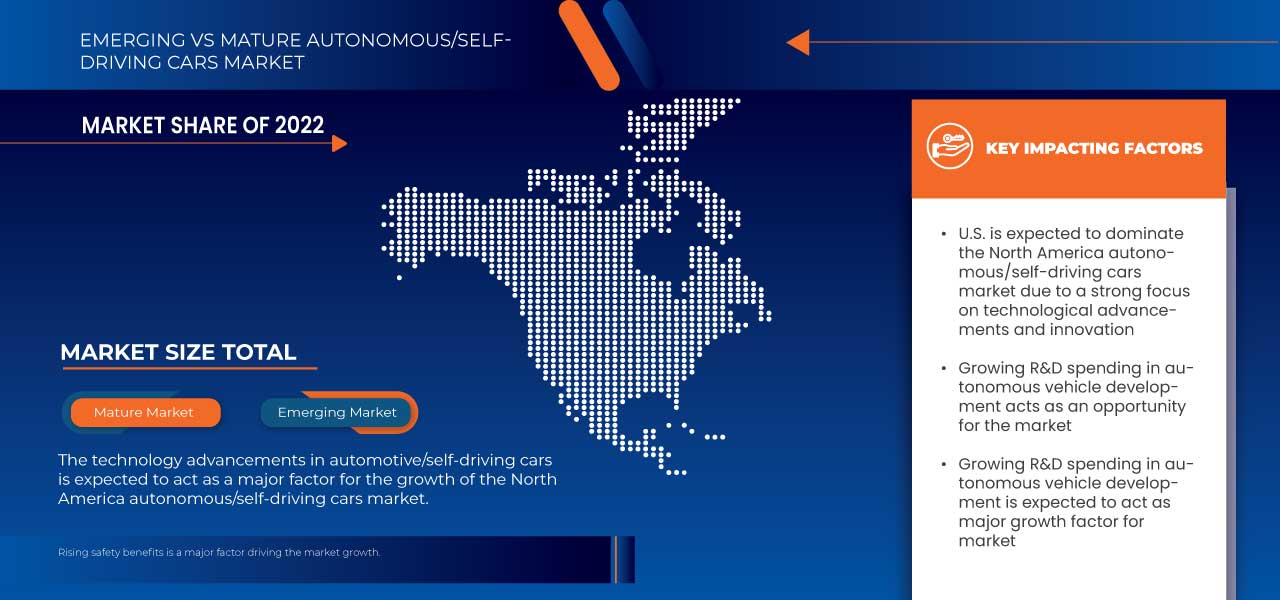
The U.S. is expected to dominate the North America autonomous/self-driving cars market due to increasing customer inclinations toward autonomous cars.
The country section of the report also provides individual market-impacting factors and changes in market regulation that impact the current and future trends of the market. Data points like downstream and upstream value chain analysis, technical trends, porter's five forces analysis, and case studies are some of the pointers used to forecast the market scenario for individual countries. Also, the presence and availability of regional brands and their challenges faced due to large or scarce competition from local and domestic brands, the impact of domestic tariffs, and trade routes are considered while providing forecast analysis of the country data.
Competitive Landscape and North America Autonomous/Self-Driving Cars Market Share Analysis
The North America autonomous/self-driving cars market competitive landscape provides details of competitors. Details included are company overview, company financials, revenue generated, market potential, investment in R&D, new market initiatives, production sites and facilities, company strengths and weaknesses, product launch, product approvals, product width and breadth, application dominance, and product type lifeline curve. The above data points provided are only related to the company’s focus on the market.
Some of the major market players operating in the autonomous/self-driving cars market are Waymo LLC (A Subsidiary of Alphabet Inc), Nuro, Inc., Huawei Technologies Co., Ltd., NVIDIA Corporation, Mobileye, Latitude AI LLC (A Subsidiary Of Ford Motor), Aurora Innovation Inc., RENESAS ELECTRONICS CORPORATION, Mercedes-Benz AG, Infineon Technologies AG, Continental AG, Volkswagen, Tesla, Valeo, Robert Bosch LLC, Aptiv., Hitachi Astemo, Ltd, HELLA GmbH & Co. KGaA, Magna International Inc., ZF Friedrichshafen AG, and TEXAS INSTRUMENTS INCORPORATED, among others.
SKU-
Obtenha acesso online ao relatório sobre a primeira nuvem de inteligência de mercado do mundo

- Painel interativo de análise de dados
- Painel de análise da empresa para oportunidades de elevado potencial de crescimento
- Acesso de analista de pesquisa para personalização e customização. consultas
- Análise da concorrência com painel interativo
- Últimas notícias, atualizações e atualizações Análise de tendências
- Aproveite o poder da análise de benchmark para um rastreio abrangente da concorrência
Metodologia de Investigação
A recolha de dados e a análise do ano base são feitas através de módulos de recolha de dados com amostras grandes. A etapa inclui a obtenção de informações de mercado ou dados relacionados através de diversas fontes e estratégias. Inclui examinar e planear antecipadamente todos os dados adquiridos no passado. Da mesma forma, envolve o exame de inconsistências de informação observadas em diferentes fontes de informação. Os dados de mercado são analisados e estimados utilizando modelos estatísticos e coerentes de mercado. Além disso, a análise da quota de mercado e a análise das principais tendências são os principais fatores de sucesso no relatório de mercado. Para saber mais, solicite uma chamada de analista ou abra a sua consulta.
A principal metodologia de investigação utilizada pela equipa de investigação do DBMR é a triangulação de dados que envolve a mineração de dados, a análise do impacto das variáveis de dados no mercado e a validação primária (especialista do setor). Os modelos de dados incluem grelha de posicionamento de fornecedores, análise da linha de tempo do mercado, visão geral e guia de mercado, grelha de posicionamento da empresa, análise de patentes, análise de preços, análise da quota de mercado da empresa, normas de medição, análise global versus regional e de participação dos fornecedores. Para saber mais sobre a metodologia de investigação, faça uma consulta para falar com os nossos especialistas do setor.
Personalização disponível
A Data Bridge Market Research é líder em investigação formativa avançada. Orgulhamo-nos de servir os nossos clientes novos e existentes com dados e análises que correspondem e atendem aos seus objetivos. O relatório pode ser personalizado para incluir análise de tendências de preços de marcas-alvo, compreensão do mercado para países adicionais (solicite a lista de países), dados de resultados de ensaios clínicos, revisão de literatura, mercado remodelado e análise de base de produtos . A análise de mercado dos concorrentes-alvo pode ser analisada desde análises baseadas em tecnologia até estratégias de carteira de mercado. Podemos adicionar quantos concorrentes necessitar de dados no formato e estilo de dados que procura. A nossa equipa de analistas também pode fornecer dados em tabelas dinâmicas de ficheiros Excel em bruto (livro de factos) ou pode ajudá-lo a criar apresentações a partir dos conjuntos de dados disponíveis no relatório.











