



Saudi Arabia Warehousing Market, By Component (Hardware/System, Software, and Services), Function (Inventory Control and Management, Asset Tracking, Yard & Dock Management, Order Fulfilment, and Workforce & Task (Process) Management, Shipping, Predictive Maintenance, and Others), Type (Insource Warehousing and Outsource Warehousing), Size (Small, Medium, and Large), Ownership (Public Warehouses, Private Warehouses, Bonded Warehouses, and Consolidated Warehouse), Warehousing Storage Nature (Ambient Warehousing (Around 80°F), Air Conditioned (56°F and 75°F), Refrigerated (33°F and 55°F), and Cold/Frozen (Of or Below 32°F)), WMS Tier Type (Advanced WMS, Basic WMS, and Intermediate WMS), End User (Retail and E-Commerce, Transportation and Logistics, Automotive, Healthcare, Food and Beverages, Electrical and Electronics, Chemical, Agriculture, Energy and Utilities, and Others) - Industry Trends and Forecast to 2030.
Saudi Arabia Warehousing Market Analysis and Insights
Saudi Arabia is becoming a hub for regional trade and a key player in global supply chain networks as the largest economy in the Middle East. The warehousing industry in the kingdom is witnessing rapid development, with a surge in demand for modern, technologically advanced storage facilities that can meet the requirements of diverse industries. The growth of e-commerce, along with the government's focus on economic diversification and investments in infrastructure, is driving the need for efficient and strategically located warehousing solutions. With its strategic geographic location and ambitious Vision 2030 plan, Saudi Arabia warehousing market is poised for continued expansion and innovation to meet the evolving demands of the modern business landscape. The market is experiencing significant growth and transformation in response to the country's expanding logistics and e-commerce sectors.
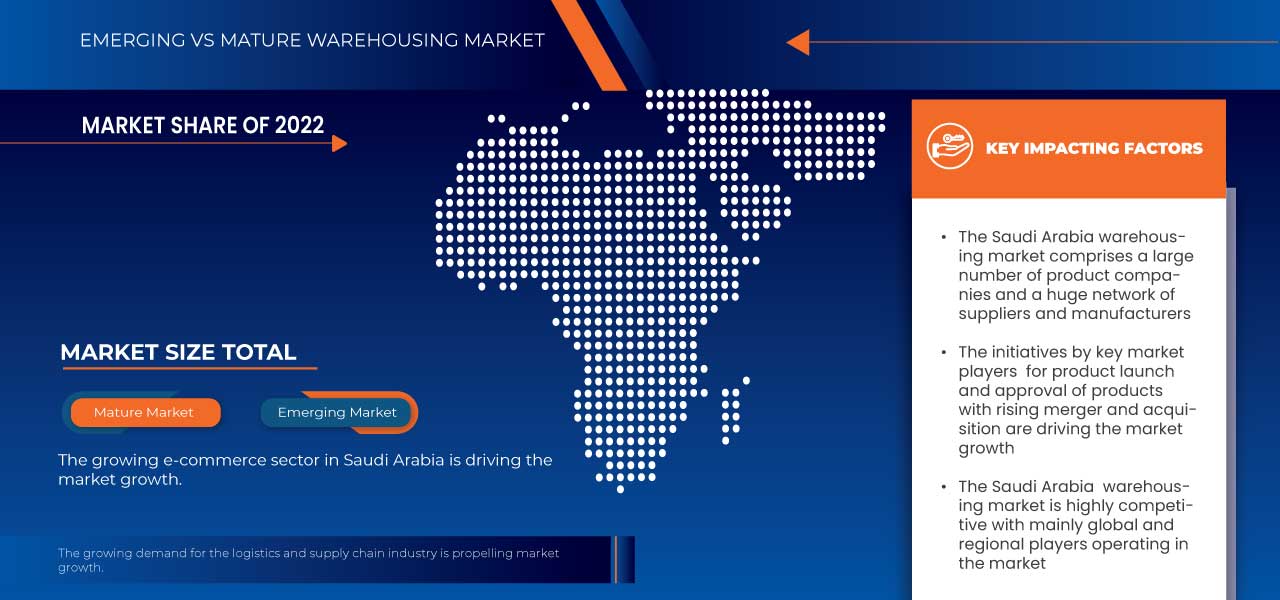
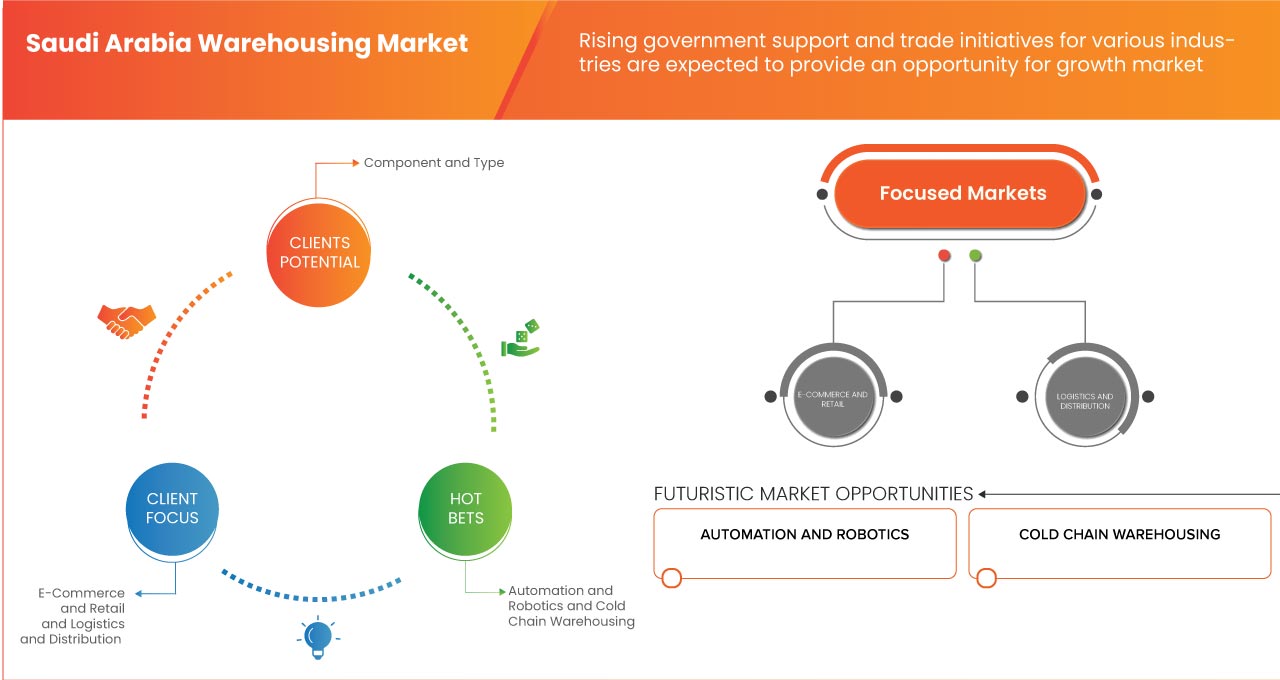
Data Bridge Market Research analyzes that the Saudi Arabia warehousing market is expected to reach USD 13,214.96 million by 2030 from USD 9,314.17 million in 2022, growing with a substantial CAGR of 4.5% in the forecast period of 2023 to 2030.
|
Report Metric |
Details |
|
Forecast Period |
2023 to 2030 |
|
Base Year |
2022 |
|
Historic Years |
2021 (Customizable to 2015- 2020) |
|
Quantitative Units |
Revenue in USD Million, Volumes in Units, Pricing in USD |
|
Segments Covered |
Component (Hardware/System, Software, and Services), Function (Inventory Control and Management, Asset Tracking, Yard & Dock Management, Order Fulfilment, and Workforce & Task (Process) Management, Shipping, Predictive Maintenance, and Others), Type (Insource Warehousing and Outsource Warehousing), Size (Small, Medium, and Large), Ownership (Public Warehouses, Private Warehouses, Bonded Warehouses, and Consolidated Warehouse), Warehousing Storage Nature (Ambient Warehousing (Around 80°F), Air Conditioned (56°F and 75°F), Refrigerated (33°F and 55°F), and Cold/Frozen (Of or Below 32°F)), WMS Tier Type (Advanced WMS, Basic WMS, and Intermediate WMS), End User (Retail and E-Commerce, Transportation and Logistics, Automotive, Healthcare, Food and Beverages, Electrical and Electronics, Chemical, Agriculture, Energy and Utilities, and Others) |
|
Country Covered |
Saudi Arabia |
|
Market Players Covered |
Kuehne+Nagel, CEVA Logistics, YBA KANOO, GAC, Tamer Logistics, Almajdouie Logistics, DB Schenker, Wared Logistics, Aramex, MLS, SMSA Express Transportation Company Ltd., Binzagr, DHL, HALA, Sign Logistics, LSC Warehousing & Logistics Company, Agility, Aiduk, Takhzeen, fourwinds-ksa, Camels Party Logistics, BAFCO, S.A. TALKE Ltd., LogiPoint, and United Group |
Market Definition
Warehousing refers to the industry and infrastructure related to the storage, management, and distribution of goods and products within the Kingdom of Saudi Arabia. This market encompasses a wide range of services and facilities that play a crucial role in the supply chain and logistics of various industries. Warehousing comprises a network of storage facilities, distribution centers, and logistics services dedicated to the efficient and secure storage, handling, and movement of goods and products. These facilities can vary in size and specialization, serving industries such as manufacturing, retail, e-commerce, agriculture, and more.
Saudi Arabia Warehousing Market Dynamics
This section deals with understanding the market drivers, advantages, opportunities, restraints, and challenges. All of this is discussed in detail below:
Drivers
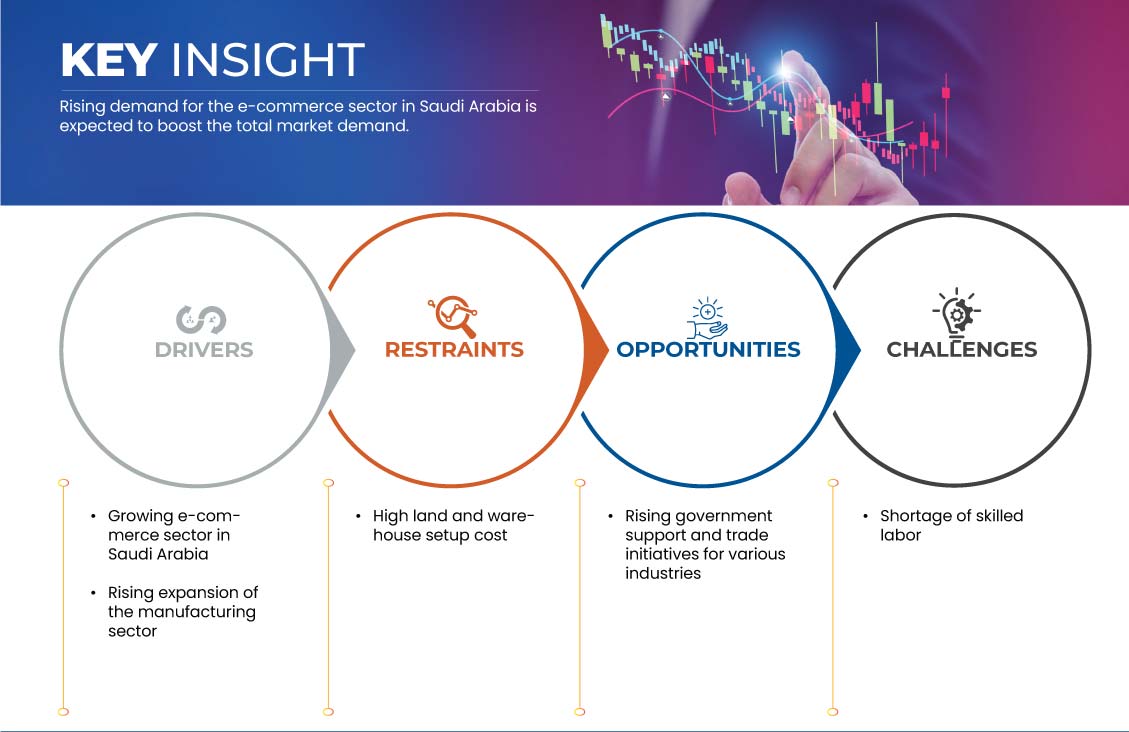
- Growing E-Commerce Sector in Saudi Arabia
The burgeoning e-commerce sector in Saudi Arabia is a powerful driver behind the market growth and expansion. There is a heightened demand for efficient storage and distribution facilities to support e-commerce operations due to the rapid increase in online shopping and changing consumer preferences. Warehouses play a pivotal role in ensuring timely order fulfilment, inventory management, and the seamless delivery of products to online shoppers, thereby enhancing the overall customer experience.
- Rising Expansion of the Manufacturing Sector
The growth of manufacturing in Saudi Arabia is playing a big role in the warehousing market. Factories and industries are producing goods due to which they need places to store them. Warehouses are like big storage spaces where companies keep their products before they are sent to stores or customers. In addition, as manufacturing is on the rise in Saudi Arabia, so the demand for warehouses is going up because they provide a safe and organized way to store all the things that are made. This trend is boosting the warehousing market in Saudi Arabia creating opportunities for businesses that provide warehousing services.
Restraint
- High Land and Warehouse Setup Cost
High land and warehouse setup costs pose a significant restraint to market growth. The expenses associated with acquiring suitable land and constructing warehouses can be a substantial barrier for businesses looking to establish or expand their presence in the country. These costs encompass land prices, construction materials, labor, and compliance with local regulations, which collectively contribute to the overall financial burden.
Opportunity
- Rising Government Support and Trade Initiatives for Various Industries
The increasing support and trade-related initiatives from the government present a significant opportunity for market growth. These measures foster a more favorable business environment, attracting a diverse range of industries to the region. The demand for modern warehousing facilities is expected to grow as various sectors expand their operations, offering a promising prospect for the industry's development and expansion.
Challenge
- Skilled Labor Shortage
A significant factor expected to challenge the market growth is the shortage of skilled labor. There is a growing demand for workers with specialized skills in areas such as warehouse management, logistics, and the operation of advanced automation and technology systems as the industry continues to grow and evolve. However, the availability of such skilled labor remains limited in the market, leading to recruitment difficulties and increased labor costs.
Recent Developments
- In May 2023, Tamer Logistics achieved a significant milestone by winning the Most Inspiring Logistics Company of the Year Award at the TLME Inspiration Awards 2023. This prestigious recognition not only celebrated their ability to adapt and innovate in a rapidly changing industry but also reinforced their position as a genuine leader in FMCG, Healthcare, Cosmetics, and Third-Party Logistics within the Kingdom of Saudi Arabia. This award served as a testament to their commitment to excellence and highlighted their role in redefining supply chain and logistics, ultimately contributing to enhanced reputation and industry leadership
- In September 2021, MLS secured an exclusive role as the sole aftermarket services provider for Hyundai and Nissan in Saudi Arabia. This strategic partnership has not only bolstered Mosanada's market presence but also enabled the company to offer comprehensive and specialized services to a wide range of customers, contributing to revenue growth and enhancing its reputation as a trusted provider in the automotive sector
Saudi Arabia Warehousing Market Scope
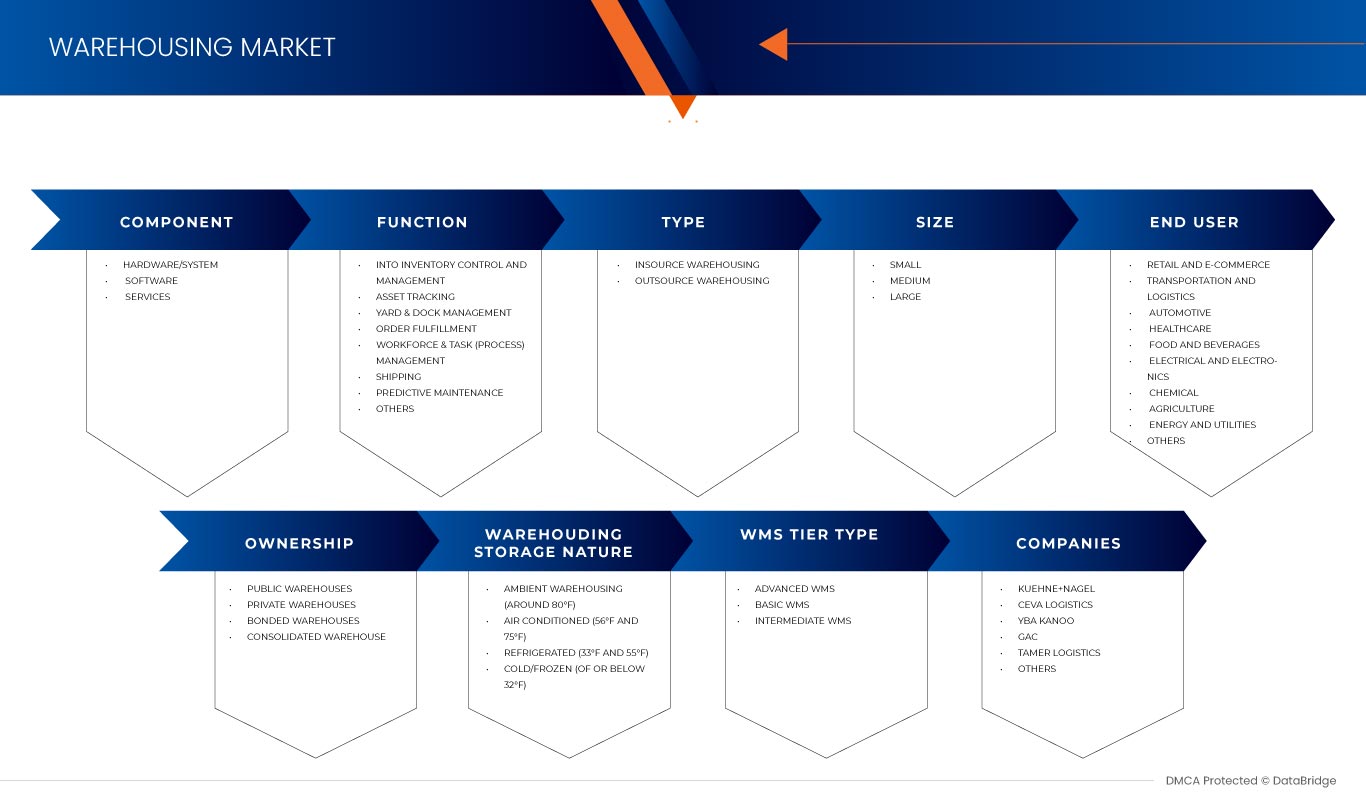
The Saudi Arabia warehousing market is segmented into eight notable segments based on component, function, type, size, ownership, and warehousing storage nature, WMS tier type, and end user. The growth among segments helps you analyze niche pockets of growth and strategies to approach the market and determine your core application areas and the difference in your target markets.
Component
- Hardware/System
- Software
- Services
On the basis of component, the market is segmented into hardware/system, software, and services.
Function
- Inventory Control and Management
- Asset Tracking
- Equipment and Vehicle Tracking
- Yard & Dock Management
- Order Fulfillment
- Workforce & Task (Process) Management
- Shipping
- Predictive Maintenance
- Others
On the basis of function, the market is segmented into inventory control and management, asset tracking, yard & dock management, order fulfillment, workforce & task (process) management, shipping, predictive maintenance, and others.
Type
- Insource Warehousing
- Outsource Warehousing
On the basis of type, the market is segmented into insource warehousing and outsource warehousing.
Size
- Small
- Medium
- Large
On the basis of size, the market is segmented small, medium, and large.
Ownership
- Public Warehouses
- Private Warehouses
- Bonded Warehouses
- Consolidated Warehouse
On the basis of ownership, the market is segmented into public warehouses, private warehouses, bonded warehouses, and consolidated warehouse
Warehousing Storage Nature
- Ambient Warehousing (Around 80°F)
- Air Conditioned (56°F and 75°F)
- Refrigerated (33°F and 55°F)
- Cold/Frozen (Of or Below 32°F)
On the basis of warehousing storage nature, the market is segmented into ambient warehousing (around 80°F), air conditioned (56°F and 75°F), refrigerated (33°F and 55°F), and cold/frozen (of or below 32°F).
WMS Tier Type
- Advanced WMS
- Basic WMS
- Intermediate WMS
On the basis of WMS tier type, the market is segmented into advanced WMS, basic WMS, and intermediate WMS.
End User
- Retail and E-Commerce
- Transportation and Logistics
- Automotive
- Healthcare
- Food and Beverages
- Electrical and Electronics
- Agriculture
- Energy and Utilities
- Others
On the basis of end user, the market is segmented into retail and e-commerce, transportation and logistics, automotive, healthcare, food and beverages, electrical and electronics, chemical, agriculture, energy and utilities, and others.
Saudi Arabia Warehousing Market Country Analysis/Insights
Saudi Arabia warehousing market is analyzed and market size information is provided by component, function, type, size, ownership, and warehousing storage nature, WMS tier type, and end user.
On the basis of city, the market is segmented into Jeddah, Riyadh, Dammam, Al Khobar, and rest of Saudi Arabia. Riyadh, the capital city of Saudi Arabia dominated the Saudi Arabia warehousing market. Its dominance is driven by its central location, making it a strategic hub for the distribution of goods throughout the country. In addition, Riyadh's thriving business environment, in line with the government's Vision 2030 initiative, has attracted significant investment in logistics and warehousing infrastructure, further bolstering its position as a warehousing market leader in the kingdom.
The city section of the report also provides individual market-impacting factors and changes in regulation in the market domestically that impact the current and future trends of the market. Data points such as new sales, replacement sales, country demographics, regulatory acts, and import-export tariffs are some of the major pointers used to forecast the market scenario for individual countries. Also, the presence and availability of country brands and their challenges faced due to large or scarce competition from local and domestic brands, and the impact of sales channels are considered while providing forecast analysis of the country data.
Competitive Landscape and Saudi Arabia Warehousing Market Share Analysis
The Saudi Arabia warehousing market competitive landscape provides details of competitors. Details included are company overview, company financials, revenue generated, market potential, investment in R&D, new market initiatives, production sites and facilities, company strengths and weaknesses, product launch, product approvals, product width and breadth, application dominance, and product type lifeline curve. The above data points provided are only related to the company’s focus on the market.
Some of the major market players operating in the Saudi Arabia warehousing market are Kuehne+Nagel, CEVA Logistics, YBA KANOO, GAC, Tamer Logistics, Almajdouie Logistics, DB Schenker, Wared Logistics, Aramex, MLS, SMSA Express Transportation Company Ltd., Binzagr, DHL, HALA, Sign Logistics, LSC Warehousing & Logistics Company, Agility, Aiduk, Takhzeen, fourwinds-ksa, Camels Party Logistics, BAFCO, S.A. TALKE Ltd., LogiPoint, and United Group among others.
SKU-
Obtenha acesso online ao relatório sobre a primeira nuvem de inteligência de mercado do mundo

- Painel interativo de análise de dados
- Painel de análise da empresa para oportunidades de elevado potencial de crescimento
- Acesso de analista de pesquisa para personalização e customização. consultas
- Análise da concorrência com painel interativo
- Últimas notícias, atualizações e atualizações Análise de tendências
- Aproveite o poder da análise de benchmark para um rastreio abrangente da concorrência
Metodologia de Investigação
A recolha de dados e a análise do ano base são feitas através de módulos de recolha de dados com amostras grandes. A etapa inclui a obtenção de informações de mercado ou dados relacionados através de diversas fontes e estratégias. Inclui examinar e planear antecipadamente todos os dados adquiridos no passado. Da mesma forma, envolve o exame de inconsistências de informação observadas em diferentes fontes de informação. Os dados de mercado são analisados e estimados utilizando modelos estatísticos e coerentes de mercado. Além disso, a análise da quota de mercado e a análise das principais tendências são os principais fatores de sucesso no relatório de mercado. Para saber mais, solicite uma chamada de analista ou abra a sua consulta.
A principal metodologia de investigação utilizada pela equipa de investigação do DBMR é a triangulação de dados que envolve a mineração de dados, a análise do impacto das variáveis de dados no mercado e a validação primária (especialista do setor). Os modelos de dados incluem grelha de posicionamento de fornecedores, análise da linha de tempo do mercado, visão geral e guia de mercado, grelha de posicionamento da empresa, análise de patentes, análise de preços, análise da quota de mercado da empresa, normas de medição, análise global versus regional e de participação dos fornecedores. Para saber mais sobre a metodologia de investigação, faça uma consulta para falar com os nossos especialistas do setor.
Personalização disponível
A Data Bridge Market Research é líder em investigação formativa avançada. Orgulhamo-nos de servir os nossos clientes novos e existentes com dados e análises que correspondem e atendem aos seus objetivos. O relatório pode ser personalizado para incluir análise de tendências de preços de marcas-alvo, compreensão do mercado para países adicionais (solicite a lista de países), dados de resultados de ensaios clínicos, revisão de literatura, mercado remodelado e análise de base de produtos . A análise de mercado dos concorrentes-alvo pode ser analisada desde análises baseadas em tecnologia até estratégias de carteira de mercado. Podemos adicionar quantos concorrentes necessitar de dados no formato e estilo de dados que procura. A nossa equipa de analistas também pode fornecer dados em tabelas dinâmicas de ficheiros Excel em bruto (livro de factos) ou pode ajudá-lo a criar apresentações a partir dos conjuntos de dados disponíveis no relatório.











