


Europe Identity Document (ID) Barcode Reading in Factory Automation Market Segmentation, By Product Type (Fixed Mount Barcode Scanner, Handheld Scanner, Mobile Computers Barcode Scanner, and Others), Technology (Laser Scanner, Omnidirectional Barcode Scanners, Camera-Based Readers, and CCD (Charge Coupled Device) Readers, RFID (Radio Frequency Identification) Technology, Pen-Type Scanners, and Others), Barcode Type (1D and 2D), Vertical (Consumer Electronics, Automotive, Logistics, Food and Beverage, Pharmaceutical and Medical, Packaging, Oil and Gas, and Others) - Industry Trends and Forecast to 2033
What is the Europe Identity Document (ID) Barcode Reading in Factory Automation Market Size and Growth Rate?
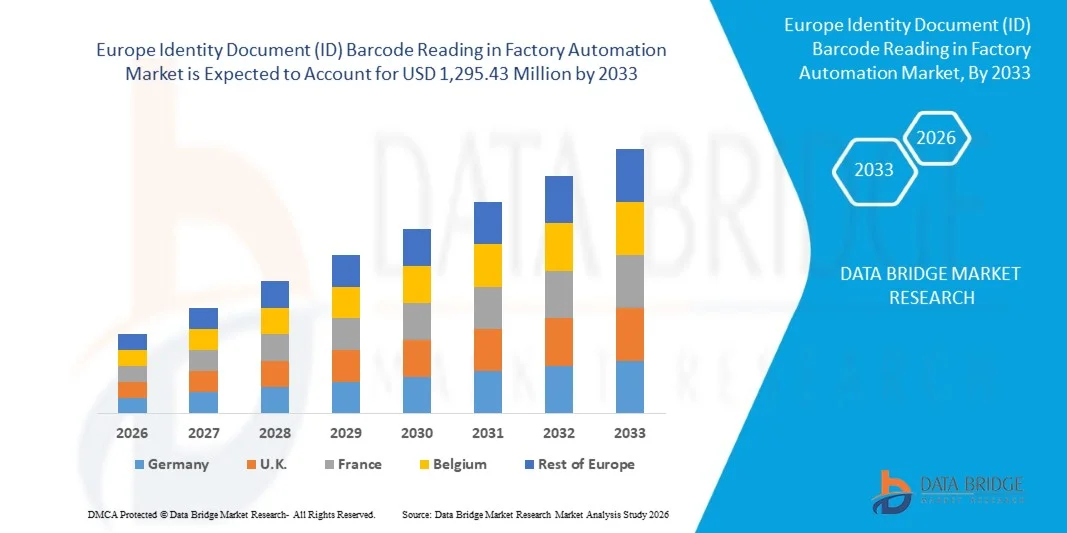
- The Europe Identity Document (ID) Barcode Reading in Factory Automation market size was valued at USD 794.60 million in 2025 and is expected to reach USD 1,295.43 million by 2033, at a CAGR of 6.30% during the forecast period
- The market growth is largely fueled by the increasing demand for automated identification and verification solutions across manufacturing facilities, driven by the need for operational efficiency, accurate traceability, and regulatory compliance
- Furthermore, rising implementation of Industry 4.0 technologies, along with advancements in barcode scanning, RFID, and mobile computing devices, is establishing ID barcode reading as a vital component of modern factory automation systems, thereby significantly boosting the industry's growth
What are the Major Takeaways of Identity Document (ID) Barcode Reading in Factory Automation Market?
- Identity document (ID) barcode reading solutions, enabling automated identification and verification, are increasingly vital components of modern factory automation systems across industries such as manufacturing, automotive, and logistics due to their ability to enhance operational efficiency, ensure accurate traceability, and support regulatory compliance
- The escalating demand for ID barcode reading in factory automation is primarily fueled by the rapid adoption of Industry 4.0 technologies, the need for secure and real-time identity verification, and the rising preference for integrated, automated systems to streamline production processes
- Germany dominated the Europe identity document (ID) barcode reading in factory automation market with the largest revenue share of 39.01% in 2025, driven by strong demand from the automotive, electronics, pharmaceuticals, food & beverage, logistics, and advanced manufacturing industries
- The U.K. is projected to register the fastest CAGR of 9.74% from 2026 to 2033, driven by increasing investments in smart manufacturing, logistics automation, pharmaceuticals, and food processing sectors
- The Fixed Mount Barcode Scanner segment dominated the largest market revenue share of 42.8% in 2024, owing to its high-speed scanning capability, continuous operation without manual intervention, and suitability for integration within high-volume production lines
Report Scope and Identity Document (ID) Barcode Reading in Factory Automation Market Segmentation
|
Attributes |
Identity Document (ID) Barcode Reading in Factory Automation Key Market Insights |
|
Segments Covered |
|
|
Countries Covered |
Europe
|
|
Key Market Players |
|
|
Market Opportunities |
|
|
Value Added Data Infosets |
In addition to the insights on market scenarios such as market value, growth rate, segmentation, geographical coverage, and major players, the market reports curated by the Data Bridge Market Research also include in-depth expert analysis, pricing analysis, brand share analysis, consumer survey, demography analysis, supply chain analysis, value chain analysis, raw material/consumables overview, vendor selection criteria, PESTLE Analysis, Porter Analysis, and regulatory framework. |
What is the Key Trend in the Identity Document (ID) Barcode Reading in Factory Automation Market?
“Integration of Identity Document (ID) Barcode Reading in Factory Automation”
- A significant and accelerating trend in the factory automation market is the increased integration of identity document (ID) barcode reading solutions with advanced automation and real-time monitoring systems, improving efficiency, accuracy, and compliance across industrial operations
- For instance, manufacturers are increasingly deploying fixed-mount and handheld barcode scanners on production lines to automate employee identification, access control, and compliance with safety regulations, reducing manual processes and human error
- The integration of ID barcode readers with factory management systems enables real-time tracking of personnel movements, ensuring authorized access to restricted areas and enhancing overall workplace security
- Companies such as Cognex and Zebra Technologies are developing barcode reading solutions with advanced optical performance and connectivity features, supporting seamless integration with Industry 4.0 platforms and factory automation networks
- The demand for ID barcode reading technologies is growing across industries such as automotive, electronics, and pharmaceuticals, as manufacturers prioritize traceability, regulatory compliance, and operational efficiency in line with global automation trends
What are the Key Drivers of Identity Document (ID) Barcode Reading in Factory Automation Market?
- The growing need for automated personnel identification and access verification within factory environments is a significant driver for the adoption of ID barcode reading solutions
- For instance, companies in sectors such as automotive and food processing are increasingly deploying barcode and RFID-based identification systems to streamline workforce management, track personnel entry points, and ensure compliance with safety and regulatory requirements
- Automated ID barcode reading reduces administrative burdens, minimizes human error, and enhances productivity by providing real-time personnel data and secure access to critical production zones
- This efficiency is particularly valuable in large-scale production environments where workforce management requires real-time, scalable solutions
- Furthermore, as manufacturers integrate these solutions with existing factory automation and security infrastructure, they gain improved visibility, traceability, and control over workforce operations, driving market growth
Which Factor is Challenging the Growth of the Identity Document (ID) Barcode Reading in Factory Automation Market?
- Despite the operational benefits, the high upfront costs associated with implementing ID barcode reading solutions present a significant challenge, particularly for small and medium-sized manufacturers. Expenses related to purchasing advanced hardware, system integration, software licensing, and employee training can create financial barriers to adoption
- For instance, deploying fixed-mount barcode scanners, RFID-enabled readers, and integrated workforce management systems requires substantial capital investment, often beyond the reach of resource-constrained businesses or companies in developing economies
- In addition, the integration of ID barcode reading solutions with existing factory infrastructure may demand technical expertise and system upgrades, further adding to implementation costs and complexity
- While larger manufacturers may justify the investment through improved efficiency, regulatory compliance, and workforce security, smaller businesses often face challenges in demonstrating short-term returns, limiting their willingness to adopt such technologies
- Overcoming this challenge will require industry players to develop more affordable, scalable solutions tailored to varying business sizes and regional needs, as well as increasing awareness of the long-term benefits of enhanced personnel management, operational efficiency, and regulatory compliance
How is the Identity Document (ID) Barcode Reading in Factory Automation Market Segmented?
The market is segmented on the basis of product type, technology, barcode type, and vertical.
- By Product Type
On the basis of product type, the Identity Document (ID) Barcode Reading in Factory Automation market is segmented into Fixed Mount Barcode Scanner, Handheld Scanner, Mobile Computers Barcode Scanner, and Others. The Fixed Mount Barcode Scanner segment dominated the largest market revenue share of 42.8% in 2024, owing to its high-speed scanning capability, continuous operation without manual intervention, and suitability for integration within high-volume production lines. Fixed mount scanners are extensively deployed across factory floors where space efficiency, accuracy, and rapid processing of ID barcodes are critical, particularly in automated packaging, assembly, and inspection stations. Their ability to provide consistent performance under harsh industrial environments also drives widespread adoption in sectors such as automotive, logistics, and electronics manufacturing.
The Mobile Computers Barcode Scanner segment is anticipated to witness the fastest growth rate from 2025 to 2032, driven by the growing need for workforce mobility, real-time data capture, and flexible scanning operations across factory floors and warehouses. These devices integrate barcode scanning with mobile computing capabilities, allowing operators to verify ID documents, track materials, and manage assets seamlessly while on the move. The rising trend of digital transformation in factory automation, combined with the need for versatile, ergonomic, and connected scanning solutions, significantly contributes to the expanding demand for mobile computer scanners.
- By Technology
On the basis of technology, the market is segmented into Laser Scanner, Omnidirectional Barcode Scanners, Camera-Based Readers, CCD (Charge Coupled Device) Readers, RFID (Radio Frequency Identification) Technology, Pen-Type Scanners, and Others. The Laser Scanner segment held the largest market revenue share in 2024, primarily attributed to its precision, speed, and cost-effectiveness in reading linear (1D) ID barcodes across production lines. Laser scanners are favored for their durability and reliable performance in industrial settings, where accuracy and fast data capture are essential for verifying worker IDs, tracking components, and ensuring process compliance. Their proven technology, combined with ease of installation and minimal maintenance requirements, makes them a preferred choice for factory automation applications.
The Camera-Based Readers segment is expected to witness the fastest CAGR from 2025 to 2032, fueled by the rising need to capture complex, high-density, and damaged barcodes, especially in harsh factory environments. Camera-based readers offer superior versatility by supporting both 1D and 2D barcode formats, while also providing image capture and optical character recognition (OCR) capabilities for advanced ID verification processes. Their integration with machine vision systems and ability to operate under variable lighting and orientations enhances their adoption in industries such as electronics, pharmaceuticals, and automotive manufacturing.
- By Barcode Type
On the basis of barcode type, the market is segmented into 1D and 2D. The 1D barcode segment dominated the market with the largest revenue share in 2024, due to its long-established use in factory automation for basic identification, tracking, and inventory control tasks. 1D barcodes are simple, widely recognized, and cost-effective, making them prevalent for worker ID badges, raw material labeling, and product identification across diverse manufacturing environments. Their compatibility with traditional laser scanning systems contributes to their continued strong market presence.
The 2D barcode segment is projected to register the fastest growth during 2025 to 2032, driven by its ability to store significantly more information in a compact space, enhanced data security, and high readability even under challenging factory conditions. The demand for advanced ID verification, traceability, and anti-counterfeiting measures across critical industries such as pharmaceuticals, electronics, and automotive is propelling the shift towards 2D barcode adoption in factory automation.
- By Vertical
On the basis of vertical, the market is segmented into Consumer Electronics, Automotive, Logistics, Food and Beverage, Pharmaceutical and Medical, Packaging, Oil and Gas, and Others. The Automotive segment accounted for the largest market revenue share in 2024, driven by the sector's high reliance on automated ID verification, component tracking, and production line efficiency. Factory automation in automotive manufacturing requires robust barcode reading solutions to ensure quality control, regulatory compliance, and seamless material flow, making ID barcode scanning integral to the process. The industry's emphasis on precision, safety, and real-time monitoring further accelerates the demand for reliable scanning technologies.
The Pharmaceutical and Medical segment is anticipated to experience the fastest growth from 2025 to 2032, owing to stringent regulations regarding product authentication, traceability, and personnel identification in manufacturing environments. With increasing focus on preventing counterfeiting, enhancing patient safety, and ensuring compliance with global standards such as GS1 and FDA guidelines, the adoption of advanced barcode reading solutions for ID documents is rapidly growing within pharmaceutical production and medical equipment manufacturing facilities.
Which Country Holds the Largest Share of the Identity Document (ID) Barcode Reading in Factory Automation Market?
- Germany dominated the Europe identity document (ID) barcode reading in factory automation market with the largest revenue share of 39.01% in 2025, driven by strong demand from the automotive, electronics, pharmaceuticals, food & beverage, logistics, and advanced manufacturing industries
- Increasing deployment of fixed-mount barcode scanners, camera-based readers, 1D/2D code systems, and automated identification solutions across production lines continues to accelerate market growth. Germany remains a leading contributor within Europe owing to its strong industrial automation ecosystem and widespread adoption of Industry 4.0 technologies
- Stringent regional quality, traceability, and manufacturing compliance standards are further strengthening product adoption across the country. Rising need for real-time inventory management, error-free product tracking, and automated workflow optimization is significantly supporting market expansion. Europe is projected to witness substantial growth through the forecast period, with Germany continuing to remain one of the largest contributors in the region
U.K. Identity Document (ID) Barcode Reading in Factory Automation Market Insight
The U.K. is projected to register the fastest CAGR of 9.74% from 2026 to 2033, driven by increasing investments in smart manufacturing, logistics automation, pharmaceuticals, and food processing sectors. Growing adoption of fixed and handheld barcode scanners, machine vision readers, and 2D code verification systems across automated industrial sites is supporting market development. Expansion of digital manufacturing standards, rising automation across production facilities, and growing investments in industrial infrastructure are accelerating demand. Businesses are increasingly adopting Identity Document (ID) Barcode Reading in Factory Automation solutions to ensure operational efficiency, product traceability, and regulatory compliance.
Which are the Top Companies in Identity Document (ID) Barcode Reading in Factory Automation Market?
The Identity Document (ID) Barcode Reading in Factory Automation industry is primarily led by well-established companies, including:
- General Electric (U.S.)
- Endress+Hauser Group Services AG (Switzerland)
- Emerson Electric Co. (U.S.)
- Rockwell Automation, Inc. (U.S.)
- Schneider Electric (France)
- Siemens (Germany)
- Mitsubishi Electric Corporation (Japan)
- Yokogawa India Ltd. (India)
- ABB (Switzerland)
- Jadak (U.S.)
- Balluff Automation India Pvt. Ltd. (India)
- RTscan Technology Limited (China)
- Scandit (Switzerland)
- Wasp Barcode Technologies (U.S.)
- SATO America (U.S.)
- Axicon Auto ID Limited (U.K.)
- Handheld Group (Sweden)
- Cognex Corporation (U.S.)
- Great Eastern (India)
- Data Logic S.p.A (Italy)
- Honeywell International, Inc. (U.S.)
- OMRON Corporation (Japan)
- Zebra Technologies Corp. (U.S.)
- KEYENCE CORPORATION (Japan)
What are the Recent Developments in Europe Identity Document (ID) Barcode Reading in Factory Automation Market?
- In October 2024, Viziotix showcased its Maxi-Scan technology at Vision 2024 in Stuttgart, Germany. Viziotix introduced its Maxi-Scan algorithm, enabling simultaneous scanning of multiple barcodes in a single image. This advancement allows drones and robots to conduct rapid inventory checks, even in challenging conditions such as low lighting or motion blur. The technology supports real-time processing on edge devices, enhancing automation in logistics and warehouse operations
- In January 2024, Datalogic launched the Blade Series of compact 1D barcode readers. The Blade Series is designed for industrial environments requiring high-performance traceability solutions. Equipped with a 1920x128 pixel camera sensor and advanced lighting, these readers can reliably decode labels even under poor conditions, such as discoloration or damage. This innovation aims to improve efficiency in packaging and intralogistics sectors
- In January 2025, Cognex released the DataMan 290 and 390 AI-powered barcode readers. These new models incorporate advanced AI technology to enhance decoding reliability across various manufacturing applications. The readers feature a user-friendly web interface for easy setup and maintenance, making them accessible even to non-technical users. They are designed to handle a wide range of barcode types, including damaged or low-quality codes
- In August 2024, Scandit acquired MarketLab to enhance its ShelfView capabilities.
- This acquisition enables Scandit to offer improved smart data capture solutions for retailers, enhancing store performance and associate efficiency. The integration aims to provide better monetization of shelf data with consumer packaged goods partners, leveraging advanced barcode scanning technologies
- In May 2024, Pepperl+Fuchs announced plans to open a new U.S. headquarters in late 2025. The new facility will strengthen the company's presence in North America and support its growth in the industrial automation sector. Pepperl+Fuchs specializes in sensor technology and automation solutions, contributing to advancements in barcode reading and factory automation technologies
SKU-
Получите онлайн-доступ к отчету на первой в мире облачной платформе рыночной аналитики

- Интерактивная панель анализа данных
- Панель анализа компании для возможностей с высоким потенциалом роста
- Доступ аналитика-исследователя для настройки и запросов
- Анализ конкурентов с помощью интерактивной панели
- Последние новости, обновления и анализ тенденций
- Используйте возможности сравнительного анализа для комплексного отслеживания конкурентов
Методология исследования
Сбор данных и анализ базового года выполняются с использованием модулей сбора данных с большими размерами выборки. Этап включает получение рыночной информации или связанных данных из различных источников и стратегий. Он включает изучение и планирование всех данных, полученных из прошлого заранее. Он также охватывает изучение несоответствий информации, наблюдаемых в различных источниках информации. Рыночные данные анализируются и оцениваются с использованием статистических и последовательных моделей рынка. Кроме того, анализ доли рынка и анализ ключевых тенденций являются основными факторами успеха в отчете о рынке. Чтобы узнать больше, пожалуйста, запросите звонок аналитика или оставьте свой запрос.
Ключевой методологией исследования, используемой исследовательской группой DBMR, является триангуляция данных, которая включает в себя интеллектуальный анализ данных, анализ влияния переменных данных на рынок и первичную (отраслевую экспертную) проверку. Модели данных включают сетку позиционирования поставщиков, анализ временной линии рынка, обзор рынка и руководство, сетку позиционирования компании, патентный анализ, анализ цен, анализ доли рынка компании, стандарты измерения, глобальный и региональный анализ и анализ доли поставщика. Чтобы узнать больше о методологии исследования, отправьте запрос, чтобы поговорить с нашими отраслевыми экспертами.
Доступна настройка
Data Bridge Market Research является лидером в области передовых формативных исследований. Мы гордимся тем, что предоставляем нашим существующим и новым клиентам данные и анализ, которые соответствуют и подходят их целям. Отчет можно настроить, включив в него анализ ценовых тенденций целевых брендов, понимание рынка для дополнительных стран (запросите список стран), данные о результатах клинических испытаний, обзор литературы, обновленный анализ рынка и продуктовой базы. Анализ рынка целевых конкурентов можно проанализировать от анализа на основе технологий до стратегий портфеля рынка. Мы можем добавить столько конкурентов, о которых вам нужны данные в нужном вам формате и стиле данных. Наша команда аналитиков также может предоставить вам данные в сырых файлах Excel, сводных таблицах (книга фактов) или помочь вам в создании презентаций из наборов данных, доступных в отчете.











