



Global Array-based Systems Market Segmentation, By Technique (Surface Plasmon Resonance, Microcantilever, Scanning Kelvin Nanoprobe, Enthalpy Array, Atomic Force Microscopy, Electrochemical Impedance Spectroscopy, Interference-based Technique, Ellipsometry Technique and Others), Application (Drug Discovery, Biomolecular Interactions, Detection of Disease Biomarkers and Others), End User (Contract Research Organizations, Academic and Research Institutes, Pharmaceutical and Biotechnology Industries and Others) - Industry Trends and Forecast to 2033
Array-based Systems Market Size
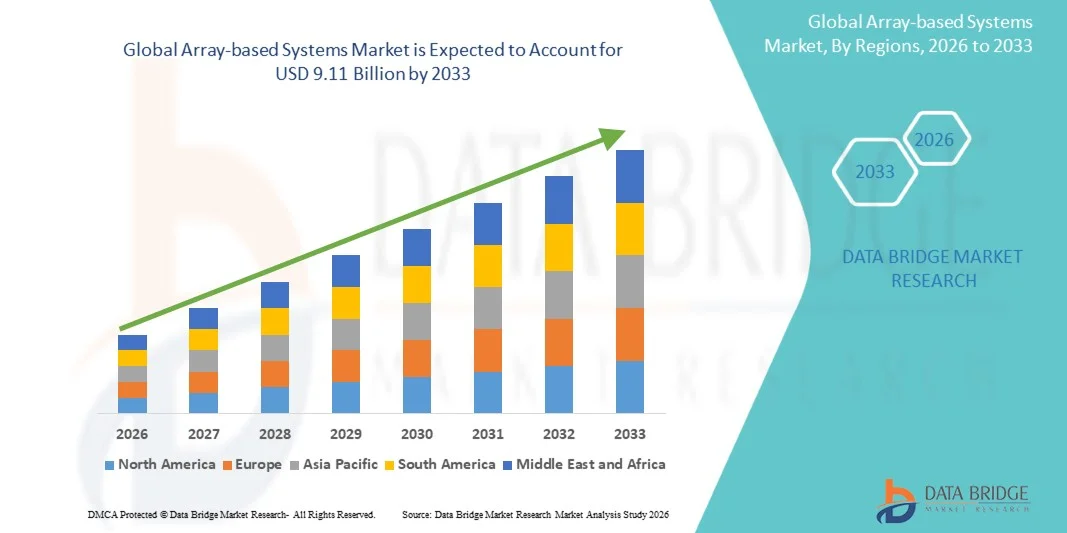
- The global array-based systems market size was valued at USD 5.20 billion in 2025 and is expected to reach USD 9.11 billion by 2033, at a CAGR of 7.27% during the forecast period
- The market growth is largely fueled by the increasing adoption of high-throughput genomic and proteomic technologies, along with rapid advancements in bioinformatics and molecular analysis tools, leading to enhanced research capabilities and broader applications of array-based systems in diagnostics and drug discovery
- Furthermore, rising demand for precision medicine, growing investment in life sciences research, and expanding applications in genetic screening, disease profiling, and biomarker identification are establishing array-based systems as a critical component of modern biomedical research. These converging factors are accelerating the uptake of Array-based Systems solutions, thereby significantly boosting the industry's growth
Array-based Systems Market Analysis
- Array-based systems, which include technologies such as DNA microarrays and protein arrays, are increasingly vital in modern biomedical research and diagnostics due to their ability to enable high-throughput analysis of genes, proteins, and molecular interactions for disease detection and drug development
- The escalating demand for array-based systems is primarily fueled by the growing adoption of precision medicine, increasing prevalence of chronic and genetic diseases, and rapid advancements in genomics and proteomics research technologies
- North America dominated the array-based systems market with the largest revenue share of approximately 38.7% in 2025, characterized by strong biotechnology infrastructure, high research funding, and widespread adoption of genomic technologies, with the U.S. witnessing substantial growth driven by expanding applications in diagnostics and personalized medicine
- Asia-Pacific is expected to be the fastest growing region in the array-based systems market during the forecast period, with a projected CAGR of around 10.2%, due to increasing investments in life sciences research, growing healthcare infrastructure, and rising focus on genomic research initiatives
- The drug discovery segment held the largest market revenue share of 44.1% in 2025, driven by increasing pharmaceutical R&D activities and the need for efficient target identification
Report Scope and Array-based Systems Market Segmentation
|
Attributes |
Array-based Systems Key Market Insights |
|
Segments Covered |
|
|
Countries Covered |
North America
Europe
Asia-Pacific
Middle East and Africa
South America
|
|
Key Market Players |
|
|
Market Opportunities |
|
|
Value Added Data Infosets |
In addition to the insights on market scenarios such as market value, growth rate, segmentation, geographical coverage, and major players, the market reports curated by the Data Bridge Market Research also include in-depth expert analysis, patient epidemiology, pipeline analysis, pricing analysis, and regulatory framework. |
Array-based Systems Market Trends
“Improved Clinical Efficiency Enabled by AI and Voice-Driven Healthcare Systems”
- A significant and emerging trend in the Global Array-based Systems market is the integration of artificial intelligence (AI) and voice-enabled technologies within healthcare environments to improve workflow efficiency, clinical decision-making, and patient management systems
- For instance, AI-powered hospital information systems are increasingly being used to automatically organize patient data and assist clinicians in faster diagnosis and treatment planning
- AI-enabled Array-based Systems in healthcare are increasingly being used to support intelligent data analysis, automated diagnostics assistance, and predictive insights that help clinicians improve treatment accuracy and operational speed. For instance, predictive analytics tools can analyze historical patient records to identify high-risk cases of complications in chronic disease management
- Voice-enabled technologies are also being integrated into healthcare Array-based Systems, allowing medical professionals to access patient records, update clinical notes, and retrieve diagnostic information hands-free, thereby reducing administrative burden and improving efficiency in high-pressure clinical environments. For instance, doctors in hospitals use voice-to-text clinical documentation systems during patient consultations to save time and reduce manual entry errors
- The combination of AI and voice integration in healthcare Array-based Systems is enabling more streamlined hospital workflows, improved interoperability between systems, and enhanced care coordination across departments. For instance, integrated hospital platforms allow nurses, physicians, and lab technicians to access synchronized patient updates in real time from a unified dashboard
- The growing adoption of AI and voice-enabled Array-based Systems is reshaping hospital operations by reducing paperwork, improving response time, and enabling more accurate clinical decision-making. For instance, smart hospital solutions are increasingly deploying integrated AI assistants to support triage and patient monitoring processes
Array-based Systems Market Dynamics
Driver
“Increasing Demand for Digital Transformation in Healthcare System”
- The global array-based systems market is witnessing strong growth driven by the rapid digital transformation of healthcare infrastructure worldwide
- For instance, hospitals are increasingly shifting from paper-based records to fully digital hospital information systems to improve efficiency and accuracy
- Hospitals and healthcare providers are increasingly adopting advanced Array-based Systems to improve patient data management, clinical workflow automation, and operational efficiency. For instance, integrated electronic health record platforms are being deployed to streamline patient admission, treatment tracking, and discharge processes
- Rising demand for real-time data access, electronic health records integration, and predictive analytics is significantly supporting market expansion. For instance, real-time monitoring dashboards are being used in ICUs to track patient vitals continuously and alert staff instantly during emergencies
- Healthcare organizations are also focusing on reducing administrative workload and improving decision-making speed, which is accelerating the adoption of AI-enabled Array-based Systems. For instance, automated coding and billing systems are helping hospitals reduce documentation time and administrative errors
- In addition, government initiatives promoting healthcare digitization and smart hospital development are further contributing to market growth. For instance, national digital health missions in several countries are supporting the implementation of interoperable healthcare IT systems
Restraint/Challenge
“Data Privacy Concerns and High Implementation Costs”
- One of the major challenges in the Global Array-based Systems market is the growing concern over patient data privacy and cybersecurity risks associated with digital healthcare system
- For instance, increasing incidents of healthcare data breaches have raised concerns about the security of electronic patient records
- Healthcare Array-based Systems handle sensitive patient information, making them highly vulnerable to data breaches and unauthorized access if not properly secured. For instance, weak authentication systems in some legacy hospital software have led to unauthorized access risks
- Compliance with strict regulatory frameworks such as HIPAA and other regional data protection laws increases implementation complexity for healthcare providers. For instance, hospitals must invest heavily in compliance audits and secure data storage infrastructure to meet regulatory standards
- Another significant challenge is the high initial cost of deploying advanced Array-based Systems, including infrastructure upgrades, software integration, and staff training. For instance, small and mid-sized hospitals often struggle to afford full-scale digital transformation systems
- Smaller healthcare facilities, particularly in developing regions, often face budget constraints, limiting large-scale adoption of advanced digital systems. For instance, rural clinics may continue relying on basic record-keeping systems due to limited funding
- Addressing these challenges through stronger cybersecurity frameworks, regulatory compliance solutions, and cost-effective deployment models will be critical for market expansion. For instance, cloud-based healthcare platforms are emerging as a more affordable alternative for digital adoption
Array-based Systems Market Scope
The market is segmented on the basis of technique, application, and end user.
• By Technique
On the basis of technique, the Array-based Systems market is segmented into Surface Plasmon Resonance, Microcantilever, Scanning Kelvin Nanoprobe, Enthalpy Array, Atomic Force Microscopy, Electrochemical Impedance Spectroscopy, Interference-based Technique, Ellipsometry Technique, and others. The Surface Plasmon Resonance (SPR) segment dominated the largest market revenue share of 38.6% in 2025, driven by its high sensitivity and real-time, label-free detection capabilities in biomolecular interaction studies. SPR is widely used in drug discovery and biosensing applications due to its accuracy and reliability. Increasing demand for rapid analytical techniques in pharmaceutical research further supports growth. Expanding adoption in academic and clinical research enhances usage. Technological advancements improve detection precision and throughput. Growing investment in life sciences research strengthens market expansion. The technique’s ability to analyze molecular binding kinetics boosts preference. Rising focus on personalized medicine further drives adoption. These factors collectively reinforce SPR dominance.
The Atomic Force Microscopy (AFM) segment is expected to witness the fastest CAGR of 10.2% from 2026 to 2033, driven by its ability to provide high-resolution nanoscale imaging and mechanical property analysis. AFM is increasingly used in biomolecular and cellular studies. Growing demand for nanotechnology-based research fuels adoption. Advancements in probe technology enhance accuracy and speed. Expanding applications in disease biomarker detection support growth. Rising pharmaceutical R&D investments strengthen usage. The technique’s versatility across biological and material sciences boosts demand. Increasing academic research activities further support expansion. Integration with advanced imaging systems improves efficiency. These factors position AFM as the fastest-growing technique segment.
• By Application
On the basis of application, the Array-based Systems market is segmented into drug discovery, biomolecular interactions, detection of disease biomarkers, and others. The drug discovery segment held the largest market revenue share of 44.1% in 2025, driven by increasing pharmaceutical R&D activities and the need for efficient target identification. Array-based systems enable high-throughput screening of drug candidates. Growing demand for faster and cost-effective drug development supports adoption. Expanding biotechnology research further drives usage. Rising prevalence of chronic diseases increases drug development efforts. Advanced analytical tools improve screening accuracy. Collaboration between pharma companies and research institutes boosts innovation. Increasing focus on precision medicine strengthens demand. Government funding for drug research supports growth. These factors ensure dominance of the drug discovery segment.
The detection of disease biomarkers segment is expected to witness the fastest CAGR of 11.3% from 2026 to 2033, driven by increasing demand for early disease diagnosis and personalized treatment approaches. Biomarker detection enables accurate disease identification and monitoring. Rising prevalence of cancer and infectious diseases supports growth. Advancements in diagnostic technologies improve sensitivity and reliability. Expanding clinical research enhances adoption. Growing focus on preventive healthcare boosts demand. Increasing use of array-based platforms in diagnostics strengthens expansion. Rising healthcare investments support technology adoption. Improved awareness of early diagnosis further drives usage. These factors position biomarker detection as the fastest-growing application segment.
• By End User
On the basis of end user, the Array-based Systems market is segmented into contract research organizations (CROs), academic and research institutes, pharmaceutical and biotechnology industries, and others. The pharmaceutical and biotechnology industries segment accounted for the largest market revenue share of 49.7% in 2025, driven by extensive use of array-based systems in drug development and molecular analysis. These industries rely heavily on high-throughput screening technologies. Increasing R&D expenditure supports adoption. Growing focus on biologics and targeted therapies strengthens demand. Strong infrastructure and funding capabilities enhance usage. Collaboration with research institutes boosts innovation. Rising prevalence of chronic diseases increases research needs. Advancements in analytical platforms improve efficiency. Expanding global pharmaceutical pipelines support growth. These factors ensure dominance of this segment.
The contract research organizations (CROs) segment is expected to witness the fastest CAGR of 9.8% from 2026 to 2033, driven by increasing outsourcing of drug discovery and clinical research activities. CROs offer cost-effective and specialized research services. Growing demand for faster drug development supports expansion. Pharmaceutical companies increasingly rely on outsourcing models. Advancements in analytical technologies improve CRO capabilities. Rising clinical trial complexity boosts demand. Expanding global outsourcing trends support adoption. Increased investment in life sciences research strengthens growth. CROs provide scalable and flexible research solutions. These factors position CROs as the fastest-growing end-user segment.
Array-based Systems Market Regional Analysis
- North America dominated the array-based systems market with the largest revenue share of approximately 38.7% in 2025, characterized by strong biotechnology infrastructure, high research funding, and widespread adoption of genomic technologies
- The region benefits from advanced laboratory ecosystems, strong presence of leading life sciences companies, and continuous innovation in genomic and diagnostic platforms
- The market plays a key role in market expansion, driven by increasing applications of array-based technologies in disease diagnostics, biomarker discovery, and personalized medicine solutions
U.S. Array-based Systems Market Insight
The U.S. array-based systems market captured the largest share within North America, supported by rapid advancements in genomics, expanding precision medicine programs, and strong integration of array-based technologies in clinical and research settings. For instance, hospitals and diagnostic laboratories are increasingly using genomic microarray platforms to identify genetic abnormalities linked to cancer and rare diseases. Additionally, strong R&D funding from both public and private sectors continues to accelerate innovation and adoption across healthcare and pharmaceutical applications.
Europe Array-based Systems Market Insight
The Europe array-based systems market is projected to expand at a steady CAGR during the forecast period, driven by increasing investment in life sciences research, strong regulatory support for precision medicine, and growing adoption of genomic technologies in clinical diagnostics. For instance, research institutions across Europe are increasingly utilizing array-based platforms for large-scale population genomics studies and disease risk analysis. The region’s strong academic research network and healthcare infrastructure are further supporting market expansion across both diagnostic and research applications.
U.K. Array-based Systems Market Insight
The U.K. array-based systems market is witnessing steady growth due to rising investment in genomics research, increasing focus on personalized healthcare, and strong collaboration between academic institutions and biotech companies. For instance, national genomic initiatives are supporting large-scale DNA sequencing and array-based diagnostic programs aimed at improving early disease detection. The country’s well-developed healthcare system and strong research ecosystem are further enhancing adoption of advanced genomic technologies.
Germany Array-based Systems Market Insight
The Germany array-based systems market is expanding due to strong biotechnology research capabilities, increasing government support for life sciences innovation, and growing adoption of genomic technologies in clinical and pharmaceutical applications. For instance, German research institutes are actively using array-based platforms for cancer research and genetic disorder analysis. The country’s emphasis on high-quality healthcare infrastructure and precision diagnostics is further supporting market growth.
Asia-Pacific Array-based Systems Market Insight
The Asia- array-based systems market is expected to be the fastest-growing region during the forecast period, with a projected CAGR of approximately 10.2%, driven by increasing investments in life sciences research, expanding healthcare infrastructure, and rising focus on genomic research initiatives. Countries such as China, Japan, and India are significantly increasing funding for biotechnology and precision medicine programs. For instance, growing government-backed genomic research projects and expanding biotech startup ecosystems are accelerating adoption of array-based technologies across the region.
Japan Array-based Systems Market Insight
The Japan array-based systems market is gaining momentum due to advanced healthcare infrastructure, strong focus on precision medicine, and increasing use of genomic technologies in disease research. For instance, Japanese research institutions are leveraging array-based platforms for early detection of genetic disorders and cancer biomarker identification. The country’s aging population and rising demand for advanced diagnostics are further driving adoption of genomic and molecular testing solutions.
China Array-based Systems Market Insight
The China array-based systems market accounted for the largest share in the Asia-Pacific region in 2025, driven by rapid expansion of biotechnology research, strong government support for genomics programs, and growing investment in precision medicine. For instance, large-scale national genomic initiatives and increasing use of array-based diagnostic tools in hospitals are significantly boosting demand. The country’s expanding biotechnology sector and rising focus on personalized healthcare are key factors supporting market growth.
Array-based Systems Market Share
The Array-based Systems industry is primarily led by well-established companies, including:
- Thermo Fisher Scientific Inc. (U.S.)
- Agilent Technologies, Inc. (U.S.)
- Illumina, Inc. (U.S.)
- Bio-Rad Laboratories, Inc. (U.S.)
- Danaher Corporation (U.S.)
- PerkinElmer, Inc. (U.S.)
- Merck KGaA (Germany)
- Roche Diagnostics (Switzerland)
- QIAGEN N.V. (Netherlands)
- GE HealthCare (U.S.)
- Siemens Healthineers AG (Germany)
- Oxford Nanopore Technologies plc (U.K.)
- Bio-Techne Corporation (U.S.)
- Sartorius AG (Germany)
- Waters Corporation (U.S.)
- Bruker Corporation (U.S.)
- Charles River Laboratories International, Inc. (U.S.)
- Eurofins Scientific SE (Luxembourg)
- Takara Bio Inc. (Japan)
- Becton, Dickinson and Company (U.S.)
Latest Developments in Global Array-based Systems Market
- In November 2025, Hitachi Vantara launched its Virtual Storage Platform One Block High End, an all-flash NVMe storage solution engineered for mission-critical workloads requiring high-performance block storage and enhanced cyber-resilience, alongside Seagate’s next-generation Exos JBOD systems featuring Mozaic HAMR technology for up to 3.2 PB capacity in a single enclosure
- In August 2025, NVM Express, Inc. published an updated set of NVMe specifications—including Rapid Path Failure Recovery, Power Limit Config, and Configurable Device Personality—to strengthen NVMe capabilities across AI, cloud, and enterprise storage systems, accelerating innovation in array-based storage performance and standardization
- In August 2025, Adaptec announced the SmartRAID 4300 series, a new software-defined RAID card optimized for enterprise data centers supporting up to 32 NVMe SSDs with high sequential read/write performance, improving scalability and flexibility for modern storage arrays
SKU-
Получите онлайн-доступ к отчету на первой в мире облачной платформе рыночной аналитики

- Интерактивная панель анализа данных
- Панель анализа компании для возможностей с высоким потенциалом роста
- Доступ аналитика-исследователя для настройки и запросов
- Анализ конкурентов с помощью интерактивной панели
- Последние новости, обновления и анализ тенденций
- Используйте возможности сравнительного анализа для комплексного отслеживания конкурентов
Методология исследования
Сбор данных и анализ базового года выполняются с использованием модулей сбора данных с большими размерами выборки. Этап включает получение рыночной информации или связанных данных из различных источников и стратегий. Он включает изучение и планирование всех данных, полученных из прошлого заранее. Он также охватывает изучение несоответствий информации, наблюдаемых в различных источниках информации. Рыночные данные анализируются и оцениваются с использованием статистических и последовательных моделей рынка. Кроме того, анализ доли рынка и анализ ключевых тенденций являются основными факторами успеха в отчете о рынке. Чтобы узнать больше, пожалуйста, запросите звонок аналитика или оставьте свой запрос.
Ключевой методологией исследования, используемой исследовательской группой DBMR, является триангуляция данных, которая включает в себя интеллектуальный анализ данных, анализ влияния переменных данных на рынок и первичную (отраслевую экспертную) проверку. Модели данных включают сетку позиционирования поставщиков, анализ временной линии рынка, обзор рынка и руководство, сетку позиционирования компании, патентный анализ, анализ цен, анализ доли рынка компании, стандарты измерения, глобальный и региональный анализ и анализ доли поставщика. Чтобы узнать больше о методологии исследования, отправьте запрос, чтобы поговорить с нашими отраслевыми экспертами.
Доступна настройка
Data Bridge Market Research является лидером в области передовых формативных исследований. Мы гордимся тем, что предоставляем нашим существующим и новым клиентам данные и анализ, которые соответствуют и подходят их целям. Отчет можно настроить, включив в него анализ ценовых тенденций целевых брендов, понимание рынка для дополнительных стран (запросите список стран), данные о результатах клинических испытаний, обзор литературы, обновленный анализ рынка и продуктовой базы. Анализ рынка целевых конкурентов можно проанализировать от анализа на основе технологий до стратегий портфеля рынка. Мы можем добавить столько конкурентов, о которых вам нужны данные в нужном вам формате и стиле данных. Наша команда аналитиков также может предоставить вам данные в сырых файлах Excel, сводных таблицах (книга фактов) или помочь вам в создании презентаций из наборов данных, доступных в отчете.











