



Global Cranial Fixation and Stabilization Systems Market Segmentation, By Product (Cranial Fixation Systems, and Cranial Stabilization Systems), Material Type (Nonresorbable and Resorbable), End User (Hospitals, and Ambulatory Surgical Centers)- Industry Trends and Forecast to 2033
Cranial Fixation and Stabilization Systems Market Size
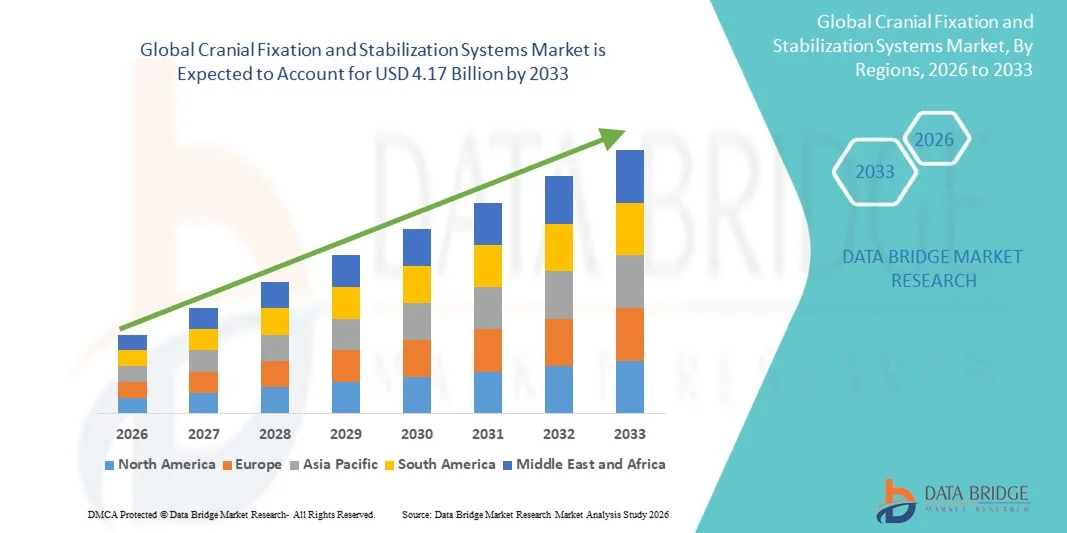
- The global cranial fixation and stabilization systems market size was valued at USD 2.17 billion in 2025 and is expected to reach USD 4.17 billion by 2033, at a CAGR of 8.52% during the forecast period
- The market growth is largely fueled by the rising incidence of traumatic brain injuries, increasing number of neurosurgical procedures, and continuous advancements in biomaterials and fixation technologies, leading to improved surgical outcomes and patient safety across healthcare settings
- Furthermore, growing demand for minimally invasive neurosurgical techniques, expanding healthcare infrastructure in emerging economies, and the increasing focus on precision and stability in cranial surgeries are establishing cranial fixation and stabilization systems as essential components in modern neurosurgical care. These converging factors are accelerating the adoption of advanced fixation solutions, thereby significantly boosting the industry's growth
Cranial Fixation and Stabilization Systems Market Analysis
- Cranial fixation and stabilization systems, designed to securely position and immobilize cranial bones during and after neurosurgical procedures, are increasingly vital components of modern neurosurgery due to their essential role in maintaining cranial integrity, supporting bone healing, and improving surgical accuracy across trauma, tumor, and reconstructive cases
- The escalating demand for cranial fixation and stabilization systems is primarily fueled by the rising incidence of traumatic brain injuries, increasing prevalence of neurological disorders, growing volume of neurosurgical procedures, and continuous advancements in biocompatible and resorbable materials that enhance patient safety and postoperative outcomes
- North America dominated the cranial fixation and stabilization systems market with the largest revenue share of 41.8% in 2025, characterized by advanced healthcare infrastructure, high neurosurgical procedure rates, and the strong presence of leading medical device manufacturers, with the U.S. experiencing significant growth driven by technological innovation, favorable reimbursement frameworks, and rising adoption of advanced surgical solutions
- Asia-Pacific is expected to be the fastest growing region in the cranial fixation and stabilization systems market during the forecast period due to expanding healthcare infrastructure, increasing healthcare expenditure, improving access to specialized neurosurgical care, and a growing patient population requiring cranial interventions
- Cranial fixation systems segment dominated the cranial fixation and stabilization systems market with a market share of 62.4% in 2025, driven by their extensive clinical application in securing bone flaps and fractures, broad availability in both nonresorbable and resorbable material types
Report Scope and Cranial Fixation and Stabilization Systems Market Segmentation
|
Attributes |
Cranial Fixation and Stabilization Systems Key Market Insights |
|
Segments Covered |
|
|
Countries Covered |
North America
Europe
Asia-Pacific
Middle East and Africa
South America
|
|
Key Market Players |
|
|
Market Opportunities |
|
|
Value Added Data Infosets |
In addition to the insights on market scenarios such as market value, growth rate, segmentation, geographical coverage, and major players, the market reports curated by the Data Bridge Market Research also include in-depth expert analysis, patient epidemiology, pipeline analysis, pricing analysis, and regulatory framework |
Cranial Fixation and Stabilization Systems Market Trends
“Rising Adoption of Bioresorbable and Patient-Specific Cranial Solutions”
- A significant and accelerating trend in the global cranial fixation and stabilization systems market is the increasing adoption of bioresorbable materials and patient-specific implant technologies, driven by the need for improved surgical outcomes and reduced long-term complications. This shift is significantly enhancing procedural efficiency and postoperative recovery in neurosurgical care
- For instance, leading medical device manufacturers are expanding portfolios of resorbable cranial fixation systems designed to gradually degrade after bone healing, eliminating the need for secondary removal procedures. Similarly, customized cranial plates developed using advanced imaging and 3D printing technologies offer improved anatomical fit and precision
- The integration of advanced biomaterials enables improved biocompatibility, reduced infection risks, and minimized inflammatory responses. For instance, resorbable polymer-based systems are increasingly utilized in pediatric neurosurgeries where skull growth considerations are critical. Furthermore, patient-specific fixation solutions provide enhanced stability and reduced operative time through precise preoperative planning
- The seamless incorporation of digital surgical planning tools with cranial fixation systems facilitates greater accuracy and consistency in complex cranial reconstructions. Through integrated imaging and design platforms, surgeons can optimize implant positioning and fixation strategies, resulting in improved clinical outcomes and streamlined workflows
- This trend toward more advanced, biocompatible, and customized fixation systems is fundamentally reshaping expectations in neurosurgical procedures. Consequently, companies are developing next-generation cranial fixation products featuring improved material strength, resorption control, and compatibility with minimally invasive surgical techniques
- The demand for innovative cranial fixation and stabilization systems offering enhanced safety, precision, and reduced long-term complications is growing steadily across hospitals and specialized neurosurgical centers, as healthcare providers increasingly prioritize improved patient outcomes and surgical efficiency
- In addition, the growing focus on pediatric neurosurgery and congenital cranial defect management is further stimulating demand for adaptable and growth-compatible fixation solutions worldwide
Cranial Fixation and Stabilization Systems Market Dynamics
Driver
“Increasing Neurosurgical Procedures and Rising Incidence of Traumatic Brain Injuries”
- The growing prevalence of traumatic brain injuries, brain tumors, and congenital cranial deformities, coupled with the increasing volume of neurosurgical interventions, is a significant driver for the heightened demand for cranial fixation and stabilization systems
- For instance, rising hospital admissions related to road accidents and sports injuries have led to an increased number of craniotomies and reconstructive cranial procedures globally, thereby driving the need for reliable fixation systems. Such strategic expansions in trauma and neurosurgery departments are expected to support market growth during the forecast period
- As healthcare providers focus on improving surgical precision and patient safety, cranial fixation systems offer rigid stabilization, reduced intraoperative complications, and enhanced postoperative healing compared to traditional wiring techniques
- Furthermore, the expansion of advanced healthcare infrastructure and improved access to specialized neurosurgical care in emerging economies are contributing to greater adoption of modern cranial stabilization technologies
- The increasing preference for minimally invasive neurosurgical techniques and advanced fixation materials is propelling the integration of innovative cranial systems in both public and private healthcare institutions. Continuous training programs and growing awareness among surgeons regarding advanced fixation options further contribute to market expansion
- Rising healthcare expenditure and government investments in tertiary care hospitals are further strengthening the availability of advanced neurosurgical equipment and fixation systems
- In addition, the growing geriatric population, which is more susceptible to neurological disorders and head injuries, is contributing significantly to the increasing procedural volume worldwide
Restraint/Challenge
“High Procedural Costs and Stringent Regulatory Requirements”
- Concerns surrounding the high cost of cranial fixation and stabilization procedures, including implant expenses and surgical infrastructure requirements, pose a significant challenge to broader market adoption, particularly in low- and middle-income regions
- For instance, the elevated pricing of advanced bioresorbable and patient-specific cranial implants can limit accessibility in cost-sensitive healthcare systems, restricting widespread utilization despite clinical benefits
- Addressing cost-related barriers while maintaining product quality and compliance with strict regulatory standards is crucial for manufacturers. Companies must adhere to rigorous approval processes and clinical validation requirements to ensure product safety and effectiveness. In addition, lengthy regulatory pathways for new biomaterials and implant designs can delay product launches and increase development costs
- While technological advancements continue to enhance product performance, reimbursement limitations and budget constraints within public healthcare systems can slow procurement decisions. Variability in regulatory frameworks across regions further complicates global market expansion strategies
- Overcoming these challenges through cost optimization strategies, expanded reimbursement coverage, streamlined regulatory approvals, and increased investment in clinical research will be vital for sustaining long-term growth in the cranial fixation and stabilization systems market
- Limited availability of skilled neurosurgeons and trained operating room staff in certain developing regions can further restrict the effective adoption of advanced cranial fixation technologies
- Moreover, the risk of postoperative complications such as infection or implant-related adverse reactions may create cautious adoption patterns among healthcare providers, particularly when introducing newer biomaterials
Cranial Fixation and Stabilization Systems Market Scope
The market is segmented on the basis of product, material type, and end user.
- By Product
On the basis of product, the global cranial fixation and stabilization systems market is segmented into cranial fixation systems and cranial stabilization systems. The cranial fixation systems segment dominated the market with the largest revenue share of 62.4% in 2025, driven by their extensive application in securing bone flaps and fractures during craniotomy and cranial reconstruction procedures. These systems, which include plates, screws, and meshes, are widely used due to their ability to provide rigid and long-term stability following neurosurgical interventions. Hospitals and neurosurgeons prefer fixation systems for their proven clinical reliability and compatibility with both resorbable and nonresorbable materials. The growing number of traumatic brain injury cases and tumor-related surgeries further strengthens the demand for fixation systems globally. In addition, continuous product innovations aimed at enhancing strength, flexibility, and ease of implantation are reinforcing the segment’s leading position in the market.
The cranial stabilization systems segment is anticipated to witness the fastest growth rate from 2026 to 2033, fueled by the rising adoption of advanced headrest and skull clamp systems during neurosurgical procedures. Stabilization systems play a critical role in maintaining precise head positioning and minimizing intraoperative movement, thereby improving surgical accuracy and safety. Increasing preference for minimally invasive neurosurgical techniques is contributing to higher demand for reliable stabilization equipment. Technological advancements such as lightweight materials and ergonomic designs are enhancing surgeon comfort and procedural efficiency. Furthermore, expanding neurosurgical infrastructure in emerging economies is expected to accelerate the adoption of cranial stabilization systems during the forecast period.
- By Material Type
On the basis of material type, the market is segmented into nonresorbable and resorbable materials. The nonresorbable segment held the largest market revenue share in 2025, driven by the widespread use of titanium-based fixation devices known for their superior strength, durability, and biocompatibility. Nonresorbable implants provide long-term structural support, making them suitable for complex cranial reconstructions and high-load-bearing applications. Their established clinical track record and predictable performance outcomes make them the preferred choice among neurosurgeons. In addition, cost-effectiveness compared to some advanced bioresorbable options further contributes to their dominant market position. The availability of diverse nonresorbable product portfolios from major manufacturers also supports sustained segment growth.
The resorbable segment is expected to witness the fastest CAGR from 2026 to 2033, driven by increasing demand for implants that naturally degrade after fulfilling their fixation role. Resorbable materials are particularly beneficial in pediatric neurosurgery, where skull growth considerations make permanent implants less desirable. These systems reduce the need for secondary removal surgeries, thereby lowering long-term patient risk and healthcare costs. Ongoing advancements in polymer science are improving the mechanical strength and controlled degradation rates of resorbable implants. Rising awareness regarding the clinical benefits of bioresorbable materials is further accelerating adoption across advanced healthcare facilities.
- By End User
On the basis of end user, the market is segmented into hospitals and ambulatory surgical centers. The hospitals segment dominated the market with the largest revenue share in 2025, attributed to the high volume of complex neurosurgical procedures performed in tertiary care and specialized hospitals. Hospitals are equipped with advanced surgical infrastructure, experienced neurosurgeons, and comprehensive postoperative care facilities, making them the primary centers for cranial fixation procedures. The presence of dedicated trauma and neurocritical care units further supports the high procedural volume in hospital settings. In addition, favorable reimbursement frameworks and government funding in developed regions contribute to the segment’s strong market position.
The ambulatory surgical centers segment is projected to witness the fastest growth during the forecast period, driven by the increasing shift toward outpatient surgical procedures and cost-effective care delivery models. Advancements in minimally invasive neurosurgical techniques are enabling select cranial procedures to be performed in specialized ambulatory settings. These centers offer reduced hospital stays, lower procedural costs, and improved patient convenience. Growing investments in advanced surgical equipment within ambulatory facilities are supporting the expansion of neurosurgical capabilities. As healthcare systems emphasize efficiency and value-based care, ambulatory surgical centers are expected to play a progressively important role in the cranial fixation and stabilization systems market.
Cranial Fixation and Stabilization Systems Market Regional Analysis
- North America dominated the cranial fixation and stabilization systems market with the largest revenue share of 41.8% in 2025, characterized by advanced healthcare infrastructure, high neurosurgical procedure rates, and the strong presence of leading medical device manufacturers
- Healthcare providers in the region highly prioritize surgical precision, advanced biomaterials, and innovative fixation technologies that enhance patient outcomes and reduce postoperative complications
- This widespread adoption is further supported by favorable reimbursement policies, substantial healthcare expenditure, continuous technological advancements, and the presence of leading medical device manufacturers, establishing cranial fixation and stabilization systems as essential components in modern neurosurgical care across hospitals and specialized center
U.S. Cranial Fixation and Stabilization Systems Market Insight
The U.S. cranial fixation and stabilization systems market captured the largest revenue share of 79% in 2025 within North America, fueled by the high volume of neurosurgical procedures and the strong presence of advanced healthcare infrastructure. Healthcare providers are increasingly prioritizing improved surgical precision and patient safety through the adoption of technologically advanced fixation systems. The growing incidence of traumatic brain injuries and brain tumors further propels demand for reliable cranial implants. Moreover, favorable reimbursement frameworks and continuous innovation in bioresorbable and titanium-based fixation technologies are significantly contributing to market expansion.
Europe Cranial Fixation and Stabilization Systems Market Insight
The Europe cranial fixation and stabilization systems market is projected to expand at a substantial CAGR throughout the forecast period, primarily driven by well-established healthcare systems and rising demand for advanced neurosurgical interventions. The increase in road accidents and age-related neurological conditions is fostering procedural growth across the region. European healthcare providers emphasize high standards of surgical safety and biocompatibility, supporting the adoption of advanced fixation materials. The region is experiencing steady growth across tertiary hospitals and specialty neurosurgical centers, with modern cranial systems increasingly incorporated into both emergency and elective procedures.
U.K. Cranial Fixation and Stabilization Systems Market Insight
The U.K. cranial fixation and stabilization systems market is anticipated to grow at a noteworthy CAGR during the forecast period, driven by increasing neurosurgical case volumes and continued investment in advanced surgical technologies. In addition, rising awareness regarding early diagnosis and treatment of neurological disorders is encouraging timely surgical intervention. The country’s strong public healthcare framework supports access to specialized neurosurgical services. Continuous upgrades in hospital infrastructure and the adoption of minimally invasive surgical approaches are expected to further stimulate market growth.
Germany Cranial Fixation and Stabilization Systems Market Insight
The Germany cranial fixation and stabilization systems market is expected to expand at a considerable CAGR during the forecast period, fueled by advanced medical infrastructure and strong emphasis on precision-based surgical solutions. Germany’s leadership in medical technology innovation promotes the adoption of high-quality cranial fixation implants. Increasing demand for durable and biocompatible materials aligns with the country’s focus on safety and long-term clinical outcomes. The integration of advanced imaging and digital surgical planning tools with fixation systems is becoming increasingly prevalent, supporting improved procedural efficiency and patient recovery.
Asia-Pacific Cranial Fixation and Stabilization Systems Market Insight
The Asia-Pacific cranial fixation and stabilization systems market is poised to grow at the fastest CAGR during the forecast period of 2026 to 2033, driven by rising healthcare expenditure, expanding hospital infrastructure, and a growing patient pool with neurological conditions. The region's increasing incidence of head injuries due to traffic accidents and sports-related trauma is driving procedural demand. Government initiatives aimed at strengthening tertiary care services are supporting the adoption of advanced cranial systems. Furthermore, improving accessibility to specialized neurosurgical care is expanding the utilization of fixation and stabilization technologies across emerging economies.
Japan Cranial Fixation and Stabilization Systems Market Insight
The Japan cranial fixation and stabilization systems market is gaining momentum due to the country’s advanced healthcare system, aging population, and growing demand for precision neurosurgical solutions. The Japanese market places strong emphasis on safety, quality, and minimally invasive treatment approaches. Adoption of bioresorbable fixation materials is increasing, particularly in pediatric and reconstructive cases. Moreover, continuous technological innovation and integration of high-resolution imaging systems are fueling growth in specialized neurosurgical centers across the country.
India Cranial Fixation and Stabilization Systems Market Insight
The India cranial fixation and stabilization systems market accounted for the largest market revenue share in Asia Pacific in 2025, attributed to expanding healthcare infrastructure, rising trauma cases, and increasing awareness of advanced neurosurgical treatments. India is emerging as a key market for cost-effective yet technologically advanced medical devices. Growing investments in tertiary hospitals and medical colleges are enhancing access to complex cranial procedures. The push toward improving emergency and trauma care services, along with increasing availability of domestically manufactured fixation systems, is propelling market growth in India.
Cranial Fixation and Stabilization Systems Market Share
The Cranial Fixation and Stabilization Systems industry is primarily led by well-established companies, including:
- Medtronic (Ireland)
- Stryker (U.S.)
- Zimmer Biomet (U.S.)
- B. Braun SE (Germany)
- Integra LifeSciences Corporation (U.S.)
- KLS Martin Group (Germany)
- OsteoMed, LLC (U.S.)
- Micromar Indústria e Comércio Ltda (Brazil)
- Changzhou Huida Medical Instrument Co., Ltd. (China)
- Pro Med Instruments GmbH (Germany)
- Medicon eG (Germany)
- Jeil Medical Corporation (South Korea)
- Evonos GmbH & Co. KG (Germany)
- NEOS Surgery S.L. (Italy)
- Acumed LLC (U.S.)
- Brainlab AG (Germany)
- OrthoPediatrics Neuro (U.S.)
- Nexus CMF (U.S.)
- Xillix Technologies Inc. (Canada)
- Synimed Sarl (France)
What are the Recent Developments in Global Cranial Fixation and Stabilization Systems Market?
- In November 2025, the U.S. FDA granted 510(k) clearance for the mb-FIX Cranial Stabilization System, including CT/MRI-compatible skull clamps that provide rigid head fixation during craniotomies and spinal surgeries, enabling broader use of advanced stabilization hardware in neurosurgical operating rooms
- In September 2025, a study published in the Chinese Neurosurgical Journal revealed a fully absorbable cranial fixation device from MedArt Technology that significantly improves bone healing, reduces complications, and provides complete resorption as the skull heals, outperforming traditional metal systems in clinical evaluation
- In December 2024, RevBio received expanded FDA approval and CMS reimbursement for its TETRANITE® regenerative bone adhesive for cranial flap fixation, allowing broader clinical use cases and insurance coverage, which supports adoption of non-hardware fixation alternatives in brain surgery
- In April 2024, Kelyniam Global and Fin-ceramica announced that the NEOS Surgery Cranial LOOP™ fixation system received FDA 510(k) clearance for use with Finceramica’s CustomizedBone™ hydroxyapatite cranial implants, enabling rapid, radiolucent fixation of bone flaps post-craniotomy and expanding options for patient-specific cranial repair solutions
- In September 2023, ZETA Surgical’s ZETA system received initial FDA 510(k) clearance for cranial surgical procedures, followed by expanded indications and instrument compatibility in 2024, marking a milestone in navigated precision for neurosurgery and cranial stabilization workflows
SKU-
Получите онлайн-доступ к отчету на первой в мире облачной платформе рыночной аналитики

- Интерактивная панель анализа данных
- Панель анализа компании для возможностей с высоким потенциалом роста
- Доступ аналитика-исследователя для настройки и запросов
- Анализ конкурентов с помощью интерактивной панели
- Последние новости, обновления и анализ тенденций
- Используйте возможности сравнительного анализа для комплексного отслеживания конкурентов
Методология исследования
Сбор данных и анализ базового года выполняются с использованием модулей сбора данных с большими размерами выборки. Этап включает получение рыночной информации или связанных данных из различных источников и стратегий. Он включает изучение и планирование всех данных, полученных из прошлого заранее. Он также охватывает изучение несоответствий информации, наблюдаемых в различных источниках информации. Рыночные данные анализируются и оцениваются с использованием статистических и последовательных моделей рынка. Кроме того, анализ доли рынка и анализ ключевых тенденций являются основными факторами успеха в отчете о рынке. Чтобы узнать больше, пожалуйста, запросите звонок аналитика или оставьте свой запрос.
Ключевой методологией исследования, используемой исследовательской группой DBMR, является триангуляция данных, которая включает в себя интеллектуальный анализ данных, анализ влияния переменных данных на рынок и первичную (отраслевую экспертную) проверку. Модели данных включают сетку позиционирования поставщиков, анализ временной линии рынка, обзор рынка и руководство, сетку позиционирования компании, патентный анализ, анализ цен, анализ доли рынка компании, стандарты измерения, глобальный и региональный анализ и анализ доли поставщика. Чтобы узнать больше о методологии исследования, отправьте запрос, чтобы поговорить с нашими отраслевыми экспертами.
Доступна настройка
Data Bridge Market Research является лидером в области передовых формативных исследований. Мы гордимся тем, что предоставляем нашим существующим и новым клиентам данные и анализ, которые соответствуют и подходят их целям. Отчет можно настроить, включив в него анализ ценовых тенденций целевых брендов, понимание рынка для дополнительных стран (запросите список стран), данные о результатах клинических испытаний, обзор литературы, обновленный анализ рынка и продуктовой базы. Анализ рынка целевых конкурентов можно проанализировать от анализа на основе технологий до стратегий портфеля рынка. Мы можем добавить столько конкурентов, о которых вам нужны данные в нужном вам формате и стиле данных. Наша команда аналитиков также может предоставить вам данные в сырых файлах Excel, сводных таблицах (книга фактов) или помочь вам в создании презентаций из наборов данных, доступных в отчете.











