



Global Functional Flour Market Segmentation, By Type (Pre-Cooked Flours, Specialty Flours, and Others), Source (Cereals and Legumes), Application (Products, Soups and Sauces, RTE Products, and Others) - Industry Trends and Forecast to 2033
Functional Flour Market Size
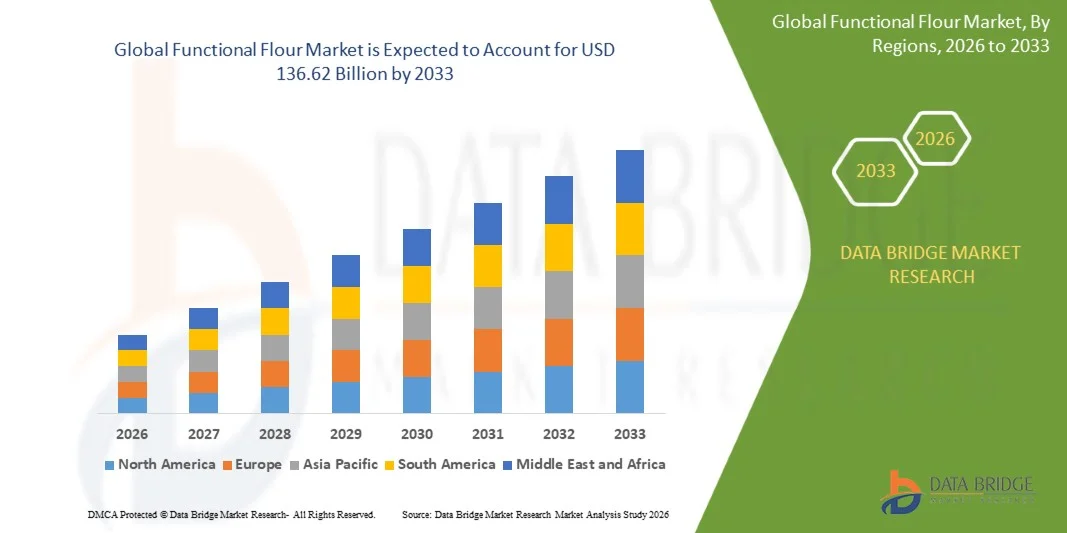
- The global functional flour market size was valued at USD 76.32 billion in 2025 and is expected to reach USD 136.62 billion by 2033, at a CAGR of 7.55% during the forecast period
- The market growth is largely fueled by the increasing consumer shift toward health-conscious diets and the rising demand for clean-label, fortified, and functional food ingredients, leading to higher adoption of functional flours across bakery, processed, and convenience food applications
- Furthermore, growing awareness regarding nutritional enrichment, digestive health, and plant-based protein consumption is establishing functional flours as a preferred ingredient in modern food formulations. These converging factors are accelerating product innovation and usage across diverse applications, thereby significantly boosting the market growth
Functional Flour Market Analysis
- Functional flours are specialized flour products that are processed or fortified to enhance nutritional value, functionality, and performance in food applications such as bakery, soups, sauces, and ready-to-eat products. These flours offer benefits such as improved texture, stability, protein enrichment, and clean-label compatibility, making them suitable for both industrial and household usage
- The escalating demand for functional flours is primarily driven by increasing health awareness, rising demand for gluten-free and plant-based food products, and the growing need for convenience and ready-to-eat food solutions, which collectively support their widespread adoption across global food industries
- North America dominated the functional flour market with a share of 33.72% in 2025, due to increasing consumer preference for fortified and clean-label food products along with strong demand for convenience-based nutrition
- Asia-Pacific is expected to be the fastest growing region in the functional flour market during the forecast period due to rapid urbanization, rising disposable incomes, and increasing awareness regarding health and nutrition
- Cereals segment dominated the market with a market share of 63.48% in 2025, due to the widespread consumption of wheat, rice, and corn-based functional flours. These sources are easily available, cost-effective, and widely accepted across diverse food applications. Cereals offer versatile functionality in baking, thickening, and texturizing, making them a preferred choice for manufacturers
Report Scope and Functional Flour Market Segmentation
|
Attributes |
Functional Flour Key Market Insights |
|
Segments Covered |
|
|
Countries Covered |
North America
Europe
Asia-Pacific
Middle East and Africa
South America
|
|
Key Market Players |
|
|
Market Opportunities |
|
|
Value Added Data Infosets |
In addition to the insights on market scenarios such as market value, growth rate, segmentation, geographical coverage, and major players, the market reports curated by the Data Bridge Market Research also include in-depth expert analysis, pricing analysis, brand share analysis, consumer survey, demography analysis, supply chain analysis, value chain analysis, raw material/consumables overview, vendor selection criteria, PESTLE Analysis, Porter Analysis, and regulatory framework. |
Functional Flour Market Trends
“Rising Demand for Clean-Label and Plant-Based Functional Ingredients”
- A significant trend in the functional flour market is the increasing demand for clean-label and plant-based ingredients, driven by growing consumer preference for natural, minimally processed, and nutritionally enriched food products across global markets. This shift is strengthening the role of functional flours as essential ingredients in bakery, snacks, and ready-to-eat food applications where transparency and health benefits are prioritized
- For instance, Cargill has introduced clean-label rice and pulse-based functional flours that support simplified ingredient lists while maintaining texture and stability in processed foods. Such developments enhance product appeal and enable manufacturers to meet evolving consumer expectations regarding ingredient transparency and nutritional value
- The adoption of plant-based diets is accelerating the use of functional flours derived from legumes and alternative grains that provide higher protein and fiber content. This is positioning functional flours as key components in plant-based food formulations designed to replicate traditional textures and improve nutritional profiles
- The bakery and snack industries are increasingly incorporating functional flours to enhance product quality, extend shelf life, and deliver added health benefits without relying on synthetic additives. This trend is supporting innovation in healthier product alternatives across mainstream food categories
- Food manufacturers are focusing on ingredient innovation to improve functionality such as water absorption, viscosity, and emulsification, which enhances the performance of functional flours in diverse applications. This is expanding their usage across soups, sauces, and convenience foods requiring consistent texture and stability
- The market is witnessing strong momentum in health-focused food production where functional flours contribute to improved digestion, protein enrichment, and gluten-free formulations. This rising adoption is reinforcing the transition toward healthier, sustainable, and performance-driven food ingredients across global food systems
Functional Flour Market Dynamics
Driver
“Increasing Consumer Focus on Health, Nutrition, and Fortified Food Products”
- The increasing awareness regarding health and nutrition is driving the demand for functional flours as consumers seek food products enriched with proteins, fibers, and essential micronutrients. These flours support the development of healthier food options that align with preventive healthcare and wellness-oriented consumption patterns
- For instance, Archer Daniels Midland offers specialty and fortified flour solutions designed to enhance protein content and nutritional value in bakery and processed food products. These solutions enable food manufacturers to develop nutrient-dense offerings while maintaining product quality and consistency
- The growing demand for gluten-free and allergen-free products is fueling the adoption of functional flours derived from rice, pulses, and other alternative sources. These flours cater to consumers with dietary restrictions and support the expansion of inclusive food product portfolios
- The rise in consumption of ready-to-eat and convenience foods is further driving the need for functional flours that enhance texture, stability, and shelf life. This is increasing their integration into packaged and processed food segments across global markets
- The sustained focus on healthier lifestyles and balanced diets continues to reinforce the demand for functional flours across multiple food applications. This driver is shaping long-term market growth by aligning product development with evolving consumer expectations and dietary trends
Restraint/Challenge
“High Processing Cost and Limited Raw Material Standardization”
- The functional flour market faces challenges due to the high processing costs associated with advanced milling, fortification, and treatment techniques required to enhance functionality and nutritional value. These processes demand specialized equipment and technologies, increasing overall production expenses for manufacturers
- For instance, Ingredion Incorporated utilizes advanced processing technologies to develop functional flours with specific textural and nutritional properties, which involve higher operational costs and complex production methods. These factors can limit affordability and adoption, particularly in price-sensitive markets
- The variability in raw material quality, especially in plant-based sources such as legumes and alternative grains, creates challenges in maintaining consistency in functional performance. This lack of standardization affects product reliability and increases the complexity of large-scale production
- Manufacturers must adhere to strict food safety and regulatory standards, which require extensive testing and quality assurance processes. These requirements further increase production time and operational costs across the value chain
- The challenge of balancing cost efficiency with high-quality functional performance continues to impact market expansion. These constraints require ongoing innovation and process optimization to ensure scalability while maintaining product effectiveness and competitiveness
Functional Flour Market Scope
The market is segmented on the basis of type, source, and application.
• By Type
On the basis of type, the functional flour market is segmented into pre-cooked flours, specialty flours, and others. The pre-cooked flours segment dominated the largest market revenue share in 2025, driven by their convenience, reduced preparation time, and wide usage in ready-to-eat and instant food formulations. These flours are extensively utilized in bakery and processed food industries due to their improved digestibility and enhanced functional properties. Consumers increasingly prefer pre-cooked variants as they support quick meal preparation without compromising nutritional value. Their compatibility with industrial-scale processing and consistent quality further strengthens their dominance across global markets.
The specialty flours segment is anticipated to witness the fastest growth rate from 2026 to 2033, fueled by rising demand for gluten-free, high-protein, and fortified food products. These flours cater to evolving dietary preferences, including clean-label and health-focused consumption trends. Increasing awareness regarding functional benefits such as improved gut health and nutrient enrichment is accelerating adoption. Food manufacturers are incorporating specialty flours into innovative formulations to meet consumer demand for customized nutrition. Continuous product innovation and expansion of plant-based alternatives are further supporting segment growth.
• By Source
On the basis of source, the functional flour market is segmented into cereals and legumes. The cereals segment dominated the largest market revenue share of 63.48% in 2025, driven by the widespread consumption of wheat, rice, and corn-based functional flours. These sources are easily available, cost-effective, and widely accepted across diverse food applications. Cereals offer versatile functionality in baking, thickening, and texturizing, making them a preferred choice for manufacturers. The established supply chain and large-scale production capabilities further contribute to their leading position in the market.
The legumes segment is expected to witness the fastest growth rate from 2026 to 2033, fueled by increasing demand for plant-based protein and nutrient-dense ingredients. Legume-based flours such as chickpea and lentil are gaining traction due to their high protein, fiber, and micronutrient content. Rising health consciousness and dietary shifts toward vegan and vegetarian lifestyles are driving their adoption. These flours also support gluten-free formulations, making them suitable for consumers with dietary restrictions. Continuous innovation in legume processing technologies is enhancing their functionality and market penetration.
• By Application
On the basis of application, the functional flour market is segmented into products, soups and sauces, RTE products, and others. The products segment dominated the largest market revenue share in 2025, driven by extensive utilization in bakery, snacks, and confectionery items. Functional flours enhance texture, shelf life, and nutritional value, making them essential in processed food production. Growing consumer demand for healthier bakery alternatives is further supporting segment growth. Manufacturers are increasingly incorporating functional flours to improve product differentiation and meet clean-label requirements.
The RTE products segment is anticipated to witness the fastest growth rate from 2026 to 2033, fueled by the rising demand for convenience foods and busy consumer lifestyles. Functional flours play a crucial role in improving the quality, stability, and nutritional profile of ready-to-eat meals. Increasing urbanization and changing dietary habits are accelerating the adoption of such products globally. Food companies are focusing on fortification and innovation to enhance the appeal of RTE offerings. The growing preference for quick, nutritious, and easy-to-prepare meals is significantly driving this segment’s expansion.
Functional Flour Market Regional Analysis
- North America dominated the functional flour market with the largest revenue share of 33.72% in 2025, driven by increasing consumer preference for fortified and clean-label food products along with strong demand for convenience-based nutrition
- Consumers in the region prioritize health-oriented diets, leading to higher adoption of functional flours enriched with proteins, fibers, and micronutrients across bakery and processed food applications
- This growth is supported by high disposable incomes, advanced food processing industries, and rising awareness regarding preventive healthcare, establishing functional flour as a key ingredient in daily consumption
U.S. Functional Flour Market Insight
The U.S. functional flour market captured the largest revenue share within North America in 2025, fueled by strong demand for gluten-free and plant-based food alternatives. Consumers are increasingly focusing on healthier eating habits, driving the adoption of fortified and specialty flours in bakery and packaged food segments. The presence of major food manufacturers and continuous innovation in clean-label products further accelerates market expansion. Moreover, increasing demand for functional ingredients in ready-to-eat and convenience foods is significantly contributing to the growth of the market.
Europe Functional Flour Market Insight
The Europe functional flour market is projected to expand at a substantial CAGR throughout the forecast period, primarily driven by rising health consciousness and stringent food quality regulations. The growing demand for organic and non-GMO ingredients is fostering the adoption of functional flours across the region. Consumers are inclined toward nutritional enrichment and transparency in food labeling, supporting market growth. The region is witnessing increasing application of functional flours in bakery, snacks, and dietary food products, particularly in developed economies.
U.K. Functional Flour Market Insight
The U.K. functional flour market is anticipated to grow at a noteworthy CAGR during the forecast period, driven by increasing demand for healthier bakery alternatives and functional food ingredients. Rising awareness regarding digestive health and protein intake is encouraging consumers to shift toward specialty and fortified flours. The strong retail and e-commerce presence further enhances accessibility to such products. The growing inclination toward vegan and gluten-free diets is expected to continue driving the market in the country.
Germany Functional Flour Market Insight
The Germany functional flour market is expected to expand at a considerable CAGR during the forecast period, fueled by increasing focus on nutritional food consumption and sustainable product offerings. Germany’s well-established food processing industry and emphasis on innovation support the adoption of functional flours. Consumers prefer high-quality, clean-label ingredients, which is boosting demand across bakery and packaged food sectors. The integration of functional flours into traditional and modern food products is further accelerating market growth.
Asia-Pacific Functional Flour Market Insight
The Asia-Pacific functional flour market is poised to grow at the fastest CAGR during the forecast period of 2026 to 2033, driven by rapid urbanization, rising disposable incomes, and increasing awareness regarding health and nutrition. The growing demand for convenience foods and fortified products is significantly boosting market adoption. Expanding food processing industries and government initiatives promoting nutritional security are further supporting growth. The region’s large population base and shifting dietary patterns are contributing to widespread demand for functional flours.
Japan Functional Flour Market Insight
The Japan functional flour market is gaining momentum due to increasing demand for convenient, healthy, and fortified food products. The country’s focus on balanced nutrition and innovation in food technology supports the adoption of functional flours. Consumers are inclined toward products that offer health benefits such as improved digestion and enhanced nutrient intake. The integration of functional flours into processed and ready-to-eat food categories is driving market growth.
China Functional Flour Market Insight
The China functional flour market accounted for the largest market revenue share in Asia Pacific in 2025, attributed to rapid urbanization, growing middle-class population, and rising health awareness. The increasing demand for fortified and value-added food products is boosting the adoption of functional flours across various applications. China’s strong manufacturing base and expanding food industry further support market expansion. The growing trend of health-focused consumption and availability of diverse functional flour products are key factors driving growth in the country.
Functional Flour Market Share
The functional flour industry is primarily led by well-established companies, including:
- Cargill, Incorporated (U.S.)
- Archer Daniels Midland (U.S.)
- Bunge Limited (U.S.)
- Agrana Beteiligungs-AG (Austria)
- SunOpta, Inc. (Canada)
- The Scoular Company (U.S.)
- The Hain Celestial Group, Inc. (U.S.)
- Associated British Foods plc (U.K.)
- General Mills, Inc. (U.S.)
- Parrish and Heimbecker Limited (Canada)
- Conagra Brands, Inc. (U.S.)
- ITC Limited (India)
Latest Developments in Global Functional Flour Market
- In February 2026, Archer Daniels Midland expanded its portfolio of plant-based functional ingredients by introducing advanced pulse-based flours with enhanced protein concentration, improved solubility, and better processing stability for bakery and ready-to-eat applications. This development is significantly influencing the functional flour market by accelerating the shift toward plant-based nutrition and enabling manufacturers to formulate high-protein, clean-label products without compromising texture or taste. The innovation also strengthens ADM’s competitive positioning while supporting broader adoption of functional flours across diverse food categories, particularly in protein-enriched snacks and convenience foods
- In January 2026, Ingredion Incorporated expanded its clean-label functional flour range derived from pulses and grains, focusing on improving texture, mouthfeel, and sugar reduction in processed food formulations. This initiative is driving market growth by helping food manufacturers reformulate products to meet evolving regulatory standards and consumer demand for healthier alternatives. The enhanced functionality of these flours allows replacement of artificial additives, thereby supporting clean-label trends and increasing their application across bakery, snacks, sauces, and ready meals, ultimately boosting overall market penetration
- In December 2025, Protein Industries Canada, Maia Farms, and Phytokana Ingredients collaborated on a CAD 32.5 million project to convert fava beans into sustainable functional ingredients using proprietary processing technology that avoids heat and chemicals. This advancement is strengthening the functional flour market by promoting environmentally sustainable production methods while enhancing the nutritional quality, taste, and texture of plant-based ingredients. It also supports the expansion of alternative protein sources, enabling wider use in dairy substitutes, plant-based meats, and fortified food products, thereby reinforcing long-term market growth
- In July 2024, Cargill launched SimPure 92260, a soluble rice flour designed to replicate the functionality of maltodextrin while offering a more recognizable ingredient profile. This innovation is contributing to market expansion by enabling manufacturers to develop reduced-sugar and clean-label products without sacrificing viscosity, texture, or sensory characteristics. Its versatility across applications such as bakery, beverages, and snacks enhances its commercial viability and supports the increasing demand for transparent labeling and healthier ingredient alternatives
- In May 2024, GoodMills Innovation introduced Smart Wheat high-protein flour specifically designed for bakery applications, incorporating native proteins that improve gluten network formation and dough performance. This development is positively impacting the market by enhancing product consistency, texture, and nutritional value in baked goods. It also aligns with the rising consumer preference for protein-enriched foods, enabling manufacturers to differentiate their offerings and expand their presence in the functional flour segment, particularly within premium and health-focused bakery products
SKU-
Получите онлайн-доступ к отчету на первой в мире облачной платформе рыночной аналитики

- Интерактивная панель анализа данных
- Панель анализа компании для возможностей с высоким потенциалом роста
- Доступ аналитика-исследователя для настройки и запросов
- Анализ конкурентов с помощью интерактивной панели
- Последние новости, обновления и анализ тенденций
- Используйте возможности сравнительного анализа для комплексного отслеживания конкурентов
Методология исследования
Сбор данных и анализ базового года выполняются с использованием модулей сбора данных с большими размерами выборки. Этап включает получение рыночной информации или связанных данных из различных источников и стратегий. Он включает изучение и планирование всех данных, полученных из прошлого заранее. Он также охватывает изучение несоответствий информации, наблюдаемых в различных источниках информации. Рыночные данные анализируются и оцениваются с использованием статистических и последовательных моделей рынка. Кроме того, анализ доли рынка и анализ ключевых тенденций являются основными факторами успеха в отчете о рынке. Чтобы узнать больше, пожалуйста, запросите звонок аналитика или оставьте свой запрос.
Ключевой методологией исследования, используемой исследовательской группой DBMR, является триангуляция данных, которая включает в себя интеллектуальный анализ данных, анализ влияния переменных данных на рынок и первичную (отраслевую экспертную) проверку. Модели данных включают сетку позиционирования поставщиков, анализ временной линии рынка, обзор рынка и руководство, сетку позиционирования компании, патентный анализ, анализ цен, анализ доли рынка компании, стандарты измерения, глобальный и региональный анализ и анализ доли поставщика. Чтобы узнать больше о методологии исследования, отправьте запрос, чтобы поговорить с нашими отраслевыми экспертами.
Доступна настройка
Data Bridge Market Research является лидером в области передовых формативных исследований. Мы гордимся тем, что предоставляем нашим существующим и новым клиентам данные и анализ, которые соответствуют и подходят их целям. Отчет можно настроить, включив в него анализ ценовых тенденций целевых брендов, понимание рынка для дополнительных стран (запросите список стран), данные о результатах клинических испытаний, обзор литературы, обновленный анализ рынка и продуктовой базы. Анализ рынка целевых конкурентов можно проанализировать от анализа на основе технологий до стратегий портфеля рынка. Мы можем добавить столько конкурентов, о которых вам нужны данные в нужном вам формате и стиле данных. Наша команда аналитиков также может предоставить вам данные в сырых файлах Excel, сводных таблицах (книга фактов) или помочь вам в создании презентаций из наборов данных, доступных в отчете.











