


Global Geosynthetics Market, By Product (Geotextiles, Geomembranes, Geogrids, Geocells, Geonets, and Others) - Industry Trends and Forecast to 2030.
Geosynthetics Market Analysis and Insights
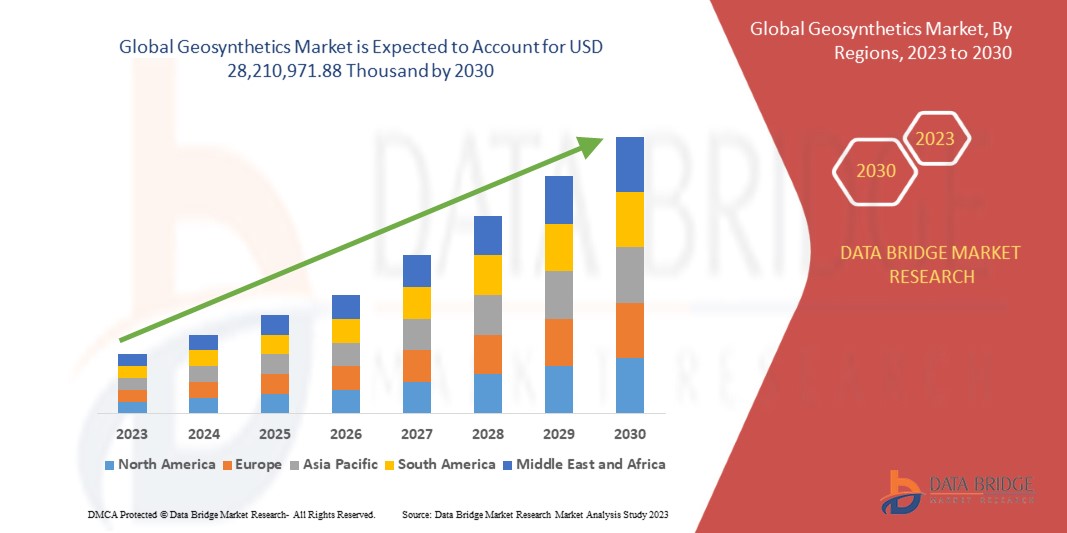
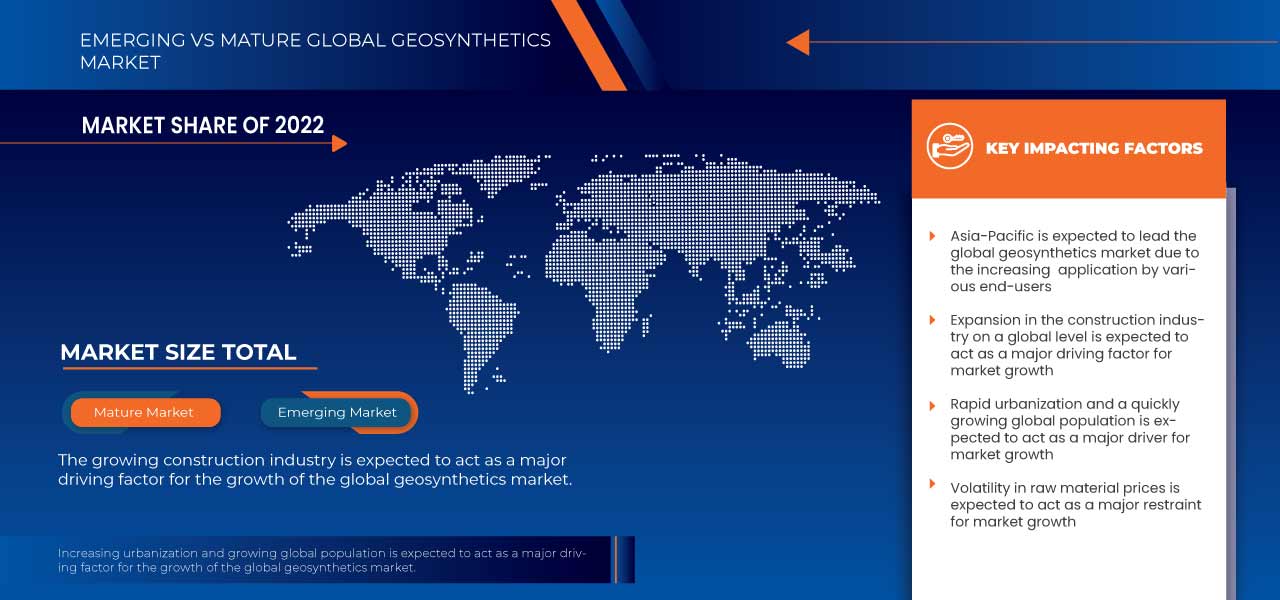
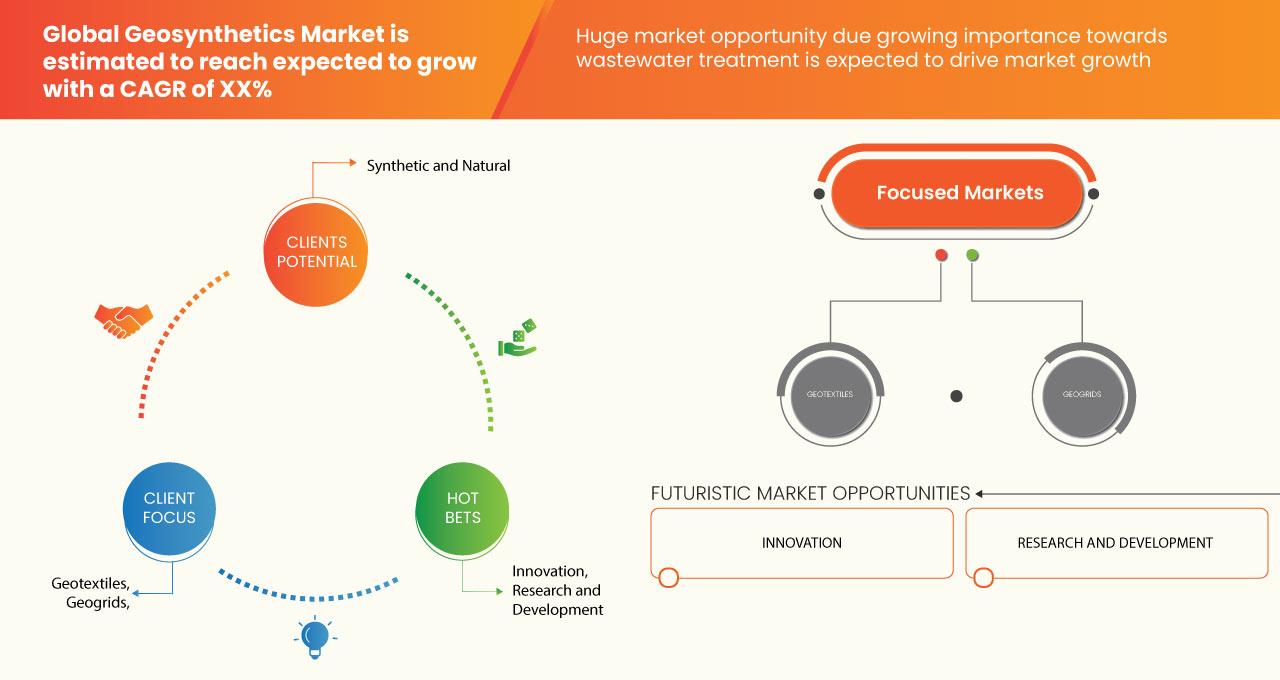
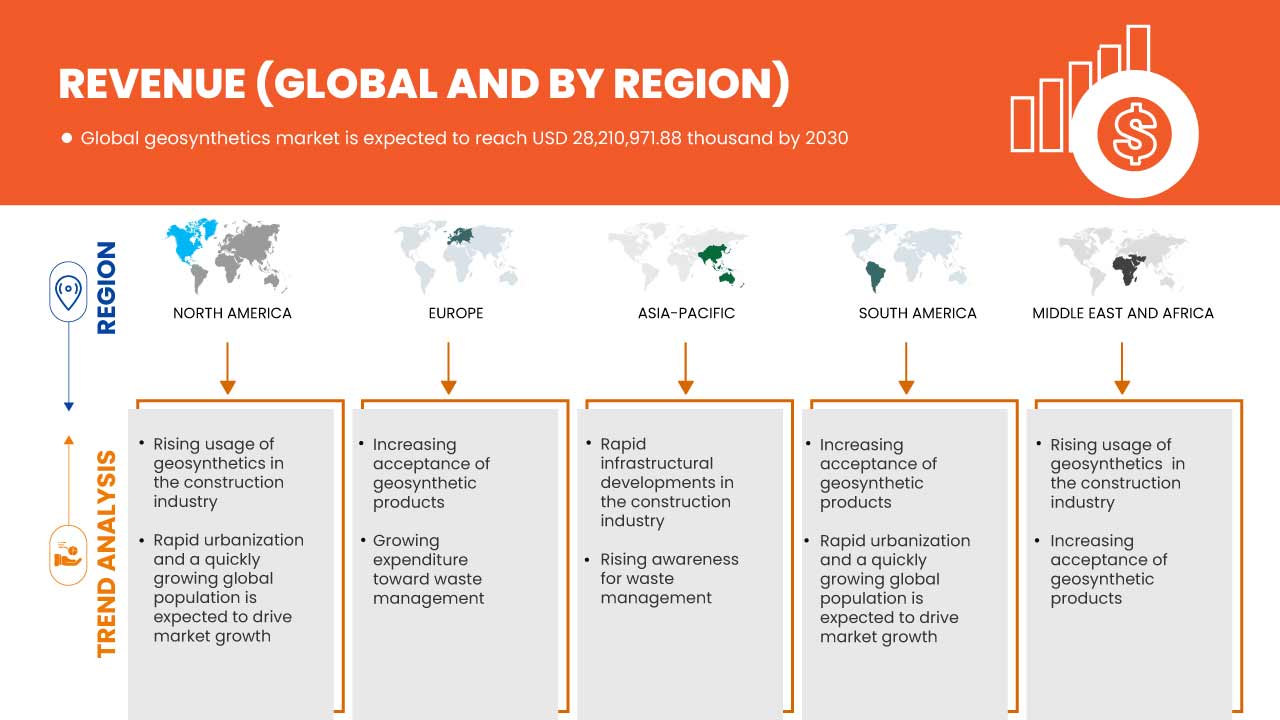
The global geosynthetics market is expected to gain significant growth in the forecast period of 2023 to 2030. Data Bridge Market Research analyzes that the market is growing with a CAGR of 5.9% in the forecast period of 2023 to 2030 and is expected to reach USD 28,210,971.88 thousand by 2030. The major factor driving the growth of the global geosynthetics market is the expansion of the construction industry on a global level.
The global geosynthetics market report provides details of market share, new developments, and the impact of domestic and localized market players, analysis opportunities in terms of emerging revenue pockets, changes in market regulations, products approvals, strategic decisions, product launches, geographic expansions, and technological innovations in the market. To understand the analysis and the market scenario contact us for an Analyst Brief, our team will help you create a revenue impact solution to achieve your desired goal.
|
Report Metric |
Details |
|
Forecast Period |
2023 to 2030 |
|
Base Year |
2022 |
|
Historic Years |
2021 (Customizable to 2020 - 2015) |
|
Quantitative Units |
Revenue in USD Thousand, Volume in Thousand Square Meter |
|
Segments Covered |
By Product (Geotextiles, Geomembranes, Geogrids, Geocells, Geonets, and Others) |
|
Counties Covered |
U.S., Canada, Mexico, Germany, U.K., Italy, France, Spain, Russia, Switzerland, Turkey, Belgium, Netherlands, rest of Europe, China, Japan, South Korea, India, Singapore, Thailand, Indonesia, Malaysia, Philippines, Australia & New Zealand, rest of Asia-Pacific, Brazil, Argentina, rest of South America, South Africa, Egypt, Saudi Arabia, UAE, Israel, and rest of Middle East and Africa |
|
Market Players Covered |
Tensar, A Division of CMC, Leggett & Platt, Incorporated, Berry Global, Inc., Carthage Mills, Inc., TENAX, Global Synthetics, HUESKER, AGRU, SKAPS Industries, Glen Raven Inc., SOLMAX, Schouw & Co., Naue Gmbh & Co.KG, Officine Maccaferri Spa, Swicofil AG, PRS Geo-Technologies., and Freudenberg among others |
Market Definition
Geosynthetics refer to polymers that are employed in civil engineering, construction, and related applications. These are generally used to stabilize the terrains and exhibit high durability that complements the other building materials. The different types of geosynthetics involve geotextile, geomembrane, geo-composite, and geosynthetic liner among others. Apart from civil engineering and construction, these are also used in transportation and hydraulic applications. They are typically made from synthetic materials such as PVC, polyethylene, or polypropylene, which when properly embedded, can help contribute to soil stabilization and prevent erosion.
Global Geosynthetics Market Dynamics
Drivers
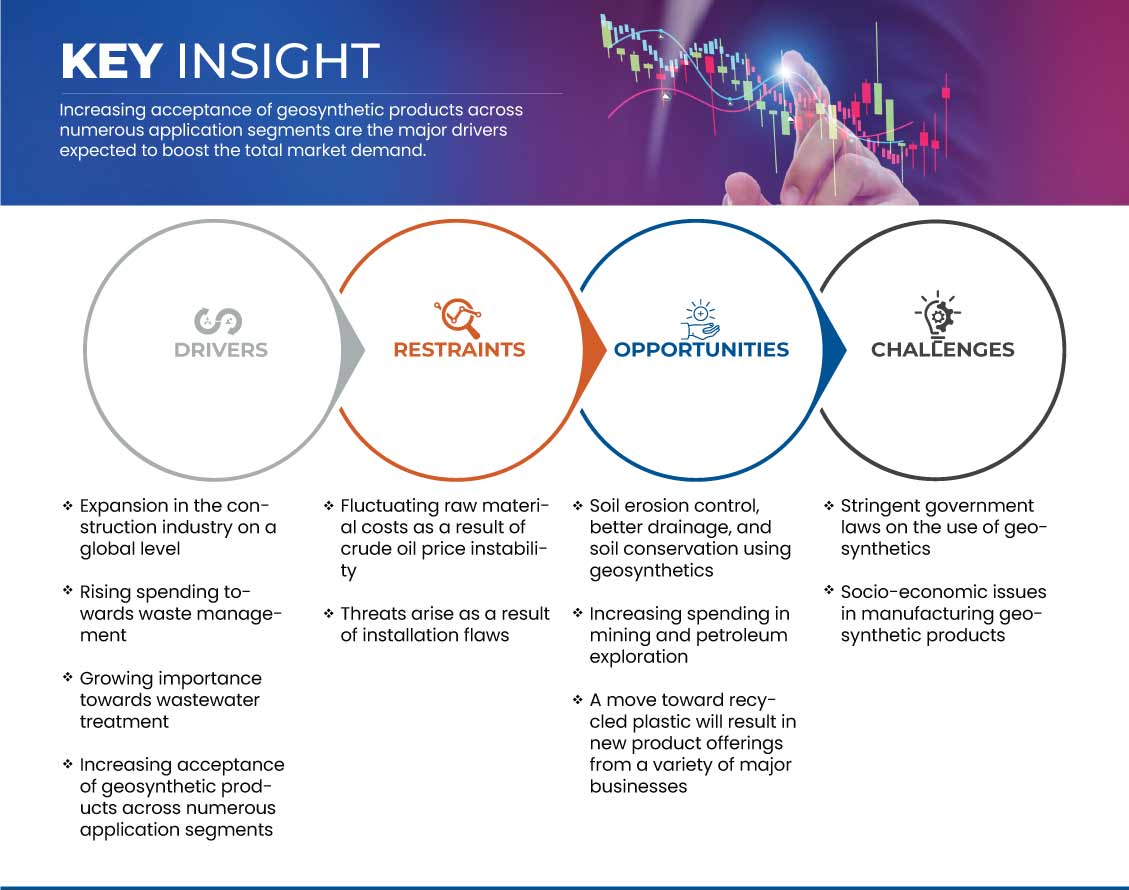
- Expansion in the Construction Industry on a Global Level
Geosynthetics of various sorts are employed in civil engineering and building projects. Depleting sources of granular and other basic raw materials, along with restricted project funding, have created new chances for inventive engineering to provide cost-effective solutions. One of these breakthroughs is the use of geosynthetics in civil engineering. Geosynthetics are recognized as genuine engineering materials that not only substitute for limited raw resources such as cement and steel but are also proving to be a fairly solid and good alternative to traditional designs.
This growth in the construction industry increases demand for geosynthetic goods such as geotextiles, geogrids, geonets, geomembranes, Geosynthetic Clay Liner (GCL), geocells, geocomposites, geopipes, and geofoams. Geotextiles and geogrid are used to improve the performance of permanent roads or to lower their thickness.
- Rising Spending Towards Waste Management
Rapid urbanization and a quickly growing global population both contribute to increased amounts of liquid and solid waste. Growing environmental consciousness is increasing the demand for projects that correctly handle water and waste. Geosynthetics operate as smart products as waste containment and management solutions in an effort to safeguard the environment from dangerous industrial wastes. Landfill gases and leachate should ideally be managed in a way that preserves the environment.
Geosynthetics are used in waste management for landfill liner solutions, leachate drainage, gas collection, and dewatering systems. Geomembranes operate as liquid and landfill gas barriers, and GCL is used for landfill liners. Geonets, geotubes, and geocomposites are low-cost leachate drainage alternatives. These heavy-duty geosynthetics can endure high flow rates, are simple to install, and can sustain vertical loading. Biaxial geonets in gas collecting systems swiftly transport the gas to the site of treatment. Geotubes, also known as dewatering tubes, are essential in any waste management operation.
- Increasing Acceptance of Geosynthetic Products Across Numerous Application Segments
Geosynthetics have a wide range of uses. It is nearly hard to find a significant infrastructure project that does not include the use of some form of geosynthetic component. This is why geosynthetics are a distinct type of material. They provide a variety of roles ranging from chemical containment to soil structural reinforcement, as well as many more in between such as drainage, material separation, and filtering. These are the most important geosynthetic uses.
A containment application is any application that uses geosynthetics as a barrier to liquid or gas materials. Heap leach mining liners, wastewater management, secondary tank containment, and landfill leachate liners are a few examples. The most typical geosynthetics for containment applications are clay liners, geocomposites, and geomembranes.
Geosynthetics in drainage applications remove subsurface or surface water from a given location. They serve a twofold purpose: first, they keep fine soil grains from clogging drainage systems, and second, they reinforce and maintain the structure's integrity. Dams, tunnels, pavement and roads, subsurface drainage, and erosion control all use geomembranes, geotextiles, and geogrids.
Filtration geosynthetics layers are used in most civil engineering applications to remove and separate moisture or fine particles from a structure. Geosynthetics such as geomembranes and geotextiles are widely acknowledged to provide superior filtration. They offer solutions for building airfields, roadways, and sports courts.
As a result, geosynthetics are frequently employed in the above-described applications. Furthermore, growing industrialization and an increase in the number of large infrastructure and environmental projects are moving the geosynthetics market forward.
OPPORTUNITIES
- Soil Erosion Control, Better Drainage, and Soil Conservation Using Geosynthetics
Soil erosion is considered a regular occurrence as the natural development rate of soil has been quite sluggish in recent years. Therefore, it is recommended to use the best solution to artificially prevent soil erosion. Erosion management is also required to provide stability to other buildings against landslides, among other things, and it is also required to save the planets and soil formations from failing due to rain, gravity, or a variety of other factors. Geosynthetics are used to "block or limit soil or other particle motions at the surface of, for example, a slope" in surface soil erosion management.
River banks are protected by geotextiles against erosion caused by currents or lapping. They function as a filter when combined with natural or artificial enrockments. Geotextiles used for erosion control can be woven or nonwoven. Woven textiles are suitable in soils with bigger particle sizes because they have greater pores. Nonwovens are employed in areas where soils such as clay silt develop. When hydraulic uplift is predicted, these materials must have a high permeability.
Geotextiles are used for drainage, erosion management, and cost-effective ground modification, geogrids are generally used for soil and aggregate reinforcing, geomembranes are used for separation of soil and fluid, improving soil shear strength, and geocomposites/geoweb are used in drainage.
- Increasing Spending in Mining and Petroleum Exploration
Geomembranes are more usually employed in mining applications such as heap leach facilities, evaporation ponds, and tailings impoundments, where normally very high loads occur. High-Density Polyethylene (HDPE), Polyvinyl Chloride (PVC), Polypropylene (PP), and other materials are common raw materials for geomembranes. However, because of their superior chemical resistance and physical qualities, HDPE geomembranes are the most commonly utilized. Other design considerations must be considered in addition to the geomembranes' qualities, such as the influence of high stresses, the kind of foundation, and the material put beneath and on top of the geomembranes. The mining industry consumes around 40% of worldwide geomembrane output. In addition, firms in the mining sector provide and manufacture numerous geomembrane systems.
RESTRAINTS/CHALLENGES
- Stringent Government Laws on the Use of Geosynthetics
Geosynthetics is a hot topic these days since they are finding a larger range of uses. Geosynthetic goods are less hazardous to the environment. Specific issues such as how they are made, handled, and installed, as well as the difficulties that geosynthetic materials may generate, must also be considered. Each government or nation throughout the world has developed strict regulations, guidelines, and criteria for their controlled usage without causing any harm or damage to the environment or in other sorts of key applications where geosynthetics are frequently employed.
- Fluctuating Raw Material Prices and Prohibition on Plastic Usage Socio-Economic Issues in Manufacturing Geosynthetic Products
The geosynthetic maker has several challenges. The supply chain, labor problems, growing energy prices, quality improvements, keeping competitive, and sustainability are among the primary issues.
The progressive removal of COVID limitations in 2022 has increased demand, exacerbating pandemic-related supply chain concerns with maritime freight and polymer resins. As a result, businesses must get items from local, SME-sized manufacturing plants. With sustained geopolitical stability causing a sovereign risk migration to domestic supply chains, the market looks to perceive this change as somewhat permanent and not cyclical.
There is also a growing inflationary cost disparity between nations with industrial competence. When compared to China's inflation rate of 2%, European countries (Spain, France, Germany, and Italy) have interest rates ranging from 6.2% to 9.2%, Australia has 7.8%, and the U.S. has 6.4%. As a result, rising energy costs provide a point of arbitrage between various manufacturing zones. With an expected increase in upstream crude oil and feedstock polyethylene, production costs will rise accordingly, affecting the final pricing of HDPE-based geosynthetics.
Improved quality leads to increased customer satisfaction, less waste, and lower total costs. Continuous geomembrane production without specified maintenance shutdowns for cleaning barrels and screws, on the other hand, might result in gels and burned resin inclusion problems. If this occurs, the investment in plant maintenance would have more than quadrupled. As a result, quality control should be improved in order to limit the amount of rejection.
Global Geosynthetics Market Scope
The global geosynthetics market is segmented into one notable segment based on product. The growth amongst these segments will help you analyze major growth segments in the industries and provide the users with a valuable market overview and market insights to make strategic decisions to identify core market applications.
Product
- Geotextiles
- Geomembranes
- Geogrids
- Geocells
- Geonets
- Others
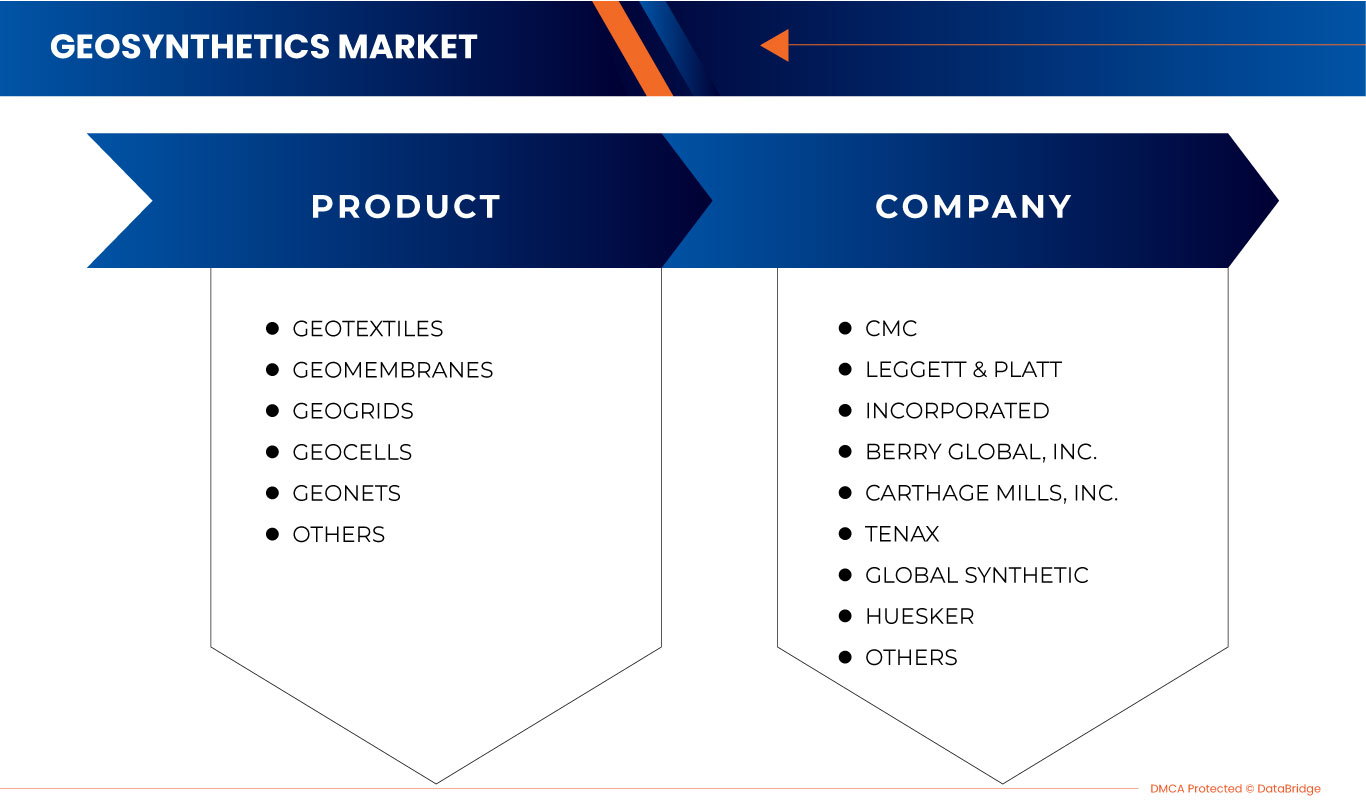
Based on product, the market is segmented into geotextiles, geomembranes, geogrids, geocells, geonets, and others.
Global Geosynthetics Market Regional Analysis/Insights
The global geosynthetics market is segmented based on product.
The countries covered in the global geosynthetics market are U.S., Canada, Mexico, Germany, U.K., Italy, France, Spain, Russia, Switzerland, Turkey, Belgium, Netherlands, rest of Europe, China, Japan, South Korea, India, Singapore, Thailand, Indonesia, Malaysia, Philippines, Australia & New Zealand, rest of Asia-Pacific, Brazil, Argentina, rest of South America, South Africa, Egypt, Saudi Arabia, UAE, Israel, and rest of Middle East and Africa. Asia-pacific is dominating the global geosynthetics market in terms of market share and market revenue due to the expansion in the construction industry on a global level in the region.
The country section of the report also provides individual market-impacting factors and changes in market regulation that impact the current and future trends of the market. Data points downstream and upstream value chain analysis, technical trends, porter's five forces analysis, and case studies are some of the pointers used to forecast the market scenario for individual countries. Also, the presence and availability of global brands and their challenges faced due to large or scarce competition from local and domestic brands, the impact of domestic tariffs, and trade routes are considered while providing forecast analysis of the country data.
Competitive Landscape and Global Geosynthetics Market Share Analysis
The global geosynthetics market competitive landscape provides details of competitors. Details included are company overview, company financials, revenue generated, market potential, investment in R&D, new market initiatives, production sites and facilities, company strengths and weaknesses, product launch, product approvals, patents, product width and breadth, application dominance, and product lifeline curve. The above data points provided are only related to the companies’ focus related to the market.
Some of the prominent participants operating in the global geosynthetics market are Tensar, A Division of CMC, Leggett & Platt, Incorporated, Berry Global, Inc., Carthage Mills, Inc., TENAX, Global Synthetics, HUESKER, AGRU, SKAPS Industries, Glen Raven, Inc., SOLMAX, Schouw & Co., Naue Gmbh & Co.KG, Officine Maccaferri Spa, Swicofil AG, PRS Geo-Technologies., and Freudenberg among others.
SKU-
Получите онлайн-доступ к отчету на первой в мире облачной платформе рыночной аналитики

- Интерактивная панель анализа данных
- Панель анализа компании для возможностей с высоким потенциалом роста
- Доступ аналитика-исследователя для настройки и запросов
- Анализ конкурентов с помощью интерактивной панели
- Последние новости, обновления и анализ тенденций
- Используйте возможности сравнительного анализа для комплексного отслеживания конкурентов
Методология исследования
Сбор данных и анализ базового года выполняются с использованием модулей сбора данных с большими размерами выборки. Этап включает получение рыночной информации или связанных данных из различных источников и стратегий. Он включает изучение и планирование всех данных, полученных из прошлого заранее. Он также охватывает изучение несоответствий информации, наблюдаемых в различных источниках информации. Рыночные данные анализируются и оцениваются с использованием статистических и последовательных моделей рынка. Кроме того, анализ доли рынка и анализ ключевых тенденций являются основными факторами успеха в отчете о рынке. Чтобы узнать больше, пожалуйста, запросите звонок аналитика или оставьте свой запрос.
Ключевой методологией исследования, используемой исследовательской группой DBMR, является триангуляция данных, которая включает в себя интеллектуальный анализ данных, анализ влияния переменных данных на рынок и первичную (отраслевую экспертную) проверку. Модели данных включают сетку позиционирования поставщиков, анализ временной линии рынка, обзор рынка и руководство, сетку позиционирования компании, патентный анализ, анализ цен, анализ доли рынка компании, стандарты измерения, глобальный и региональный анализ и анализ доли поставщика. Чтобы узнать больше о методологии исследования, отправьте запрос, чтобы поговорить с нашими отраслевыми экспертами.
Доступна настройка
Data Bridge Market Research является лидером в области передовых формативных исследований. Мы гордимся тем, что предоставляем нашим существующим и новым клиентам данные и анализ, которые соответствуют и подходят их целям. Отчет можно настроить, включив в него анализ ценовых тенденций целевых брендов, понимание рынка для дополнительных стран (запросите список стран), данные о результатах клинических испытаний, обзор литературы, обновленный анализ рынка и продуктовой базы. Анализ рынка целевых конкурентов можно проанализировать от анализа на основе технологий до стратегий портфеля рынка. Мы можем добавить столько конкурентов, о которых вам нужны данные в нужном вам формате и стиле данных. Наша команда аналитиков также может предоставить вам данные в сырых файлах Excel, сводных таблицах (книга фактов) или помочь вам в создании презентаций из наборов данных, доступных в отчете.











