



Global Neonatal (Preterm) Infant Care Market Segmentation, By Prenatal and Fetal Equipment (Ultrasound and Ultrasonography Devices, Fetal Doppler's, Fetal Magnetic Resonance Imaging (MRI), and Fetal Monitors), Neonatal Equipment (Infant Warmers and Incubators, Phototherapy Equipment, Neonatal Monitoring Devices and Respiratory Assistance, and Monitoring Devices), Product (Delivery Systems, Bili Lights, Respiratory Assistance Devices, Thermal Control Equipment's, Monitoring Devices, Diagnostic Equipment, and Pre Term Infant Formula), Application (Thermoregulation Devices, Monitoring Systems, Hearing Screening Devices, and Vision Screening Equipment), End Users (Hospital, Pediatric and Neonatal Clinics, and Nursing Homes)- Industry Trends and Forecast to 2033
Neonatal (Preterm) Infant Care Market Size
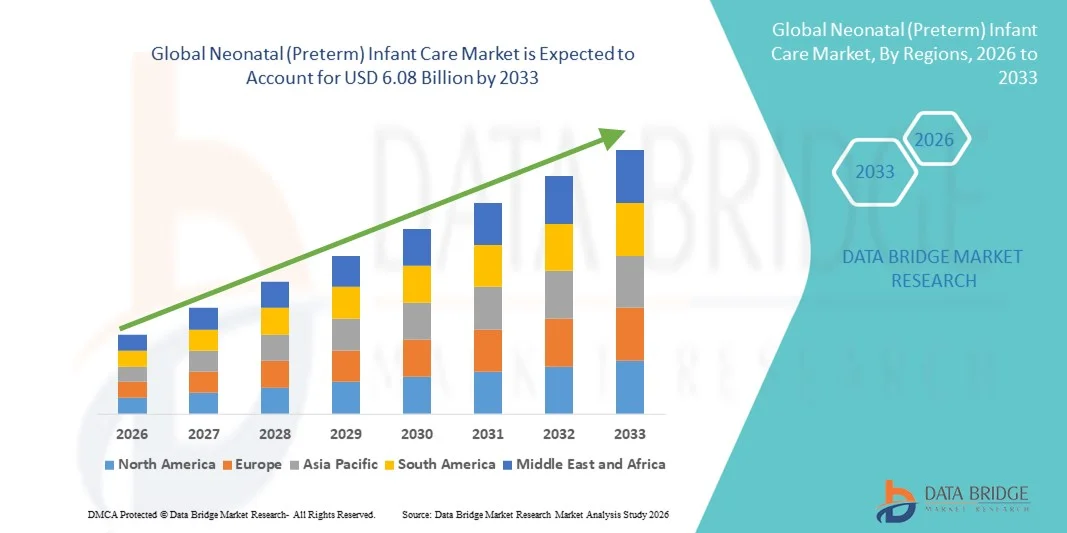
- The global neonatal (preterm) infant care market size was valued at USD 3.57 billion in 2025 and is expected to reach USD 6.08 billion by 2033, at a CAGR of 6.90% during the forecast period
- The market growth is largely fueled by the rising incidence of preterm births and increasing demand for specialized neonatal intensive care units (NICUs), leading to greater adoption of advanced neonatal care equipment and monitoring systems across healthcare facilities
- Furthermore, ongoing technological advancements in neonatal care devices and growing investments in maternal and child healthcare infrastructure are establishing neonatal infant care solutions as essential components of modern healthcare systems. These converging factors are accelerating the adoption of neonatal care technologies, thereby significantly boosting the industry's growth
Neonatal (Preterm) Infant Care Market Analysis
- Neonatal (preterm) infant care solutions, which include specialized medical equipment, monitoring systems, and therapeutic support used in neonatal intensive care units (NICUs), are increasingly vital components of modern healthcare systems due to their critical role in supporting premature infants with underdeveloped organs and complex medical needs
- The escalating demand for neonatal (preterm) infant care is primarily fueled by the rising incidence of premature births worldwide, growing awareness about neonatal health, and increasing investments in advanced neonatal care technologies and healthcare infrastructure
- North America dominated the neonatal (preterm) infant care market with the largest revenue share of 41.3% in 2025, characterized by well-established healthcare infrastructure, high healthcare expenditure, and a strong presence of leading neonatal care device manufacturers, with the U.S. experiencing significant adoption of advanced neonatal monitoring and life-support systems across hospitals and specialized NICUs
- Asia-Pacific is expected to be the fastest growing region in the neonatal (preterm) infant care market during the forecast period due to increasing birth rates, improving healthcare infrastructure, and rising government initiatives focused on maternal and infant healthcare
- Infant Warmers and Incubators segment dominated the neonatal (preterm) infant care market with a market share of 38.6% in 2025, driven by their essential role in maintaining body temperature, stabilizing vital functions, and improving survival outcomes for premature and low-birth-weight infants in neonatal intensive care units
Report Scope and Neonatal (Preterm) Infant Care Market Segmentation
|
Attributes |
Neonatal (Preterm) Infant Care Key Market Insights |
|
Segments Covered |
|
|
Countries Covered |
North America
Europe
Asia-Pacific
Middle East and Africa
South America
|
|
Key Market Players |
|
|
Market Opportunities |
|
|
Value Added Data Infosets |
In addition to the insights on market scenarios such as market value, growth rate, segmentation, geographical coverage, and major players, the market reports curated by the Data Bridge Market Research also include in-depth expert analysis, patient epidemiology, pipeline analysis, pricing analysis, and regulatory framework |
Neonatal (Preterm) Infant Care Market Trends
Advancement in Smart and Integrated Neonatal Monitoring Technologies
- A significant and accelerating trend in the global neonatal (preterm) infant care market is the rapid advancement and integration of smart monitoring technologies in neonatal intensive care units (NICUs), enabling healthcare professionals to monitor vital parameters of premature infants with greater precision and real-time insights. This technological progress is significantly improving clinical decision-making and patient outcomes
- For instance, advanced neonatal monitoring systems developed by companies such as GE HealthCare and Drägerwerk AG & Co. KGaA provide integrated monitoring platforms capable of tracking multiple physiological parameters such as heart rate, oxygen saturation, and respiratory rate in premature infants. Similarly, modern incubators and monitoring devices from Koninklijke Philips N.V. support continuous monitoring and automated alarms for improved neonatal care
- The integration of digital monitoring technologies enables features such as real-time data analysis, early detection of complications, and improved clinical workflow efficiency. For instance, advanced neonatal monitoring systems can analyze physiological data trends and alert clinicians to early signs of respiratory distress or infection. Furthermore, smart sensors and wireless monitoring devices reduce the need for excessive physical handling of fragile preterm infants, thereby improving patient safety and comfort
- The seamless integration of neonatal monitoring equipment with hospital information systems and electronic health records facilitates centralized data management across neonatal care units. Through unified platforms, clinicians can track infant health metrics, treatment progress, and device performance in real time, enabling more coordinated and efficient neonatal care delivery within hospitals and specialized clinics
- This trend towards more intelligent, integrated, and data-driven neonatal care solutions is fundamentally reshaping the way premature infants are monitored and treated in modern healthcare facilities. Consequently, companies such as Natus Medical Incorporated are developing advanced neonatal monitoring and screening technologies designed to improve early diagnosis and treatment outcomes in neonatal intensive care units
- The demand for advanced neonatal monitoring systems and integrated care solutions is growing rapidly across hospitals and pediatric care facilities, as healthcare providers increasingly prioritize improved survival outcomes, early diagnosis, and efficient neonatal care management for premature infants
- The increasing integration of portable neonatal care devices and wireless monitoring solutions is also supporting more flexible and efficient neonatal care environments, allowing healthcare providers to maintain continuous monitoring while minimizing disruption to fragile premature infants
Neonatal (Preterm) Infant Care Market Dynamics
Driver
Rising Incidence of Preterm Births and Growing Demand for Advanced Neonatal Care
- The increasing prevalence of preterm births worldwide, along with growing investments in neonatal intensive care infrastructure, is a significant driver for the heightened demand for neonatal (preterm) infant care equipment and technologies
- For instance, in March 2024, Koninklijke Philips N.V. expanded its neonatal care portfolio by introducing advanced neonatal monitoring and respiratory support technologies designed to improve outcomes for premature infants in neonatal intensive care units. Such strategies by key companies are expected to drive the neonatal infant care industry growth during the forecast period
- As healthcare systems become more focused on reducing neonatal mortality rates, hospitals and healthcare providers are increasingly adopting advanced incubators, monitoring systems, and respiratory assistance devices that support the complex physiological needs of premature infants. These technologies play a critical role in stabilizing vital functions and enabling early detection of medical complications
- Furthermore, the increasing awareness regarding maternal and neonatal health, along with expanding neonatal healthcare programs and government initiatives, is encouraging hospitals to upgrade neonatal care infrastructure with advanced medical equipment and specialized neonatal monitoring systems
- The growing adoption of neonatal intensive care technologies, combined with rising healthcare expenditure and improving hospital infrastructure, is accelerating the deployment of advanced neonatal care devices in both developed and developing healthcare systems. The expansion of specialized neonatal clinics and improvements in clinical training further contribute to market growth
- In addition, the rising availability of government funding and international healthcare initiatives focused on reducing infant mortality is supporting the expansion of neonatal intensive care units and encouraging hospitals to adopt advanced neonatal equipment
- Increasing collaborations between healthcare institutions and medical device manufacturers are also accelerating innovation and facilitating the introduction of advanced neonatal care technologies designed to improve treatment outcomes for premature infants
Restraint/Challenge
High Cost of Advanced Neonatal Equipment and Limited Healthcare Infrastructure
- Concerns surrounding the high cost of advanced neonatal care equipment and the limited availability of neonatal intensive care facilities in certain developing regions pose a significant challenge to broader market growth. As neonatal care devices require specialized infrastructure and trained healthcare professionals, access to advanced neonatal treatment remains uneven across different healthcare systems
- For instance, many hospitals in low- and middle-income countries still face limitations in establishing fully equipped neonatal intensive care units due to financial constraints and shortages of specialized medical staff. Such challenges can delay the adoption of advanced neonatal monitoring and respiratory care technologies
- Addressing these infrastructure challenges requires substantial investments in hospital facilities, training programs for neonatal specialists, and expansion of neonatal care services. Companies such as Medtronic plc and Masimo Corporation are working on improving accessibility to neonatal monitoring technologies through advanced but more efficient solutions. In addition, the high procurement and maintenance costs of sophisticated neonatal equipment can limit adoption among smaller healthcare facilities and clinics
- While technological advancements continue to improve neonatal care capabilities, the financial burden associated with installing and maintaining specialized neonatal equipment remains a major constraint for healthcare systems with limited budgets. These financial challenges may slow the expansion of neonatal intensive care infrastructure in certain regions
- Limited availability of skilled neonatal specialists and trained healthcare professionals in certain regions also poses challenges for the effective utilization of advanced neonatal care equipment and monitoring systems
- Furthermore, strict regulatory approval requirements and quality compliance standards for neonatal medical devices can increase development costs and delay the introduction of new technologies into the market
- Overcoming these challenges through government healthcare investments, international healthcare support programs, and the development of cost-effective neonatal care technologies will be essential for improving access to neonatal intensive care and sustaining long-term market growth
Neonatal (Preterm) Infant Care Market Scope
The market is segmented on the basis of prenatal and fetal equipment, neonatal equipment, product, application, and end users.
- By Prenatal and Fetal Equipment
On the basis of prenatal and fetal equipment, the neonatal (preterm) infant care market is segmented into ultrasound and ultrasonography devices, fetal doppler's, fetal magnetic resonance imaging (MRI), and fetal monitors. The ultrasound and ultrasonography devices segment dominated the market with the largest market revenue share in 2025, driven by their widespread use in monitoring fetal growth, detecting developmental abnormalities, and assessing fetal health during pregnancy. These devices are essential diagnostic tools in prenatal care as they allow healthcare professionals to visualize fetal development in real time and identify potential complications early. The increasing prevalence of high-risk pregnancies and the growing emphasis on early diagnosis of fetal abnormalities further contribute to the demand for advanced ultrasound systems in hospitals and maternal healthcare facilities. Continuous technological advancements such as 3D and 4D imaging capabilities are also enhancing diagnostic accuracy and clinical outcomes.
The fetal monitors segment is anticipated to witness the fastest growth rate during the forecast period, fueled by increasing demand for continuous monitoring of fetal heart rate and uterine contractions during pregnancy and labor. Fetal monitoring technologies play a critical role in identifying fetal distress and enabling timely medical intervention to reduce complications during childbirth. The rising adoption of advanced electronic fetal monitoring systems in hospitals and maternity clinics is contributing to this segment’s growth. In addition, the integration of digital monitoring systems and improved sensor technologies is enabling more accurate and reliable fetal health assessments. Growing awareness about prenatal care and maternal health monitoring is also supporting the increasing use of fetal monitoring equipment worldwide.
- By Neonatal Equipment
On the basis of neonatal equipment, the neonatal (preterm) infant care market is segmented into infant warmers and incubators, phototherapy equipment, neonatal monitoring devices and respiratory assistance, and monitoring devices. The infant warmers and incubators segment dominated the market with the largest market revenue share of 38.6% in 2025 due to their critical role in maintaining optimal body temperature for premature and low-birth-weight infants. Premature infants often have underdeveloped thermoregulation systems, making temperature stability a key factor for survival and recovery. Incubators and warmers provide a controlled environment that helps regulate temperature, humidity, and oxygen levels, ensuring proper physiological development. Hospitals and neonatal intensive care units widely rely on these devices for the stabilization and continuous care of premature infants. The growing number of neonatal intensive care units and the rising incidence of preterm births are further driving the demand for these essential neonatal care devices.
The neonatal monitoring devices and respiratory assistance segment is expected to register the fastest growth rate during the forecast period due to increasing demand for advanced monitoring and life-support systems for critically ill neonates. These devices enable healthcare professionals to continuously monitor vital parameters such as heart rate, oxygen saturation, and respiratory activity. Respiratory support equipment is particularly important for premature infants with underdeveloped lungs who require assisted ventilation or oxygen therapy. Technological advancements in neonatal monitoring systems, including integrated monitoring platforms and improved sensor technologies, are further accelerating adoption. The rising focus on improving neonatal survival rates and reducing complications associated with premature births is also contributing to the rapid growth of this segment.
- By Product
On the basis of product, the neonatal (preterm) infant care market is segmented into delivery systems, bili lights, respiratory assistance devices, thermal control equipment's, monitoring devices, diagnostic equipment, and pre term infant formula. The thermal control equipment's segment dominated the market with the largest revenue share in 2025, primarily due to the essential role these devices play in stabilizing body temperature in premature infants. Maintaining proper thermal conditions is critical for neonatal survival, as preterm infants are highly susceptible to hypothermia due to their immature physiological systems. Thermal control equipment such as incubators and radiant warmers provide a stable environment that supports metabolic balance and overall development. The increasing demand for advanced neonatal care solutions and the rising number of neonatal intensive care units are further supporting the growth of this segment.
The respiratory assistance devices segment is expected to witness the fastest growth rate during the forecast period due to the growing need for respiratory support in premature infants suffering from respiratory distress syndrome and other pulmonary complications. These devices, including ventilators and continuous positive airway pressure systems, play a vital role in supporting breathing and improving oxygen delivery. The increasing prevalence of premature births and the rising adoption of advanced respiratory care technologies in neonatal intensive care units are driving demand for these devices. In addition, technological advancements in non-invasive respiratory support systems are improving treatment outcomes and enhancing patient safety.
- By Application
On the basis of application, the neonatal (preterm) infant care market is segmented into thermoregulation devices, monitoring systems, hearing screening devices, and vision screening equipment. The thermoregulation devices segment dominated the market with the largest market revenue share in 2025, as maintaining optimal body temperature is one of the most critical requirements for premature infant survival. Thermoregulation devices such as incubators and warmers help maintain a stable thermal environment that supports proper physiological functioning and growth. These devices are extensively used in neonatal intensive care units to prevent complications such as hypothermia and metabolic instability. The increasing number of preterm births and the growing demand for specialized neonatal care equipment are further supporting the widespread use of thermoregulation technologies in healthcare facilities.
The monitoring systems segment is expected to witness the fastest growth rate during the forecast period due to the increasing need for continuous monitoring of vital parameters in premature infants. Monitoring systems provide real-time data on heart rate, respiratory rate, oxygen saturation, and other critical indicators, enabling healthcare professionals to respond quickly to medical emergencies. Technological advancements in wireless monitoring systems and integrated patient monitoring platforms are improving efficiency in neonatal care units. The growing emphasis on improving neonatal outcomes and reducing infant mortality rates is also encouraging hospitals to adopt advanced monitoring technologies.
- By End Users
On the basis of end users, the neonatal (preterm) infant care market is segmented into hospital, pediatric and neonatal clinics, and nursing homes. The hospital segment dominated the market with the largest revenue share in 2025 due to the availability of advanced medical infrastructure and specialized neonatal intensive care units. Hospitals are the primary healthcare settings for the treatment and management of premature infants requiring continuous monitoring and specialized medical intervention. The presence of skilled healthcare professionals, advanced diagnostic technologies, and life-support equipment enables hospitals to provide comprehensive neonatal care. Increasing hospital admissions of premature infants and the expansion of NICU facilities are further driving the dominance of this segment.
The pediatric and neonatal clinics segment is anticipated to witness the fastest growth rate during the forecast period, driven by increasing demand for specialized neonatal care services and follow-up treatments for premature infants. These clinics provide focused medical care for infants who require continuous monitoring and developmental assessments after hospital discharge. The growing awareness among parents regarding early diagnosis and treatment of neonatal health issues is contributing to the rising demand for specialized pediatric care centers. In addition, improvements in neonatal healthcare infrastructure and the expansion of private pediatric clinics are supporting the rapid growth of this segment.
Neonatal (Preterm) Infant Care Market Regional Analysis
- North America dominated the neonatal (preterm) infant care market with the largest revenue share of 41.3% in 2025, characterized by well-established healthcare infrastructure, high healthcare expenditure, and a strong presence of leading neonatal care device manufacturers
- Healthcare providers in the region prioritize the adoption of advanced neonatal equipment such as incubators, respiratory support devices, and monitoring systems to improve survival rates and clinical outcomes for premature infants. The emphasis on high-quality neonatal care, combined with strong government initiatives supporting maternal and child health, further strengthens the market position in this region
- This widespread adoption is supported by a high concentration of leading neonatal device manufacturers, technological innovations, and increasing awareness among parents regarding preterm infant care. North America’s technologically advanced hospitals and neonatal centers are increasingly implementing integrated neonatal monitoring solutions, establishing the region as a benchmark for modern neonatal care practices
U.S. Neonatal (Preterm) Infant Care Market Insight
The U.S. neonatal (preterm) infant care market captured the largest revenue share of 82% in 2025 within North America, fueled by the presence of advanced neonatal intensive care units (NICUs) and well-established healthcare infrastructure. Hospitals and specialized clinics are increasingly adopting advanced incubators, respiratory support systems, and monitoring devices to improve survival rates of premature infants. The growing focus on maternal and neonatal health programs, coupled with high healthcare expenditure and awareness of early diagnosis and intervention, further propels the market. In addition, integration of smart neonatal monitoring systems and telehealth technologies is enhancing the efficiency of neonatal care delivery across the country.
Europe Neonatal (Preterm) Infant Care Market Insight
The Europe neonatal (preterm) infant care market is projected to expand at a substantial CAGR during the forecast period, primarily driven by increasing government initiatives and investments in maternal and child healthcare. The growing need for specialized neonatal equipment, such as incubators, phototherapy devices, and respiratory support systems, is fostering the adoption of advanced neonatal care solutions. European healthcare providers are also focusing on improving survival rates of premature infants, with hospitals integrating comprehensive monitoring and thermoregulation technologies. Rising urbanization and healthcare modernization across the region further support market growth in hospitals, maternity clinics, and specialized neonatal centers.
U.K. Neonatal (Preterm) Infant Care Market Insight
The U.K. neonatal (preterm) infant care market is anticipated to grow at a noteworthy CAGR during the forecast period, driven by increasing preterm birth rates and the rising emphasis on neonatal health. Healthcare facilities are upgrading NICUs with advanced incubators, monitoring devices, and respiratory assistance systems to ensure effective care for preterm infants. In addition, parental awareness and demand for high-quality neonatal care are encouraging adoption of modern neonatal technologies. The U.K.’s advanced healthcare infrastructure and growing focus on preventive neonatal interventions are expected to continue stimulating market growth across both hospitals and specialized pediatric clinics.
Germany Neonatal (Preterm) Infant Care Market Insight
The Germany neonatal (preterm) infant care market is expected to expand at a considerable CAGR during the forecast period, fueled by rising awareness of neonatal health and the increasing availability of technologically advanced neonatal equipment. Germany’s strong healthcare infrastructure, combined with emphasis on quality and innovation, promotes the adoption of incubators, respiratory devices, and monitoring systems. Hospitals and specialized neonatal units are investing in smart neonatal care technologies to improve survival rates and reduce complications in preterm infants. Integration of advanced monitoring solutions and evidence-based neonatal practices is becoming increasingly prevalent, supporting sustained market growth.
Asia-Pacific Neonatal (Preterm) Infant Care Market Insight
The Asia-Pacific neonatal (preterm) infant care market is poised to grow at the fastest CAGR of 25% during 2026 to 2033, driven by rising preterm birth rates, improving healthcare infrastructure, and increasing government initiatives promoting maternal and child health. Countries such as China, Japan, and India are witnessing growing demand for advanced neonatal equipment, including incubators, monitoring systems, and respiratory support devices. The region’s expanding neonatal healthcare facilities and rising awareness among parents about specialized care for premature infants are driving adoption. In addition, technological advancements and local manufacturing of neonatal devices are making solutions more affordable and accessible across hospitals and clinics.
Japan Neonatal (Preterm) Infant Care Market Insight
The Japan neonatal (preterm) infant care market is gaining momentum due to advanced healthcare systems, high-quality hospital infrastructure, and growing awareness of neonatal health. The adoption of modern neonatal monitoring systems, incubators, and respiratory support devices is driven by the increasing number of preterm births and the emphasis on improving infant survival rates. Integration of neonatal care technologies with hospital management systems is enhancing efficiency in NICUs. Furthermore, Japan’s aging population and demand for high standards in pediatric healthcare are expected to spur continued growth in both hospitals and specialized neonatal clinics.
India Neonatal (Preterm) Infant Care Market Insight
The India neonatal (preterm) infant care market accounted for the largest revenue share in Asia-Pacific in 2025, attributed to the country’s rising preterm birth rates, expanding healthcare infrastructure, and increased investments in maternal and child health programs. India is rapidly adopting advanced neonatal equipment, including incubators, monitoring devices, and respiratory assistance systems, across hospitals and neonatal clinics. The push toward improving neonatal survival rates, combined with the government’s focus on maternal and child healthcare initiatives, is driving market growth. Affordable solutions, local manufacturing, and rising parental awareness further contribute to the increasing adoption of neonatal care technologies in both urban and semi-urban regions.
Neonatal (Preterm) Infant Care Market Share
The Neonatal (Preterm) Infant Care industry is primarily led by well-established companies, including:
- GE HealthCare (U.S.)
- Koninklijke Philips N.V. (Netherlands)
- Medtronic (Ireland)
- Drägerwerk AG & Co. KGaA (Germany)
- Fisher & Paykel Healthcare Corporation Limited (New Zealand)
- Natus Medical Incorporated (U.S.)
- Masimo Corporation (U.S.)
- BD (U.S.)
- Utah Medical Products, Inc. (U.S.)
- Atom Medical Corporation (Japan)
- Phoenix Medical Systems Pvt. Ltd. (India)
- Inspiration Healthcare Group plc (U.K.)
- Vyaire Medical (U.S.)
- NIHON KOHDEN CORPORATION (Japan)
- Ambu A/S (Denmark)
- Mindray Medical International (China)
- ICU Medical, Inc. (U.S.)
- Fanem Ltda. (Brazil)
- Nice Neotech Medical Systems Pvt. Ltd. (India)
- Advanced Instrumentations, Inc. (U.S.)
What are the Recent Developments in Global Neonatal (Preterm) Infant Care Market?
- In February 2026, Eyas Medical Imaging’s Ascent³T Neonatal Magnetic Resonance Imaging (MRI) System earned FDA 510(k) clearance as the first dedicated high‑field (3 T) neonatal MRI, allowing detailed whole‑body imaging directly in NICUs and improving diagnostic capabilities for preterm infants’ brain, lungs, heart, and abdominal conditions
- In December 2025, Lightweight, portable “Mom Incubators” used in Ukraine passed clinical trials at five NHS trusts in the U.K., demonstrating efficient thermoregulation for preterm babies and enabling mother‑side care without traditional bulky NICU incubators a meaningful innovation in neonatal care delivery
- In November 2025, King George’s Medical University (KGMU) launched a 12‑bed Maternal Newborn ICU (MnICU) that co‑locates mothers with preterm infants during NICU care, supporting Kangaroo Mother Care and reducing stress‑related complications for babies under 34 weeks gestation
- In August 2025, Covenant Children’s Hospital in Texas announced the addition of a specialized “Small Baby” NICU dedicated to infants born before 32 weeks, featuring reduced light and noise and enhanced infection control, expanding capacity for very preterm care
- In May 2024, Masimo receives FDA clearance for the Stork™ over‑the‑counter baby monitoring system, enabling continuous monitoring of oxygen saturation (SpO₂), pulse rate, and skin temperature at home without a prescription, providing caregivers enhanced neonatal vital sign tracking outside the hospital
SKU-
Получите онлайн-доступ к отчету на первой в мире облачной платформе рыночной аналитики

- Интерактивная панель анализа данных
- Панель анализа компании для возможностей с высоким потенциалом роста
- Доступ аналитика-исследователя для настройки и запросов
- Анализ конкурентов с помощью интерактивной панели
- Последние новости, обновления и анализ тенденций
- Используйте возможности сравнительного анализа для комплексного отслеживания конкурентов
Методология исследования
Сбор данных и анализ базового года выполняются с использованием модулей сбора данных с большими размерами выборки. Этап включает получение рыночной информации или связанных данных из различных источников и стратегий. Он включает изучение и планирование всех данных, полученных из прошлого заранее. Он также охватывает изучение несоответствий информации, наблюдаемых в различных источниках информации. Рыночные данные анализируются и оцениваются с использованием статистических и последовательных моделей рынка. Кроме того, анализ доли рынка и анализ ключевых тенденций являются основными факторами успеха в отчете о рынке. Чтобы узнать больше, пожалуйста, запросите звонок аналитика или оставьте свой запрос.
Ключевой методологией исследования, используемой исследовательской группой DBMR, является триангуляция данных, которая включает в себя интеллектуальный анализ данных, анализ влияния переменных данных на рынок и первичную (отраслевую экспертную) проверку. Модели данных включают сетку позиционирования поставщиков, анализ временной линии рынка, обзор рынка и руководство, сетку позиционирования компании, патентный анализ, анализ цен, анализ доли рынка компании, стандарты измерения, глобальный и региональный анализ и анализ доли поставщика. Чтобы узнать больше о методологии исследования, отправьте запрос, чтобы поговорить с нашими отраслевыми экспертами.
Доступна настройка
Data Bridge Market Research является лидером в области передовых формативных исследований. Мы гордимся тем, что предоставляем нашим существующим и новым клиентам данные и анализ, которые соответствуют и подходят их целям. Отчет можно настроить, включив в него анализ ценовых тенденций целевых брендов, понимание рынка для дополнительных стран (запросите список стран), данные о результатах клинических испытаний, обзор литературы, обновленный анализ рынка и продуктовой базы. Анализ рынка целевых конкурентов можно проанализировать от анализа на основе технологий до стратегий портфеля рынка. Мы можем добавить столько конкурентов, о которых вам нужны данные в нужном вам формате и стиле данных. Наша команда аналитиков также может предоставить вам данные в сырых файлах Excel, сводных таблицах (книга фактов) или помочь вам в создании презентаций из наборов данных, доступных в отчете.











