


Global Non-Woven Fabric Market, By Technology (Spunlaid, Drylaid, Wetlaid, Others), Material (Polypropylene (PP), Polyethylene Terephthalate (PET), Polyethylene (PE), Rayon, Wood Pulp, Bi-Component (BICO), Others), Layer (Single-layer, Multilayer), Function (Disposable, Non-Disposable), Application (Construction, Textile, Personal Care, Filtration, Others) – Industry Trends and Forecast to 2030.
Non-Woven Fabric Market Analysis and Size
The market for medical nonwoven is anticipated to experience rapid growth in response to the increasing emphasis on reducing hospital-acquired infections (HAIs). According to estimates, the Centers for Disease Control and Prevention (CDC) reports approximately 1.7 million HAIs and 99,000 fatalities annually in the United States. HAIs currently rank as the sixth leading cause of death in acute care hospitals in the country. However, surgical nonwoven products have proven to be highly effective in mitigating the risk of HAIs. Consequently, the introduction of medical nonwoven products to the market is a direct response to these influential factors.
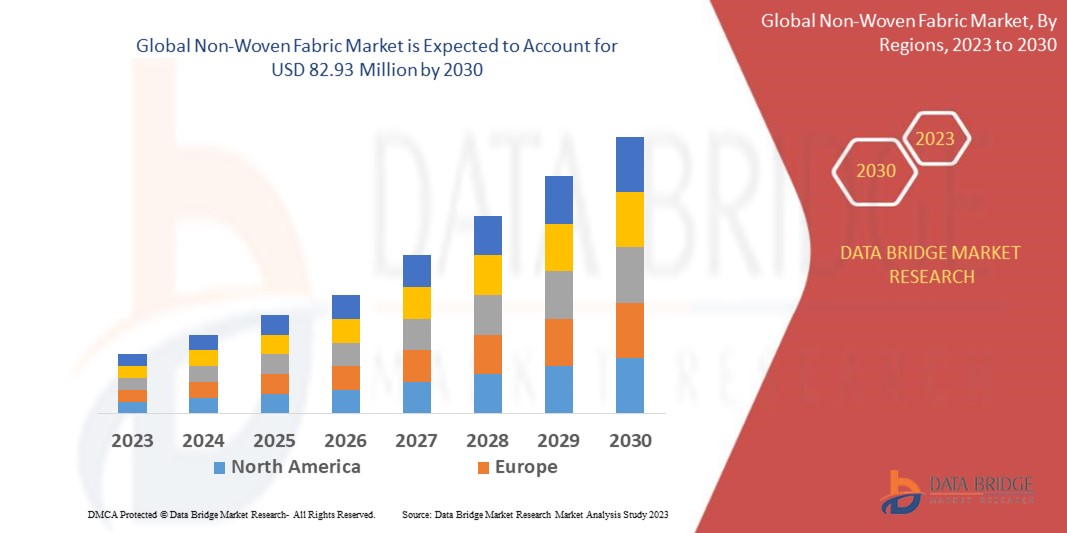
Data Bridge Market Research analyses that the global non-woven fabric market which was USD 46.74 million in 2022, is expected to reach USD 82.93 million by 2030, and is expected to undergo a CAGR of 7.43% during the forecast period of 2023 to 2030. “Spunlaid” dominates the type segment of the global non-woven fabric market due to versatility, cost-efficiency, and wide applications. In addition to the insights on market scenarios such as market value, growth rate, segmentation, geographical coverage, and major players, the market reports curated by the Data Bridge Market Research also include in-depth expert analysis, geographically represented company-wise production and capacity, network layouts of distributors and partners, detailed and updated price trend analysis and deficit analysis of supply chain and demand.
Non-Woven Fabric Market Scope and Segmentation
|
Report Metric |
Details |
|
Forecast Period |
2023 to 2030 |
|
Base Year |
2022 |
|
Historic Years |
2021 (Customizable to 2015-2020) |
|
Quantitative Units |
Revenue in USD Million, Pricing in USD |
|
Segments Covered |
Technology (Spunlaid, Drylaid, Wetlaid, Others), Material (Polypropylene (PP), Polyethylene Terephthalate (PET), Polyethylene (PE), Rayon, Wood Pulp, Bi-Component (BICO), Others), Layer (Single-layer, Multilayer), Function (Disposable, Non-Disposable), Application (Construction, Textile, Personal Care, Filtration, Others) |
|
Countries Covered |
U.S., Canada and Mexico in North America, Germany, France, U.K., Netherlands, Switzerland, Belgium, Russia, Italy, Spain, Turkey, Rest of Europe in Europe, China, Japan, India, South Korea, Singapore, Malaysia, Australia, Thailand, Indonesia, Philippines, Rest of Asia-Pacific , Saudi Arabia, U.A.E., South Africa, Egypt, Israel, Rest of Middle East and Africa, Brazil, Argentina and Rest of South America. |
|
Market Players Covered |
Kimberly-Clark Corporation (U.S.) DuPont de Nemours, Inc. (U.S.), Berry Global Group, Inc. (U.S.), Ahlstrom-Munksjö (Finland), Fitesa (Brazil), Freudenberg Group (Germany), Suominen Corporation (Finland), Avgol Nonwovens (Israel), Toray Industries, Inc. (Japan), Fibertex Nonwovens A/S (Denmark), Mitsui Chemicals, Inc. (Japan), Asahi Kasei Corporation (Japan), Sandler AG (Germany) |
|
Market Opportunities |
|
Market Definition
Non-woven fabrics are textile such as materials formed through various production methods, such as fiber entanglement in substances such as olefin, polyester, and rayon, along with chemical and thermal bonding. Unlike traditional textiles such as cotton, linen, wool, and silk, nonwoven materials do not necessitate weaving or knitting processes. They are lightweight and find applications in interlinings, insulation, protective clothing, industrial workwear, chemical defense suits, and footwear components.
Global Non-Woven Fabric Market Dynamics
Drivers
- Growing Hygiene and Healthcare Concerns
The global non-woven fabric market is being propelled by increasing awareness of hygiene and healthcare. Nonwoven fabrics are extensively used in medical and personal care products such as surgical masks, diapers, and feminine hygiene products due to their superior absorption, softness, and barrier properties. The ongoing emphasis on health and hygiene, particularly in the wake of the COVID-19 pandemic, is driving the demand for nonwoven materials
- Sustainability and Environmental Concerns
The rising environmental consciousness, there is a growing preference for sustainable and eco-friendly materials. Nonwoven fabrics, when produced using recycled materials or biodegradable fibers, offer a more sustainable alternative to traditional textiles. This eco-friendly aspect is attracting both consumers and industries, contributing to the expansion of the non-woven fabric market
Opportunities
- Innovative Product Development
The non-woven fabric market offers opportunities for innovation in terms of developing new applications and products. Advanced nonwoven materials with enhanced properties, such as improved filtration, durability, and breathability, can cater to emerging market needs, including filtration media, automotive components, and others
- Expanding Geographical Reach
As awareness of the benefits of nonwoven fabrics grows, there is room for expansion into new geographical regions. Developing economies with rising healthcare and hygiene demands present untapped opportunities for nonwoven fabric manufacturers to expand their market presence and meet evolving consumer needs
Restraints/Challenges
- Cost and Pricing Pressure
The production of nonwoven fabrics involves various processes and technologies, which can lead to relatively higher manufacturing costs compared to conventional textiles. These elevated costs can pose a restraint, especially in price-sensitive markets where consumers and manufacturers seek cost-effective solutions
- Raw Material Supply Chain Disruptions
The non-woven fabric industry heavily relies on a consistent and stable supply of raw materials, including synthetic fibers. Disruptions in the supply chain due to factors such as natural disasters or geopolitical tensions can lead to shortages and increased production costs, challenging the industry's stability
Recent Developments
- In August 2023, Toppan, Mitsui Chemicals Tohcello, and Mitsui Chemicals are starting pilot tests to horizontally recycle printed BOPP film into new flexible packaging. This collaborative effort seeks to establish recycling technologies and infrastructure
- In March 2023, Innovia Films, a leading producer of specialty BOPP and CPP films, is expanding its Leipzig, Germany unit with an 8.8-meter-wide co-extrusion line to meet sustainability-driven demand for thin gauge label films. This unique technology, boasting 36,000 tons of annual capacity, prioritizes energy efficiency and begins production in H2 2024
Global Non-Woven Fabric Market Scope
The global non-woven fabric market is segmented on the basis of technology, material, layer, function and application. The growth amongst these segments will help you analyze meagre growth segments in the industries and provide the users with a valuable market overview and market insights to help them make strategic decisions for identifying core market applications.
Technology
- Spunlaid
- Spunbond
- Polypropylene
- Polyester
- Polyethylene
- Biocomponent Fiber
- Spun Melt Spun
- Meltblown
- Drylaid
- Needlepunch
- Spunlace
- Thermal Bonded
- Thru Air
- Others
- Latex
- Airlaid
- Carded
- Wetlaid
- Others
Material
- Polypropylene (PP)
- Polyethylene Terephthalate (PET)
- Polyethylene (PE)
- Rayon
- Wood Pulp
- Bi-Component (BICO)
- Others
Layer
- Single-layer
- Multilayer
Function
- Disposable
- Non-Disposable
Application
- Construction
- Geotextile
- Wall Wraps
- Ground Covers
- Textile
- Furniture Fabrics
- Carpet
- Medical Protective Apparel
- Industrial Protective Apparel
- Personal Care
- Disposable Diapers
- Feminine Care Products
- Adult Incontinence
- Filtration
- Others
Global Non-woven Fabric Market Regional Analysis/Insights
The global non-woven fabric market is analyzed and market size insights and trends are provided by technology, material, layer, function, and application referenced above.
The countries covered in the global non-woven fabric market report are U.S., Canada and Mexico in North America, Germany, France, U.K., Netherlands, Switzerland, Belgium, Russia, Italy, Spain, Turkey, Rest of Europe in Europe, China, Japan, India, South Korea, Singapore, Malaysia, Australia, Thailand, Indonesia, Philippines, Rest of Asia-Pacific , Saudi Arabia, U.A.E., South Africa, Egypt, Israel, Rest of Middle East and Africa, Brazil, Argentina and Rest of South America
Asia-Pacific dominates the global non-woven fabric market due to manufacturing capacity, and rising hygiene product demand.
The country section of the report also provides individual market impacting factors and changes in regulation in the market domestically that impacts the current and future trends of the market. Data points such as down-stream and up-stream value chain analysis, technical trends and porter's five forces analysis, case studies are some of the pointers used to forecast the market scenario for individual countries. Also, the presence and availability of global brands and their challenges faced due to large or scarce competition from local and domestic brands, impact of domestic tariffs and trade routes are considered while providing forecast analysis of the country data.
Competitive Landscape and Global Non-Woven Fabric Market Share Analysis
The global non-woven fabric market competitive landscape provides details by competitor. Details included are company overview, company financials, revenue generated, market potential, investment in research and development, new market initiatives, global presence, production sites and facilities, production capacities, company strengths and weaknesses, product launch, product width and breadth, application dominance. The above data points provided are only related to the company’s focus related to global non-woven fabric market.
Some of the major players operating in the global non-woven fabric market are:
- Kimberly-Clark Corporation (U.S.)
- DuPont de Nemours, Inc. (U.S.)
- Berry Global Group, Inc. (U.S.)
- Ahlstrom-Munksjö (Finland)
- Fitesa (Brazil)
- Freudenberg Group (Germany)
- Suominen Corporation (Finland)
- Avgol Nonwovens (Israel)
- Toray Industries, Inc. (Japan)
- Fibertex Nonwovens A/S (Denmark)
- Mitsui Chemicals, Inc. (Japan)
- Asahi Kasei Corporation (Japan)
- Sandler AG (Germany)
SKU-
Получите онлайн-доступ к отчету на первой в мире облачной платформе рыночной аналитики

- Интерактивная панель анализа данных
- Панель анализа компании для возможностей с высоким потенциалом роста
- Доступ аналитика-исследователя для настройки и запросов
- Анализ конкурентов с помощью интерактивной панели
- Последние новости, обновления и анализ тенденций
- Используйте возможности сравнительного анализа для комплексного отслеживания конкурентов
Методология исследования
Сбор данных и анализ базового года выполняются с использованием модулей сбора данных с большими размерами выборки. Этап включает получение рыночной информации или связанных данных из различных источников и стратегий. Он включает изучение и планирование всех данных, полученных из прошлого заранее. Он также охватывает изучение несоответствий информации, наблюдаемых в различных источниках информации. Рыночные данные анализируются и оцениваются с использованием статистических и последовательных моделей рынка. Кроме того, анализ доли рынка и анализ ключевых тенденций являются основными факторами успеха в отчете о рынке. Чтобы узнать больше, пожалуйста, запросите звонок аналитика или оставьте свой запрос.
Ключевой методологией исследования, используемой исследовательской группой DBMR, является триангуляция данных, которая включает в себя интеллектуальный анализ данных, анализ влияния переменных данных на рынок и первичную (отраслевую экспертную) проверку. Модели данных включают сетку позиционирования поставщиков, анализ временной линии рынка, обзор рынка и руководство, сетку позиционирования компании, патентный анализ, анализ цен, анализ доли рынка компании, стандарты измерения, глобальный и региональный анализ и анализ доли поставщика. Чтобы узнать больше о методологии исследования, отправьте запрос, чтобы поговорить с нашими отраслевыми экспертами.
Доступна настройка
Data Bridge Market Research является лидером в области передовых формативных исследований. Мы гордимся тем, что предоставляем нашим существующим и новым клиентам данные и анализ, которые соответствуют и подходят их целям. Отчет можно настроить, включив в него анализ ценовых тенденций целевых брендов, понимание рынка для дополнительных стран (запросите список стран), данные о результатах клинических испытаний, обзор литературы, обновленный анализ рынка и продуктовой базы. Анализ рынка целевых конкурентов можно проанализировать от анализа на основе технологий до стратегий портфеля рынка. Мы можем добавить столько конкурентов, о которых вам нужны данные в нужном вам формате и стиле данных. Наша команда аналитиков также может предоставить вам данные в сырых файлах Excel, сводных таблицах (книга фактов) или помочь вам в создании презентаций из наборов данных, доступных в отчете.











