What is the Insulation Market Size and Growth Rate?
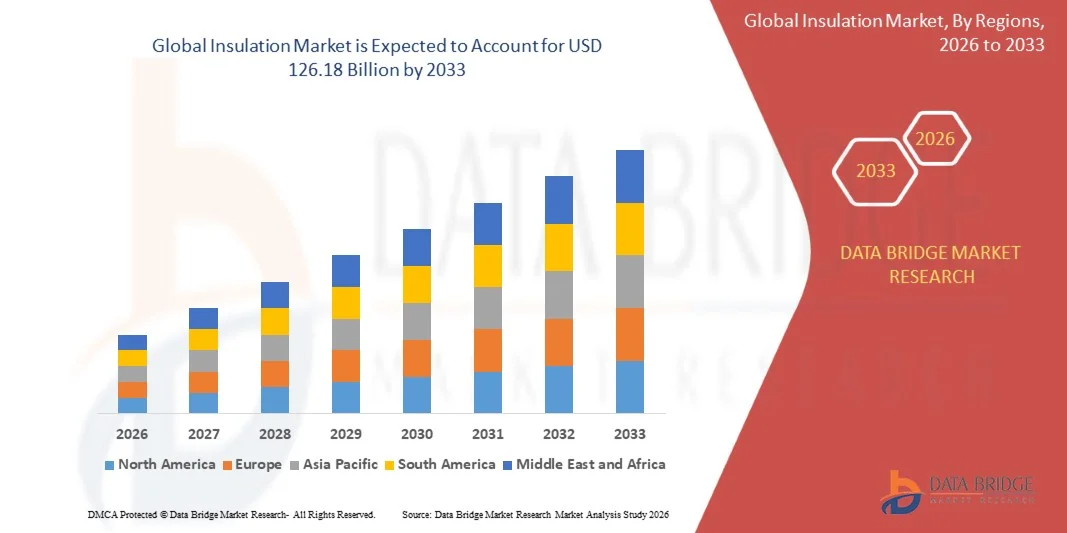
- As per Data Bridge Market Research analysis, the insulation market was valued at USD 75.11 billion in 2025 and is projected to reach USD 126.18 billion by 2033, growing at a CAGR of 6.70% from 2026 to 2033.
- The market is experiencing consistent growth driven by rising demand for energy-efficient buildings, increasing construction and infrastructure development, stringent energy conservation regulations, and growing adoption of advanced thermal and acoustic insulation materials across industrial and commercial applications.
- The increasing focus on reducing energy consumption and carbon emissions, combined with rapid urbanization and industrialization, is compelling building owners, manufacturers, and infrastructure developers to adopt high-performance insulation solutions. Glass wool, mineral wool, expanded polystyrene, and other advanced insulation materials are increasingly being used to minimize heat transfer, improve energy efficiency, and reduce heating and cooling requirements across residential, commercial, and industrial environments.
Market Size & Forecast
- Global Market Value (2025): USD 75.11 Billion
- Expected Market Value (2033): USD 126.18 Billion
- Forecast CAGR (2026–2033): 6.70%
- Leading Region in 2025: North America
- Fastest Growing Region: Asia Pacific
What are the Major Takeaways of the Insulation Market?
- North America dominated the insulation market with the largest revenue share of 35.8% in 2025, supported by stringent energy-efficiency standards, renovation activity, and increasing demand for high-performance insulation across residential and commercial buildings.
- Asia-Pacific is expected to be the fastest-growing region at a CAGR of 7.5% from 2026 to 2033, fueled by rapid urbanization, expanding construction activity, infrastructure investments, and rising adoption of energy-efficient building materials.
- The expanded polystyrene segment led the market with a 38.1% share in 2025, driven by its lightweight nature, cost-effectiveness, and excellent thermal resistance.
- Glass wool are the fastest-growing product type, projected to register a CAGR of 6.8%, reflecting the surge in demand for thermal and acoustic insulation solutions.
- The thermal segment dominated the function category with a 70% revenue share in 2025, led by its extensive use for reducing heat transfer across buildings, industrial systems, pipelines, and equipment
- Blanket accounted for 40% of the market share in 2025, preferred by its widespread use in residential walls, attics, floors, ceilings, and HVAC systems
- The HVAC & OEM segment is the fastest-growing application category, with a CAGR of 7.0%, driven by increasing deployment of energy-efficient heating, ventilation, air-conditioning, refrigeration, and equipment systems.
Report Scope and Insulation Market Segmentation
|
Attributes |
Insulation Key Market Insights |
|
Segments Covered |
|
|
Countries Covered |
North America
Europe
Asia-Pacific
Middle East and Africa
South America
|
|
Key Market Players |
|
|
Market Opportunities |
|
|
Value Added Data Infosets |
In addition to the insights on market scenarios such as market value, growth rate, segmentation, geographical coverage, and major players, the market reports curated by the Data Bridge Market Research also include import export analysis, production capacity overview, production consumption analysis, price trend analysis, climate change scenario, supply chain analysis, value chain analysis, raw material/consumables overview, vendor selection criteria, PESTLE Analysis, Porter Analysis, and regulatory framework. |
What is the Key Trend in the Insulation Market?
- Manufacturers are increasingly shifting toward sustainable, recycled, and low-carbon insulation materials to reduce the environmental impact of construction, improve resource efficiency, and meet increasingly stringent energy-performance and decarbonization requirements across buildings.
- For instance, in May 2025, Saint-Gobain launched its FutuRE program in Indonesia, highlighting sustainable construction solutions including low-carbon insulation systems, recycled-material products, and recycling services to support more responsible construction practices.
- Circularity is becoming increasingly important as manufacturers seek to recover insulation waste, reduce dependence on virgin resources, and develop closed-loop material flows for mineral wool, fiberglass, EPS, and other insulation products.
- Building owners and developers are also increasingly evaluating insulation materials based on thermal performance, recycled content, embodied carbon, fire performance, and lifecycle sustainability, rather than focusing solely on initial installation costs.
- For instance, in July 2025, Knauf Insulation officially opened a Rock Mineral Wool manufacturing plant in Tashkent, Uzbekistan, with an annual production capacity of 30,000 tonnes, designed to supply high-performance, non-combustible insulation for energy-efficient buildings and support the country's green-building transition.
- As construction industries increasingly prioritize decarbonization and resource efficiency, the development of recyclable, bio-based, and low-carbon insulation materials is expected to accelerate, strengthening sustainability as a central direction in insulation product development.
What are the Key Drivers of the Insulation Market?
- The rapid expansion of energy-efficiency requirements and building decarbonization initiatives is increasing demand for high-performance insulation that reduces heating and cooling requirements, lowers energy consumption, and improves the overall efficiency of building envelopes.
- For instance, in June 2025, the European Commission issued implementation guidance for the revised Energy Performance of Buildings Directive, which aims to accelerate building renovation and establish a zero-emission building stock by 2050; the directive also targets a 16% reduction in average residential building energy use by 2030 compared with 2020.
- Building renovation and retrofitting programs are creating additional demand for wall, roof, floor, and envelope insulation, particularly as governments and property owners seek to improve the energy performance of aging building stocks and reduce long-term operating costs.
- For instance, in February 2025, an EU-supported technical initiative highlighted prefabricated panel insulation as a faster renovation approach for improving building-envelope performance, with the technology designed to reduce energy consumption and heating costs during building upgrades.
- With buildings accounting for a substantial share of global energy consumption and governments strengthening energy-performance standards, insulation is becoming an increasingly important component of energy-efficient construction, renovation, and decarbonization strategies across residential, commercial, and industrial applications
Which Factors are Challenging the Growth of the Insulation Market?
- The shortage of skilled insulation and construction workers is creating implementation constraints because effective insulation installation requires trained personnel to achieve appropriate coverage, airtightness, thermal performance, and compliance with building standards.
- For instance, in October 2024, the International Energy Agency reported that many countries were experiencing labor shortages across energy-efficiency occupations, including insulation workers, while noting that the building sector would need to create approximately 1.3 million additional energy-efficiency jobs over the following six years in its net-zero scenario.
- These workforce limitations can delay renovation programs and increase installation costs, particularly in markets where governments are simultaneously targeting large-scale building retrofits and energy-efficiency improvements.
- The shortage is particularly significant in European renovation markets, where large numbers of inefficient buildings require upgrades but the availability of qualified workers remains insufficient to meet planned renovation volumes.
- For instance, in October 2024, the European Climate, Infrastructure and Environment Executive Agency reported an annual shortfall of 13,600 construction workers in Hungary and identified a requirement for 430,000 skilled workers in France by 2030 to renovate more than 900,000 residential buildings.
- Persistent labor shortages, combined with the technical requirements of insulation installation and the need for qualified contractors, can increase project timelines and costs, limiting the pace of insulation deployment despite strong demand from energy-efficiency and building-renovation initiatives.
How is the Insulation Market Segmented?
The insulation market is segmented on the basis of product, function, form, and application.
- By Product
On the basis of product, the insulation market is segmented into expanded polystyrene, glass wool, mineral wool, cellulose, calcium silicate, and others. The expanded polystyrene segment dominated the market with a 38.1% share in 2025, owing to its lightweight nature, cost-effectiveness, and excellent thermal resistance. EPS is widely used across residential and commercial buildings for walls, roofs, and floors. Its moisture resistance and compressive strength make it suitable for applications requiring durable insulation performance. The material is also relatively easy to transport, handle, and install, supporting adoption across large construction projects. Growing construction activity and demand for energy-efficient building envelopes are further supporting EPS consumption.
The glass wool segment is projected to register the fastest growth at a CAGR of 6.8% during forecast period, driven by increasing demand for thermal and acoustic insulation solutions. Glass wool provides effective thermal resistance while also offering sound absorption and fire-resistance properties. It is widely used in residential and commercial buildings, particularly in walls, ceilings, partitions, and HVAC systems. Increasing energy-efficiency requirements are encouraging the adoption of materials that reduce heat transfer and heating and cooling requirements. Its recyclability and growing use of recycled materials are also improving its sustainability profile. Rising demand for safer and more energy-efficient buildings is further supporting its adoption.
- By Function
On the basis of function, the insulation market is segmented into thermal, acoustic, electric, and others. The thermal insulation segment dominated the market with 70% share in 2025, supported by its extensive use for reducing heat transfer across buildings, industrial systems, pipelines, and equipment. Thermal insulation is widely adopted to reduce heating and cooling requirements and improve overall energy efficiency. It is extensively incorporated into walls, roofs, floors, ducts, pipes, refrigeration systems, and industrial equipment. Increasing energy costs and stricter energy-efficiency requirements are encouraging building owners and industrial operators to improve thermal performance. The segment benefits from applications across residential, commercial, infrastructure, and industrial environments.
The acoustic insulation segment is projected to register the fastest growth at CAGR of 7.0% during forecast period, driven by increasing demand for noise-control solutions across residential, commercial, industrial, and transportation environments. Acoustic insulation helps reduce airborne and impact noise and improves indoor comfort. Rapid urbanization is increasing exposure to traffic, construction, industrial, and neighborhood noise, encouraging greater adoption of sound-control materials. Modern buildings are increasingly designed around occupant comfort and improved indoor environmental quality. Glass wool and mineral wool are widely used for acoustic applications because of their sound-absorption characteristics. Increasing building-performance requirements are also encouraging the integration of acoustic insulation during new construction and renovation.
- By Form
On the basis of form, the insulation market is segmented into blanket, foam, board, and pipe. The blanket segment dominated the market with 40% share in 2025, supported by its widespread use in residential walls, attics, floors, ceilings, and HVAC systems. Blanket insulation offers flexibility and can be installed across relatively large surface areas. Its simple handling and installation characteristics make it suitable for both new construction and renovation projects. Fiberglass and mineral wool are commonly supplied in blanket or batt formats for building applications. The availability of different thicknesses and thermal-performance levels allows products to meet diverse insulation requirements. Increasing residential construction and retrofitting activity continues to support demand for blanket insulation.
The foam segment is projected to register the fastest growth at CAGR of 6.4% during forecast period, driven by rising demand for high-performance insulation in energy-efficient building envelopes. Foam products provide strong thermal resistance and can help minimize heat transfer through walls, roofs, floors, and foundations. Rigid foam boards are increasingly used where high thermal performance is required within a limited installation thickness. Their moisture-control and dimensional-stability characteristics also support adoption in demanding construction applications. Increasing use of external insulation systems and advanced foam materials is expanding the application base. Regulatory pressure for improved building energy performance is further encouraging the use of high-efficiency insulation
- By Application
On the basis of application, the insulation market is segmented into residential construction, industrial, HVAC & OEM, and non-residential construction. The residential construction segment dominated the market with 30% share in 2025, supported by extensive insulation requirements in walls, roofs, attics, floors, and foundations. Increasing residential construction activity is generating sustained demand for thermal and acoustic insulation materials. Energy-efficiency requirements are encouraging developers and homeowners to incorporate insulation into new buildings and renovation projects. Insulation improves building-envelope performance and can reduce heating and cooling requirements. Growing awareness of indoor comfort and energy conservation is also supporting residential adoption. Government initiatives promoting efficient buildings and residential energy conservation are further contributing to demand.
The HVAC & OEM segment is projected to register the fastest growth at CAGR of 7.0% during forecast period, driven by increasing deployment of energy-efficient heating, ventilation, air-conditioning, refrigeration, and equipment systems. Insulation is important in HVAC applications for minimizing thermal losses, controlling condensation, and maintaining desired temperatures. Growing demand for air-conditioning and refrigeration equipment in emerging economies is expanding the requirement for specialized insulation solutions. Increasing energy-efficiency requirements are encouraging OEMs to improve insulation around ducts, pipes, chillers, compressors, and other equipment components. Demand for temperature-controlled environments in healthcare, food processing, cold-chain logistics, and data centers is creating additional applications. Industrial and commercial facilities are also upgrading HVAC systems to reduce energy consumption and operating costs.
Which Region Holds the Largest Share of the Insulation Market?
- North America dominated the insulation market with the largest revenue share of 35.8% in 2025, supported by stringent energy-efficiency standards, renovation activity, and increasing demand for high-performance insulation across residential and commercial buildings.
- The region also benefits from increasing adoption of energy-efficient building materials, government initiatives supporting building decarbonization, and growing insulation demand across infrastructure, industrial, and HVAC applications. Rising investments in sustainable construction and improvements to aging building stock continue to strengthen North America’s position in the global insulation market.
U.S. Insulation Market Insight
The U.S. insulation market is witnessing strong growth due to rising investments in energy-efficient buildings, residential renovation, and building energy-performance improvements. The country’s mature construction sector, along with increasing adoption of advanced thermal and acoustic insulation materials, is driving demand across residential, commercial, industrial, and HVAC applications. In addition, growing emphasis on reducing building energy consumption and improving energy efficiency is accelerating insulation adoption across new construction and retrofit projects.
Asia-Pacific Insulation Market Insight
The Asia-Pacific insulation market is expected to witness rapid growth, driven by increasing urbanization, expanding construction activities, and rising investments in energy-efficient buildings across countries such as China, India, and Japan. Growing awareness regarding energy conservation, rising adoption of advanced insulation materials, and increasing demand for sustainable construction solutions are supporting regional market expansion. In addition, the growing focus on improving building energy performance and reducing energy consumption is accelerating insulation adoption across residential, industrial, and commercial sectors.
Japan Insulation Market Insight
The Japan insulation market is witnessing consistent growth due to rising investments in energy-efficient buildings, building modernization, and advanced construction materials. Residential and commercial construction projects are increasingly emphasizing improved thermal performance and reduced energy consumption, supporting demand for high-performance insulation solutions. Moreover, increasing focus on energy-efficient building practices and the modernization of existing properties is further contributing to market growth across residential and non-residential applications.
China Insulation Market Insight
The China insulation market is growing rapidly, driven by increasing urbanization, expanding construction activities, and rising government focus on improving building energy efficiency. Growing adoption of thermal insulation materials across residential, commercial, and industrial buildings is significantly boosting market demand. In addition, continued efforts to improve the energy performance of buildings and expand energy-saving measures are supporting insulation adoption, positioning China as an important growth market for insulation solutions.
U.K. Insulation Market Insight
The U.K. insulation market is experiencing steady growth, supported by rising adoption of energy-efficiency measures, residential retrofit programs, and demand for improved building performance. Government initiatives such as the Great British Insulation Scheme have supported insulation improvements in less energy-efficient homes, while continued emphasis on reducing household energy consumption is contributing to market demand. Furthermore, the scheme included measures such as cavity-wall insulation, supporting the wider adoption of insulation solutions across residential properties.
Germany Insulation Market Insight
The Germany insulation market is expanding steadily due to the country’s strong focus on energy-efficient construction, building modernization, and decarbonization of the building sector. Increasing adoption of energy-efficient building measures, including improved wall insulation, is supporting demand across residential and non-residential construction. Furthermore, government-backed programs for climate-friendly construction and energy-efficient building modernization are encouraging improvements in building performance and supporting the adoption of advanced insulation solutions.
Which are the Top Companies in Insulation Market?
The insulation industry is primarily led by well-established companies, including:
- Owens Corning (U.S.)
- ROCKWOOL A/S (Denmark)
- Knauf Insulation (Germany)
- Saint-Gobain (France)
- Kingspan Group (Ireland)
- Armacell (Luxembourg)
- Recticel NV (Belgium)
- STEICO SE (Germany)
- SOPREMA S.A.S. (France)
- BASF (Germany)
- DuPont de Nemours, Inc. (U.S.)
- Evonik Industries AG (Germany)
- Covestro AG (Germany)
- Huntsman International LLC (U.S.)
- Carlisle Companies Incorporated (U.S.)
- GAF (U.S.)
- Aspen Aerogels, Inc. (U.S.)
- Thermaflex International Holding B.V. (Netherlands)
- NMC sa (Belgium)
- Dow (U.S.)
What are Latest Developments in Insulation Market?
- In April 2025, Armacell launched ArmaGel XGC, a next-generation cryogenic and dual-temperature aerogel insulation blanket, designed to provide high thermal performance while improving worker safety through proprietary low-dust technology. The product is manufactured in China, with additional production commencing at Armacell’s new facility in India, strengthening the company’s global supply capabilities for industrial and energy applications.
- In May 2024, Knauf Insulation announced the launch of its new Performance+ fiberglass insulation portfolio for HVAC applications, introducing a product line designed to improve indoor environmental quality and installation performance. The portfolio became the first HVAC fiberglass insulation line from the company to receive Asthma & Allergy Friendly certification and was developed without formaldehyde, supporting growing demand for healthier and high-performance insulation solutions.
- In January 2023, Owens Corning highlighted its expanded insulation portfolio at the International Builders’ Show, including the launch of spray foam insulation products following its acquisition of Natural Polymers. The company showcased Ultra-Pure low-VOC spray foam with Odor Scavenger technology alongside fiberglass, mineral wool, loosefill, and foam board insulation products, strengthening its portfolio of energy-efficient building insulation solutions.
- In August 2022, Knauf Insulation officially opened its first manufacturing plant in Malaysia, expanding its production capabilities for glass mineral wool insulation in the Asia-Pacific region. The Johor facility was developed to serve growing regional demand for insulation solutions and supports applications across residential and non-residential buildings, strengthening the company’s presence in the Asia-Pacific insulation market.
- In September 2021, CertainTeed introduced InsulPure Fiberglass Building Insulation, expanding its high-performance insulation portfolio with a new fiberglass binder formulation designed to improve product performance, handling, and installation. The product incorporated recycled content and was developed to provide thermal and acoustic performance while supporting green-building requirements and improved installation efficiency.

- Interactive Data Analysis Dashboard
- Company Analysis Dashboard for high growth potential opportunities
- Research Analyst Access for customization & queries
- Competitor Analysis with Interactive dashboard
- Latest News, Updates & Trend analysis
- Harness the Power of Benchmark Analysis for Comprehensive Competitor Tracking
Global Insulation Market, Supply Chain Analysis and Ecosystem Framework
To support market growth and help clients navigate the impact of geopolitical shifts, DBMR has integrated in-depth supply chain analysis into its Global Insulation Market research reports. This addition empowers clients to respond effectively to global changes affecting their industries. The supply chain analysis section includes detailed insights such as Global Insulation Market consumption and production by country, price trend analysis, the impact of tariffs and geopolitical developments, and import and export trends by country and HSN code. It also highlights major suppliers with data on production capacity and company profiles, as well as key importers and exporters. In addition to research, DBMR offers specialized supply chain consulting services backed by over a decade of experience, providing solutions like supplier discovery, supplier risk assessment, price trend analysis, impact evaluation of inflation and trade route changes, and comprehensive market trend analysis.
Data collection and base year analysis are done using data collection modules with large sample sizes. The stage includes obtaining market information or related data through various sources and strategies. It includes examining and planning all the data acquired from the past in advance. It likewise envelops the examination of information inconsistencies seen across different information sources. The market data is analysed and estimated using market statistical and coherent models. Also, market share analysis and key trend analysis are the major success factors in the market report. To know more, please request an analyst call or drop down your inquiry.
The key research methodology used by DBMR research team is data triangulation which involves data mining, analysis of the impact of data variables on the market and primary (industry expert) validation. Data models include Vendor Positioning Grid, Market Time Line Analysis, Market Overview and Guide, Company Positioning Grid, Patent Analysis, Pricing Analysis, Company Market Share Analysis, Standards of Measurement, Global versus Regional and Vendor Share Analysis. To know more about the research methodology, drop in an inquiry to speak to our industry experts.
Data Bridge Market Research is a leader in advanced formative research. We take pride in servicing our existing and new customers with data and analysis that match and suits their goal. The report can be customized to include price trend analysis of target brands understanding the market for additional countries (ask for the list of countries), clinical trial results data, literature review, refurbished market and product base analysis. Market analysis of target competitors can be analyzed from technology-based analysis to market portfolio strategies. We can add as many competitors that you require data about in the format and data style you are looking for. Our team of analysts can also provide you data in crude raw excel files pivot tables (Fact book) or can assist you in creating presentations from the data sets available in the report.