Global Respiratory Distress Syndrome Treatment Market Segmentation, By Treatment (Medication, Therapy, and Others), Route of Administration (Parenteral, Inhalation, and Others), End-Users (Hospitals, Homecare, Speciality Centres, and Others), Distribution Channel (Hospital Pharmacy, Online Pharmacy, and Retail Pharmacy)- Industry Trends and Forecast to 2033
Respiratory Distress Syndrome Treatment Market Size
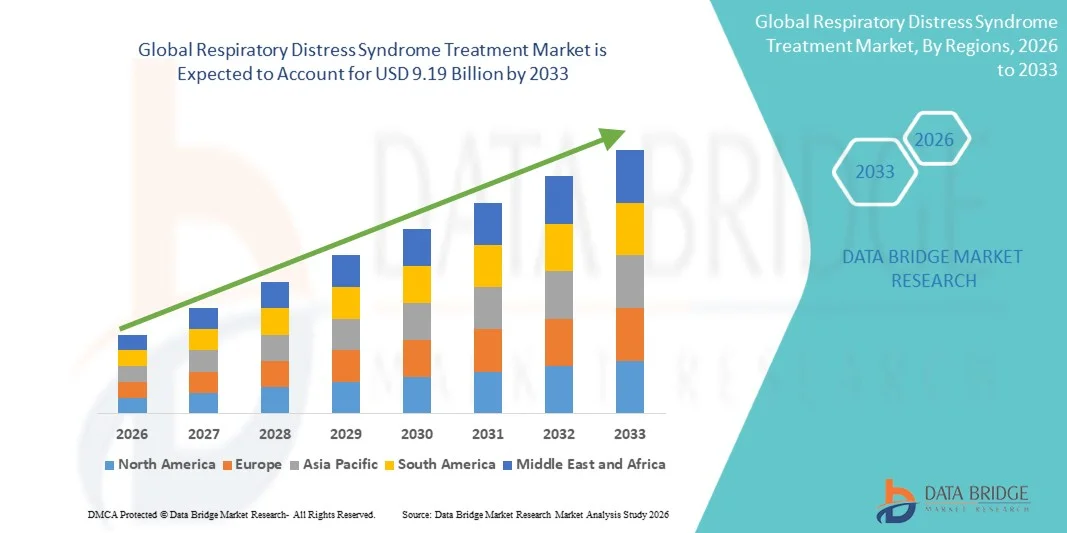
- The global respiratory distress syndrome treatment market size was valued at USD 4.79 billion in 2025 and is expected to reach USD 9.19 billion by 2033, at a CAGR of 8.5% during the forecast period
- The market growth is largely fueled by the increasing prevalence of neonatal respiratory distress syndrome and acute respiratory distress syndrome (ARDS), along with continuous advancements in critical care infrastructure and respiratory therapies, leading to improved diagnosis and treatment outcomes across healthcare settings
- Furthermore, rising demand for effective surfactant therapies, advanced ventilation systems, and supportive care solutions, coupled with growing awareness and healthcare investments, is establishing RDS treatment as a critical component of modern intensive care. These converging factors are accelerating the adoption of advanced treatment approaches, thereby significantly boosting the industry's growth
Respiratory Distress Syndrome Treatment Market Analysis
- Respiratory distress syndrome treatment, comprising medications, therapeutic interventions, and supportive care, plays a critical role in neonatal and intensive care settings, as it is essential for managing severe respiratory complications in premature infants and patients suffering from acute respiratory distress syndrome (ARDS)
- The escalating demand for respiratory distress syndrome treatment is primarily fueled by the rising incidence of preterm births, increasing prevalence of respiratory disorders, and continuous advancements in treatment modalities, along with improved access to neonatal and critical care services across healthcare systems
- North America dominated the respiratory distress syndrome treatment market with the largest revenue share of around 38.5% in 2025, characterized by advanced healthcare infrastructure, high healthcare expenditure, and strong adoption of innovative medications and respiratory therapies, with the U.S. witnessing significant utilization of respiratory distress syndrome treatment solutions in neonatal intensive care units
- Asia-Pacific is expected to be the fastest growing region in the respiratory distress syndrome treatment market during the forecast period due to improving healthcare infrastructure, rising awareness regarding neonatal care, and increasing investments in healthcare across emerging economies such as China and India
- Medication segment dominated the respiratory distress syndrome treatment market with a market share of 44.6% in 2025, driven by the widespread use of surfactants, corticosteroids, and other pharmacological treatments that are considered first-line therapies for managing respiratory distress conditions
Report Scope and Respiratory Distress Syndrome Treatment Market Segmentation
|
Attributes |
Respiratory Distress Syndrome Treatment Key Market Insights |
|
Segments Covered |
|
|
Countries Covered |
North America
Europe
Asia-Pacific
Middle East and Africa
South America
|
|
Key Market Players |
|
|
Market Opportunities |
|
|
Value Added Data Infosets |
In addition to the insights on market scenarios such as market value, growth rate, segmentation, geographical coverage, and major players, the market reports curated by the Data Bridge Market Research also include in-depth expert analysis, patient epidemiology, pipeline analysis, pricing analysis, and regulatory framework |
Respiratory Distress Syndrome Treatment Market Trends
“Advancements in Surfactant Therapy and Respiratory Support Technologies”
- A significant and accelerating trend in the global respiratory distress syndrome treatment market is the continuous advancement in surfactant therapies and respiratory support technologies such as non-invasive ventilation and high-frequency oscillatory ventilation. This combination of innovations is significantly improving patient survival rates and clinical outcomes
- For instance, poractant alfa and beractant are widely used surfactant therapies that enhance lung function in premature infants, while advanced ventilators provide precise oxygen delivery and pressure control in critical care settings. Similarly, newer aerosolized surfactant delivery methods are being explored to reduce invasiveness
- Technological integration in respiratory distress syndrome treatment enables features such as improved drug delivery systems and patient monitoring, leading to optimized treatment protocols and better patient management. For instance, modern ventilators utilize smart monitoring systems to adjust oxygen flow and pressure based on patient response in real time. Furthermore, non-invasive respiratory support offers patients reduced complications and improved comfort during treatment
- The integration of advanced treatment solutions with neonatal and intensive care infrastructure facilitates centralized patient monitoring and coordinated care delivery. Through integrated ICU systems, healthcare providers can manage respiratory support alongside other critical parameters, creating a more efficient and responsive care environment
- This trend towards more precise, efficient, and patient-centric treatment approaches is fundamentally reshaping clinical practices in respiratory care. Consequently, companies such as Chiesi Farmaceutici and Vyaire Medical are developing advanced respiratory solutions with improved drug formulations and intelligent ventilation systems for enhanced treatment outcomes
- The demand for respiratory distress syndrome treatment solutions that offer improved efficacy and advanced respiratory support is growing rapidly across hospitals and neonatal care units, as healthcare providers increasingly prioritize better patient outcomes and reduced mortality rates
- The increasing adoption of minimally invasive and non-invasive treatment approaches is further shaping the market, as healthcare providers seek to reduce complications, shorten hospital stays, and enhance patient recovery outcomes
Respiratory Distress Syndrome Treatment Market Dynamics
Driver
“Rising Incidence of Preterm Births and Increasing Demand for Critical Care Solutions”
- The increasing incidence of preterm births and the growing burden of respiratory disorders, coupled with advancements in neonatal and critical care, is a significant driver for the heightened demand for respiratory distress syndrome treatment
- For instance, in March 2024, Chiesi Farmaceutici expanded its neonatal care portfolio with enhanced surfactant therapies aimed at improving outcomes in premature infants. Such strategies by key companies are expected to drive the respiratory distress syndrome treatment market growth in the forecast period
- As healthcare systems become more focused on reducing neonatal mortality and improving critical care outcomes, respiratory distress syndrome treatment offers essential solutions such as surfactant replacement therapy, oxygen support, and mechanical ventilation, providing a strong clinical value over conventional care approaches
- Furthermore, the increasing investments in healthcare infrastructure and the expansion of neonatal intensive care units are making respiratory distress syndrome treatment a critical component of modern healthcare systems, supporting early diagnosis and timely intervention
- The growing emphasis on early-stage treatment, improved access to healthcare services, and the adoption of advanced respiratory support technologies are key factors propelling the demand for respiratory distress syndrome treatment across hospitals and specialty care centers. The trend towards technological integration in ICUs and enhanced treatment protocols further contributes to market growth
- Increasing government initiatives and healthcare policies focused on reducing infant mortality rates are further supporting the adoption of respiratory distress syndrome treatment across both developed and developing regions
- The rising awareness among healthcare professionals and caregivers regarding early diagnosis and timely treatment is also accelerating the demand for advanced respiratory distress syndrome treatment solutions
Restraint/Challenge
“High Treatment Costs and Limited Access in Developing Regions”
- The high cost associated with advanced respiratory distress syndrome treatment and limited access to specialized neonatal care facilities pose a significant challenge to broader market expansion. As these treatments require sophisticated equipment and skilled professionals, accessibility remains uneven across regions, raising concerns among healthcare providers and patients
- For instance, limited availability of neonatal intensive care units and high-cost ventilators in low- and middle-income countries has restricted access to effective respiratory distress syndrome treatment
- Addressing these challenges through cost-effective treatment solutions, government support, and expansion of healthcare infrastructure is crucial for improving accessibility. Companies such as GE HealthCare and Fisher & Paykel Healthcare are focusing on developing affordable respiratory support systems to cater to emerging markets. Additionally, the complexity of treatment procedures and requirement for trained professionals can act as a barrier in resource-limited settings, particularly in rural or underserved areas. While technological advancements continue, their adoption may be slower in regions with limited healthcare budgets
- While efforts are being made to improve accessibility, disparities in healthcare infrastructure and affordability can still hinder widespread adoption, especially in developing regions where advanced care facilities are limited
- Overcoming these challenges through increased healthcare investments, training programs for medical professionals, and the development of cost-efficient treatment options will be vital for sustained market growth
- Regulatory challenges and lengthy approval processes for new drugs and therapies can delay market entry, limiting the availability of innovative respiratory distress syndrome treatment options in certain regions
- Potential side effects and risks associated with certain treatments, including ventilator-induced lung injury and complications from prolonged oxygen therapy, may also restrict adoption and require careful clinical management
Respiratory Distress Syndrome Treatment Market Scope
The market is segmented on the basis of treatment, route of administration, end-users, and distribution channel.
- By Treatment
On the basis of treatment, the respiratory distress syndrome treatment market is segmented into medication, therapy, and others. The medication segment dominated the market with the largest revenue share of 44.6% in 2025, driven by the widespread use of surfactants, corticosteroids, and antibiotics as first-line interventions in both neonatal and acute respiratory distress cases. Medications play a critical role in stabilizing lung function and improving oxygenation, particularly in premature infants. The availability of clinically proven drug formulations and ongoing advancements in synthetic and recombinant surfactants further strengthen this segment’s dominance. Additionally, strong clinical guidelines supporting early pharmacological intervention and increasing accessibility to essential drugs across hospitals contribute to sustained demand. The segment also benefits from continuous research and development efforts aimed at enhancing drug efficacy and reducing side effects.
The therapy segment is anticipated to witness the fastest growth rate during the forecast period, fueled by increasing adoption of advanced respiratory support techniques such as mechanical ventilation, continuous positive airway pressure (CPAP), and extracorporeal membrane oxygenation (ECMO). These therapies are essential for managing severe cases where medication alone is insufficient. The growing emphasis on non-invasive ventilation and improved patient monitoring systems is further accelerating segment growth. Technological advancements in respiratory devices and increasing integration of smart ICU systems are enhancing treatment outcomes. Moreover, rising investments in critical care infrastructure and expanding ICU capacities globally are supporting the rapid adoption of therapeutic interventions.
- By Route of Administration
On the basis of route of administration, the respiratory distress syndrome treatment market is segmented into parenteral, inhalation, and others. The parenteral segment dominated the market with the largest revenue share in 2025, owing to its rapid onset of action and high bioavailability, which are crucial in emergency and critical care settings. Parenteral administration is widely used for delivering surfactants and other life-saving medications directly into the bloodstream, ensuring immediate therapeutic effects. Its reliability and effectiveness in neonatal intensive care units make it a preferred choice among healthcare professionals. Furthermore, the increasing number of hospital admissions for severe respiratory conditions and the need for precise dosing further drive the segment’s dominance. Continuous improvements in injectable drug formulations and delivery systems also contribute to its widespread adoption.
The inhalation segment is expected to witness the fastest growth rate during the forecast period, driven by its targeted drug delivery mechanism and reduced systemic side effects. Inhalation therapies allow direct delivery of medications to the lungs, enhancing treatment efficiency and patient comfort. Advancements in nebulizers and aerosol-based drug delivery systems are further supporting the growth of this segment. Additionally, the rising preference for non-invasive treatment approaches and increasing research into inhalable surfactants are boosting adoption. The segment is also benefiting from technological innovations that enable better drug deposition and improved patient compliance, particularly in pediatric and geriatric populations.
- By End-Users
On the basis of end-users, the respiratory distress syndrome treatment market is segmented into hospitals, homecare, speciality centres, and others. The hospitals segment dominated the market with the largest revenue share in 2025, attributed to the availability of advanced medical infrastructure, skilled healthcare professionals, and specialized neonatal and intensive care units. Hospitals are the primary point of care for severe respiratory distress cases, requiring continuous monitoring and advanced life-support systems. The high volume of patient admissions and access to comprehensive treatment options further strengthen this segment’s leadership. Additionally, increasing healthcare expenditure and government support for hospital-based care contribute to sustained growth. The presence of multidisciplinary teams and access to emergency care also make hospitals the preferred choice for RDS treatment.
The homecare segment is anticipated to witness the fastest growth rate during the forecast period, driven by the growing shift towards decentralized healthcare and the increasing adoption of portable respiratory support devices. Homecare settings offer cost-effective treatment options and improved patient comfort, particularly for long-term management of respiratory conditions. Advances in telemedicine and remote monitoring technologies are enabling effective patient supervision outside hospital environments. Additionally, the rising burden on hospital infrastructure and the need to reduce healthcare costs are encouraging the transition to home-based care. Increasing awareness and availability of user-friendly respiratory devices are further supporting the expansion of this segment.
- By Distribution Channel
On the basis of distribution channel, the respiratory distress syndrome treatment market is segmented into hospital pharmacy, online pharmacy, retail pharmacy. The hospital pharmacy segment dominated the market with the largest revenue share in 2025, driven by the high demand for immediate and reliable access to critical medications within hospital settings. Hospital pharmacies ensure the availability of specialized drugs and treatments required for emergency and intensive care. The strong integration of hospital pharmacies with clinical workflows and treatment protocols enhances efficiency and patient outcomes. Additionally, the growing number of hospital admissions and the need for continuous drug supply further support this segment’s dominance. Strict regulatory standards and quality assurance in hospital pharmacies also contribute to their leading position.
The online pharmacy segment is expected to witness the fastest growth rate during the forecast period, fueled by increasing digitalization in healthcare and the growing preference for convenient medication access. Online platforms offer a wide range of pharmaceutical products, competitive pricing, and home delivery services, making them an attractive option for patients and caregivers. The expansion of e-commerce infrastructure and rising internet penetration are further driving segment growth. Additionally, the integration of digital health platforms and teleconsultation services is enhancing the accessibility of prescribed medications. Increasing consumer awareness and acceptance of online healthcare solutions are expected to significantly boost this segment’s growth trajectory.
Respiratory Distress Syndrome Treatment Market Regional Analysis
- North America dominated the respiratory distress syndrome treatment market with the largest revenue share of around 38.5% in 2025, characterized by advanced healthcare infrastructure, high healthcare expenditure, and strong adoption of innovative medications and respiratory therapies
- Healthcare providers in the region highly prioritize the use of advanced surfactant therapies, respiratory support systems, and integrated ICU technologies to improve patient outcomes and survival rates
- This widespread adoption is further supported by well-established healthcare infrastructure, high healthcare expenditure, and a strong presence of leading pharmaceutical and medical device companies, establishing respiratory distress syndrome treatment as a critical component in both neonatal and intensive care settings
U.S. Respiratory Distress Syndrome Treatment Market Insight
The U.S. respiratory distress syndrome treatment market captured the largest revenue share within North America in 2025, fueled by the high incidence of preterm births and the strong presence of advanced neonatal and critical care infrastructure. Healthcare providers are increasingly prioritizing effective treatment solutions such as surfactant therapies and advanced ventilation systems to improve patient outcomes. The growing focus on reducing neonatal mortality, combined with robust healthcare spending and continuous technological advancements, further propels the respiratory distress syndrome treatment market. Moreover, the integration of advanced ICU technologies and improved clinical protocols is significantly contributing to the market's expansion.
Europe Respiratory Distress Syndrome Treatment Market Insight
The Europe respiratory distress syndrome treatment market is projected to expand at a substantial CAGR throughout the forecast period, primarily driven by well-established healthcare systems and increasing focus on neonatal care. The rise in preterm birth rates, coupled with strong government support for maternal and child healthcare, is fostering the adoption of advanced treatment solutions. European healthcare providers are also emphasizing early diagnosis and effective management of respiratory conditions. The region is experiencing significant growth across hospitals and specialty care centers, with respiratory distress syndrome treatment being incorporated into both existing and newly developed healthcare facilities.
U.K. Respiratory Distress Syndrome Treatment Market Insight
The U.K. respiratory distress syndrome treatment market is anticipated to grow at a noteworthy CAGR during the forecast period, driven by increasing awareness regarding neonatal health and the demand for advanced respiratory care solutions. Additionally, government initiatives aimed at improving healthcare services and reducing infant mortality rates are encouraging healthcare providers to adopt effective treatment options. The country’s strong healthcare infrastructure, alongside its focus on research and innovation in respiratory care, is expected to continue to stimulate market growth.
Germany Respiratory Distress Syndrome Treatment Market Insight
The Germany respiratory distress syndrome treatment market is expected to expand at a considerable CAGR during the forecast period, fueled by increasing investments in healthcare infrastructure and the demand for technologically advanced treatment solutions. Germany’s well-developed healthcare system, combined with its emphasis on innovation and high-quality patient care, promotes the adoption of advanced respiratory therapies. The integration of modern medical technologies with neonatal and intensive care practices is also becoming increasingly prevalent, aligning with the country’s focus on improving clinical outcomes.
Asia-Pacific Respiratory Distress Syndrome Treatment Market Insight
The Asia-Pacific respiratory distress syndrome treatment market is poised to grow at the fastest CAGR during the forecast period of 2026 to 2033, driven by increasing birth rates, rising healthcare expenditure, and improving access to neonatal and critical care services in countries such as China, Japan, and India. The region's growing focus on enhancing healthcare infrastructure, supported by government initiatives promoting maternal and child health, is driving the adoption of respiratory distress syndrome treatment. Furthermore, as APAC continues to develop its healthcare capabilities, the accessibility and availability of advanced treatment options are expanding to a wider patient population.
Japan Respiratory Distress Syndrome Treatment Market Insight
The Japan respiratory distress syndrome treatment market is gaining momentum due to the country’s advanced healthcare system, aging population, and increasing demand for high-quality medical care. The Japanese market places a significant emphasis on patient safety and treatment efficiency, and the adoption of advanced respiratory therapies is driven by the increasing need for effective critical care solutions. The integration of modern medical technologies with hospital care systems is fueling growth. Moreover, Japan's focus on innovation and research is likely to spur demand for improved and efficient respiratory distress syndrome treatment solutions in both neonatal and adult care settings.
India Respiratory Distress Syndrome Treatment Market Insight
The India respiratory distress syndrome treatment market accounted for a significant market revenue share in Asia Pacific in 2025, attributed to the country's high birth rate, increasing prevalence of respiratory conditions, and improving healthcare infrastructure. India stands as one of the fastest-growing markets for advanced medical treatments, and respiratory distress syndrome treatment is becoming increasingly important in hospitals and specialty care centers. The push towards improving maternal and neonatal healthcare services, along with rising government initiatives and investments, are key factors propelling the market in India.
Respiratory Distress Syndrome Treatment Market Share
The Respiratory Distress Syndrome Treatment industry is primarily led by well-established companies, including:
- AbbVie Inc. (U.S.)
- Chiesi Farmaceutici S.p.A. (Italy)
- Pfizer Inc. (U.S.)
- Novartis AG (Switzerland)
- Sanofi (France)
- Merck & Co., Inc. (U.S.)
- GSK plc (U.K.)
- F. Hoffmann-La Roche Ltd (Switzerland)
- Teva Pharmaceutical Industries Ltd. (Israel)
- Takeda Pharmaceutical Company Limited (Japan)
- Fresenius Kabi AG (Germany)
- Windtree Therapeutics, Inc. (U.S.)
- GE HealthCare (U.S.)
- Koninklijke Philips N.V. (Netherlands)
- Drägerwerk AG & Co. KGaA (Germany)
- Fisher & Paykel Healthcare Corporation Limited (New Zealand)
- Vyaire Medical, Inc. (U.S.)
- Hamilton Medical AG (Switzerland)
- Getinge AB (Sweden)
- ResMed Inc. (U.S.)
What are the Recent Developments in Global Respiratory Distress Syndrome Treatment Market?
- In September 2025, researchers published findings in Nature Publishing Group highlighting advancements in less-invasive surfactant delivery techniques, including thin catheter-based administration for neonatal respiratory distress syndrome. These innovations aim to reduce the need for mechanical ventilation while improving survival outcomes in premature infants. The study emphasized ongoing clinical trials evaluating safer and more effective surfactant delivery methods, reflecting a shift toward minimally invasive treatment strategies
- In August 2025, a clinical review published by U.S. Pharmacist highlighted continued advancements in ventilation technologies such as neurally adjusted ventilatory assist (NAVA) and volume guarantee (VG) for managing respiratory distress syndrome. These technologies enable personalized respiratory support by continuously adapting to patient breathing patterns, improving treatment precision. The adoption of such intelligent ventilation systems is enhancing patient outcomes and reducing complications in neonatal intensive care units
- In January 2025, a clinical study published in MDPI demonstrated the effectiveness of laryngeal mask airway (LMA)-based surfactant delivery as a less invasive alternative for treating neonatal respiratory distress syndrome. The approach showed positive clinical outcomes, including reduced need for additional invasive procedures and shorter oxygen dependency duration. This innovation supports the transition toward minimally invasive respiratory care techniques
- In March 2024, a randomized clinical trial published in JAMA Pediatrics investigated oropharyngeal surfactant administration in preterm newborns, demonstrating its potential to improve early respiratory outcomes. The study explored alternative delivery routes aimed at reducing invasive procedures and improving neonatal stabilization immediately after birth. This development reflects growing research into optimizing early-stage intervention strategies for respiratory distress syndrome
- In December 2021, a major randomized clinical trial published in JAMA (OPTIMIST-A study) evaluated minimally invasive surfactant therapy (MIST) in preterm infants with respiratory distress syndrome. The study assessed its impact on survival without bronchopulmonary dysplasia, demonstrating the clinical potential of less invasive approaches compared to conventional methods. This trial significantly influenced treatment guidelines and clinical practices in neonatal care
SKU-
Получите онлайн-доступ к отчету на первой в мире облачной платформе рыночной аналитики
- Интерактивная панель анализа данных
- Панель анализа компании для возможностей с высоким потенциалом роста
- Доступ аналитика-исследователя для настройки и запросов
- Анализ конкурентов с помощью интерактивной панели
- Последние новости, обновления и анализ тенденций
- Используйте возможности сравнительного анализа для комплексного отслеживания конкурентов
Методология исследования
Сбор данных и анализ базового года выполняются с использованием модулей сбора данных с большими размерами выборки. Этап включает получение рыночной информации или связанных данных из различных источников и стратегий. Он включает изучение и планирование всех данных, полученных из прошлого заранее. Он также охватывает изучение несоответствий информации, наблюдаемых в различных источниках информации. Рыночные данные анализируются и оцениваются с использованием статистических и последовательных моделей рынка. Кроме того, анализ доли рынка и анализ ключевых тенденций являются основными факторами успеха в отчете о рынке. Чтобы узнать больше, пожалуйста, запросите звонок аналитика или оставьте свой запрос.
Ключевой методологией исследования, используемой исследовательской группой DBMR, является триангуляция данных, которая включает в себя интеллектуальный анализ данных, анализ влияния переменных данных на рынок и первичную (отраслевую экспертную) проверку. Модели данных включают сетку позиционирования поставщиков, анализ временной линии рынка, обзор рынка и руководство, сетку позиционирования компании, патентный анализ, анализ цен, анализ доли рынка компании, стандарты измерения, глобальный и региональный анализ и анализ доли поставщика. Чтобы узнать больше о методологии исследования, отправьте запрос, чтобы поговорить с нашими отраслевыми экспертами.
Доступна настройка
Data Bridge Market Research является лидером в области передовых формативных исследований. Мы гордимся тем, что предоставляем нашим существующим и новым клиентам данные и анализ, которые соответствуют и подходят их целям. Отчет можно настроить, включив в него анализ ценовых тенденций целевых брендов, понимание рынка для дополнительных стран (запросите список стран), данные о результатах клинических испытаний, обзор литературы, обновленный анализ рынка и продуктовой базы. Анализ рынка целевых конкурентов можно проанализировать от анализа на основе технологий до стратегий портфеля рынка. Мы можем добавить столько конкурентов, о которых вам нужны данные в нужном вам формате и стиле данных. Наша команда аналитиков также может предоставить вам данные в сырых файлах Excel, сводных таблицах (книга фактов) или помочь вам в создании презентаций из наборов данных, доступных в отчете.