


Global Vision Processing Unit Market Segmentation, By Application (Smartphones, Drones, Cameras, AR/VR, Medical Devices, Robots, and Autonomous Vehicles), Vertical (Consumer Electronics, Security and Surveillance, Automotive, Industrial, Healthcare, and Others), Fabrication Process (≤16 nm and 16–28 nm) - Industry Trends and Forecast to 2033
Vision Processing Unit Market Size
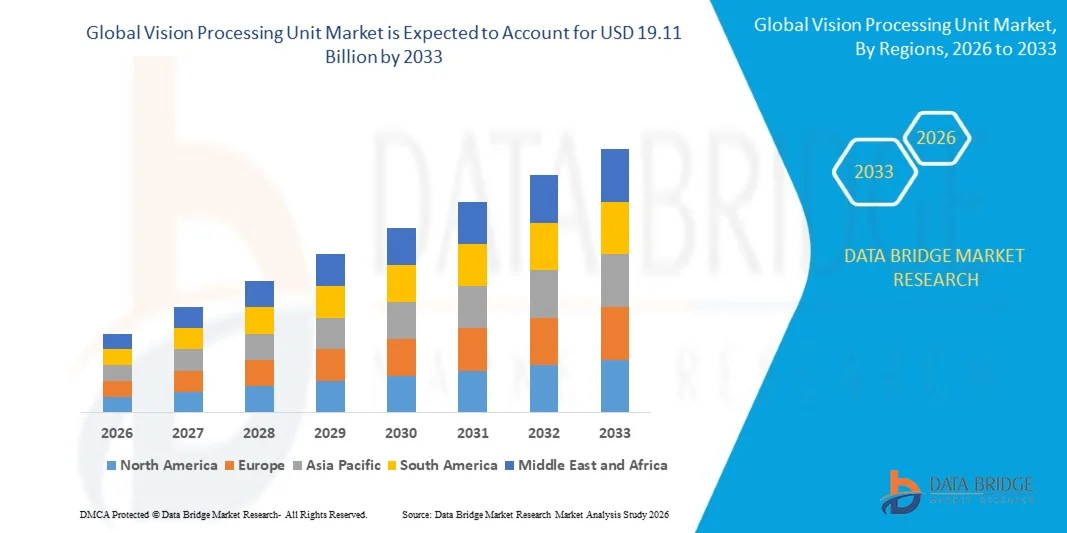
- The global vision processing unit market size was valued at USD 4.55 billion in 2025 and is expected to reach USD 19.11 billion by 2033, at a CAGR of 19.63% during the forecast period
- The market growth is largely fueled by the increasing adoption of artificial intelligence and machine learning technologies across industries, driving demand for efficient real-time image and video processing solutions in applications such as autonomous vehicles, smart surveillance, and industrial automation
- Furthermore, the rising need for low-power, high-performance computing at the edge is accelerating the deployment of vision processing units in consumer electronics, automotive systems, and IoT devices. These converging factors are significantly enhancing processing efficiency and enabling faster decision-making, thereby boosting the overall growth of the vision processing unit market
Vision Processing Unit Market Analysis
- Vision processing units are specialized processors designed to accelerate computer vision tasks such as image recognition, object detection, and video analytics, enabling efficient handling of complex visual data in real time. These processors are widely integrated into edge devices, enhancing performance while minimizing latency and power consumption
- The growing demand for VPUs is primarily driven by the rapid expansion of edge AI, increasing deployment of smart cameras and autonomous systems, and the need for high-speed visual data processing across sectors such as healthcare, automotive, consumer electronics, and security
- North America dominated the vision processing unit market with a share of 38.5% in 2025, due to strong demand for AI-enabled devices, advanced driver assistance systems, and high adoption of edge computing technologies across industries
- Asia-Pacific is expected to be the fastest growing region in the vision processing unit market during the forecast period due to rapid industrialization, expanding consumer electronics production, and increasing adoption of AI technologies in countries such as China, Japan, and India
- >16–28 nm segment dominated the market with a market share of 56.5% in 2025, due to its cost-effectiveness and widespread adoption in mid-range and industrial applications where ultra-high processing performance is not essential. These fabrication nodes offer a balanced combination of performance, reliability, and lower manufacturing costs, making them suitable for use in surveillance systems, industrial automation, and legacy devices
Report Scope and Vision Processing Unit Market Segmentation
|
Attributes |
Vision Processing Unit Key Market Insights |
|
Segments Covered |
|
|
Countries Covered |
North America
Europe
Asia-Pacific
Middle East and Africa
South America
|
|
Key Market Players |
|
|
Market Opportunities |
|
|
Value Added Data Infosets |
In addition to the insights on market scenarios such as market value, growth rate, segmentation, geographical coverage, and major players, the market reports curated by the Data Bridge Market Research also include in-depth expert analysis, geographically represented company-wise production and capacity, network layouts of distributors and partners, detailed and updated price trend analysis and deficit analysis of supply chain and demand. |
Vision Processing Unit Market Trends
“Rising Integration of Edge AI and Real-Time Vision Processing”
- A significant trend in the vision processing unit market is the increasing integration of edge AI capabilities into devices requiring real-time image and video analysis, driven by the need for faster decision-making and reduced latency across applications such as autonomous vehicles, smart surveillance, and industrial automation. This trend is strengthening the role of VPUs as essential components for enabling efficient on-device processing without heavy reliance on cloud infrastructure
- For instance, Intel Corporation has developed Movidius VPUs that are widely deployed in edge AI devices for real-time computer vision applications. These processors enable efficient inference and image processing directly on devices, improving responsiveness and reducing power consumption in applications such as robotics and smart cameras
- The adoption of VPUs in autonomous systems is expanding rapidly as real-time object detection, lane recognition, and environment mapping require high-speed visual data processing. This is positioning VPUs as critical enablers for safe and efficient autonomous mobility solutions across automotive and robotics sectors
- The consumer electronics industry is increasingly incorporating VPUs into smartphones, AR/VR devices, and smart cameras to enhance image processing, facial recognition, and augmented reality experiences. This integration is driving improved performance and user experience in devices that rely heavily on visual computing capabilities
- Industrial automation is witnessing rising deployment of VPUs in machine vision systems for quality inspection, defect detection, and process optimization. These applications require precise and continuous image analysis, reinforcing the importance of VPUs in achieving higher productivity and operational efficiency
- The market is experiencing strong growth as industries continue to prioritize low-latency processing and intelligent decision-making at the edge. This growing integration of edge AI with vision processing is reinforcing the transition toward smarter, faster, and more autonomous systems across global markets
Vision Processing Unit Market Dynamics
Driver
“Increasing Adoption of AI-Powered Imaging Across Industries”
- The growing use of artificial intelligence in imaging and video analytics across sectors such as healthcare, automotive, retail, and security is driving demand for vision processing units that can efficiently handle complex visual workloads. These processors enable faster data interpretation and support advanced functionalities such as object detection, facial recognition, and predictive analytics
- For instance, NVIDIA Corporation integrates advanced vision processing capabilities within its Jetson platform to support AI-powered imaging in robotics and intelligent video analytics. These solutions enable high-performance visual computing and are widely used in applications requiring real-time decision-making and automation
- The expansion of smart surveillance systems is significantly boosting the demand for VPUs as cameras increasingly rely on embedded intelligence for real-time threat detection and monitoring. This shift is reducing dependency on centralized systems and enhancing efficiency in security operations
- The automotive sector is rapidly adopting AI-powered vision systems for advanced driver-assistance systems and autonomous driving technologies. VPUs play a crucial role in processing large volumes of visual data, enabling vehicles to interpret surroundings and respond accurately
- The continuous advancement of AI-driven applications and increasing reliance on visual data across industries are reinforcing this driver. The demand for efficient, high-performance vision processing solutions is expected to remain strong, supporting sustained market growth
Restraint/Challenge
“High Development Costs and Design Complexity of VPUs”
- The vision processing unit market faces challenges due to the high costs associated with designing and developing specialized processors capable of handling complex visual computing tasks. These chips require advanced architectures, extensive testing, and optimization to ensure performance efficiency and low power consumption
- For instance, Apple Inc. invests heavily in the development of its custom silicon such as the M-series chips, which incorporate advanced neural and vision processing capabilities. The complexity involved in designing such high-performance chips results in significant R&D expenditures and extended development cycles
- The integration of multiple functionalities such as AI acceleration, image processing, and power management into a single chip increases design complexity and requires specialized expertise. This creates barriers for new entrants and limits the speed of innovation for smaller players
- Manufacturing VPUs involves advanced semiconductor fabrication processes such as smaller nanometer nodes, which require high capital investment and access to cutting-edge fabrication facilities. These requirements contribute to increased production costs and supply chain dependencies
- The market continues to face pressure to balance performance, power efficiency, and cost-effectiveness while scaling production. These challenges collectively restrain market growth by increasing entry barriers and limiting widespread adoption in cost-sensitive applications
Vision Processing Unit Market Scope
The market is segmented on the basis of application, vertical, and fabrication process.
• By Application
On the basis of application, the Vision Processing Unit market is segmented into smartphones, drones, cameras, AR/VR, medical devices, robots, and autonomous vehicles. The smartphones segment dominated the largest market revenue share in 2025, driven by the extensive integration of AI-powered imaging, facial recognition, and real-time video processing features in modern mobile devices. VPUs enable efficient on-device processing, reducing latency and enhancing privacy by minimizing cloud dependency. The continuous demand for enhanced camera capabilities, computational photography, and augmented reality features in smartphones significantly supports the dominance of this segment.
The autonomous vehicles segment is anticipated to witness the fastest growth rate from 2026 to 2033, fueled by the increasing development of self-driving technologies and advanced driver assistance systems. VPUs play a critical role in enabling real-time object detection, lane tracking, and environment mapping, which are essential for safe autonomous navigation. The rising investments in smart mobility solutions and the growing emphasis on vehicle safety and automation further accelerate the adoption of VPUs in this segment.
• By Vertical
On the basis of vertical, the Vision Processing Unit market is segmented into consumer electronics, security and surveillance, automotive, industrial, healthcare, and others. The consumer electronics segment dominated the largest market revenue share in 2025, driven by the widespread adoption of VPUs in devices such as smartphones, cameras, and AR/VR headsets. The increasing consumer demand for intelligent features such as facial recognition, gesture control, and enhanced imaging capabilities continues to boost VPU integration. Rapid advancements in edge AI and the need for real-time processing in compact devices further strengthen the dominance of this segment.
The automotive segment is expected to witness the fastest growth rate from 2026 to 2033, fueled by the rising adoption of advanced driver assistance systems and autonomous driving technologies. VPUs are increasingly used in vehicles for real-time visual data processing, enabling functions such as pedestrian detection and collision avoidance. The growing focus on vehicle automation, safety regulations, and the integration of AI-driven technologies in modern vehicles contribute significantly to the rapid growth of this segment.
• By Fabrication Process
On the basis of fabrication process, the Vision Processing Unit market is segmented into ≤16 nm and >16–28 nm. The >16–28 nm segment dominated the largest market revenue share of 56.5% in 2025, driven by its cost-effectiveness and widespread adoption in mid-range and industrial applications where ultra-high processing performance is not essential. These fabrication nodes offer a balanced combination of performance, reliability, and lower manufacturing costs, making them suitable for use in surveillance systems, industrial automation, and legacy devices. The continued demand for affordable and scalable vision processing solutions across developing markets further strengthens the dominance of this segment.
The ≤16 nm segment is anticipated to witness steady growth during the forecast period, driven by increasing demand for high-performance and energy-efficient processing required for advanced AI workloads and real-time image analytics. These smaller nodes enable higher transistor density and faster data processing, which are critical for applications such as autonomous vehicles, robotics, and high-end consumer electronics. The growing adoption of edge AI and the need for low-latency processing capabilities are further accelerating the demand for ≤16 nm VPUs.
Vision Processing Unit Market Regional Analysis
- North America dominated the vision processing unit market with the largest revenue share of 38.5% in 2025, driven by strong demand for AI-enabled devices, advanced driver assistance systems, and high adoption of edge computing technologies across industries
- Enterprises and consumers in the region highly prioritize real-time image processing, low-latency performance, and integration of VPUs in applications such as smartphones, autonomous vehicles, and surveillance systems
- This widespread adoption is further supported by significant investments in AI research, presence of major semiconductor companies, and rapid technological advancements, establishing VPUs as a critical component across multiple high-growth applications
U.S. Vision Processing Unit Market Insight
The U.S. vision processing unit market accounted for the largest revenue share within North America in 2025, driven by rapid advancements in artificial intelligence, machine learning, and computer vision technologies. Strong demand from sectors such as autonomous vehicles, surveillance, and consumer electronics is accelerating adoption. The presence of leading chip manufacturers and tech firms, combined with increasing deployment of edge AI solutions and smart devices, continues to propel market expansion. Moreover, growing investments in robotics and automation further strengthen the demand for VPUs across diverse applications.
Europe Vision Processing Unit Market Insight
The Europe vision processing unit market is expected to grow at a substantial CAGR during the forecast period, driven by increasing adoption of industrial automation and stringent quality control requirements across manufacturing sectors. Rising focus on Industry 4.0 and smart factory initiatives is fostering the integration of VPUs into machine vision systems. The demand for energy-efficient and high-precision processing solutions is also contributing to market growth, with widespread adoption across automotive, healthcare, and security applications.
U.K. Vision Processing Unit Market Insight
The U.K. vision processing unit market is projected to expand at a notable CAGR during the forecast period, driven by increasing investments in AI research and growing deployment of computer vision technologies in retail, healthcare, and security sectors. Rising adoption of smart surveillance systems and automation solutions is supporting demand for efficient image processing hardware. The country’s strong digital ecosystem and emphasis on innovation are further accelerating the integration of VPUs into advanced applications.
Germany Vision Processing Unit Market Insight
The Germany vision processing unit market is anticipated to grow at a considerable CAGR during the forecast period, supported by the country’s strong automotive and industrial base. Increasing adoption of machine vision in manufacturing for quality inspection and process automation is driving demand. Germany’s focus on precision engineering and smart manufacturing, along with integration of AI-driven vision systems, is contributing to sustained growth in VPU adoption across industrial applications.
Asia-Pacific Vision Processing Unit Market Insight
The Asia-Pacific vision processing unit market is poised to grow at the fastest CAGR during the forecast period of 2026 to 2033, driven by rapid industrialization, expanding consumer electronics production, and increasing adoption of AI technologies in countries such as China, Japan, and India. Growing demand for smartphones, smart cameras, and automotive electronics is accelerating VPU integration. In addition, strong government initiatives supporting digital transformation and the region’s role as a global manufacturing hub are enhancing accessibility and affordability of VPU technologies.
Japan Vision Processing Unit Market Insight
The Japan vision processing unit market is gaining traction due to the country’s leadership in robotics, automation, and advanced electronics. Increasing deployment of VPUs in industrial robots, smart surveillance, and automotive systems is driving growth. The emphasis on precision, efficiency, and high-quality manufacturing is encouraging adoption of advanced vision processing solutions. Integration with IoT-enabled devices and smart infrastructure is further strengthening the market outlook.
China Vision Processing Unit Market Insight
The China vision processing unit market held the largest revenue share in Asia Pacific in 2025, driven by rapid expansion of the electronics manufacturing sector and strong demand for AI-powered devices. Increasing adoption of smart surveillance, facial recognition systems, and autonomous technologies is fueling market growth. Government initiatives promoting AI development and smart city projects, along with the presence of domestic semiconductor manufacturers, are key factors accelerating the adoption of VPUs across multiple industries.
Vision Processing Unit Market Share
The vision processing unit industry is primarily led by well-established companies, including:
- Samsung Electronics Co., Ltd. (South Korea)
- Intel Corporation (U.S.)
- CEVA, Inc. (U.S.)
- NXP Semiconductors N.V. (Netherlands)
- HiSilicon Technologies Co., Ltd. (China)
- MediaTek Inc. (Taiwan)
- Imagination Technologies Limited (U.K.)
- VeriSilicon Holdings Co., Ltd. (China)
- Lattice Semiconductor Corporation (U.S.)
- Texas Instruments Incorporated (U.S.)
- Blaize, Inc. (U.S.)
- Socionext Inc. (Japan)
- Alphabet Inc. (U.S.)
- NEXTCHIP Co., Ltd. (South Korea)
Latest Developments in Global Vision Processing Unit Market
- In January 2025, Intel Corporation introduced its next-generation AI-enabled edge processors with enhanced vision processing acceleration capabilities, significantly improving real-time image recognition, object detection, and low-latency inference at the edge. This advancement strengthens the vision processing unit market by enabling industries such as manufacturing, retail, and smart surveillance to deploy more efficient edge-based vision systems, reducing reliance on cloud infrastructure while enhancing responsiveness and operational efficiency
- In October 2024, NVIDIA Corporation expanded its embedded AI computing portfolio with upgraded Jetson modules featuring improved GPU architecture and dedicated vision processing enhancements for robotics and edge AI applications. This development is driving the vision processing unit market by enabling high-performance machine vision workloads, supporting scalable deployment in autonomous robots, healthcare imaging, and intelligent transportation systems, while also improving energy efficiency and computational throughput
- In May 2024, Thundercomm collaborated with Qualcomm Technologies, Inc. to introduce the Snapdragon Dev Kit for Windows, a compact AI-powered PC equipped with Snapdragon X Elite designed for developers working on next-generation applications. This initiative supports the vision processing unit market by accelerating the development and optimization of AI and computer vision applications, fostering a stronger ecosystem for edge AI devices and enabling faster commercialization of vision-enabled solutions
- In May 2024, Nano Labs Ltd. launched the Cuckoo3.0 chip, offering a major leap in computing performance and energy efficiency with significantly higher single-core processing capability compared to its previous version. This innovation contributes to the vision processing unit market by enabling faster processing of complex algorithms, improving performance in AI-driven workloads, and supporting applications that require high-throughput data processing such as blockchain-based computing and advanced analytics
- In May 2024, Apple Inc. introduced the M4 chip for its latest iPad Pro, built using second-generation 3-nanometer technology to deliver enhanced power efficiency, faster neural processing, and improved graphics performance. This development supports the vision processing unit market by advancing on-device AI and vision processing capabilities, enabling seamless execution of augmented reality, image recognition, and real-time video processing applications, while also driving demand for high-performance, energy-efficient chips in consumer electronics
SKU-
Получите онлайн-доступ к отчету на первой в мире облачной платформе рыночной аналитики

- Интерактивная панель анализа данных
- Панель анализа компании для возможностей с высоким потенциалом роста
- Доступ аналитика-исследователя для настройки и запросов
- Анализ конкурентов с помощью интерактивной панели
- Последние новости, обновления и анализ тенденций
- Используйте возможности сравнительного анализа для комплексного отслеживания конкурентов
Методология исследования
Сбор данных и анализ базового года выполняются с использованием модулей сбора данных с большими размерами выборки. Этап включает получение рыночной информации или связанных данных из различных источников и стратегий. Он включает изучение и планирование всех данных, полученных из прошлого заранее. Он также охватывает изучение несоответствий информации, наблюдаемых в различных источниках информации. Рыночные данные анализируются и оцениваются с использованием статистических и последовательных моделей рынка. Кроме того, анализ доли рынка и анализ ключевых тенденций являются основными факторами успеха в отчете о рынке. Чтобы узнать больше, пожалуйста, запросите звонок аналитика или оставьте свой запрос.
Ключевой методологией исследования, используемой исследовательской группой DBMR, является триангуляция данных, которая включает в себя интеллектуальный анализ данных, анализ влияния переменных данных на рынок и первичную (отраслевую экспертную) проверку. Модели данных включают сетку позиционирования поставщиков, анализ временной линии рынка, обзор рынка и руководство, сетку позиционирования компании, патентный анализ, анализ цен, анализ доли рынка компании, стандарты измерения, глобальный и региональный анализ и анализ доли поставщика. Чтобы узнать больше о методологии исследования, отправьте запрос, чтобы поговорить с нашими отраслевыми экспертами.
Доступна настройка
Data Bridge Market Research является лидером в области передовых формативных исследований. Мы гордимся тем, что предоставляем нашим существующим и новым клиентам данные и анализ, которые соответствуют и подходят их целям. Отчет можно настроить, включив в него анализ ценовых тенденций целевых брендов, понимание рынка для дополнительных стран (запросите список стран), данные о результатах клинических испытаний, обзор литературы, обновленный анализ рынка и продуктовой базы. Анализ рынка целевых конкурентов можно проанализировать от анализа на основе технологий до стратегий портфеля рынка. Мы можем добавить столько конкурентов, о которых вам нужны данные в нужном вам формате и стиле данных. Наша команда аналитиков также может предоставить вам данные в сырых файлах Excel, сводных таблицах (книга фактов) или помочь вам в создании презентаций из наборов данных, доступных в отчете.











