



Middle East and Africa Structural Health Monitoring Market, By Type (Hardware, Software, and Services), Connectivity (Wired and Wireless), Installation Type (New installation and Retrofit), Method (Visual Inspection and Non-Destructive Evaluation (NDE)), Application (Damage Detection, Crack Detection, Strain Monitoring, Wire Break Monitoring, Leakage Detection, Multimodal Sensing, Corrosion Monitoring, Hotspot Monitoring, Impact Monitoring, and Deflection Monitoring), End User (Civil, Aerospace, Energy, Mining, Marine, Industrial, Offshore Platform, Defense, School, Public Park and Recreation, Automotive, and Others) - Industry Trends and Forecast to 2030.
Middle East and Africa Structural Health Monitoring Market Analysis and Insights
Manufacturers are continuously trying to find ways to increase the precision of work, enhance services, and safety, and work with growing technology. The requirement for these reasons is being fulfilled by implementing structural health monitoring as they are used to provide enhanced, uninterrupted, free, and timely services at the end user applications. Structural health monitoring in the infrastructure industry is being used widely for structural health monitoring solutions and the rising adoption of digital technologies in the industrial sector. Structural health monitoring helps operators make better decisions around supply chain, machinery, assets performance, drilling, and others. The Middle East and Africa structural health monitoring market is expected to grow due to growing digitization in the construction industry.
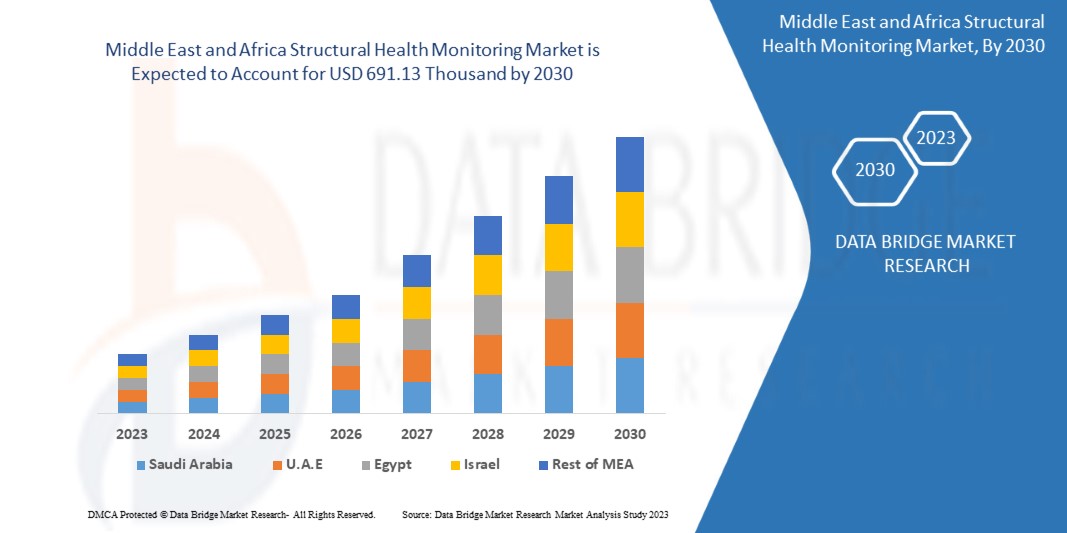
Data Bridge Market Research analyzes that the Middle East and Africa structural health monitoring market is expected to reach the value of USD 691.13 million by 2030 from USD 230.03 million in 2022, growing at a CAGR of 14.9% during the forecast period of 2023 to 2030.
|
Report Metric |
Details |
|
Forecast Period |
2023 to 2030 |
|
Base Year |
2022 |
|
Historic Years |
2021 (Customizable to 2015-2020) |
|
Quantitative Units |
Revenue in USD Million |
|
Segments Covered |
Type (Hardware, Software, and Services), Connectivity (Wired and Wireless), Installation Type (New installation and Retrofit), Method (Visual Inspection and Non-Destructive Evaluation (NDE)), Application (Damage Detection, Crack Detection, Strain Monitoring, Wire Break Monitoring, Leakage Detection, Multimodal Sensing, Corrosion Monitoring, Hotspot Monitoring, Impact Monitoring, and Deflection Monitoring), End User (Civil, Aerospace, Energy, Mining, Marine, Industrial, Offshore Platform, Defense, School, Public Park and Recreation, Automotive, and Others) |
|
Countries Covered |
South Africa, Saudi Arabia, Bahrain, U.A.E., Kuwait, Oman, Qatar, Egypt, Israel and rest of Middle East and Africa |
|
Market Players Covered |
Xylem Inc., James Fisher and Sons plc, HBK, Campbell Scientific, Inc., GEOKON, NATIONAL INSTRUMENTS CORP., GeoSIG Ltd, Kinemetrics, Sisgeo S.r.L, SIXSENSE System, and OSMOS Group SA (A subsidiary of Eren Group) among others |
Market Definition
Structural Health Monitoring (SHM) monitors changes in the material and geometric qualities of engineering structures, such as bridges and buildings, over time using periodically sampled response measurements. The output of this process is periodically updated information regarding the ability of the structure to perform its intended function in light of the inevitable aging and degradation resulting from operational environments for long-term structural health monitoring. After extreme events, such as earthquakes or blast loading, structural health monitoring is used for rapid condition screening and aims to provide, in near real-time, reliable information regarding the integrity of the structure.
Middle East and Africa Structural Health Monitoring Market Dynamics
This section deals with understanding the market drivers, advantages, opportunities, restraints, and challenges. All of this is discussed in detail below:
Driver
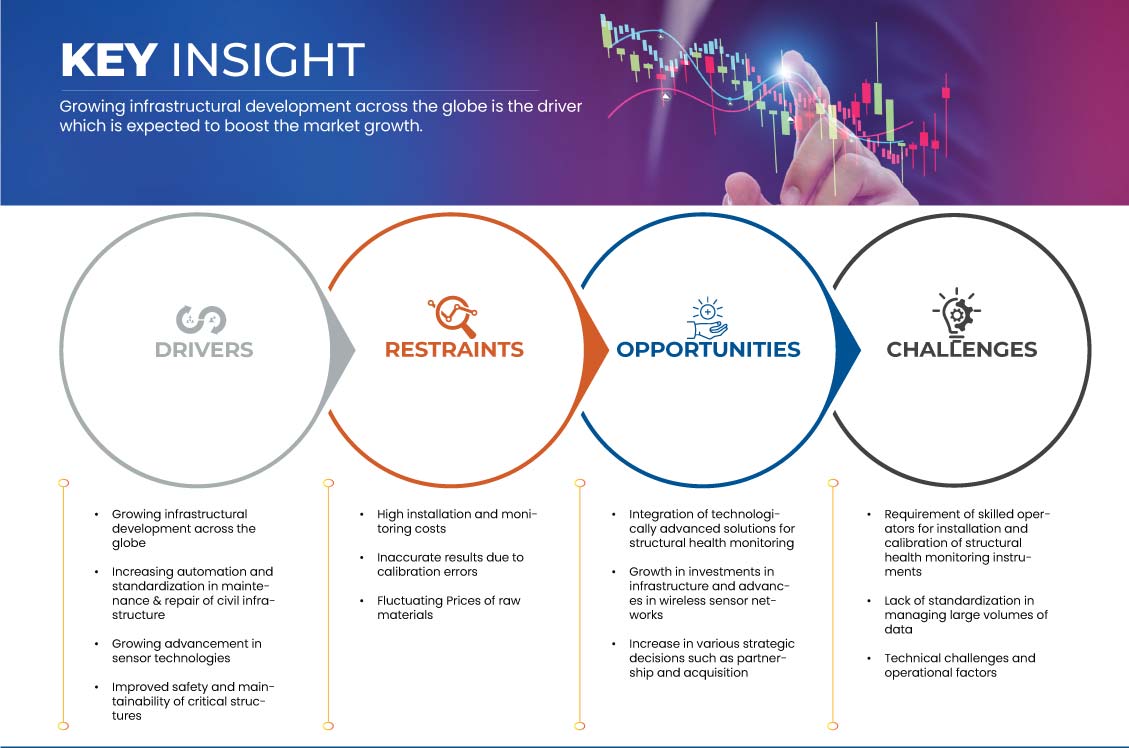
- Growing Infrastructural Development Across the Globe
Structural Health Monitoring (SHM) is a range of systems implemented on full-scale civil infrastructures to assist and inform operators about the continued 'fitness for purpose' of structures under gradual or sudden changes to their state and to learn about either or both of the load and response mechanisms.
The importance of infrastructure is widely recognized and well-researched. However, there have been relatively few attempts to track and monitor infrastructure investment across countries where studies have assessed Middle East and Africa infrastructure needs; the adoption of myriad definitions and approaches has consistently made monitoring trends difficult. The various initiatives and developments in infrastructure across the globe are expected to drive the growth of the Middle East and Africa structural health monitoring market.
Restraint
- High Installation and Monitoring Costs
The need and requirement for structural health monitoring systems have increased due to rapid digitalization and improved industrialization. Most complicated civil structures need structural health monitoring systems. But small structures cannot manage the structural health monitoring systems' installation cost and maintenance charges. As the need increases, the raw materials cost for structural health monitoring systems gradually increases.
Both capital expenditure (CAPEX) and operational expenditure (OPEX) are essential for structural health monitoring systems. The initial procurement of structural health monitoring systems, huge cabinets, and monitoring software is included in CAPEX. Structural health monitoring systems cost more than others because they require huge cabinets containing modules that allow growth. As a result, organizations must plan for their desired capacity to reap the full benefits of structural health monitoring systems. Also, structural health monitoring systems involve costing issues in the maintenance and upgradation of the system, which is projected to restrain the market.
Opportunity
-
Integration of Technologically Advanced Solutions for Structural Health Monitoring
Business process automation uses technology to execute recurring tasks or processes in a business where manual effort can be replaced. It is done to minimize costs, increase efficiency, and streamline processes. Digital transformation has been a top priority for companies in recent years, but now many businesses are taking a closer look at the actively evolving concept of digitalization.
Structural health monitoring implements a damage detection strategy for aerospace, civil and mechanical engineering infrastructure. Advances in sensors and information technologies have brought structural health monitoring (SHM) a data-driven remedy for civil infrastructure safety. Typical damage experienced by this infrastructure might be the development of fatigue cracks, degradation of structural connections, or bearing wear in rotating machinery. This application's structural health monitoring solution will integrate structural dynamics, wireless data acquisition, local actuation, micro-electromechanical systems (MEMS) technology, and statistical pattern recognition algorithms.
Challenge
- Lack of Standardization in Managing Large Volumes of Data
The lack of standardized terminology for categorizing and describing various interventions in the field of structural health monitoring involves structural factors, environmental factors, and others that are causing problems for the health of critical structures. The structural health monitoring solution installed places is classified depending upon the criticality of the civil structures and the location of the structures. Different structural health monitoring solutions, such as the sensor system, the data acquisition, and transmission system, the data management system, the condition evaluation system, and others, are used for different intense critical structures in dams, bridges, and other manufacturing industries. Therefore, standardization acts as the major factor that acts as a major challenge for the market.
Recent Developments
- In May 2021, Sisgeo S.r.l. introduced the MD-Profile gauges. The system is suitable for geotechnical and structural applications, for which vertical or horizontal accurate profiling is needed, to improve the product portfolio of the company
- In November 2020, HBK updated or technically refined its compressive force transducer C10 to make it more cost-efficient due to increased precision. This helped the product as an ideal solution for demanding test branches, laboratory, and production applications
Middle East and Africa Structural Health Monitoring Market Scope
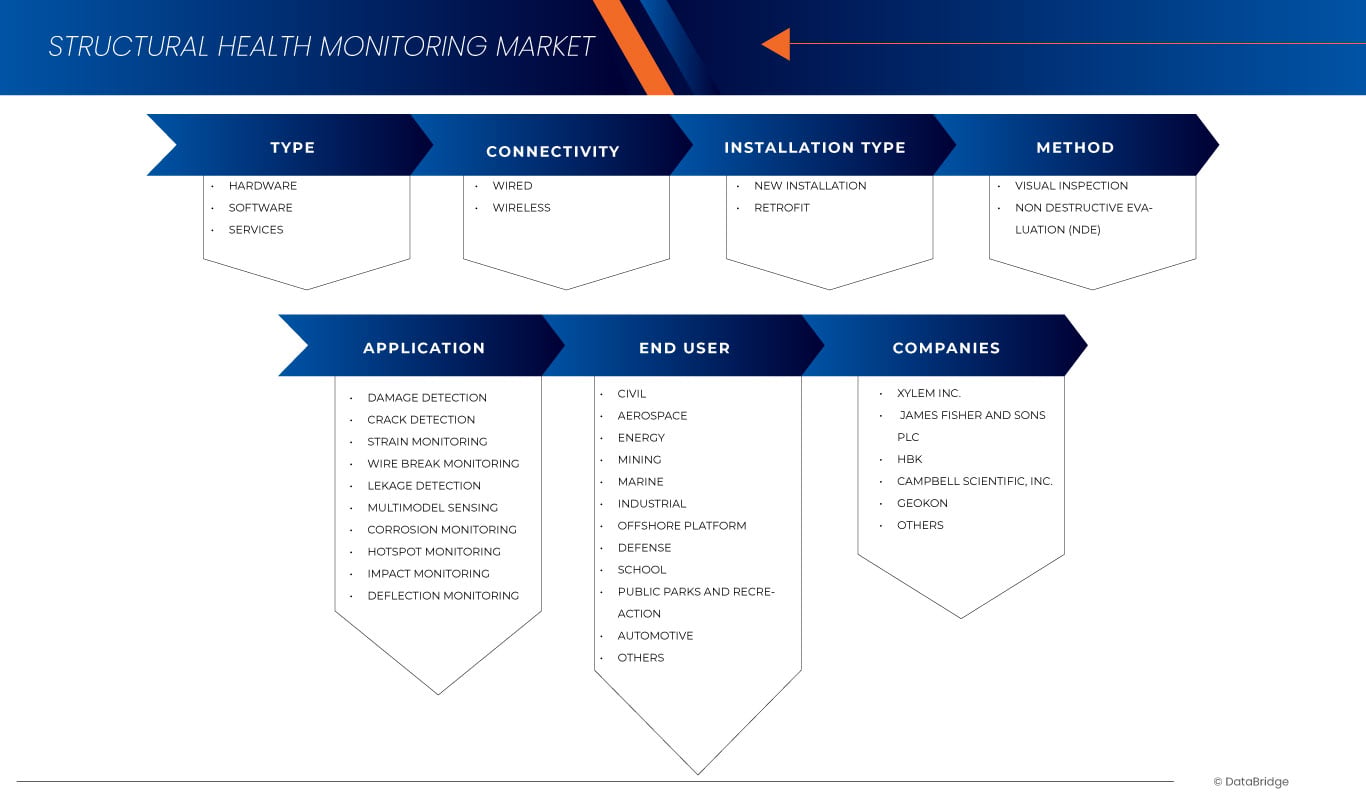
Middle East and Africa structural health monitoring market is segmented into six notable segments such as type, connectivity, installation, method, application, and end user. The growth among segments helps you analyze niche pockets of growth and strategies to approach the market and determine your core application areas and the difference in your target markets.
Type
- Hardware
- Software
- Services
On the basis of type, the Middle East and Africa structural health monitoring market is segmented into hardware, software and services.
Connectivity
- Wired
- Wireless
On the basis of connectivity, the Middle East and Africa structural health monitoring market is segmented into wired and wireless.
Installation Type
- New Installation
- Retrofit
On the basis of installation, the Middle East and Africa structural health monitoring market is segmented into new installation and retrofit.
Method
- Visual Inspection
- Non-Destructive Evaluation (NDE)
On the basis of method, the Middle East and Africa structural health monitoring market is segmented into visual inspection and non-destructive evaluation.
Application
- Damage Detection
- Crack Detection
- Strain Monitoring
- Wire Break Monitoring
- Leakage Detection
- Multimodal Sensing
- Corrosion Monitoring
- Hotspot Monitoring
- Impact Monitoring
- Deflection Monitoring
On the basis of application, the Middle East and Africa structural health monitoring market is segmented into damage detection, crack detection, strain monitoring, wire break monitoring, leakage detection, multimodal sensing, corrosion monitoring, hotspot monitoring, impact monitoring and deflection monitoring.
End User
- Civil
- Aerospace
- Energy
- Mining
- Marine
- Industrial
- Offshore Platform
- Defense
- Schools
- Public Parks and Recreation
- Automotive
- Others
On the basis of end user, the Middle East and Africa structural health monitoring market is segmented into civil, aerospace, energy, mining, marine, industrial, offshore platform, defense, school, public park & recreation, automotive and others.
Middle East and Africa Structural Health Monitoring Regional Analysis/Insights
The Middle East and Africa structural health monitoring market is categorized into six notable segments such as type, connectivity, installation type, method, application, and end user.
The countries covered in the Middle East and Africa structural health monitoring market report South Africa, Saudi Arabia, Bahrain, U.A.E., Kuwait, Oman, Qatar, Egypt, Israel and the rest of Middle East and Africa.
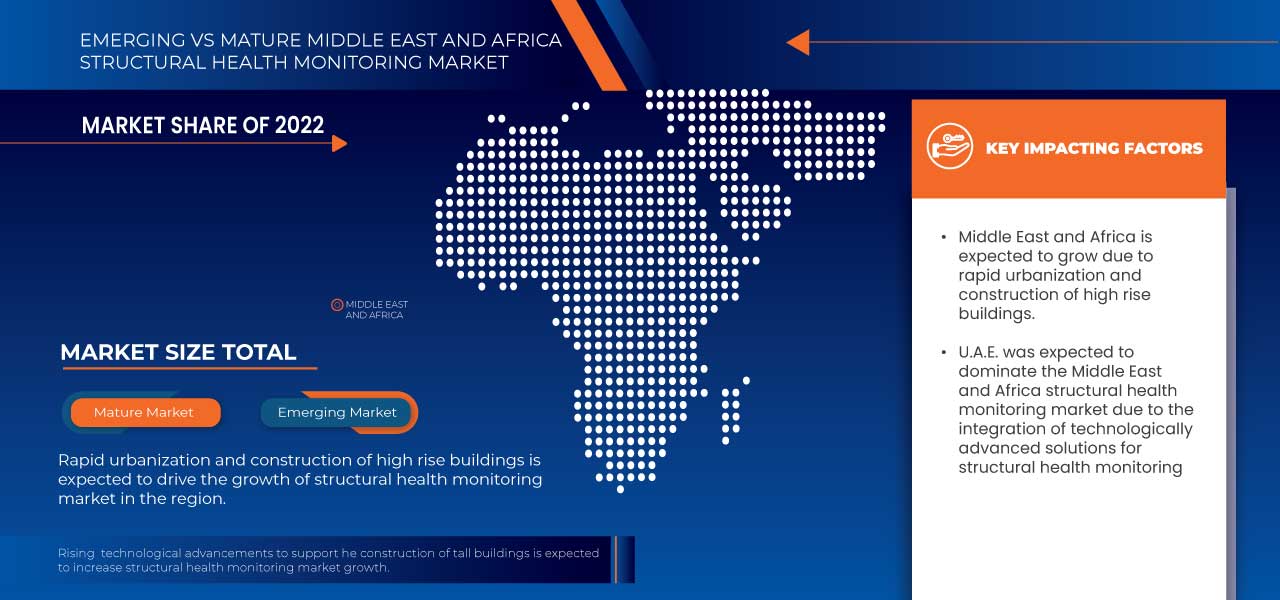
U.A.E. is expected to dominate the market due to rise in technological advancement in structural health monitoring market.
The country section of the report also provides individual market impacting factors and changes in regulation in the market domestically that impact the current and future trends of the market. Data points such as new sales, replacement sales, country demographics, regulatory acts, and import-export tariffs are some of the major pointers used to forecast the market scenario for individual countries. In addition, presence and availability of Middle East and Africa brands and their challenges faced due to large or scarce competition from local and domestic brands, and impact of sales channels are considered while providing forecast analysis of the country data.
Competitive Landscape and Middle East and Africa Structural Health Monitoring Market Share Analysis
Middle East and Africa structural health monitoring market competitive landscape provides details by competitor. Details included are company overview, company financials, revenue generated, market potential, investment in R&D, new market initiatives, production sites and facilities, company strengths and weaknesses, product launch, product approvals, product width and breath, application dominance, product type lifeline curve. The above data points provided are only related to the company’s focus on the Middle East and Africa structural health monitoring market.
Some of the major players operating in the Middle East and Africa structural health monitoring market are Xylem Inc., James Fisher and Sons plc, HBK, Campbell Scientific, Inc., GEOKON, NATIONAL INSTRUMENTS CORP., GeoSIG Ltd, Kinemetrics, Sisgeo S.r.L, SIXSENSE System, and OSMOS Group SA (A subsidiary of Eren Group) among others.
SKU-
Получите онлайн-доступ к отчету на первой в мире облачной платформе рыночной аналитики

- Интерактивная панель анализа данных
- Панель анализа компании для возможностей с высоким потенциалом роста
- Доступ аналитика-исследователя для настройки и запросов
- Анализ конкурентов с помощью интерактивной панели
- Последние новости, обновления и анализ тенденций
- Используйте возможности сравнительного анализа для комплексного отслеживания конкурентов
Методология исследования
Сбор данных и анализ базового года выполняются с использованием модулей сбора данных с большими размерами выборки. Этап включает получение рыночной информации или связанных данных из различных источников и стратегий. Он включает изучение и планирование всех данных, полученных из прошлого заранее. Он также охватывает изучение несоответствий информации, наблюдаемых в различных источниках информации. Рыночные данные анализируются и оцениваются с использованием статистических и последовательных моделей рынка. Кроме того, анализ доли рынка и анализ ключевых тенденций являются основными факторами успеха в отчете о рынке. Чтобы узнать больше, пожалуйста, запросите звонок аналитика или оставьте свой запрос.
Ключевой методологией исследования, используемой исследовательской группой DBMR, является триангуляция данных, которая включает в себя интеллектуальный анализ данных, анализ влияния переменных данных на рынок и первичную (отраслевую экспертную) проверку. Модели данных включают сетку позиционирования поставщиков, анализ временной линии рынка, обзор рынка и руководство, сетку позиционирования компании, патентный анализ, анализ цен, анализ доли рынка компании, стандарты измерения, глобальный и региональный анализ и анализ доли поставщика. Чтобы узнать больше о методологии исследования, отправьте запрос, чтобы поговорить с нашими отраслевыми экспертами.
Доступна настройка
Data Bridge Market Research является лидером в области передовых формативных исследований. Мы гордимся тем, что предоставляем нашим существующим и новым клиентам данные и анализ, которые соответствуют и подходят их целям. Отчет можно настроить, включив в него анализ ценовых тенденций целевых брендов, понимание рынка для дополнительных стран (запросите список стран), данные о результатах клинических испытаний, обзор литературы, обновленный анализ рынка и продуктовой базы. Анализ рынка целевых конкурентов можно проанализировать от анализа на основе технологий до стратегий портфеля рынка. Мы можем добавить столько конкурентов, о которых вам нужны данные в нужном вам формате и стиле данных. Наша команда аналитиков также может предоставить вам данные в сырых файлах Excel, сводных таблицах (книга фактов) или помочь вам в создании презентаций из наборов данных, доступных в отчете.











