


North America Lithium-Ion Battery Recycling Market, By Component (Active Material, Non-Active Material), Chemistry (Lithium-Nickel Manganese Cobalt (Li-NMC), LithiumCobalt Oxide (LCO), Lithium-Manganese Oxide (LMO), Lithium-Iron Phosphate (LFP), Lithium-Nickel Cobalt Aluminium Oxide (NCA), Lithium-Titanate Oxide (LTO)), Recycling Process (Hydrometallurgical Process, Pyrometallurgy Process, Physical/ Mechanical Process) – Industry Trends and Forecast to 2029.
Market Analysis and Size
Lithium ion battery comprises of lithium ions which moves from negative electrode to the positive electrode through the electrolyte during charging and moves backwards at the time of charging. These batteries are rechargeable and commonly used in consumer electronics and automobiles. It consists of four components cathode, anode, separator and electrolyte. Anode helps in storing and releasing of lithium ions from cathode, enabling the pass of current through an external circuit. Cathode acts as a source of lithium ions which determines the capacity and average voltage of the battery. Electrolytic is basically the medium which helps in the movement of the ions. Separator basically helps in preventing the contact between the cathode and anode. Aluminium foils are used as a current collector for cathodes and copper foils are used as a current collector for anodes. The combination of all four components makes up a cell which is used to power various applications. With cluster of cells module is formed and with cluster of modules a pack is formed. Lithium ion batteries offer high energy density, voltage capacity and lower self-discharge rate than other rechargeable batteries. This makes them highly suitable for wide range of applications.
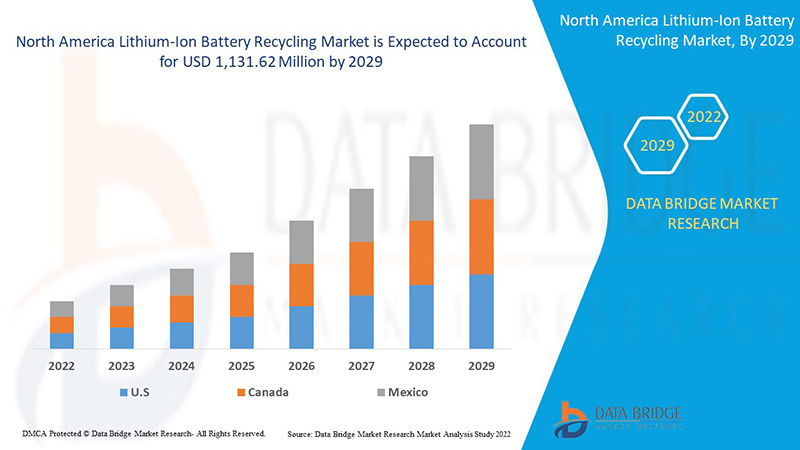
Data Bridge Market Research analyses that the North America lithium-ion battery recycling market is expected to reach the value of USD 1,131.62 million by 2029, at a CAGR of 19.7% during the forecast period. The lithium-ion battery recycling market report also covers pricing analysis, patent analysis, and technological advancements in depth.
|
Report Metric |
Details |
|
Forecast Period |
2022 to 2029 |
|
Base Year |
2021 |
|
Historic Years |
2020 |
|
Quantitative Units |
Revenue in USD Million, Pricing in USD |
|
Segments Covered |
By Component (Active Material, Non-Active Material), Chemistry (Lithium-Nickel Manganese Cobalt (Li-NMC), Lithium Cobalt Oxide (LCO), Lithium-Manganese Oxide (LMO), Lithium-Iron Phosphate (LFP), Lithium-Nickel Cobalt Aluminium Oxide (NCA), Lithium-Titanate Oxide (LTO)), Recycling Process (Hydrometallurgical Process, Pyrometallurgy Process, Physical/ Mechanical Process) |
|
Countries Covered |
U.S., Canada and Mexico in North America |
|
Market Players Covered |
Glencore, Retriev Technologies, Umicore, American Manganese Inc., Li-Cycle Corp, TES, Contemporary Amperex Technology Co., Limited, Ganfeng Lithium Co.,Ltd., OnTo Technology LLC, Lithion Recycling, ECOBAT, Veolia Environnement SA, Batrec Industrie, Redwood Materials, Inc. |
Lithium-Ion Battery Recycling Market Dynamics
This section deals with understanding the market drivers, advantages, opportunities, restraints and challenges. All of this is discussed in detail as below:
Drivers
- Rising demand for smart phones & consumer electronics
The demands and requirements of consumer electronics have continued to increase at an exponential rate. Lithium-ion batteries are common in consumer electronics. They are one of the most popular types of rechargeable battery for portable electronics, with proper energy-to-weight ratios, high open circuit voltage and low self-discharge rate. The advancement in technologies has compacted the size of electronic devices making it slimmer and lightweight which is increasing the requirement of lithium ion battery. The lithium ion battery last longer, charge faster and have a higher power density for more battery life in a lighter package.
- Penetration of low carbon generation transportation fleet
Road transport emissions account for almost 75% of all transport GHG (greenhouse gas) emissions and 11% of global GHG emissions. Electrification is the key decarburization lever for road transport. In contrast, Electric vehicle currently emits 30-60% fewer emissions than combustion engines depending on the power mix. Without action, global road transport emissions would continue to grow as a result of increased transport needs supplied by fossil fuels. However, electrification helps to reduce CO2 emissions and improve air quality by avoiding mixing of toxic gases. To mitigate climate change and create a fossil fuel-free economy, the global community has agreed that GHG emissions must be reduced rapidly and significantly. Li-ion batteries are thus considered as the promising clean technology to replace the conventional fossil-fuel powered device. Compared to the other high-quality rechargeable battery technologies, Li-ion batteries have highest energy densities of any battery technology today (100-265 Wh/kg or 250-670 Wh/L). Li-ion batteries are also used to power electrical systems for some aerospace applications, being environmental friendly & lightweight is the major factor among others.
Opportunities
- Growing number of R&D initiatives and government facilities for recycling
Lithium ion batteries have wide range of application and with more efforts put in through research and development, more advance characteristics are being developed. Companies are building new manufacturing facilities for fulfilling the surging demands of lithium ion batteries in application for electrical vehicles, medical devices and data communication. The new facilities and growing research and development is creating new opportunity for growth of global lithium ion battery market.
Restraints/Challenges
- Safety issues related to the storage and transportation of spent batteries
Lithium ions are widely used in various applications such as consumer electronics, industrial applications, medical devices and in automobiles. Lithium ion batteries are light weight and are now designed to be flexible in nature with variable shapes. However, lithium ion batteries can be extremely dangerous if defective or overcharged, packaged incorrectly, misused or mishandled. Lithium is highly reactive and flammable and can therefore cause severe damage to life and property. These characteristics can cause harm during storage, usage and transportation of lithium ion.
- Issues related to overheating of lithium-ion battery
Despite their technological promise, Li-ion batteries still have a number of shortcomings, particularly with regards to safety. Li-ion batteries have a tendency to overheat, and can be damaged at high voltages. In some cases, this can lead to thermal runaway and combustion. These batteries require safety mechanisms to limit voltage and internal pressures, which can increase weight and limit performance in some cases. Li-ion batteries are also subject to aging, meaning that they can lose capacity and frequently fail after a number of years. Another factor limiting their widespread adoption is their cost, which is around 40% higher than Ni-Cd.
Post COVID-19 Impact on Lithium-Ion Battery Recycling Market
COVID-19 created a major impact on the lithium-ion battery recycling market as almost every country has opted for the shutdown for every production facility except the ones dealing in producing the essential goods.
Post pandemic, the growth of the lithium-ion battery recycling market is attributed to the increasing adoption of electrification of automotive industry across all regions and countries. Although automotive industry faced major issues during pandemic, the electric vehicle sales jumped to higher levels in post pandemic scenario. Also demand for consumer battery operated electronics has increased over the period of time which is acting as a driver for this market’s growth.
Manufacturers are making various strategic decisions to bounce back post-COVID-19. The players are conducting multiple research and development activities to improve the technology involved in the lithium-ion battery recycling. With this, the companies will bring advanced technologies to the market. In addition, government initiatives for usage of electric vehicle has led to the market's growth
Recent Development
- In March 2022, Li-Cycle Corp had expanded their foot printinto North America region where acenter of excellence to be established in Kingston’s Clogg’s Road business park. This will further help the company to enhance their lithium-ion battery recycling services portfolio across the market.
- In November 2021, ECOBAT had announced the expansion of its new facilities in the North American and European region into a new 5-year upsized global funding facility led by J.P. Morgan. With this, the company had aimed to offer full suite lithium battery recycling services across the region.
North America Lithium-Ion Battery Recycling Market Scope
The lithium-ion battery recycling market is segmented on the basis of component, chemistry, and recycling process. The growth amongst these segments will help you analyze meagre growth segments in the industries and provide the users with a valuable market overview and market insights to help them make strategic decisions for identifying core market applications.
Component
- Active Material
- Non-Active Material
On the basis of component, the lithium-ion battery recycling market is segmented into active material and non-active material.
Chemistry
- Lithium-Nickel Manganese Cobalt (Li-NMC)
- Lithium Cobalt Oxide (LCO)
- Lithium-Manganese Oxide (LMO)
- Lithium-Iron Phosphate (LFP)
- Lithium-Nickel Cobalt Aluminium Oxide (NCA)
- Lithium-Titanate Oxide (LTO)
On the basis of chemistry, the lithium-ion battery recycling market has been segmented into below lithium-nickel manganese cobalt (Li-NMC), lithium cobalt oxide (LCO), lithium-manganese oxide (LMO), lithium-iron phosphate (LFP), lithium-nickel cobalt aluminium oxide (NCA), lithium-titanate oxide (LTO).
Recycling process
- Hydrometallurgical Process
- Pyrometallurgy Process
- Physical/ Mechanical Process
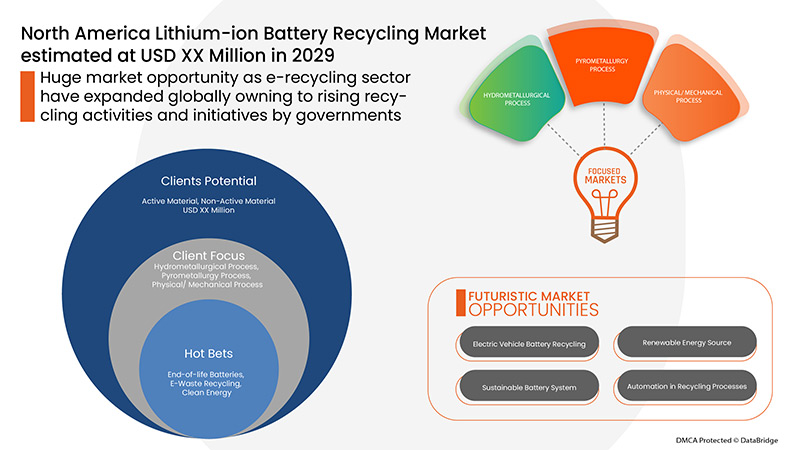
On the basis of recycling process, the lithium-ion battery recycling market has been segmented into hydrometallurgical process, pyrometallurgy process, physical/ mechanical process.
Lithium-Ion Battery Recycling Market Regional Analysis/Insights
The lithium-ion battery recycling market is analysed and market size insights and trends are provided by country, component, recycling process and chemistry as referenced above.
The countries covered in the lithium-ion battery recycling market report are U.S., Canada and Mexico in North America.
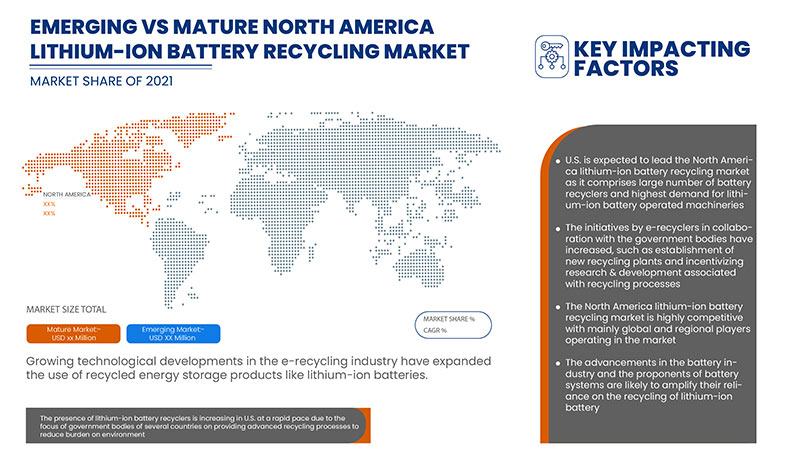
U.S. dominates in North America region due to increasing demand for lithium-ion batteries in electric vehicles, mobile devices and smart wearables.
The country section of the report also provides individual market impacting factors and changes in market regulation that impact the current and future trends of the market. Data points like down-stream and upstream value chain analysis, technical trends and porter's five forces analysis, case studies are some of the pointers used to forecast the market scenario for individual countries. Also, the presence and availability of North America brands and their challenges faced due to large or scarce competition from local and domestic brands, impact of domestic tariffs and trade routes are considered while providing forecast analysis of the country data.
Competitive Landscape and Lithium-Ion Battery Recycling Market Share Analysis
The lithium-ion battery recycling market competitive landscape provides details by competitor. Details included are company overview, company financials, revenue generated, market potential, investment in research and development, new market initiatives, North America presence, production sites and facilities, production capacities, company strengths and weaknesses, product launch, product width and breadth, application dominance. The above data points provided are only related to the companies' focus related to lithium-ion battery recycling market.
Some of the major players operating in the lithium-ion battery recycling market are Glencore, Retriev Technologies, Umicore, American Manganese Inc., Li-Cycle Corp, TES, Contemporary Amperex Technology Co., Limited, Ganfeng Lithium Co.,Ltd., OnTo Technology LLC, Lithion Recycling, ECOBAT, Veolia Environnement SA, Batrec Industrie, Redwood Materials, Inc.
SKU-
Получите онлайн-доступ к отчету на первой в мире облачной платформе рыночной аналитики

- Интерактивная панель анализа данных
- Панель анализа компании для возможностей с высоким потенциалом роста
- Доступ аналитика-исследователя для настройки и запросов
- Анализ конкурентов с помощью интерактивной панели
- Последние новости, обновления и анализ тенденций
- Используйте возможности сравнительного анализа для комплексного отслеживания конкурентов
Методология исследования
Сбор данных и анализ базового года выполняются с использованием модулей сбора данных с большими размерами выборки. Этап включает получение рыночной информации или связанных данных из различных источников и стратегий. Он включает изучение и планирование всех данных, полученных из прошлого заранее. Он также охватывает изучение несоответствий информации, наблюдаемых в различных источниках информации. Рыночные данные анализируются и оцениваются с использованием статистических и последовательных моделей рынка. Кроме того, анализ доли рынка и анализ ключевых тенденций являются основными факторами успеха в отчете о рынке. Чтобы узнать больше, пожалуйста, запросите звонок аналитика или оставьте свой запрос.
Ключевой методологией исследования, используемой исследовательской группой DBMR, является триангуляция данных, которая включает в себя интеллектуальный анализ данных, анализ влияния переменных данных на рынок и первичную (отраслевую экспертную) проверку. Модели данных включают сетку позиционирования поставщиков, анализ временной линии рынка, обзор рынка и руководство, сетку позиционирования компании, патентный анализ, анализ цен, анализ доли рынка компании, стандарты измерения, глобальный и региональный анализ и анализ доли поставщика. Чтобы узнать больше о методологии исследования, отправьте запрос, чтобы поговорить с нашими отраслевыми экспертами.
Доступна настройка
Data Bridge Market Research является лидером в области передовых формативных исследований. Мы гордимся тем, что предоставляем нашим существующим и новым клиентам данные и анализ, которые соответствуют и подходят их целям. Отчет можно настроить, включив в него анализ ценовых тенденций целевых брендов, понимание рынка для дополнительных стран (запросите список стран), данные о результатах клинических испытаний, обзор литературы, обновленный анализ рынка и продуктовой базы. Анализ рынка целевых конкурентов можно проанализировать от анализа на основе технологий до стратегий портфеля рынка. Мы можем добавить столько конкурентов, о которых вам нужны данные в нужном вам формате и стиле данных. Наша команда аналитиков также может предоставить вам данные в сырых файлах Excel, сводных таблицах (книга фактов) или помочь вам в создании презентаций из наборов данных, доступных в отчете.











