Europe Molecular Spectroscopy Market Size, Share and Trends Analysis Report – Industry Overview and Forecast to 2033

请求目录 请求目录 与分析师交谈 与分析师交谈 免费样本报告 免费样本报告 购买前请咨询 提前咨询 立即购买 立即购买

Europe Molecular Spectroscopy Market Size, Share and Trends Analysis Report – Industry Overview and Forecast to 2033

Europe Molecular Spectroscopy Market Segmentation, By Technology (Nuclear Magnetic Resonance Spectroscopy, UV-Visible Spectroscopy, Infrared Spectroscopy, Near-Infrared Spectroscopy, Colour Measurement Spectroscopy, Raman Spectroscopy and Other Technologies), Application (Pharmaceutical Applications, Food and Beverage Testing, Biotechnology and Biopharmaceutical Applications, Environmental Testing, Academic Research and Other Applications)- Industry Trends and Forecast to 2033

  • Healthcare
  • Dec 2021
  • Europe
  • 350 页面
  • 桌子數: 220
  • 图号: 60

Europe Molecular Spectroscopy Market

市场规模(十亿美元)

CAGR :  % Diagram

Chart Image USD 14.87 Billion USD 25.74 Billion 2025 2033
Diagram Forecast Period
2026 –2033
Diagram Market Size (Base Year)
USD 14.87 Billion
Diagram Market Size (Forecast Year)
USD 25.74 Billion
Diagram CAGR
%
Diagram Major Markets Players
  • Thermo Fisher Scientific
  • Merck KGaA
  • PerkinElmer
  • ABB
  • Agilent Technologies

Europe Molecular Spectroscopy Market Segmentation, By Technology (Nuclear Magnetic Resonance Spectroscopy, UV-Visible Spectroscopy, Infrared Spectroscopy, Near-Infrared Spectroscopy, Colour Measurement Spectroscopy, Raman Spectroscopy and Other Technologies), Application (Pharmaceutical Applications, Food and Beverage Testing, Biotechnology and Biopharmaceutical Applications, Environmental Testing, Academic Research and Other Applications)- Industry Trends and Forecast to 2033

Europe Molecular Spectroscopy Market Size

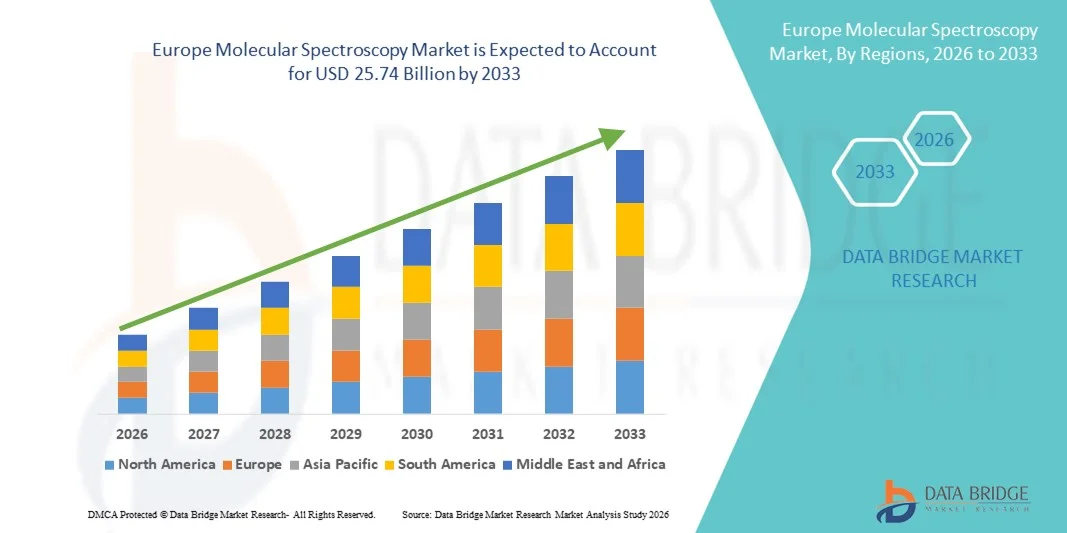
  • The Europe molecular spectroscopy market size was valued at USD 14.87 billion in 2025 and is expected to reach USD 25.74 billion by 2033, at a CAGR of 7.10% during the forecast period
  •  The market growth is largely fueled by increasing adoption of advanced analytical techniques across pharmaceutical, biotechnology, and academic research sectors, combined with regulatory emphasis on environmental monitoring and quality control, which is driving demand for molecular spectroscopic instruments and solutions across Europe
  • Furthermore, rising investments in R&D, growing focus on precision in chemical and biological analysis, and strong integration of spectroscopy technologies in research applications are positioning molecular spectroscopy as a vital tool in life sciences and industrial laboratories, thereby significantly boosting the industry’s growth

Europe Molecular Spectroscopy Market Analysis

  • Molecular spectroscopy, encompassing techniques such as infrared (IR), ultraviolet-visible (UV-Vis), nuclear magnetic resonance (NMR), and Raman spectroscopy, is increasingly essential in modern analytical laboratories across pharmaceuticals, biotechnology, environmental testing, and academic research due to its precision, non-destructive analysis, and capability for complex molecular characterization
  • The escalating demand for molecular spectroscopy is primarily driven by growing R&D activities in life sciences and chemical industries, stringent regulatory requirements for quality control and environmental monitoring, and rising adoption of advanced analytical instrumentation for accurate molecular and chemical analysis
  • Germany dominated the molecular spectroscopy market with the largest revenue share of 28.5% in 2025, supported by its strong pharmaceutical and biotech sectors, high research investments, and the presence of major instrument manufacturers, with substantial adoption of advanced spectroscopy instruments in both academic and industrial laboratories
  • Poland is expected to be the fastest growing country in the molecular spectroscopy market during the forecast period driven by increasing industrialization, expanding research infrastructure, and rising government support for scientific and environmental initiatives
  • Infrared Spectroscopy segment dominated the Europe molecular spectroscopy market with a market share of 35.9% in 2025, fueled by its versatility in qualitative and quantitative analysis, non-destructive testing capability, and widespread application across pharmaceuticals, chemicals, and food testing laboratories

Europe Molecular Spectroscopy Marketz

Report Scope and Europe Molecular Spectroscopy Market Segmentation    

Attributes

Europe Molecular Spectroscopy Key Market Insights

Segments Covered

  • By Technology: Nuclear Magnetic Resonance Spectroscopy, UV-Visible Spectroscopy, Infrared Spectroscopy, Near-Infrared Spectroscopy, Colour Measurement Spectroscopy, Raman Spectroscopy and Other Technologies
  • By Application: Pharmaceutical Applications, Food and Beverage Testing, Biotechnology and Biopharmaceutical Applications, Environmental Testing, Academic Research and Other Applications

Countries Covered

Europe

  • Germany
  • France
  • U.K.
  • Netherlands
  • Switzerland
  • Belgium
  • Russia
  • Italy
  • Spain
  • Turkey
  • Rest of Europe

Key Market Players

  • Thermo Fisher Scientific Inc. (U.S.)
  • Agilent Technologies, Inc. (U.S.)
  • Bruker Corporation (U.S.)
  • Horiba, Ltd. (Japan)
  • Shimadzu Corporation (Japan)
  • JEOL Ltd. (Japan)
  • JASCO Corp. (Japan)
  • Merck KGaA (Germany)
  • PerkinElmer, Inc. (U.S.)
  • ABB Ltd (Switzerland)
  • Eurofins Scientific (Luxembourg)
  • Metrohm AG (Switzerland)
  • Malvern Panalytical Ltd (U.K.)
  • Analytik Jena GmbH + Co. KG (Germany)
  • Oxford Instruments plc (U.K.)
  • Teledyne Technologies, Inc. (U.S.)
  • FOSS A/S (Denmark)
  • Metrohm UK Ltd (U.K.)
  • WITec Wissenschaftliche Instrumente & Technologie GmbH (Germany)
  • Polytec GmbH (Germany)

Market Opportunities

  • Integration of AI and machine learning with spectroscopy instruments
  • Expansion into green chemistry and environmental monitoring

Value Added Data Infosets

In addition to the insights on market scenarios such as market value, growth rate, segmentation, geographical coverage, and major players, the market reports curated by the Data Bridge Market Research also include in-depth expert analysis, patient epidemiology, pipeline analysis, pricing analysis, and regulatory framework

Europe Molecular Spectroscopy Market Trends

Advancements in AI-Driven Spectroscopic Analysis

  • A significant and accelerating trend in the Europe molecular spectroscopy market is the integration of artificial intelligence (AI) and machine learning algorithms with spectroscopic instruments, enhancing automation, data interpretation, and predictive analysis capabilities
    • For instance, Bruker’s OPUS software suite incorporates AI-based spectral interpretation to streamline IR and NMR analysis, improving throughput in pharmaceutical and chemical research laboratories
  • AI integration in spectroscopy enables features such as automated peak assignment, anomaly detection in spectra, and predictive modeling for chemical composition, reducing human error and accelerating research outcomes
  • The seamless incorporation of AI with spectroscopy systems allows centralized data management and multi-instrument connectivity, facilitating coordinated analysis across labs and research facilities
  • This trend towards more intelligent, automated, and interconnected spectroscopy solutions is fundamentally reshaping user expectations for laboratory efficiency and accuracy. Consequently, companies such as Thermo Fisher Scientific are developing AI-enabled spectroscopy platforms capable of predictive analysis and real-time spectral anomaly detection
  • The demand for spectroscopy instruments with AI-assisted data analysis is growing rapidly across both academic and industrial laboratories, as organizations increasingly prioritize efficiency, accuracy, and advanced research capabilities
  • Miniaturization and portability of spectroscopic instruments, such as handheld Raman and IR devices, are enabling on-site analysis in industrial, environmental, and pharmaceutical settings, expanding the practical applications of spectroscopy

Europe Molecular Spectroscopy Market Dynamics

Driver

Rising Demand for Precision in Research and Quality Control

  • The growing emphasis on precise molecular characterization in pharmaceutical, chemical, and environmental research is a significant driver for the heightened adoption of spectroscopy instruments
    • For instance, in March 2025, Agilent Technologies introduced enhanced NMR solutions aimed at improving analytical throughput in drug discovery and quality control applications, demonstrating the rising market adoption
  • As regulatory standards tighten for product safety and environmental compliance, spectroscopy provides accurate, non-destructive analysis for both qualitative and quantitative assessments
  • Furthermore, increasing R&D investments and the adoption of advanced laboratory technologies in Europe are making spectroscopy an essential tool in chemical, biotech, and academic sectors
  • The ability to generate detailed molecular fingerprints, monitor chemical reactions in real time, and ensure regulatory compliance is propelling the adoption of spectroscopy solutions across laboratories, research institutions, and industrial facilities
  • Growing collaborations between instrument manufacturers and research institutions are accelerating technology adoption, enabling access to cutting-edge spectroscopy solutions for complex scientific challenges
  • Rising awareness of spectroscopy’s role in environmental monitoring, such as detecting pollutants and ensuring compliance with EU environmental directives, is further fueling demand for advanced instruments across Europe

Restraint/Challenge

High Instrument Costs and Technical Expertise Requirements

  • The high cost of advanced spectroscopy instruments and the need for trained personnel to operate and interpret data pose challenges to broader market penetration
    • For instance, the acquisition of high-resolution NMR and Raman spectroscopy systems can require substantial capital investment, limiting adoption among small-scale laboratories or academic institutions with budget constraints
  • Addressing these challenges through more affordable, compact, and user-friendly instruments, along with training programs and software-assisted interpretation, is crucial for expanding market access
  • In addition, the complexity of multi-modal spectroscopic techniques may require specialized technical expertise, which can slow adoption in emerging research markets
  • While modular and AI-assisted platforms are reducing the learning curve, the perceived high cost and technical barriers can still hinder widespread adoption, particularly in smaller laboratories or startups
  • Overcoming these challenges through cost-effective instrument designs, cloud-based analysis solutions, and expanded training initiatives will be vital for sustained growth of the Europe molecular spectroscopy market
  • Maintenance and calibration requirements for high-precision instruments can increase operational costs, deterring small laboratories from investing in advanced spectroscopy technologies
  • Rapid technological advancements may render older instruments obsolete, creating concerns about return on investment and forcing frequent upgrades for laboratories aiming to remain competitive

Europe Molecular Spectroscopy Market Scope

The market is segmented on the basis of technology and application.

  • By Technology

On the basis of technology, the Europe molecular spectroscopy market is segmented into Nuclear Magnetic Resonance (NMR) Spectroscopy, UV-Visible Spectroscopy, Infrared (IR) Spectroscopy, Near-Infrared (NIR) Spectroscopy, Colour Measurement Spectroscopy, Raman Spectroscopy, and Other Technologies. The Infrared (IR) Spectroscopy segment dominated the market with the largest revenue share of 35.9% in 2025, driven by its versatility in qualitative and quantitative molecular analysis across multiple industries. IR spectroscopy is widely adopted in pharmaceuticals for drug identification, in chemicals for quality control, and in food testing for compositional analysis. Laboratories favor IR spectroscopy due to its non-destructive nature, rapid results, and ease of integration with automated systems. The availability of both Fourier-transform infrared (FTIR) and conventional IR instruments enhances flexibility for research and industrial applications. Furthermore, IR spectroscopy instruments are increasingly compatible with AI-assisted software for spectral interpretation, improving data accuracy and throughput. Strong adoption in regulated sectors with high compliance requirements further cements its dominant market position.

The Near-Infrared (NIR) Spectroscopy segment is anticipated to witness the fastest growth rate of 6.8% CAGR from 2026 to 2033, fueled by increasing adoption in process analytical technology (PAT) applications and real-time quality monitoring. NIR spectroscopy offers rapid, non-destructive analysis for moisture, protein, and fat content in food, pharmaceuticals, and agricultural products. Its ability to provide online and inline monitoring of industrial processes reduces production downtime and enhances operational efficiency. The rising demand for compact and handheld NIR devices also supports growth in both laboratory and field-based applications. In addition, integration with cloud-based analytics and AI-driven prediction models is accelerating the adoption of NIR spectroscopy across European research and industrial sectors.

  • By Application

On the basis of application, the Europe molecular spectroscopy market is segmented into pharmaceutical applications, food and beverage testing, biotechnology and biopharmaceutical applications, environmental testing, academic research, and other applications. The Pharmaceutical Applications segment dominated the market with the largest revenue share of 38% in 2025, driven by strict regulatory standards for drug quality, safety, and efficacy. Spectroscopy is essential for molecular characterization, polymorph detection, and purity analysis in drug development and manufacturing. Pharmaceutical companies increasingly rely on IR, NMR, and UV-Vis spectroscopy for quality control, stability testing, and process monitoring. Adoption is further supported by the integration of spectroscopy with AI-assisted predictive analysis, ensuring compliance with Good Manufacturing Practices (GMP). Moreover, the high R&D investments in Europe’s pharmaceutical sector strengthen demand for advanced spectroscopy instruments. Academic and industrial partnerships also contribute to the widespread adoption of spectroscopy in drug discovery and formulation development.

The Food and Beverage Testing segment is expected to witness the fastest growth rate of 7.2% CAGR from 2026 to 2033, driven by rising consumer awareness of food quality, authenticity, and safety regulations across Europe. Spectroscopic techniques such as NIR, IR, and UV-Vis are extensively used for compositional analysis, contamination detection, and nutritional profiling. The increasing demand for rapid, non-destructive testing in processing lines supports the adoption of handheld and inline spectroscopy devices. In addition, regulatory pressures from EU food safety directives and growing interest in organic and functional foods are boosting market growth. Integration with real-time monitoring systems and AI-based prediction models enhances the efficiency of quality control, further accelerating adoption in food and beverage laboratories.

Europe Molecular Spectroscopy Market Regional Analysis

  • Germany dominated the molecular spectroscopy market with the largest revenue share of 28.5% in 2025, supported by its strong pharmaceutical and biotech sectors, high research investments, and the presence of major instrument manufacturers, with substantial adoption of advanced spectroscopy instruments in both academic and industrial laboratories
  •  Laboratories and research institutions in Germany highly value the precision, non-destructive analysis, and versatility offered by spectroscopy instruments such as IR, NMR, and UV-Vis systems for quality control, drug development, and environmental testing
  • This widespread adoption is further supported by the presence of leading spectroscopy instrument manufacturers, advanced research infrastructure, and stringent regulatory standards, establishing Germany as a key hub for molecular spectroscopy solutions in Europe

The Germany Molecular Spectroscopy Market Insight

The Germany molecular spectroscopy market is expected to expand at a considerable CAGR during the forecast period, fueled by the country’s strong pharmaceutical, chemical, and biotech sectors and high investment in research infrastructure. Germany’s emphasis on innovation, precision manufacturing, and regulatory compliance promotes the adoption of spectroscopy instruments in both industrial and academic laboratories. Laboratories highly value spectroscopy for drug development, process monitoring, and environmental testing. Integration with AI-driven analysis and automated data management systems is becoming increasingly prevalent, aligning with Germany’s focus on efficiency, sustainability, and high-quality scientific outputs.

U.K. Molecular Spectroscopy Market Insight

The U.K. molecular spectroscopy market is anticipated to grow at a noteworthy CAGR during the forecast period, driven by the expanding life sciences sector and increasing government and private R&D funding. Laboratories are adopting spectroscopy technologies for pharmaceutical research, food quality testing, and academic research applications. Growing awareness of compliance requirements and environmental monitoring is further driving adoption. The U.K.’s strong research infrastructure, coupled with collaboration between instrument manufacturers and universities, is stimulating market growth, with increasing incorporation of AI-assisted spectroscopy solutions in laboratory workflows.

France Molecular Spectroscopy Market Insight

The France molecular spectroscopy market is poised for steady growth during the forecast period, driven by high demand from pharmaceutical and chemical industries, stringent quality control standards, and robust R&D investments. Spectroscopy instruments are extensively utilized for drug analysis, environmental testing, and chemical characterization. Government support for scientific research and industrial innovation, along with adoption of automated and AI-integrated spectroscopy platforms, is boosting market penetration. France’s well-established laboratory infrastructure further supports the adoption of advanced spectroscopic solutions across academic and industrial applications.

Poland Molecular Spectroscopy Market Insight

The Poland molecular spectroscopy market is expected to witness the fastest CAGR in Europe during the forecast period, driven by increasing industrialization, expanding pharmaceutical and food testing laboratories, and rising government initiatives for research infrastructure development. Adoption is further supported by the growing trend of integrating spectroscopy instruments with AI and cloud-based analytical platforms. Polish laboratories are increasingly implementing compact and cost-efficient spectroscopic instruments for both academic research and industrial quality control applications. Moreover, rising awareness of environmental monitoring and food safety regulations is accelerating demand for spectroscopy technologies in the country.

Europe Molecular Spectroscopy Market Share

The Europe Molecular Spectroscopy industry is primarily led by well-established companies, including:

  • Thermo Fisher Scientific Inc. (U.S.)
  • Agilent Technologies, Inc. (U.S.)
  • Bruker Corporation (U.S.)
  • Horiba, Ltd. (Japan)
  • Shimadzu Corporation (Japan)
  • JEOL Ltd. (Japan)
  • JASCO Corp. (Japan)
  • Merck KGaA (Germany)
  • PerkinElmer, Inc. (U.S.)
  • ABB Ltd (Switzerland)
  • Eurofins Scientific (Luxembourg)
  • Metrohm AG (Switzerland)
  • Malvern Panalytical Ltd (U.K.)
  • Analytik Jena GmbH + Co. KG (Germany)
  • Oxford Instruments plc (U.K.)
  • Teledyne Technologies, Inc. (U.S.)
  • FOSS A/S (Denmark)
  • Metrohm UK Ltd (U.K.)
  • WITec Wissenschaftliche Instrumente & Technologie GmbH (Germany)
  • Polytec GmbH (Germany)

What are the Recent Developments in Europe Molecular Spectroscopy Market?

  • In January 2026, Thermo Fisher Scientific launched the Thermo Scientific DXR3 SmartRaman+ Raman spectrometer designed for at‑line quality control and non‑destructive analysis, enabling more confident detection of defects and contaminants through final product containers in pharmaceutical and industrial environments. This launch highlights continued innovation in Raman spectroscopy tools for molecular and industrial quality assurance workflows
  • In November 2025, the EU‑funded SERSing project was announced to develop ultrasensitive microdevice platforms based on surface‑enhanced Raman spectroscopy (SERS) that can be integrated into low‑weight handheld equipment to detect and identify chemical hazards on‑site. The initiative aims to create rugged, portable lab‑on‑chip Raman systems for first responders and hazardous environments, showcasing a push toward miniaturised, field‑ready spectroscopy solutions in Europe
  • In December 2025, Renishaw announced a breakthrough in Raman spectroscopy with Time‑Resolved Raman Spectroscopy (TRRS) integration a technological advancement enabling clearer Raman spectra from fluorescent and otherwise difficult samples, significantly improving molecular analysis in materials, chemical, and food research contexts
  • In October 2024, Institut Químic de Sarrià (IQS) inaugurated the new IQS‑JEOL NMR Platform a state‑of‑the‑art nuclear magnetic resonance laboratory equipped with next‑generation JEOL NMR spectrometers, marking the first such facility in the Iberian Peninsula and boosting research capabilities in chemistry, pharmaceuticals, and materials science across Southern Europe
  • In November 2023, MJH Life Sciences and Spectroscopy announced the acquisition of Spectroscopy Europe and Spectroscopy World expanding the reach of these leading analytical science publications and strengthening the platform for sharing cutting‑edge spectroscopy research, insights, and developments within the European scientific community


SKU-

在线获取全球首个市场情报云平台的报告访问权限

  • 交互式数据分析仪表板
  • 用于发现高增长潜力机会的公司分析仪表板
  • 研究分析师支持(定制与咨询)
  • 带有交互式仪表板的竞争对手分析
  • 最新新闻、更新与趋势分析
  • 利用基准分析的强大功能,实现全面的竞争对手跟踪
申请演示

研究方法

数据收集和基准年分析是使用具有大样本量的数据收集模块完成的。该阶段包括通过各种来源和策略获取市场信息或相关数据。它包括提前检查和规划从过去获得的所有数据。它同样包括检查不同信息源中出现的信息不一致。使用市场统计和连贯模型分析和估计市场数据。此外,市场份额分析和关键趋势分析是市场报告中的主要成功因素。要了解更多信息,请请求分析师致电或下拉您的询问。

DBMR 研究团队使用的关键研究方法是数据三角测量,其中包括数据挖掘、数据变量对市场影响的分析和主要(行业专家)验证。数据模型包括供应商定位网格、市场时间线分析、市场概览和指南、公司定位网格、专利分析、定价分析、公司市场份额分析、测量标准、全球与区域和供应商份额分析。要了解有关研究方法的更多信息,请向我们的行业专家咨询。

可定制

Data Bridge Market Research 是高级形成性研究领域的领导者。我们为向现有和新客户提供符合其目标的数据和分析而感到自豪。报告可定制,包括目标品牌的价格趋势分析、了解其他国家的市场(索取国家列表)、临床试验结果数据、文献综述、翻新市场和产品基础分析。目标竞争对手的市场分析可以从基于技术的分析到市场组合策略进行分析。我们可以按照您所需的格式和数据样式添加您需要的任意数量的竞争对手数据。我们的分析师团队还可以为您提供原始 Excel 文件数据透视表(事实手册)中的数据,或者可以帮助您根据报告中的数据集创建演示文稿。


常见问题

消费量,生产地和数量,进口出口分析,价格趋势分析,原材料成本,下游和上游价值链分析是欧洲分子光谱市场的主要数据指针.
欧洲分子光谱市场增长率到2029年将达到7.10%.
整个制药和生物技术部门采用分子分光学的增长以及分子分光学在环境筛选中的日益应用是欧洲分子分光学市场的增长驱动力.
该技术和应用是欧洲分子光谱市场研究所基于的因素.
欧洲分子光谱市场的主要公司有:瑟莫·费舍尔科学公司、默克克·克加阿、珀金埃尔默公司、ABB、阿吉伦特技术公司、布鲁克、HORIBA、有限公司、Shimadzu公司、JEOL有限公司和JASCO。
欧洲分子光谱市场规模在2025年被估值为148.7亿美元.
欧洲分子分光学市场将在2026至2033年的预测期内以7.10%的CAGR增长.
整个制药和生物技术部门采用分子分光学的增长以及分子分光学在环境筛选中的日益应用是欧洲分子分光学市场的增长驱动力.
该技术和应用是欧洲分子光谱市场研究所基于的因素.
欧洲分子光谱市场的主要公司有:瑟莫·费舍尔科学公司、默克克·克加阿、珀金埃尔默公司、ABB、阿吉伦特技术公司、布鲁克、HORIBA、有限公司、Shimadzu公司、JEOL有限公司和JASCO。
欧洲分子光谱市场覆盖的国家有:德国,法国,英国,荷兰,瑞士,比利时,俄罗斯,意大利,西班牙,土耳其,欧洲其他地区.
德国主导了分子光谱学市场,2025年收入份额最大,为28.5%,辅以强大的制药和生物技术部门,高研究投资,以及主要仪器制造商的存在,在学术和工业实验室都大量采用先进的光谱学仪器.
预计在预测期间,波兰将是增长最快的分子光谱市场国家,其动力是工业化程度不断提高、研究基础设施扩大、政府对科学和环境举措的支持不断提高。
欧洲分子分光学市场的一个突出趋势是人工智能和机器学习算法与分光仪器相结合,增强自动化,数据判读,预测分析能力.
日益强调医药、化学和环境研究中精确的分子特征,是加强采用光谱仪器的一个重要动力。

行业相关报告

客户评价