



Global Food Robotics Market By Type (Articulates, Cartesian, Scara, Parallel, Cylindrical, Collaborative and Others), Application (Palletizing, Packaging, Repackaging, Pick and Place, Processing), Payload (Low, Medium, Heavy), End-Use Industry (Beverages, Meat, Poultry, Seafood, Dairy, Bakery, Fruits and Vegetables, Confectionery and Others) – Industry Trends and Forecast to 2029
Market Analysis and Size
Consumption of processed foods has grown in recent decades all over the world. The growing global population is a major contributor to this increase. As a result, consumers in urban areas have access to a much broader range of food options and better food availability than those in rural areas. This urbanization trend contributes significantly to higher living standards and rising incomes, which in turn has a greater impact on the affordability of processed food products.
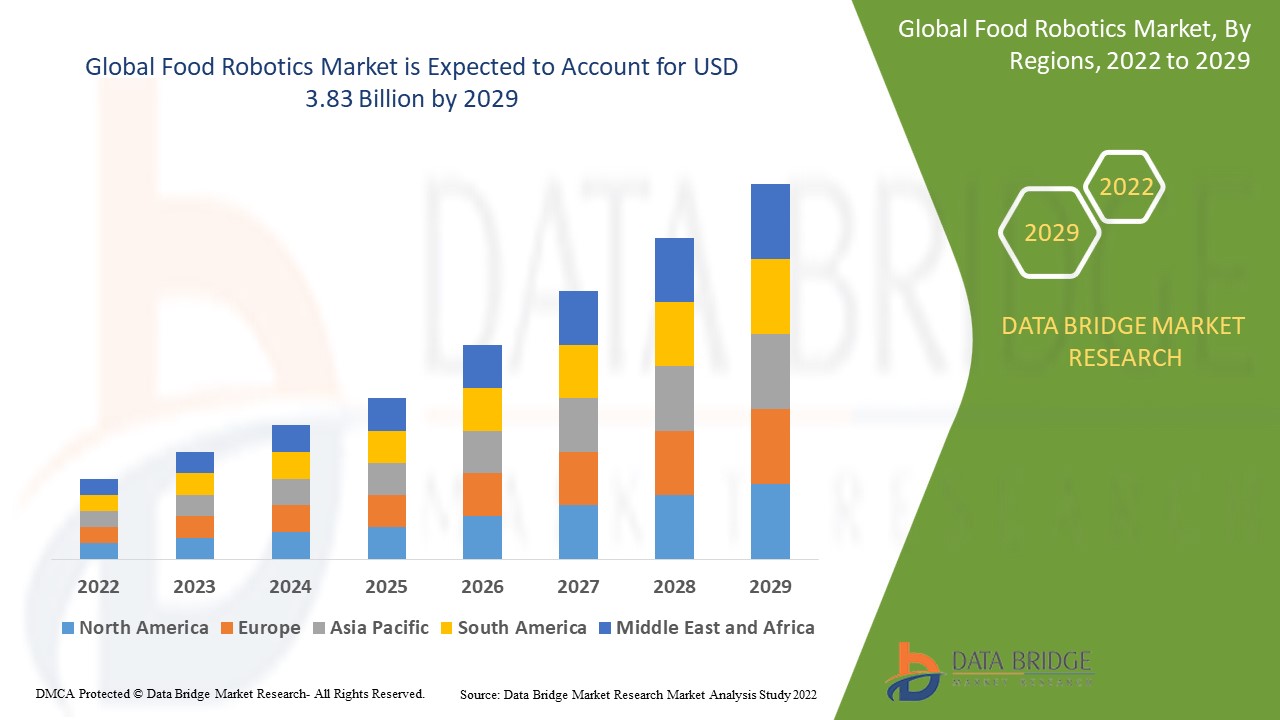
Data Bridge Market Research analyses that the food robotics market which was growing at a value of 1.4 billion in 2021 and is expected to reach the value of USD 3.83 billion by 2029, at a CAGR of 13.40% during the forecast period of 2022 to 2029.
Report Scope and Market Segmentation
|
Report Metric |
Details |
|
Forecast Period |
2022 to 2029 |
|
Base Year |
2021 |
|
Historic Years |
2020 (Customizable to 2019 - 2014) |
|
Quantitative Units |
Revenue in USD Billion, Volumes in Units, Pricing in USD |
|
Segments Covered |
Type (Articulates, Cartesian, Scara, Parallel, Cylindrical, Collaborative and Others), Application (Palletizing, Packaging, Repackaging, Pick and Place, Processing), Payload (Low, Medium, Heavy), End-Use Industry (Beverages, Meat, Poultry, Seafood, Dairy, Bakery, Fruits and Vegetables, Confectionery and Others) |
|
Countries Covered |
U.S., Canada, Mexico, Germany, Sweden, Poland, Denmark, Italy, U.K., France, Spain, Netherland, Belgium, Switzerland, Turkey, Russia, Rest of Europe, Japan, China, India, South Korea, New Zealand, Vietnam, Australia, Singapore, Malaysia, Thailand, Indonesia, Philippines, Rest of Global, Brazil, Argentina, Rest of South America, UAE, Saudi Arabia, Oman, Qatar, Kuwait, South Africa, Rest of Middle East and Africa |
|
Market Players Covered |
Marel (Iceland), GEA Group (Germany), Bühler (Switzerland), JBT (US), The Middleby Corporation (US), Heat and Control, Inc. (US), Alfa Laval (Sweden), TNA Australia Pty Ltd. (Australia), Bucher Industries (Switzerland), Equipamientos Cárnicos, S.L (Spain), Clextral (France), SPX FLOW (US), Bigtem Makine (Turkey), FENCO Food Machinery (Italy), Krones Group (Germany), Finis Food Robotics B.V. (Netherlands), Bettcher Industries, Inc. (US), Anko Food Machine Co. Ltd. (Taiwan), Heat and Control, Inc. (US), BAADER (Germany), and Dover Corporation (US) |
|
Opportunities |
|
Market Definition
Food robotics refers to machines that execute a number of complicated operations in the food and beverage sectors, such as picking, packing, and palletizing. Fictional robots have become a reality because to technical breakthroughs in a range of industries. Increased demand for increased productivity fuels the deployment of robots to automate tasks, resulting in robots becoming an integral part of a variety of industries.
Food Robotics Market Dynamics
Drivers
- Rising adoption of digitization in food industry
Digitalization optimizes business processes by utilising new digital technologies such as big data analytics, IT/OT convergence, digital twin, artificial intelligence, 3D printing, and automation technologies. IoT and AI are assisting businesses in achieving high levels of food safety, improving traceability, reducing waste, and lowering costs and risks at various stages of food processing and packaging. Digitalization has emerged as a critical enabler for automation in recent years, with AI boosting operational productivity by increasing workforce productivity. Various regulations govern the use of digitalization in the food and beverage industry.
- Growing demand in various applications
Due to their inherent advantages, such as quality control, durability, hygiene, and preservation, these systems are widely used in various applications, including bakery and confectionery, meat, seafood, and poultry, dairy, and grains. The product is becoming more widely used in end-use industries, particularly in Asia Pacific, where rising domestic manufacturing and consumer income levels are driving innovation in this sector.
Opportunity
To improve global food security, one must increase pollution control measures and reduce food losses. Standard and advanced robotics can easily achieve these solutions. Over the forecast period, this is expected to create opportunities for equipment manufacturers.
Restraints
The global food robotics market faces significant market challenges due to a lack of skilled labour. Lockdowns enacted as a result of the COVID-19 outbreak have caused major market constraint by shutting down businesses throughout economies. Incorporating IoT Technology in the food processing space, such as BAADER revamping its Food Robotics into modern digital solutions to create an automated food chain, is expected to positively drive the market in the coming years.
This food robotics market report provides details of new recent developments, trade regulations, import-export analysis, production analysis, value chain optimization, market share, impact of domestic and localized market players, analyses opportunities in terms of emerging revenue pockets, changes in market regulations, strategic market growth analysis, market size, category market growths, application niches and dominance, product approvals, product launches, geographic expansions, technological innovations in the market. To gain more info on the food robotics market contact Data Bridge Market Research for an Analyst Brief, our team will help you take an informed market decision to achieve market growth.
COVID-19 Impact on Food Robotics Market
Due to the infection, several countries imposed strict lockdowns, resulting in the shutdown of F&B processing plants and the disruption of the F&B supply chain for a limited time. The F&B supply chain has been impacted by a lack of F&B products and critical supplies, panic buying by consumers around the world, supply chain disruptions owing to travel restrictions, and labour shortages. During the first and second quarters of 2020, major robot manufacturing companies reported a loss in revenue due to lower sales caused by an economic slowdown induced by lockdown and quarantine restrictions enforced by governments around the world, as well as a temporary drop in demand for automation.
Recent Development
- Gea will introduce its new Xtru Twin 140 extruder in October 2021, rounding out its line of high-capacity output equipment. The most modern Xtru Twin 140 could produce over 3 tonnes of pellets and 10 tonnes of pet food kibbles each hour.
- SPX FLOW launched the New APV Pilot 4T Homogenizer equipment in June 2021, allowing customers to test a wide range of recipes in a single compact unit. This product would benefit food and beverage manufacturers. APV aided in the homogenization of an immiscible liquid into an emulsion
Global Food Robotics Market Scope
The food robotics market is segmented on the basis of type, application, payload and end-use. The growth amongst these segments will help you analyze meagre growth segments in the industries and provide the users with a valuable market overview and market insights to help them make strategic decisions for identifying core market applications.
Type
- Articulates
- Cartesian
- Scara
- Parallel
- Cylindrical
- Collaborative
- Others
Application
- Palletizing
- Packaging
- Repackaging
- Pick and Place
Payload
- Low
- Medium
- Heavy
End user
- Beverages
- Meat
- Poultry
- Seafood
- Dairy
- Bakery
- Fruits and Vegetables
- Confectionery
- Others
Food Robotics Market Regional Analysis/Insights
The food robotics market is analysed and market size insights and trends are provided by country, type, application, payload and end-use as referenced above.
The countries covered in the food robotics market report are U.S., Canada, Mexico, Germany, Sweden, Poland, Denmark, Italy, U.K., France, Spain, Netherland, Belgium, Switzerland, Turkey, Russia, Rest of Europe, Japan, China, India, South Korea, New Zealand, Vietnam, Australia, Singapore, Malaysia, Thailand, Indonesia, Philippines, Rest of Global, Brazil, Argentina, Rest of South America, UAE, Saudi Arabia, Oman, Qatar, Kuwait, South Africa, Rest of Middle East and Africa.
The Asia Pacific market is experiencing rapid growth as a result of its expanding economy, expanding industrial base of food processing units driven by rapid urbanization, and increasing demand for convenience food, which is driven by consumers' increasing disposable income and purchasing power. The region is expected to see a significant increase in demand for advanced food processing machinery that helps reduce processing time and improve manufacturing efficiency. The anticipated increase in the number of food processing units in this region is expected to boost the supply and consumption of food and beverage robotics. This is expected to have a positive impact on the region's food robotics market.
The country section of the report also provides individual market impacting factors and changes in market regulation that impact the current and future trends of the market. Data points like down-stream and upstream value chain analysis, technical trends and porter's five forces analysis, case studies are some of the pointers used to forecast the market scenario for individual countries. Also, the presence and availability of global brands and their challenges faced due to large or scarce competition from local and domestic brands, impact of domestic tariffs and trade routes are considered while providing forecast analysis of the country data.
Competitive Landscape and Food Robotics Market Share Analysis
The food robotics market competitive landscape provides details by competitor. Details included are company overview, company financials, revenue generated, market potential, investment in research and development, new market initiatives, global presence, production sites and facilities, production capacities, company strengths and weaknesses, product launch, product width and breadth, application dominance. The above data points provided are only related to the companies' focus related to food robotics market.
Some of the major players operating in the food robotics market are:
- Marel (Iceland)
- GEA Group (Germany)
- Bühler (Switzerland)
- JBT (US)
- The Middleby Corporation (US)
- Heat and Control, Inc. (US)
- Alfa Laval (Sweden)
- TNA Australia Pty Ltd. (Australia)
- Bucher Industries (Switzerland)
- Equipamientos Cárnicos, S.L (Spain)
- Clextral (France)
- SPX FLOW (US)
- Bigtem Makine (Turkey)
- FENCO Food Machinery (Italy)
- Krones Group (Germany)
- Finis Food Robotics B.V. (Netherlands)
- Bettcher Industries, Inc. (US)
- Anko Food Machine Co. Ltd. (Taiwan)
- Heat and Control, Inc. (US)
- BAADER (Germany)
- Dover Corporation (US)
SKU-

研究方法
数据收集和基准年分析是使用具有大样本量的数据收集模块完成的。该阶段包括通过各种来源和策略获取市场信息或相关数据。它包括提前检查和规划从过去获得的所有数据。它同样包括检查不同信息源中出现的信息不一致。使用市场统计和连贯模型分析和估计市场数据。此外,市场份额分析和关键趋势分析是市场报告中的主要成功因素。要了解更多信息,请请求分析师致电或下拉您的询问。
DBMR 研究团队使用的关键研究方法是数据三角测量,其中包括数据挖掘、数据变量对市场影响的分析和主要(行业专家)验证。数据模型包括供应商定位网格、市场时间线分析、市场概览和指南、公司定位网格、专利分析、定价分析、公司市场份额分析、测量标准、全球与区域和供应商份额分析。要了解有关研究方法的更多信息,请向我们的行业专家咨询。
可定制
Data Bridge Market Research 是高级形成性研究领域的领导者。我们为向现有和新客户提供符合其目标的数据和分析而感到自豪。报告可定制,包括目标品牌的价格趋势分析、了解其他国家的市场(索取国家列表)、临床试验结果数据、文献综述、翻新市场和产品基础分析。目标竞争对手的市场分析可以从基于技术的分析到市场组合策略进行分析。我们可以按照您所需的格式和数据样式添加您需要的任意数量的竞争对手数据。我们的分析师团队还可以为您提供原始 Excel 文件数据透视表(事实手册)中的数据,或者可以帮助您根据报告中的数据集创建演示文稿。











