Global Synthetic Spider Silk Market
市场规模(十亿美元)
CAGR :
%
USD
3.46 Billion
USD
10.58 Billion
2025
2033
| 2026 –2033 | |
| USD 3.46 Billion | |
| USD 10.58 Billion | |
|
|
|
|
全球合成蜘蛛絲市場細分,依產品類型(基因改造酵母發酵、基因改造蠶絲及基因改造大腸桿菌發酵)、應用領域(汽車、紡織、醫療保健、國防及其他)劃分-產業趨勢及至2033年的預測
合成蜘蛛絲市場規模
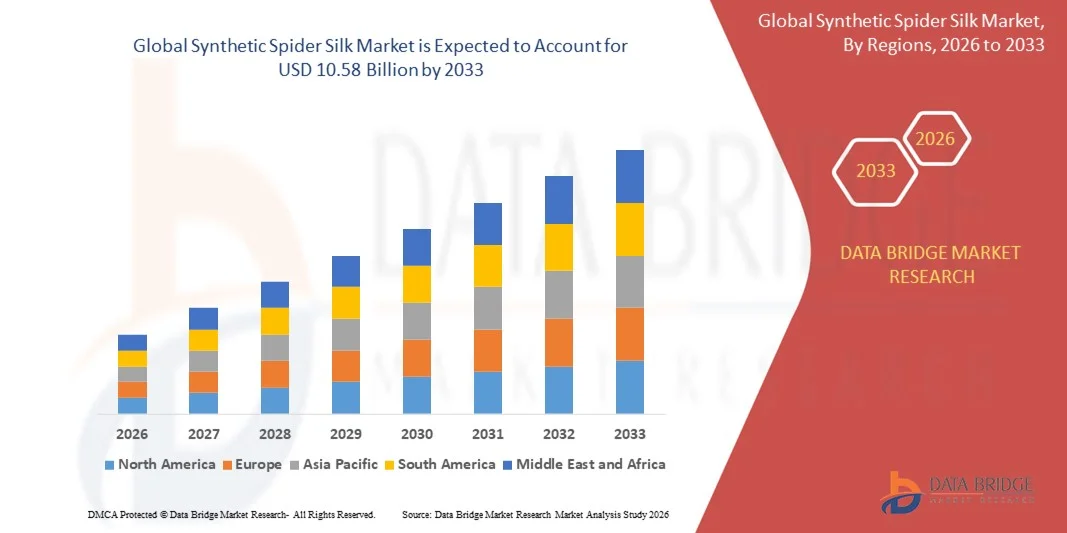
- 2025年全球合成蜘蛛絲市場規模為34.6億美元,預計2033年將達到105.8億美元,預測期內 複合年增長率為15%。
- 市場成長主要得益於生物技術和基因工程的快速發展,使得高效生產高性能合成蜘蛛絲成為可能,這些蜘蛛絲具有更高的強度、彈性和工業規模化的一致性。
- 此外,紡織、醫療保健、汽車和國防等產業對永續、輕質和高強度材料的需求不斷增長,使得合成蜘蛛絲成為傳統合成纖維的可行替代品。這些因素共同推動了生物工程蜘蛛絲解決方案的普及應用,從而顯著促進了整體市場成長。
合成蜘蛛絲市場分析
- 透過生物工程和發酵過程生產的合成蜘蛛絲,因其優異的機械性能、生物相容性和生物降解性,正成為一種在多種高價值應用中至關重要的先進材料。
- 對合成蜘蛛絲的需求不斷增長,主要驅動因素包括:以永續性為導向的材料創新、在醫療器材和再生醫學領域應用範圍的擴大,以及高性能紡織品和國防工業對耐用輕質材料的日益增長的需求。
- 由於生物技術的快速發展、紡織品製造能力的提升以及對生物基和可持續材料投資的增加,亞太地區預計將在2025年佔據合成蜘蛛絲市場47.01%的份額,成為該市場的主導地區。
- 由於生物技術創新強勁、研發投入高以及對先進生物材料的早期應用,預計北美將在預測期內成為合成蜘蛛絲市場成長最快的地區。
- 由於其可擴展性、穩定的蛋白質產量以及適用於工業規模生產,基因改造酵母發酵技術在2025年佔據了45.5%的市場份額,成為市場主導技術。酵母發酵能夠精確控制蜘蛛絲蛋白的合成,確保產品品質的均勻性並降低批次間的差異。由於該方法與現有生物反應器基礎設施相容且污染風險較低,因此備受製造商青睞。此外,該工藝還有助於長期優化成本,使其在商業紡織品和複合材料應用領域極具吸引力。與基因改造動物發酵方法相比,酵母發酵更容易獲得監管合規性,進一步鞏固了其市場主導地位。
報告範圍及合成蜘蛛絲市場細分
|
屬性 |
合成蜘蛛絲關鍵市場洞察 |
|
涵蓋部分 |
|
|
覆蓋國家/地區 |
北美洲
歐洲
亞太
中東和非洲
南美洲
|
|
主要市場參與者 |
|
|
市場機遇 |
|
|
加值資料資訊集 |
除了對市場狀況(如市場價值、成長率、細分、地理覆蓋範圍和主要參與者)的洞察之外,Data Bridge Market Research 精心編制的市場報告還包括進出口分析、產能概覽、生產消費分析、價格趨勢分析、氣候變遷情境、供應鏈分析、價值鏈分析、原材料/消耗標準概覽、供應商選擇、PESTLE 分析、五力分析和監管框架。 |
合成蜘蛛絲市場趨勢
生物工程和永續高性能纖維的應用日益廣泛
- A significant trend in the synthetic spider silk market is the rising adoption of bio-engineered and sustainable high-performance fibers, driven by growing demand for materials that combine superior strength, elasticity, and environmental compatibility. Industries are increasingly shifting away from petroleum-based synthetic fibers toward biofabricated alternatives that support sustainability goals while maintaining advanced mechanical performance
- For instance, Bolt Threads has actively developed and promoted engineered spider silk materials for apparel and performance textiles, demonstrating the commercial viability of bio-based fibers in premium markets. These developments are strengthening confidence among manufacturers and brands seeking sustainable material innovations
- The textile industry is increasingly integrating synthetic spider silk to produce lightweight, durable, and flexible fabrics that align with circular economy principles. This trend is supporting broader adoption in technical and high-end textile segments where performance and sustainability are equally critical
- Healthcare applications are also contributing to this trend, as bio-engineered spider silk is being explored for sutures, tissue scaffolds, and wound care products due to its biocompatibility and biodegradability. This is expanding the material’s relevance beyond conventional textile uses
- Research institutions and biotechnology firms are accelerating innovation in spider silk protein engineering to enhance fiber consistency and scalability. These advancements are reinforcing market momentum and supporting long-term adoption across multiple industries
- Overall, the growing preference for sustainable, bio-engineered high-performance fibers is reinforcing synthetic spider silk as a strategic material, supporting its transition from niche research applications to broader commercial deployment
Synthetic Spider Silk Market Dynamics
Driver
Advancements in Genetic Engineering and Fermentation Technologies
- Advancements in genetic engineering and fermentation technologies are a primary driver of growth in the synthetic spider silk market, as they enable precise replication and optimization of spider silk proteins at industrial scale. Improvements in gene editing, protein expression, and fermentation control are enhancing yield consistency and material performance. These technological developments are making synthetic spider silk more commercially viable across diverse applications
- For instance, Kraig Biocraft Laboratories, Inc. has advanced its genetic research by increasing the size and complexity of spider silk gene inserts, directly improving fiber strength and functional properties. Such progress is accelerating product differentiation and expanding potential end-use markets
- Fermentation-based production methods using genetically modified organisms are allowing manufacturers to achieve scalable and repeatable output while maintaining quality standards. This is particularly important for meeting growing demand from textile and biomedical industries
- Biotechnology firms are also benefiting from improved bioreactor designs and downstream processing techniques that reduce inefficiencies and support larger batch production. These advancements are lowering technical barriers to commercialization
- Collectively, ongoing progress in genetic engineering and fermentation technologies is reinforcing production scalability and performance reliability, positioning synthetic spider silk for sustained market growth
Restraint/Challenge
High Production Costs and Scaling Complexity
- The synthetic spider silk market faces notable challenges related to high production costs and the complexity of scaling biofabrication processes. Manufacturing spider silk proteins requires advanced genetic engineering, controlled fermentation environments, and sophisticated purification processes, all of which increase operational expenses. These factors limit cost competitiveness compared to conventional synthetic fibers
- For instance, AMSilk GmbH relies on highly controlled fermentation and protein purification systems to produce medical-grade spider silk materials, which demand significant capital investment and specialized expertise. Such requirements elevate production costs and restrict rapid capacity expansion
- Maintaining consistent quality at scale remains challenging, as minor variations in biological processes can impact fiber performance and yield. This increases the need for rigorous monitoring and quality control systems
- The reliance on specialized infrastructure and skilled scientific talent further adds to production complexity and operational costs. Smaller players may face difficulties entering the market due to these high entry barriers
- Scaling from pilot production to mass commercialization while preserving material properties continues to be a key constraint for manufacturers. Overall, high production costs and scaling challenges place pressure on companies to balance innovation, cost efficiency, and commercial feasibility, shaping the pace of market expansion
Synthetic Spider Silk Market Scope
The market is segmented on the basis of product type and application.
- By Product Type
On the basis of product type, the synthetic spider silk market is segmented into genetically modified yeast fermentation, genetically modified silkworm, and genetically modified E. coli fermentation. The genetically modified yeast fermentation segment dominated the market with the largest revenue share of 45.5% in 2025, driven by its scalability, consistent protein yield, and suitability for industrial-scale production. Yeast-based fermentation enables precise control over spider silk protein synthesis, ensuring uniform quality and reduced batch variability. Manufacturers favor this method due to its compatibility with existing bioreactor infrastructure and lower contamination risks. The process also supports cost optimization over time, making it attractive for commercial textile and composite applications. In addition, yeast fermentation allows easier regulatory compliance compared to transgenic animal-based methods, strengthening its dominance in the market.
The genetically modified silkworm segment is anticipated to witness the fastest growth rate during the forecast period, supported by its ability to produce spider silk fibers with mechanical properties closer to natural spider silk. This method integrates spider silk genes into silkworms, enabling direct fiber spinning without extensive downstream processing. Growing interest from high-performance textile and defense material developers is accelerating adoption. The approach also offers potential reductions in energy-intensive processing steps compared to fermentation-based routes. Advancements in genetic engineering and breeding efficiency are further improving yield consistency. As a result, genetically modified silkworms are gaining traction for premium and specialized end-use applications.
- By Application
On the basis of application, the synthetic spider silk market is segmented into automotive, textile, healthcare, defense, and others. The textile segment accounted for the largest market revenue share in 2025, driven by rising demand for lightweight, high-strength, and sustainable fibers. Synthetic spider silk offers superior tensile strength, elasticity, and biodegradability compared to conventional synthetic fibers, making it highly attractive for next-generation apparel and technical textiles. Fashion and performance wear brands are increasingly exploring spider silk to meet sustainability goals without compromising durability. The material’s softness and breathability further enhance its suitability for premium textile products. Continuous innovation in fiber spinning and weaving techniques is reinforcing the segment’s leading position.
The healthcare segment is expected to register the fastest growth over the forecast period, fueled by expanding use in sutures, tissue engineering, and regenerative medicine. Synthetic spider silk exhibits excellent biocompatibility and controlled biodegradability, making it suitable for implants and wound care products. Researchers are increasingly adopting spider silk scaffolds for cell growth due to their structural stability and minimal immune response. Rising investments in advanced biomaterials and medical biotechnology are accelerating commercialization. The ability to tailor protein structure for specific medical functions further enhances its adoption. Consequently, healthcare applications are emerging as the most rapidly expanding area for synthetic spider silk.
Synthetic Spider Silk Market Regional Analysis
- Asia-Pacific dominated the synthetic spider silk market with the largest revenue share of 47.01% in 2025, driven by rapid advancements in biotechnology, expanding textile manufacturing capabilities, and increasing investments in bio-based and sustainable materials
- The region’s strong fermentation infrastructure, cost-efficient production environment, and growing adoption of high-performance fibers across textile, automotive, and healthcare sectors are accelerating market expansion
- Supportive government initiatives for bioengineering, availability of skilled researchers, and rising demand for sustainable alternatives to conventional synthetic fibers are contributing to increased consumption of synthetic spider silk
China Synthetic Spider Silk Market Insight
China held the largest share in the Asia-Pacific synthetic spider silk market in 2025, supported by its strong biotechnology ecosystem, large-scale textile manufacturing base, and significant investments in advanced materials research. The country’s focus on sustainable industrial development, combined with its ability to scale fermentation and biofabrication processes, is driving commercial adoption. Growing demand from high-performance textiles, medical materials, and defense-related applications further supports market growth.
India Synthetic Spider Silk Market Insight
India is witnessing the fastest growth in the Asia-Pacific region, fueled by expanding biotechnology research, rising investments in sustainable textiles, and growing collaboration between academic institutions and startups. Government support for bio-based manufacturing and innovation-driven programs is strengthening domestic capabilities. Increasing interest from healthcare and advanced textile manufacturers is further accelerating market expansion.
Europe Synthetic Spider Silk Market Insight
歐洲合成蜘蛛絲市場正穩步擴張,這主要得益於對永續發展的高度重視、先進的生物材料研究以及鼓勵生物基替代品的嚴格環境法規。該地區完善的研發基礎設施以及醫療保健和汽車應用領域對高性能纖維日益增長的需求是關鍵的成長驅動力。生物製造技術的持續創新也進一步促進了區域市場的發展。
德國合成蜘蛛絲市場洞察
德國合成蜘蛛絲市場的發展得益於其在先進材料工程領域的領先地位、強大的生物技術研究實力以及產業界與學術機構的緊密合作。德國對精密製造和永續材料解決方案的重視,正推動合成蜘蛛絲在汽車、醫療和工業紡織品等領域的應用。對研發和創新的大力投入也持續支撐著市場成長。
英國合成蜘蛛絲市場洞察
英國市場受益於強大的生命科學產業、活躍的仿生材料研究以及對永續製造技術日益增長的投資。產學合作和新創企業驅動的創新正在加速合成蜘蛛絲應用的發展。醫療保健、國防和特種紡織品領域的需求尤其增長迅速。
北美合成蜘蛛絲市場洞察
預計2026年至2033年間,北美將以最快的複合年增長率成長,這主要得益於強勁的生物技術創新、高額的研發投入以及先進生物材料的早期應用。醫療器材、組織工程和國防應用領域日益增長的需求也推動了市場擴張。該地區對生物工程材料商業化的重視進一步增強了其成長前景。
美國合成蜘蛛絲市場洞察
預計到2025年,美國將佔據北美市場最大份額,這主要得益於其先進的生物技術基礎設施、強大的研發企業以及對生物材料創新的大量投入。美國在醫學研究、國防應用和永續材料開發領域的領先地位正在加速生物材料的應用。完善的商業化路徑和投資者的濃厚興趣也持續鞏固美國的領先地位。
合成蜘蛛絲市佔率
合成蜘蛛絲產業主要由一些老牌企業主導,其中包括:
- Kraig Biocraft Laboratories, Inc.(美國)
- AMSilk GmbH(德國)
- 螺栓螺紋(美國)
- 斯派伯株式會社(日本)
- 希臘絲綢公司(希臘)
- 查蒙迪紡織(絲綢工廠)有限公司(印度)
- 安徽絲綢(中國)
- 中庭集團控股有限公司(中國)
- Ongetta srl unipersonale(義大利)
- Seevix(美國)
- 浙江嘉欣絲綢有限公司 (中國)
- 四川南充六和(集團)有限公司 (中國)
- 盛坤絲綢製造有限公司(中國)
- 中國中思集團有限公司(中國)
- Spiber Technologies(日本)
全球合成蜘蛛絲市場最新發展動態
- 2025年4月,Kraig Biocraft Laboratories, Inc.為其SpydaSilk品牌註冊了四項商標,從而鞏固了其在合成蜘蛛絲市場的商業地位,加強了品牌保護,並支持其進軍高端服裝領域的戰略。此舉提升了市場知名度,建立了消費者信任,並透過品牌蜘蛛絲產品實現了長期收益成長。
- 2025年2月,Kraig Biocraft Laboratories, Inc. 在其基因研究計畫中取得重大突破,透過增加蜘蛛絲基因插入包的尺寸和複雜性,直接提升了材料的強度和性能。這項進展加速了產品差異化,並支持合成蜘蛛絲在高性能紡織品和國防領域的更廣泛應用。
- 2024年6月,生醫新創公司PrintyMed宣布計畫開始出口人造蜘蛛絲產品,標誌著該公司從研發階段邁向國際商業化。此舉擴大了其全球市場覆蓋範圍,並凸顯了生物醫學和再生醫學領域對蜘蛛絲日益增長的需求。
- 2024年3月,AMSilk GmbH擴大了其生物合成蜘蛛絲蛋白的工業化生產規模,以滿足醫療和技術紡織品製造商日益增長的需求。此舉透過提高生產一致性、擴大應用範圍以及鞏固歐洲在先進生物材料領域的地位,促進了市場成長。
- 2024年1月,Bolt Threads公司透過與服裝和高性能材料合作夥伴擴大合作,推進了其工程化蜘蛛絲材料的商業化進程。這項進展驗證了蜘蛛絲的可擴展性,並強化了其作為傳統合成纖維可持續替代品的潛力,從而加速了市場滲透。
SKU-
Get online access to the report on the World's First Market Intelligence Cloud
- Interactive Data Analysis Dashboard
- Company Analysis Dashboard for high growth potential opportunities
- Research Analyst Access for customization & queries
- Competitor Analysis with Interactive dashboard
- Latest News, Updates & Trend analysis
- Harness the Power of Benchmark Analysis for Comprehensive Competitor Tracking
研究方法
数据收集和基准年分析是使用具有大样本量的数据收集模块完成的。该阶段包括通过各种来源和策略获取市场信息或相关数据。它包括提前检查和规划从过去获得的所有数据。它同样包括检查不同信息源中出现的信息不一致。使用市场统计和连贯模型分析和估计市场数据。此外,市场份额分析和关键趋势分析是市场报告中的主要成功因素。要了解更多信息,请请求分析师致电或下拉您的询问。
DBMR 研究团队使用的关键研究方法是数据三角测量,其中包括数据挖掘、数据变量对市场影响的分析和主要(行业专家)验证。数据模型包括供应商定位网格、市场时间线分析、市场概览和指南、公司定位网格、专利分析、定价分析、公司市场份额分析、测量标准、全球与区域和供应商份额分析。要了解有关研究方法的更多信息,请向我们的行业专家咨询。
可定制
Data Bridge Market Research 是高级形成性研究领域的领导者。我们为向现有和新客户提供符合其目标的数据和分析而感到自豪。报告可定制,包括目标品牌的价格趋势分析、了解其他国家的市场(索取国家列表)、临床试验结果数据、文献综述、翻新市场和产品基础分析。目标竞争对手的市场分析可以从基于技术的分析到市场组合策略进行分析。我们可以按照您所需的格式和数据样式添加您需要的任意数量的竞争对手数据。我们的分析师团队还可以为您提供原始 Excel 文件数据透视表(事实手册)中的数据,或者可以帮助您根据报告中的数据集创建演示文稿。