


Global Emergency Medical Service (EMS) Products Market Segmentation, By Type (Patient Monitoring Systems, Wound Care Consumables, Patient Handling Equipment, Life Support and Emergency Resuscitation Equipment, Infection Control Supplies, Personal Protection Equipment, Pharmaceuticals, Tactical Equipment, and Others), Application (Cardiac Care, Trauma Care, Respiratory Care, Oncology, and Others), End User (Hospital, Trauma Centers, Ambulatory Surgical Centers, and Others) - Industry Trends and Forecast to 2033
¿Cuál es el Servicio Médico de Emergencia (EMS) Productos Tamaño del mercado y tasa de crecimiento
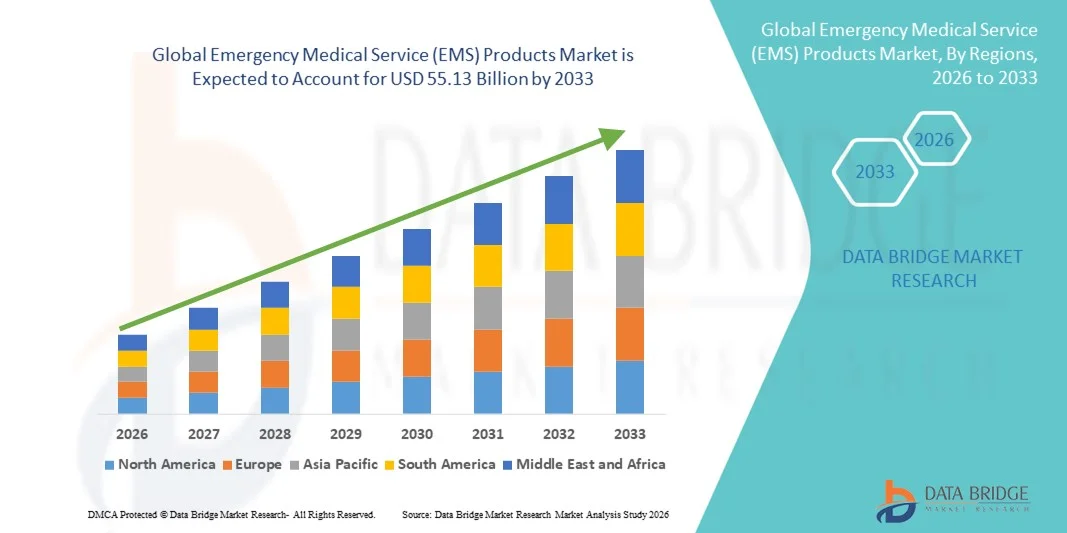
- De acuerdo con Data Bridge Market Research Analysis, el tamaño del mercado mundial de servicios médicos de emergencia (EMS) fue valorado enUSD 33.19 billion in 2025y se espera que alcanceUSD 55.13 billion by 2033, aCAGR of 6.55%durante el período previsto
- El crecimiento del mercado se ve alimentado en gran medida por la creciente incidencia de casos de trauma, emergencias cardiovasculares y accidentes de tránsito, junto con avances continuos en tecnologías de atención prehospitalaria y equipos portátiles para salvar vidas en los sistemas sanitarios
- Además, el aumento de las inversiones gubernamentales en la infraestructura de respuesta de emergencia, el aumento de la concienciación sobre la intervención médica temprana y la creciente demanda de equipo médico avanzado, fiable y de respuesta rápida están estableciendo productos del Servicio Médico de Emergencia como componentes críticos de los sistemas de atención de salud modernos. Estos factores convergentes están acelerando la captación de productos de EMS, lo que aumenta significativamente el crecimiento de la industria
Tamaño del mercado
- Valor mundial del mercado (2025):USD 33.19 billion in 2025
- Valor de mercado esperado (2033):USD 55.13 billion by 2033
- CAGR prefabricado (2026–2033):6.55%
Servicio Médico de Emergencia (EMS) Productos Análisis de Mercado
- Productos del Servicio Médico de Emergencia, incluidos los desfibriladores,sistemas de monitoreo de pacientes, dispositivos de gestión de las vías aéreas, camillas y kits de atención de traumas, son componentes cada vez más vitales de los modernos sistemas de atención prehospitalaria y de emergencia debido a su capacidad para realizar intervenciones rápidas y de salvar vidas y mejorar los resultados de supervivencia del paciente
- La creciente demanda de productos de EMS se alimenta principalmente de la creciente incidencia de casos de trauma, detenciones cardiacas, accidentes de tránsito y desastres naturales, junto con el creciente énfasis en el fortalecimiento de la infraestructura de respuesta de emergencia y la reducción de la mortalidad mediante intervenciones médicas tempranas
- América del Norte dominaba el mercado de productos de servicios médicos de emergencia (EMS) con la mayor cuota de ingresos del 37,4% en 2025, caracterizada por sistemas de respuesta de emergencia bien establecidos, alto gasto sanitario, infraestructura avanzada de ambulancias y fuerte presencia de los principales fabricantes de dispositivos médicos. Estados Unidos representa una parte importante de la demanda regional debido a las continuas mejoras en el equipo de emergencia y la adopción generalizada de tecnologías avanzadas de apoyo a la vida
- Se espera que Asia-Pacífico sea la región de más rápido crecimiento en el mercado de productos del servicio médico de emergencia (EMS) durante el período previsto, expandiéndose en una CAGR de 8,9% de 2026 a 2033, impulsada por el aumento de la urbanización, el aumento de las inversiones sanitarias, la ampliación de las redes de ambulancias y la creciente conciencia sobre la preparación médica de emergencia en las economías emergentes
- El segmento Cardiac Care dominaba con una cuota de ingresos del 34,8% en 2025, apoyada por la alta carga global de enfermedades cardiovasculares y detenciones cardiacas súbitas
Report Scope and Emergency Medical Service (EMS) Products Market Segmentation
|
Atributos |
Servicio Médico de Emergencia (EMS) Productos Insights del Mercado Clave |
|
Segmentos cubiertos |
|
|
Países cubiertos |
América del Norte
Europa
Asia y el Pacífico
Oriente Medio y África
América del Sur
|
|
Principales jugadores del mercado |
|
|
Oportunidades de mercado |
|
|
Valor añadido Data Infosets |
Además de las ideas sobre escenarios de mercado como el valor de mercado, la tasa de crecimiento, la segmentación, la cobertura geográfica y los principales actores, los informes de mercado comisariados por Data Bridge Market Research también incluyen análisis profundos de expertos, epidemiología de pacientes, análisis de tuberías, análisis de precios y marco regulatorio. |
¿Cuál es la tendencia clave en los productos del servicio médico de emergencia
Avances tecnológicos en equipo portátil y conectado de emergencia
- Una tendencia significativa y aceleradora en el mercado mundial de productos de servicios médicos de emergencia (EMS) es el rápido avance de dispositivos portátiles, ligeros y conectados de emergencia diseñados para mejorar la eficiencia de respuesta y los resultados de los pacientes en entornos prehospitales
- Productos EMS modernos como avanzadosdesfibriladores, ventiladores portátiles, dispositivos automatizados de RCP y monitores de pacientes de varios parámetros están siendo cada vez más diseñados con diseños compactos y mayor durabilidad para soportar entornos exigentes de campo
- Por ejemplo, los desfibriladores externos automatizados de próxima generación (AED) y los ventiladores de transporte ahora incorporan capacidades de transmisión de datos en tiempo real, lo que permite a los paramédicos compartir las vitales de los pacientes directamente con los departamentos de emergencia del hospital antes de la llegada.
- La integración de la conectividad inalámbrica y los sistemas de presentación de informes basados en la nube permite a los equipos EMS documentar los casos digitalmente, simplificar los flujos de trabajo y mejorar la coordinación con los centros de trauma
- Además, los fabricantes se centran en la eficiencia de la batería, la construcción robusta y los diseños ergonómicos para asegurar el despliegue rápido durante emergencias críticas, como paro cardíaco, lesiones de trauma y problemas respiratorios
- Esta tendencia hacia los equipos EMS avanzados, fiables e interoperables desde el punto de vista tecnológico está transformando la prestación de atención prehospitalaria y aumentando la demanda en los servicios de ambulancia pública, los proveedores privados de EMS, las unidades médicas militares y las organizaciones de respuesta ante desastres
Servicio Médico de Emergencia (EMS) Productos Dinámica del Mercado
Conductor
Aumento de la incidencia de casos de trauma y ampliación de la infraestructura sanitaria de emergencia
- El aumento de la prevalencia de accidentes de tránsito, enfermedades cardiovasculares, desastres naturales y otras emergencias médicas es un importante impulsor de la demanda de productos del SGA a nivel mundial
- Los gobiernos y las autoridades sanitarias están invirtiendo significativamente en fortalecer los sistemas de respuesta de emergencia, ampliar las flotas de ambulancias y mejorar el equipo médico que salva vidas para reducir las tasas de mortalidad
- Por ejemplo, varios países en desarrollo están ejecutando programas nacionales de respuesta a las emergencias encaminados a mejorar la accesibilidad de las ambulancias en las regiones rurales y semiurbanas, con lo que se recurre a la adquisición de camillas, kits de reanimación, dispositivos de gestión de las vías aéreas y sistemas de vigilancia.
- La creciente carga de detenciones cardiacas y trastornos respiratorios también ha llevado a una mayor adopción de desfibriladores, sistemas de entrega de oxígeno y equipos avanzados de gestión de las vías respiratorias en ambulancias y espacios públicos
- Además, el aumento de la conciencia acerca de la importancia de la intervención médica oportuna y de la mejora de los marcos de reembolso en las economías desarrolladas están acelerando la modernización de la infraestructura de los SGA
- La ampliación de los servicios privados de ambulancia y las redes de ambulancias aéreas contribuye aún más al crecimiento sostenido del mercado en las regiones desarrolladas y emergentes
Restraint/Challenge
Altos costos de equipo y restricciones del presupuesto operacional
- El alto costo asociado con equipos avanzados de EMS, incluidos monitores cardíacos, ventiladores de transporte, camillas eléctricas y dispositivos automatizados de RCP, plantea un desafío importante a la adopción generalizada, especialmente en los países de ingresos bajos y medianos
- Los sistemas de salud pública de muchas regiones funcionan con presupuestos limitados, lo que puede restringir las adquisiciones a gran escala y sustituir oportunamente el equipo anticuado
- Los gastos de mantenimiento, los requisitos de calibración y la necesidad de mejoras regulares aumentan aún más el costo total de propiedad de los proveedores de SMS
- Por ejemplo, las disparidades en la infraestructura sanitaria de emergencia entre las zonas urbanas y rurales pueden limitar el acceso equitativo a productos avanzados del SGA
- El requisito de la capacitación especializada para el funcionamiento de sistemas sofisticados de apoyo a la vida también constituye un obstáculo, ya que la capacitación inadecuada puede reducir la eficiencia de la utilización del equipo
- Hacer frente a estos desafíos mediante la innovación rentable de los productos, el apoyo financiero gubernamental, las asociaciones entre los sectores público y privado y los programas de capacitación estructurados será fundamental para garantizar un crecimiento sostenible en el mercado de productos del Servicio Médico de Emergencia
Servicio Médico de Emergencia (EMS) Productos Ámbito de Mercado
El mercado se segmenta por tipo, aplicación y usuario final.
- Por tipo
Sobre la base del tipo, el mercado de productos del Servicio Médico de Emergencia se segmenta en sistemas de monitorización de pacientes, consumibles de cuidado de heridos,Equipo de manejo de pacientes, Life Support and Emergency Resuscitation Equipment, Infection Control Supplies, Personal Protection Equipment, Pharmaceuticals, Tactical Equipment, and Others. El segmento Life Support and Emergency Resuscitation Equipment dominó la mayor parte de ingresos del mercado del 29,7% en 2025, impulsada por la necesidad crítica de desfibriladores, ventiladores, sistemas de suministro de oxígeno y herramientas avanzadas de gestión de las vías respiratorias en entornos prehospitales. La creciente incidencia de detenciones cardiacas, lesiones por trauma y emergencias respiratorias a nivel mundial fortalece la demanda. Los proveedores de EMS priorizan dispositivos avanzados de ahorro de vidas para mejorar las tasas de supervivencia. Las inversiones gubernamentales en programas de modernización de ambulancias apoyan aún más la adopción. Los avances tecnológicos como los desfibriladores externos automatizados (AED) y los ventiladores portátiles aumentan la eficiencia. La conciencia creciente respecto a la resucitación temprana en casos de paro cardíaco fuera de la hospitalidad contribuye a la dominación. Aumentar los programas de capacitación para los paramédicos amplían las tasas de utilización. La integración de funciones de monitoreo inteligente mejora los resultados del paciente. La expansión de la infraestructura de emergencia en las economías emergentes sostiene el crecimiento de los ingresos.
Se espera que el segmento de Sistemas de Monitoreo de Pacientes sea testigo de la CAGR más rápida del 18,5% entre 2026 y 2033, alimentada por la creciente demanda de seguimiento de señales vitales en tiempo real durante el transporte de emergencia. Los monitores cardíacos portátiles, dispositivos ECG y monitores multiparamétricos están cada vez más integrados en ambulancias. La creciente adopción de tecnologías inalámbricas y conectadas de EMS acelera la expansión de segmentos. El aumento de la prevalencia de enfermedades crónicas, como trastornos cardiovasculares y respiratorios, favorece el crecimiento. La innovación tecnológica en dispositivos de monitoreo compactos y portátiles mejora la usabilidad. Aumentar el énfasis en la transmisión remota de datos a los hospitales mejora la preparación para situaciones de emergencia. Los mandatos gubernamentales para la atención prehospitalaria avanzada refuerzan la adopción. La ampliación de los servicios de tele-EMS favorece aún más la demanda. Mejoras continuas en la vida de la batería y la portabilidad del dispositivo mejora la penetración del mercado.
- By Application
Sobre la base de la aplicación, el mercado de productos del Servicio Médico de Emergencia (EMS) se segmenta en el cuidado cardíaco,Trauma Care, Cuidado respiratorio, oncología y otros. El segmento Cardiac Care dominó con una cuota de ingresos del 34,8% en 2025, apoyada por la alta carga global de enfermedades cardiovasculares y detenciones cardiacas súbitas. Despliegue rápido de los desfibriladores y equipos de monitoreo cardíaco en las unidades de ambulancias demandan. El aumento de los programas de desfibrilación de acceso público fortalece aún más el crecimiento. Los equipos de EMS priorizan la gestión de emergencia cardiaca debido al alto riesgo de mortalidad. Aumento de las campañas de sensibilización sobre la adopción temprana de productos de apoyo al uso de la RCP y la AED. La integración tecnológica con unidades cardiacas hospitalarias mejora la continuidad de la atención del paciente. Aumentar la población geriátrica a nivel mundial aumenta las emergencias cardíacas. Las políticas de reembolso favorables en los mercados desarrollados contribuyen al dominio. La innovación continua en dispositivos cardíacos compactos sustenta el liderazgo de ingresos.
Se prevé que el segmento Trauma Care registrará el CAGR más rápido del 17,9% entre 2026 y 2033, impulsado por el aumento de accidentes de carretera, lesiones en el lugar de trabajo y desastres naturales en todo el mundo. Los proveedores de EMS requieren kits de trauma avanzados, productos de control de hemorragias y dispositivos de inmovilización. La creciente urbanización e industrialización aumentan las tasas de incidencia de traumas. Iniciativas gubernamentales para fortalecer la expansión de la infraestructura de respuesta de emergencia. Aumentar la demanda de sistemas de respuesta rápida aumenta la captación de productos. El aumento de la conciencia sobre la preparación para emergencias y primeros auxilios contribuye al crecimiento. Los avances tecnológicos en el equipo portátil de traumas aceleran aún más la adopción. Ampliar las flotas de ambulancias a nivel mundial sostienen el impulso de CAGR a largo plazo.
- Por Usuario final
Sobre la base del usuario final, el mercado de productos del Servicio Médico de Emergencia se segmenta en Hospital, Centros de Trauma, Centros Quirúrgicos Ambulatorios y Otros. El segmento de Hospitales representó la mayor cuota de ingresos del mercado del 47,6% en 2025, impulsada por la alta entrada de pacientes de casos de emergencia y la necesidad de una gestión integrada de atención aguda. Los hospitales mantienen equipos avanzados de EMS para departamentos de emergencia y unidades de atención crítica. Aumentar el desarrollo de la infraestructura sanitaria a nivel mundial fortalece la adopción. La colaboración entre los proveedores de EMS y las redes hospitalarias aumenta la demanda. La disponibilidad de profesionales sanitarios calificados apoya la utilización. Aumentar las inversiones en los programas de preparación para emergencias sostienen el dominio. El aumento de la prevalencia de enfermedades crónicas que requieren atención de emergencia apoya aún más el crecimiento de los ingresos. Los avances tecnológicos en los sistemas hospitalarios de emergencia mejoran la eficiencia.
Se prevé que el segmento de Centros Trauma sea testigo de la CAGR más rápida de 18,1% de 2026 a 2033, alimentada por el aumento del establecimiento de instalaciones especializadas de trauma en todo el mundo. Aumentar la concentración del gobierno en unidades dedicadas a la respuesta a los traumas acelera el crecimiento. Los centros de trauma requieren equipos avanzados de reanimación, monitoreo y soporte quirúrgico. El aumento de los casos de lesiones graves y accidentes refuerza la demanda. Una mejor coordinación entre el SEM y los centros de traumatología mejora los resultados de los pacientes. Las mejoras tecnológicas en el equipo quirúrgico de emergencia aumentan aún más la adopción. La expansión de redes especializadas de trauma en las economías emergentes mantiene una rápida expansión del mercado.
Servicio Médico de Emergencia (EMS) Productos Análisis Regional del Mercado
- América del Norte dominaba el mercado de productos de servicios médicos de emergencia con la mayor cuota de ingresos del 37,4% en 2025, caracterizada por sistemas de respuesta de emergencia bien establecidos, altos gastos de salud, infraestructura avanzada de ambulancias y una fuerte presencia de fabricantes líderes de dispositivos médicos
- La región se beneficia de servicios estructurados paramédicos, redes rápidas de respuesta a emergencias y actualizaciones tecnológicas continuas en ambulancias equipadas con sistemas avanzados de soporte vital
- El mercado representa una parte importante de la demanda regional debido a la modernización continua del equipo de emergencia, el aumento de la adquisición de desfibriladores y ventiladores, y la adopción generalizada de tecnologías avanzadas prehospitalarias de apoyo a la vida
Servicio Médico de Emergencia de Estados Unidos (EMS) Productos Insight
El mercado de productos de servicios médicos de emergencia de EE.UU. capturó la mayor cuota de ingresos dentro de América del Norte en 2025, con el apoyo de fuertes inversiones federales y estatales en infraestructura de salud de emergencia. El país cuenta con un marco de SEM altamente organizado que integra ambulancias terrestres, ambulancias aéreas y unidades especializadas de respuesta a los traumas. La sustitución continua de equipos anticuados con monitores cardíacos avanzados tecnológicamente, dispositivos automatizados de RCP, ventiladores de transporte y sistemas de manipulación de pacientes está impulsando una demanda sostenida. La creciente incidencia de detenciones cardiacas, lesiones por traumatismos y emergencias respiratorias apoya aún más la adopción del producto. Además, las sólidas estructuras de reembolso, el énfasis en la capacitación paramédica y la presencia de los principales fabricantes mundiales contribuyen a la expansión constante del mercado de productos EMS en los Estados Unidos.
Europe Emergency Medical Service (EMS) Productos Market Insight
Se prevé que el mercado de productos del servicio médico de emergencia en Europa se expanda en un CAGR considerable durante todo el período previsto, impulsado por sistemas de salud pública bien desarrollados y protocolos estrictos de atención de emergencia. Los países de toda la región están invirtiendo en mejorar las flotas de ambulancias con equipos avanzados de vigilancia y soporte vital para mejorar las tasas de supervivencia de los pacientes. El enfoque regulatorio para mejorar las normas de atención prehospitalaria y los tiempos de respuesta es fomentar la adquisición de modernos dispositivos EMS. Además, el aumento de las poblaciones geriátricas y el aumento de la prevalencia crónica de enfermedades contribuyen a aumentar los volúmenes de llamadas de emergencia. El enfoque de la región en las iniciativas transfronterizas de coordinación de emergencia y preparación para casos de desastre también apoya el crecimiento continuo del mercado.
U.K. Emergency Medical Service (EMS) Products Market Insight
Se prevé que el mercado de productos del servicio médico de emergencia (EMS) de los Estados Unidos crezca en una CAGR notable durante el período previsto, con el apoyo de mejoras continuas en los servicios de atención de emergencia del Servicio Nacional de Salud (NHS). Las inversiones en programas de modernización de ambulancias y sistemas digitales de grabación de datos de pacientes están fortaleciendo la demanda de equipos. Los crecientes casos de condiciones cardiovasculares y accidentes de tránsito están impulsando la necesidad de desfibriladores avanzados, herramientas de manejo de vías aéreas y dispositivos de monitoreo. Además, el énfasis del Reino Unido en reducir los tiempos de respuesta de emergencia y mejorar los servicios comunitarios de paramedicina está fomentando la adopción de equipos portátiles y eficientes de EMS. Las iniciativas en curso de capacitación del personal también garantizan una utilización óptima de las tecnologías médicas avanzadas.
Germany Emergency Medical Service (EMS) Products Market Insight
Se espera que el mercado de productos del servicio médico de emergencia de Alemania se amplíe en un CAGR considerable durante el período previsto, alimentado por la sólida infraestructura sanitaria del país y los altos estándares de atención médica de emergencia. Los centros de trauma avanzados de Alemania y los servicios de ambulancia integrados requieren un equipo sofisticado para la intervención rápida. Cada vez más hincapié en la innovación tecnológica y la automatización en los vehículos de atención de emergencia está acelerando la demanda de sistemas de monitoreo de pacientes de alto rendimiento y dispositivos de reanimación. Además, el apoyo gubernamental a los programas de preparación para la gestión de desastres y capacitación médica de emergencia refuerza aún más la adopción de productos. La experiencia de ingeniería del país también apoya la fabricación y personalización locales de soluciones EMS.
Servicio Médico de Emergencia de Asia y el Pacífico (EMS) Productos Insight
Se espera que el mercado de productos de servicios médicos de emergencia de Asia y el Pacífico sea la región de más rápido crecimiento, expandiéndose en una CAGR de 8,9% de 2026 a 2033, impulsada por la creciente urbanización, el aumento de las inversiones sanitarias y la expansión de las redes de ambulancias en las economías emergentes. Los gobiernos de países como China, la India, el Japón y Corea del Sur están dando prioridad a las mejoras en la accesibilidad y la eficacia de la respuesta sanitaria de emergencia. El rápido desarrollo de la infraestructura, el crecimiento de la población y el aumento de los accidentes de tránsito por carretera aumentan considerablemente la demanda de equipo de gestión ambiental. Además, el aumento de la conciencia sobre la preparación médica de emergencia y las reformas reglamentarias de apoyo están acelerando la adquisición de dispositivos avanzados de apoyo a la vida. El mejoramiento de los gastos sanitarios y la ampliación de los servicios de ambulancia privada contribuyen aún más al crecimiento sostenido.
Japan Emergency Medical Service (EMS) Productos Market Insight
El mercado de productos del servicio médico de emergencia de Japón está ganando una tracción constante debido al sistema de respuesta de emergencia altamente estructurado del país y a la infraestructura sanitaria avanzada. La población envejecida de Japón aumenta considerablemente la demanda de servicios médicos de respuesta rápida y equipos de atención prehospitalaria eficientes. La innovación tecnológica continua en dispositivos médicos, junto con fuertes estándares de calidad, impulsa la adopción de productos compactos y de alta precisión de EMS. Las iniciativas gubernamentales para mejorar la preparación para casos de desastre, en particular en respuesta a los terremotos y las calamidades naturales, estimulan aún más la inversión en equipo médico de emergencia. Además, la integración de los registros de salud digitales dentro de las ambulancias está mejorando la coordinación entre los equipos de EMS y los hospitales.
China Emergency Medical Service (EMS) Productos Market Insight
El mercado de productos de servicios médicos de emergencia de China representó la mayor cuota de ingresos del mercado en Asia y el Pacífico en 2025, atribuida al rápido desarrollo de la infraestructura sanitaria y la ampliación de las capacidades de respuesta de emergencia. El país está invirtiendo significativamente en mejorar las flotas de ambulancias y equiparlas con sistemas modernos de apoyo a la vida y vigilancia. El aumento de las poblaciones urbanas y el aumento de los incidentes de tráfico por carretera están impulsando la demanda de soluciones eficaces de atención prehospitalaria. Las reformas gubernamentales encaminadas a fortalecer las redes médicas de emergencia en las regiones urbanas y rurales están acelerando la adquisición de productos. Además, la presencia de fabricantes de dispositivos médicos domésticos y el creciente gasto sanitario están apoyando una mayor accesibilidad y asequibilidad de los productos de EMS en China.
¿Cuáles son las mejores empresas en productos de servicio médico de emergencia
La industria de productos del Servicio Médico de Emergencia está dirigida principalmente por empresas bien establecidas, incluyendo:
- Stryker Corporation (Estados Unidos)
- ZOLL Medical Corporation (Estados Unidos)
- Philips Healthcare (Países Bajos)
- Medtronic plc (Irlanda)
- GE HealthCare (Estados Unidos)
- Smith & Nephew plc (U.K.)
- 3M Company (U.S.)
- Cardinal Health, Inc.
- Becton, Dickinson and Company (Estados Unidos)
- Johnson & Johnson (Estados Unidos)
- Ambu A/S (Dinamarca)
- Ferno-Washington, Inc. (U.S.)
- Drägerwerk AG " Co. KGaA (Alemania)
- Hillrom (U.S.)
- Teleflex Incorporated (Estados Unidos)
- Spencer Italia S.r.l. (Italia)
- Nihon Kohden Corporation (Japón)
- Asahi Kasei Corporation (Japón)
- Mindray Medical International Limited (China)
- Braun Melsungen AG (Alemania)
Novedades en el mercado mundial de productos del servicio médico de emergencia
- En mayo de 2023, Philips Healthcare completó el despliegue de su kit de diagnóstico móvil ECG en 2.500 ambulancias en el Reino Unido, permitiendo al personal médico de emergencia realizar evaluaciones cardiacas in situ y transmitir datos en tiempo real, mejorando significativamente la atención cardiaca prehospitalaria y el diagnóstico precoz durante las respuestas de emergencia
- En octubre de 2023, Stryker Corporation lanzó su próxima generación LIFEPAK CR2 AED, un robusto y conectado Wi-Fi desfibrilador externo automatizado diseñado para el uso de EMS con conectividad de datos en tiempo real, orientación CPR y funciones remotas de presentación de informes de eventos: mejora de los flujos de trabajo y apoyo a las decisiones paramédicas
- En junio de 2023, Ferno-Washington introdujo un sistema portátil multinivel de suministro de oxígeno adaptado a las unidades de respuesta a desastres en el sudeste asiático, mejorando la capacidad del SEM para ofrecer apoyo respiratorio confiable en entornos prehospitales difíciles
- En febrero de 2024, Zoll Medical presentó un kit modular de respuesta al trauma que integraba terapia intravenosa, herramientas de estabilización de las vías respiratorias y suministros de control de hemorragia en un único kit diseñado para la preparación de emergencias masivas, racionalizando la respuesta a la atención crítica
- En abril de 2024, Spencer Italia lanzó un dispositivo de manipulación de pacientes de fibra de carbono ligero desplomable optimizado para el despliegue rápido en ambulancias aéreas y entornos EMS confinados en el Medio Oriente, mejorando el transporte seguro de pacientes con mejor ergonomía
- En julio de 2024, Pinnacle Industries Limited (India) lanzó el AD-Gen Ambulance equipado con equipos integrados de soporte vital, como desfibriladores, ventiladores, bombas de succión eléctrica, bombas de infusión y soluciones avanzadas de TI, incluyendo tabletas ePCR y navegación GPS en tiempo real, con el objetivo de mejorar los resultados del transporte de emergencia
SKU-
Obtenga acceso en línea al informe sobre la primera nube de inteligencia de mercado del mundo

- Panel de análisis de datos interactivo
- Panel de análisis de empresas para oportunidades con alto potencial de crecimiento
- Acceso de analista de investigación para personalización y consultas
- Análisis de la competencia con panel interactivo
- Últimas noticias, actualizaciones y análisis de tendencias
- Aproveche el poder del análisis de referencia para un seguimiento integral de la competencia
Metodología de investigación
La recopilación de datos y el análisis del año base se realizan utilizando módulos de recopilación de datos con muestras de gran tamaño. La etapa incluye la obtención de información de mercado o datos relacionados a través de varias fuentes y estrategias. Incluye el examen y la planificación de todos los datos adquiridos del pasado con antelación. Asimismo, abarca el examen de las inconsistencias de información observadas en diferentes fuentes de información. Los datos de mercado se analizan y estiman utilizando modelos estadísticos y coherentes de mercado. Además, el análisis de la participación de mercado y el análisis de tendencias clave son los principales factores de éxito en el informe de mercado. Para obtener más información, solicite una llamada de un analista o envíe su consulta.
La metodología de investigación clave utilizada por el equipo de investigación de DBMR es la triangulación de datos, que implica la extracción de datos, el análisis del impacto de las variables de datos en el mercado y la validación primaria (experto en la industria). Los modelos de datos incluyen cuadrícula de posicionamiento de proveedores, análisis de línea de tiempo de mercado, descripción general y guía del mercado, cuadrícula de posicionamiento de la empresa, análisis de patentes, análisis de precios, análisis de participación de mercado de la empresa, estándares de medición, análisis global versus regional y de participación de proveedores. Para obtener más información sobre la metodología de investigación, envíe una consulta para hablar con nuestros expertos de la industria.
Personalización disponible
Data Bridge Market Research es líder en investigación formativa avanzada. Nos enorgullecemos de brindar servicios a nuestros clientes existentes y nuevos con datos y análisis que coinciden y se adaptan a sus objetivos. El informe se puede personalizar para incluir análisis de tendencias de precios de marcas objetivo, comprensión del mercado de países adicionales (solicite la lista de países), datos de resultados de ensayos clínicos, revisión de literatura, análisis de mercado renovado y base de productos. El análisis de mercado de competidores objetivo se puede analizar desde análisis basados en tecnología hasta estrategias de cartera de mercado. Podemos agregar tantos competidores sobre los que necesite datos en el formato y estilo de datos que esté buscando. Nuestro equipo de analistas también puede proporcionarle datos en archivos de Excel sin procesar, tablas dinámicas (libro de datos) o puede ayudarlo a crear presentaciones a partir de los conjuntos de datos disponibles en el informe.











