


What is the Emergency Medical Service (EMS) Products Market Size and Growth Rate?
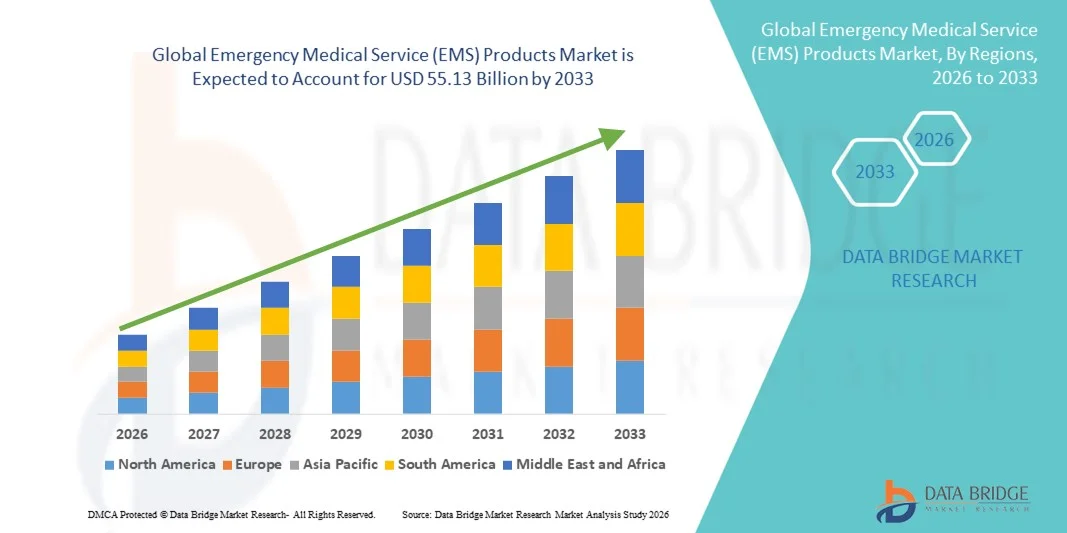
- As per Data Bridge Market Research Analysis the global emergency medical service (EMS) products market size was valued at USD 33.19 billion in 2025 and is expected to reach USD 55.13 billion by 2033, at a CAGR of 6.55% during the forecast period
- The market growth is largely fueled by the increasing incidence of trauma cases, cardiovascular emergencies, and road accidents, along with continuous advancements in pre-hospital care technologies and portable life-saving equipment across healthcare systems
- Furthermore, rising government investments in emergency response infrastructure, growing awareness regarding early medical intervention, and increasing demand for advanced, reliable, and rapid-response medical equipment are establishing Emergency Medical Service (EMS) products as critical components of modern healthcare systems. These converging factors are accelerating the uptake of EMS products, thereby significantly boosting the industry's growth
Market Size & Forecast
- Global Market Value (2025): USD 33.19 billion in 2025
- Expected Market Value (2033): USD 55.13 billion by 2033
- Forecast CAGR (2026–2033): 6.55%
Emergency Medical Service (EMS) Products Market Analysis
- Emergency Medical Service (EMS) products, including defibrillators, patient monitoring systems, airway management devices, stretchers, and trauma care kits, are increasingly vital components of modern pre-hospital and emergency care systems due to their ability to deliver rapid, life-saving interventions and improve patient survival outcomes
- The escalating demand for EMS products is primarily fueled by the rising incidence of trauma cases, cardiac arrests, road accidents, and natural disasters, along with growing emphasis on strengthening emergency response infrastructure and reducing mortality through early medical intervention
- North America dominated the emergency medical service (EMS) products market with the largest revenue share of 37.4% in 2025, characterized by well-established emergency response systems, high healthcare expenditure, advanced ambulance infrastructure, and strong presence of leading medical device manufacturers. The U.S. accounts for a significant share of regional demand due to continuous upgrades in emergency equipment and widespread adoption of advanced life-support technologies
- Asia-Pacific is expected to be the fastest-growing region in the emergency medical service (EMS) products market during the forecast period, expanding at a CAGR of 8.9% from 2026 to 2033, driven by increasing urbanization, rising healthcare investments, expanding ambulance networks, and growing awareness regarding emergency medical preparedness across emerging economies
- The Cardiac Care segment dominated with a revenue share of 34.8% in 2025, supported by the high global burden of cardiovascular diseases and sudden cardiac arrests
Report Scope and Emergency Medical Service (EMS) Products Market Segmentation
|
Attributes |
Emergency Medical Service (EMS) Products Key Market Insights |
|
Segments Covered |
|
|
Countries Covered |
North America
Europe
Asia-Pacific
Middle East and Africa
South America
|
|
Key Market Players |
|
|
Market Opportunities |
|
|
Value Added Data Infosets |
In addition to the insights on market scenarios such as market value, growth rate, segmentation, geographical coverage, and major players, the market reports curated by the Data Bridge Market Research also include in-depth expert analysis, patient epidemiology, pipeline analysis, pricing analysis, and regulatory framework. |
What is the Key Trend in the Emergency Medical Service (EMS) Products?
Technological Advancements in Portable and Connected Emergency Care Equipment
- A significant and accelerating trend in the global emergency medical service (EMS) products market is the rapid advancement of portable, lightweight, and connected emergency care devices designed to improve response efficiency and patient outcomes in pre-hospital settings
- Modern EMS products such as advanced defibrillators, portable ventilators, automated CPR devices, and multi-parameter patient monitors are increasingly being engineered with compact designs and enhanced durability to withstand demanding field environments
- For instance, next-generation automated external defibrillators (AEDs) and transport ventilators now incorporate real-time data transmission capabilities, enabling paramedics to share patient vitals directly with hospital emergency departments prior to arrival
- The integration of wireless connectivity and cloud-based reporting systems allows EMS teams to document cases digitally, streamline workflows, and improve coordination with trauma centers
- In addition, manufacturers are focusing on battery efficiency, rugged construction, and ergonomic designs to ensure rapid deployment during critical emergencies such as cardiac arrest, trauma injuries, and respiratory distress
- This trend toward technologically advanced, reliable, and interoperable EMS equipment is transforming pre-hospital care delivery and increasing demand across public ambulance services, private EMS providers, military medical units, and disaster response organizations
Emergency Medical Service (EMS) Products Market Dynamics
Driver
Rising Incidence of Trauma Cases and Expanding Emergency Healthcare Infrastructure
- The increasing prevalence of road accidents, cardiovascular diseases, natural disasters, and other medical emergencies is a major driver fueling demand for EMS products globally
- Governments and healthcare authorities are investing significantly in strengthening emergency response systems, expanding ambulance fleets, and upgrading life-saving medical equipment to reduce mortality rates
- For instance, several developing countries are implementing national emergency response programs aimed at improving ambulance accessibility in rural and semi-urban regions, thereby driving procurement of stretchers, resuscitation kits, airway management devices, and monitoring systems
- The growing burden of cardiac arrests and respiratory disorders has also led to increased adoption of defibrillators, oxygen delivery systems, and advanced airway management equipment in ambulances and public spaces
- Furthermore, rising awareness regarding the importance of timely medical intervention and improved reimbursement frameworks in developed economies are accelerating the modernization of EMS infrastructure
- The expansion of private ambulance services and air ambulance networks is further contributing to sustained market growth across both developed and emerging regions
Restraint/Challenge
High Equipment Costs and Operational Budget Constraints
- The high cost associated with advanced EMS equipment, including cardiac monitors, transport ventilators, powered stretchers, and automated CPR devices, poses a significant challenge to widespread adoption, particularly in low- and middle-income countries
- Public healthcare systems in many regions operate under limited budgets, which can restrict large-scale procurement and timely replacement of outdated equipment
- Maintenance expenses, calibration requirements, and the need for regular upgrades further increase the total cost of ownership for EMS providers
- For instance, In addition, disparities in emergency healthcare infrastructure between urban and rural areas can limit equitable access to advanced EMS products
- The requirement for specialized training to operate sophisticated life-support systems also presents a barrier, as inadequate training may reduce equipment utilization efficiency
- Addressing these challenges through cost-effective product innovation, government funding support, public-private partnerships, and structured training programs will be critical to ensuring sustainable growth in the Emergency Medical Service (EMS) Products market
Emergency Medical Service (EMS) Products Market Scope
The market is segmented on the basis of type, application, and end user.
- By Type
On the basis of type, the Emergency Medical Service (EMS) Products market is segmented into Patient Monitoring Systems, Wound Care Consumables, Patient Handling Equipment, Life Support and Emergency Resuscitation Equipment, Infection Control Supplies, Personal Protection Equipment, Pharmaceuticals, Tactical Equipment, and Others. The Life Support and Emergency Resuscitation Equipment segment dominated the largest market revenue share of 29.7% in 2025, driven by the critical need for defibrillators, ventilators, oxygen delivery systems, and advanced airway management tools in pre-hospital settings. Rising incidence of cardiac arrests, trauma injuries, and respiratory emergencies globally strengthens demand. EMS providers prioritize advanced life-saving devices to improve survival rates. Government investments in ambulance modernization programs further support adoption. Technological advancements such as automated external defibrillators (AEDs) and portable ventilators enhance efficiency. Growing awareness regarding early resuscitation in out-of-hospital cardiac arrest cases contributes to dominance. Increasing training programs for paramedics expand utilization rates. Integration of smart monitoring features improves patient outcomes. Expansion of emergency infrastructure in emerging economies sustains revenue growth.
The Patient Monitoring Systems segment is expected to witness the fastest CAGR of 18.5% from 2026 to 2033, fueled by rising demand for real-time vital sign tracking during emergency transport. Portable cardiac monitors, ECG devices, and multiparameter monitors are increasingly integrated into ambulances. Growing adoption of wireless and connected EMS technologies accelerates segment expansion. Rising prevalence of chronic diseases such as cardiovascular and respiratory disorders supports growth. Technological innovation in compact and wearable monitoring devices enhances usability. Increasing emphasis on remote data transmission to hospitals improves emergency preparedness. Government mandates for advanced pre-hospital care strengthen adoption. Expanding tele-EMS services further propel demand. Continuous upgrades in battery life and device portability enhance market penetration.
- By Application
On the basis of application, the Emergency Medical Service (EMS) Products market is segmented into Cardiac Care, Trauma Care, Respiratory Care, Oncology, and Others. The Cardiac Care segment dominated with a revenue share of 34.8% in 2025, supported by the high global burden of cardiovascular diseases and sudden cardiac arrests. Rapid deployment of defibrillators and cardiac monitoring equipment in ambulances drives demand. Increasing public access defibrillation programs further strengthen growth. EMS teams prioritize cardiac emergency management due to high mortality risk. Growing awareness campaigns regarding early CPR and AED usage support product adoption. Technological integration with hospital cardiac units enhances patient continuity of care. Rising geriatric population globally increases cardiac emergencies. Favorable reimbursement policies in developed markets contribute to dominance. Continuous innovation in compact cardiac devices sustains revenue leadership.
The Trauma Care segment is projected to register the fastest CAGR of 17.9% from 2026 to 2033, driven by increasing road accidents, workplace injuries, and natural disasters worldwide. EMS providers require advanced trauma kits, bleeding control products, and immobilization devices. Growing urbanization and industrialization raise trauma incidence rates. Government initiatives to strengthen emergency response infrastructure support expansion. Increasing demand for rapid response systems enhances product uptake. Rising awareness about first-aid and emergency preparedness contributes to growth. Technological advancements in portable trauma equipment further accelerate adoption. Expanding ambulance fleets globally sustain long-term CAGR momentum.
- By End User
On the basis of end user, the Emergency Medical Service (EMS) Products market is segmented into Hospital, Trauma Centers, Ambulatory Surgical Centers, and Others. The Hospitals segment accounted for the largest market revenue share of 47.6% in 2025, driven by high patient inflow from emergency cases and the need for integrated acute care management. Hospitals maintain advanced EMS equipment for emergency departments and critical care units. Increasing healthcare infrastructure development globally strengthens adoption. Collaboration between EMS providers and hospital networks enhances demand. Availability of skilled healthcare professionals supports utilization. Rising investments in emergency preparedness programs sustain dominance. Growing prevalence of chronic diseases requiring emergency care further supports revenue growth. Technological advancements in hospital-based emergency systems improve efficiency.
The Trauma Centers segment is anticipated to witness the fastest CAGR of 18.1% from 2026 to 2033, fueled by rising establishment of specialized trauma facilities worldwide. Increasing government focus on dedicated trauma response units accelerates growth. Trauma centers require advanced resuscitation, monitoring, and surgical support equipment. Growing cases of severe injuries and accidents strengthen demand. Enhanced coordination between EMS and trauma centers improves patient outcomes. Technological upgrades in emergency surgical equipment further boost adoption. Expansion of specialized trauma networks in emerging economies sustains rapid market expansion.
Emergency Medical Service (EMS) Products Market Regional Analysis
- North America dominated the emergency medical service (EMS) products market with the largest revenue share of 37.4% in 2025, characterized by well-established emergency response systems, high healthcare expenditure, advanced ambulance infrastructure, and a strong presence of leading medical device manufacturers
- The region benefits from structured paramedic services, rapid emergency response networks, and continuous technological upgrades in ambulances equipped with advanced life-support systems
- The market accounts for a significant share of regional demand due to ongoing modernization of emergency equipment, increased procurement of defibrillators and ventilators, and widespread adoption of advanced pre-hospital life-support technologies
U.S. Emergency Medical Service (EMS) Products Market Insight
The U.S. emergency medical service (EMS) products market captured the largest revenue share within North America in 2025, supported by robust federal and state-level investments in emergency healthcare infrastructure. The country has a highly organized EMS framework integrating ground ambulances, air ambulances, and specialized trauma response units. Continuous replacement of outdated equipment with technologically advanced cardiac monitors, automated CPR devices, transport ventilators, and patient handling systems is driving sustained demand. The increasing incidence of cardiac arrests, trauma injuries, and respiratory emergencies further supports product adoption. In addition, strong reimbursement structures, emphasis on paramedic training, and the presence of major global manufacturers contribute to the steady expansion of the EMS products market in the U.S.
Europe Emergency Medical Service (EMS) Products Market Insight
The Europe emergency medical service (EMS) products market is projected to expand at a considerable CAGR throughout the forecast period, driven by well-developed public healthcare systems and strict emergency care protocols. Countries across the region are investing in upgrading ambulance fleets with advanced monitoring and life-support equipment to enhance patient survival rates. Regulatory focus on improving pre-hospital care standards and response times is encouraging procurement of modern EMS devices. Furthermore, increasing geriatric populations and rising chronic disease prevalence are contributing to higher emergency call volumes. The region’s focus on cross-border emergency coordination and disaster preparedness initiatives also supports continued market growth.
U.K. Emergency Medical Service (EMS) Products Market Insight
The U.K. emergency medical service (EMS) products market is anticipated to grow at a noteworthy CAGR during the forecast period, supported by continuous improvements in National Health Service (NHS) emergency care services. Investments in ambulance modernization programs and digital patient data recording systems are strengthening equipment demand. Rising cases of cardiovascular conditions and road accidents are driving the need for advanced defibrillators, airway management tools, and monitoring devices. In addition, the U.K.’s emphasis on reducing emergency response times and enhancing community paramedicine services is fostering adoption of portable and efficient EMS equipment. Ongoing staff training initiatives further ensure optimal utilization of advanced medical technologies.
Germany Emergency Medical Service (EMS) Products Market Insight
The Germany emergency medical service (EMS) products market is expected to expand at a considerable CAGR during the forecast period, fueled by the country’s strong healthcare infrastructure and high standards of emergency medical care. Germany’s advanced trauma centers and integrated ambulance services require sophisticated life-saving equipment for rapid intervention. Increasing focus on technological innovation and automation in emergency care vehicles is accelerating demand for high-performance patient monitoring systems and resuscitation devices. Moreover, government support for disaster management preparedness and emergency medical training programs further strengthens product adoption. The country’s engineering expertise also supports local manufacturing and customization of EMS solutions.
Asia-Pacific Emergency Medical Service (EMS) Products Market Insight
The Asia-Pacific emergency medical service (EMS) products market is expected to be the fastest-growing region, expanding at a CAGR of 8.9% from 2026 to 2033, driven by increasing urbanization, rising healthcare investments, and expanding ambulance networks across emerging economies. Governments in countries such as China, India, Japan, and South Korea are prioritizing improvements in emergency healthcare accessibility and response efficiency. Rapid infrastructure development, population growth, and rising road traffic accidents are significantly increasing demand for EMS equipment. Furthermore, growing awareness regarding emergency medical preparedness and supportive regulatory reforms are accelerating procurement of advanced life-support devices. The region’s improving healthcare expenditure and expanding private ambulance services further contribute to sustained growth momentum.
Japan Emergency Medical Service (EMS) Products Market Insight
The Japan emergency medical service (EMS) products market is gaining steady traction due to the country’s highly structured emergency response system and advanced healthcare infrastructure. Japan’s aging population significantly increases demand for rapid-response medical services and efficient pre-hospital care equipment. Continuous technological innovation in medical devices, along with strong quality standards, drives the adoption of compact and high-precision EMS products. Government initiatives to enhance disaster preparedness, particularly in response to earthquakes and natural calamities, further stimulate investment in emergency medical equipment. In addition, integration of digital health records within ambulances is improving coordination between EMS teams and hospitals.
China Emergency Medical Service (EMS) Products Market Insight
China emergency medical service (EMS) products market accounted for the largest market revenue share in Asia-Pacific in 2025, attributed to rapid healthcare infrastructure development and expanding emergency response capabilities. The country is significantly investing in upgrading ambulance fleets and equipping them with modern life-support and monitoring systems. Rising urban populations and increasing road traffic incidents are fueling demand for efficient pre-hospital care solutions. Government reforms aimed at strengthening emergency medical networks across urban and rural regions are accelerating product procurement. In addition, the presence of domestic medical device manufacturers and growing healthcare expenditure are supporting broader accessibility and affordability of EMS products across China.
Which are the Top Companies in Emergency Medical Service (EMS) Products?
The Emergency Medical Service (EMS) Products industry is primarily led by well-established companies, including:
- Stryker Corporation (U.S.)
- ZOLL Medical Corporation (U.S.)
- Philips Healthcare (Netherlands)
- Medtronic plc (Ireland)
- GE HealthCare (U.S.)
- Smith & Nephew plc (U.K.)
- 3M Company (U.S.)
- Cardinal Health, Inc. (U.S.)
- Becton, Dickinson and Company (U.S.)
- Johnson & Johnson (U.S.)
- Ambu A/S (Denmark)
- Ferno-Washington, Inc. (U.S.)
- Drägerwerk AG & Co. KGaA (Germany)
- Hillrom (U.S.)
- Teleflex Incorporated (U.S.)
- Spencer Italia S.r.l. (Italy)
- Nihon Kohden Corporation (Japan)
- Asahi Kasei Corporation (Japan)
- Mindray Medical International Limited (China)
- Braun Melsungen AG (Germany)
Latest Developments in Global Emergency Medical Service (EMS) Products Market
- In May 2023, Philips Healthcare completed the rollout of its mobile ECG diagnostics kit across 2,500 ambulances in the United Kingdom, enabling emergency medical personnel to perform on-site cardiac evaluations and transmit data in real time, significantly enhancing pre-hospital cardiac care and early diagnosis during emergency responses
- In October 2023, Stryker Corporation launched its next-generation LIFEPAK CR2 AED, a rugged, Wi-Fi connected automated external defibrillator designed for EMS use with real-time data connectivity, CPR guidance, and remote event reporting features — improving field care workflows and paramedic decision support
- In June 2023, Ferno-Washington introduced a multi-level portable oxygen delivery system tailored for disaster response units in Southeast Asia, enhancing EMS capacity to deliver reliable respiratory support across challenging pre-hospital environments
- In February 2024, Zoll Medical unveiled a modular trauma response kit integrating IV therapy, airway stabilization tools, and hemorrhage control supplies into a single EMS-ready kit designed for mass casualty preparedness, streamlining critical care response
- In April 2024, Spencer Italia launched a collapsible lightweight carbon fiber patient handling device optimized for rapid deployment in air ambulances and confined EMS environments in the Middle East, enhancing safe patient transport with improved ergonomics
- In July 2024, Pinnacle Industries Limited (India) launched the AD-Gen Ambulance equipped with integrated life-support equipment such as defibrillators, ventilators, electric suction pumps, infusion pumps, and advanced IT solutions including ePCR tablets and real-time GPS navigation, aimed at improving emergency transport outcomes

- Interactive Data Analysis Dashboard
- Company Analysis Dashboard for high growth potential opportunities
- Research Analyst Access for customization & queries
- Competitor Analysis with Interactive dashboard
- Latest News, Updates & Trend analysis
- Harness the Power of Benchmark Analysis for Comprehensive Competitor Tracking
Data collection and base year analysis are done using data collection modules with large sample sizes. The stage includes obtaining market information or related data through various sources and strategies. It includes examining and planning all the data acquired from the past in advance. It likewise envelops the examination of information inconsistencies seen across different information sources. The market data is analysed and estimated using market statistical and coherent models. Also, market share analysis and key trend analysis are the major success factors in the market report. To know more, please request an analyst call or drop down your inquiry.
The key research methodology used by DBMR research team is data triangulation which involves data mining, analysis of the impact of data variables on the market and primary (industry expert) validation. Data models include Vendor Positioning Grid, Market Time Line Analysis, Market Overview and Guide, Company Positioning Grid, Patent Analysis, Pricing Analysis, Company Market Share Analysis, Standards of Measurement, Global versus Regional and Vendor Share Analysis. To know more about the research methodology, drop in an inquiry to speak to our industry experts.
Data Bridge Market Research is a leader in advanced formative research. We take pride in servicing our existing and new customers with data and analysis that match and suits their goal. The report can be customized to include price trend analysis of target brands understanding the market for additional countries (ask for the list of countries), clinical trial results data, literature review, refurbished market and product base analysis. Market analysis of target competitors can be analyzed from technology-based analysis to market portfolio strategies. We can add as many competitors that you require data about in the format and data style you are looking for. Our team of analysts can also provide you data in crude raw excel files pivot tables (Fact book) or can assist you in creating presentations from the data sets available in the report.













