


Global Chlorfenapyr Market Segmentation, By Product Type (Active Ingredient Type 0.95 and Active Ingredient Type 0.98), Application (Farmland, Greenhouses, and Others) - Industry Trends and Forecast to 2033
Quelle est la taille et le taux de croissance du marché du chlorfénapyr
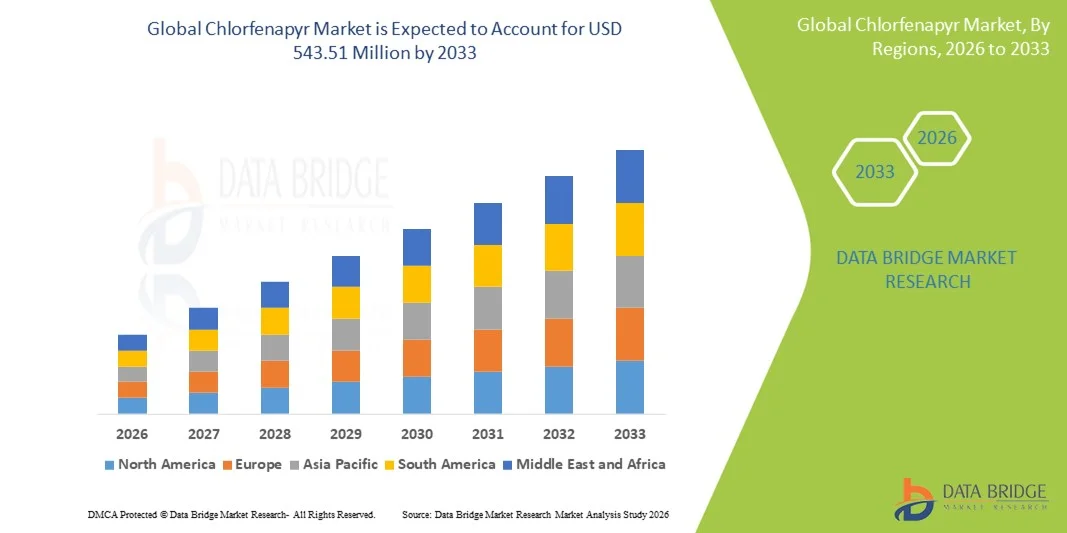
- Selon l'analyse de marché de Data Bridge, la taille du marché mondial du chlorfénapyr a été évaluée à346,19 millions de dollars en 2025et devrait atteindre543,51 millions de dollars en 2033, à unTCAC de 5,80%pendant la période de prévision
- La croissance du marché est largement alimentée par la demande croissante de solutions efficaces de protection des cultures pour améliorer les rendements, gérer la résistance aux ravageurs et soutenir des pratiques agricoles durables pour les cultures à grande échelle et de grande valeur.
- De plus, l'adoption croissante de techniques agricoles modernes, de pratiques de lutte intégrée contre les ravageurs et d'initiatives gouvernementales visant à promouvoir les pesticides à haute efficacité fait du chlorfénapyr un choix privilégié pour les producteurs. Ces facteurs convergents accélèrent l'adoption de produits à base de chlorfénapyr, ce qui stimule considérablement la croissance de l'industrie.
Taille du marché et prévisions
- Valeur marchande mondiale (2025):346,19 millions de dollars
- Valeur marchande prévue (2033) :543,51 millions de dollars
- Prévisions CAGR (2026-2033):5.80%
Quels sont les principaux débouchés du marché du chlorfénapyr
- Le chlorfénapyr, qui offre une activité à large spectre contre les ravageurs résistants et une compatibilité avec plusieurs types de cultures, est de plus en plus vital pour les cultures conventionnelles et de grande valeur en raison de son efficacité avérée, de son activité résiduelle et de ses approbations réglementaires dans les régions clés.
- La demande croissante de chlorfénapyr est principalement alimentée par le besoin croissant de solutions fiables de lutte antiparasitaire, l'expansion des activités agricoles dans les économies émergentes et la sensibilisation des agriculteurs à l'utilisation sûre et efficace des pesticides.
- L'Asie-Pacifique domine le marché du chlorfénapyr avec une part d'environ 50%en 2025, en raison de l'expansionagricoleactivités, augmentation de la demande de solutions de protection des cultures et forte présence des principaux fabricants de pesticides
- On s'attend à ce que l'Amérique du Nord soit la région qui connaît la croissance la plus rapide du marché du chlorfénapyr au cours de la période de prévision en raison de la demande croissante de produits antiparasitaires efficaces dans les cultures à grande échelle et de grande valeur.
- Le segment des ingrédients actifs de type 0,95 a dominé le marché avec une part de marché de 61,9 % en 2025, en raison de son utilisation généralisée dans les pratiques agricoles traditionnelles et de son efficacité contre un large éventail de ravageurs. Les agriculteurs préfèrent souvent la formulation de 0,95 en raison de son efficacité avérée et de sa compatibilité avec le matériel d'application de pesticides existant. Le segment bénéficie également des approbations réglementaires dans plusieurs régions, ce qui en fait un choix fiable pour les grandes exploitations agricoles. En outre, la concentration modérée assure un équilibre entre l'efficacité de la lutte antiparasitaire et la sécurité environnementale, ce qui contribue à sa domination continue.
Portée du rapport et segmentation du marché du chlorfénapyr
|
Attributs |
Chlorfénapyr Principales perspectives du marché |
|
Segments couverts |
|
|
Pays couverts |
Amérique du Nord
Europe
Asie-Pacifique
Moyen-Orient et Afrique
Amérique du Sud
|
|
Principaux acteurs du marché |
|
|
Possibilités de marché |
|
|
Infos sur la valeur ajoutée |
En plus des renseignements sur les scénarios du marché tels que la valeur marchande, le taux de croissance, la segmentation, la couverture géographique et les principaux intervenants, les rapports de marché établis par Data Bridge Market Research comprennent aussi l'analyse des exportations d'importations, l'aperçu des capacités de production, l'analyse de la consommation de production, l'analyse des tendances des prix, le scénario du changement climatique, l'analyse de la chaîne d'approvisionnement, l'analyse de la chaîne de valeur, l'aperçu des matières premières et des consommables, les critères de sélection des fournisseurs, l'analyse PESTLE, l'analyse Porter et le cadre réglementaire. |
Quelle est la tendance clé du marché du chlorfénapyr
Adoption croissante de pesticides hautement efficaces et sans danger pour l'environnement
- Une tendance importante sur le marché du chlorfénapyr est l'adoption croissante de pesticides à haute efficacité et sans danger pour l'environnement dans les cultures conventionnelles et de grande valeur. Les agriculteurs et les agro-industries se concentrent sur les solutions qui gèrent les populations de ravageurs résistants tout en minimisant l'impact environnemental, ce qui augmente le rôle du chlorfénapyr en tant qu'agent clé de protection des cultures
- Par exemple, le lancement de dix nouveaux produits, y compris des formulations de chlorfénapyr au Brésil en août 2025, met l'accent sur l'industrie en fournissant des solutions de lutte antiparasitaire avancées qui sont à la fois efficaces et respectueuses de l'environnement. Ces introductions de produits renforcent les capacités de lutte antiparasitaire dans l'agriculture à grande échelle et soutiennent des pratiques agricoles durables
- L'intégration du chlorfénapyr dans les programmes de lutte antiparasitaire intégrée prend de l'ampleur, surtout dans les régions qui cultivent les légumes, le coton et les céréales, où la gestion de la résistance est essentielle. Il s'agit de positionner le chlorfénapyr comme pesticide privilégié pour les producteurs visant à optimiser le rendement et à maintenir la conformité réglementaire
- L'augmentation des investissements dans la recherche et l'amélioration de la formulation stimule la mise au point de produits de chlorfénapyr plus ciblés, à faible teneur en résidus et à haute pureté. De telles innovations améliorent son efficacité d'application et élargissent son adoption dans diverses géographies
- La sensibilisation croissante des agriculteurs et des distributeurs de produits agrochimiques à l'utilisation sécuritaire des pesticides et au respect de la réglementation accélère l'adoption. Cette tendance est particulièrement forte en Asie-Pacifique et en Amérique du Nord, où les gouvernements et les agro-industries mettent l'accent sur l'agriculture durable.
- Le marché connaît une forte croissance à mesure que les entreprises augmentent la production et l'enregistrement des préparations de chlorfénapyr pour répondre à la demande mondiale croissante. Les approbations réglementaires dans les principaux marchés, comme l'enregistrement par l'EPA de la série de chlorofénapyr de Newfarm en novembre 2025, renforcent la confiance dans sa sécurité et son efficacité.
Dynamique du marché du chlorfénapyr
Chauffeur
Demande croissante de lutte antiparasitaire efficace dans les cultures de grande valeur
- La nécessité de protéger les cultures de grande valeur comme les fruits, les légumes et le coton contre les ravageurs résistants et difficiles à combattre est à l'origine de la demande de chlorfénapyr. Son activité à large spectre, son effet résiduel long et son efficacité prouvée en font un outil essentiel pour les producteurs visant à maximiser le rendement et à réduire les pertes de cultures
- Par exemple, le lancement de l'insecticide d'appât de Sankei Kotetu au Japon en mars 2021 démontre comment des solutions à base de chlorfénapyr sont appliquées aux cultures spécialisées, soutenant ainsi une lutte antiparasitaire précise tout en maintenant la qualité des cultures. De telles applications renforcent la position des chlorfénapyrs comme composante essentielle des programmes de lutte intégrée contre les ravageurs
- L'adoption du chlorfénapyr est encore accélérée par une sensibilisation accrue à la gestion de la résistance et à la nécessité d'une lutte antiparasitaire fiable et cohérente tant à grande échelle qu'en serre.
- L'amélioration technologique des méthodes de formulation et d'exécution permet une application plus efficace et ciblée du chlorfénapyr, réduisant l'utilisation des produits chimiques et l'impact environnemental tout en améliorant les résultats de la lutte antiparasitaire
- La demande mondiale croissante de produits agricoles de haute qualité et prêts à l'exportation continue de stimuler l'adoption du chlorfénapyr, les producteurs cherchant des solutions fiables pour maintenir le rendement et la qualité
Restriction/Défi
Restrictions réglementaires et exigences de conformité
- Le marché du chlorfénapyr est confronté à des défis en raison de cadres réglementaires rigoureux et de la nécessité de respecter les limites de sécurité, d'environnement et de résidus dans plusieurs pays. Pour satisfaire à ces exigences, il faut procéder à des essais approfondis, procéder à des procédures d'homologation et respecter les lignes directrices en matière d'étiquetage et d'application, ce qui peut retarder le lancement des produits et augmenter les coûts.
- Par exemple, le processus d'homologation et d'approbation réglementaire par l'EPA des États-Unis pour les formulations des séries de chlorfénapyr de Newfarm en novembre 2025 souligne le temps et les investissements nécessaires pour assurer la conformité sur les principaux marchés agricoles. De tels processus réglementaires peuvent restreindre l'entrée sur le marché des petits acteurs ou ralentir l'expansion
- Respect des règles localesenvironnementLes règlements, y compris les niveaux admissibles de résidus et les restrictions d'application, exigent une formulation minutieuse et une gestion des essais sur le terrain. Ces contraintes obligent les fabricants à maintenir des normes de qualité et à s'adapter à l'évolution de la réglementation.
- Les variations mondiales dans les politiques d'approbation des pesticides ajoutent de la complexité aux entreprises multinationales qui cherchent à distribuer des produits de chlorfénapyr à l'échelle internationale, exigeant souvent des présentations et des certifications distinctes pour différentes régions.
- L'effet combiné de coûts élevés de conformité, de longs processus d'approbation et de la nécessité d'un contrôle rigoureux limite l'échelle rapide et pose un défi à la croissance du marché, malgré la hausse de la demande.
Comment le marché du chlorfénapyr est-il segmenté
Le marché est segmenté en fonction du type de produit et de l'application.
- Par type de produit
En fonction du type de produit, le marché du chlorfénapyr est segmenté en ingrédients actifs de type 0.95 et en ingrédients actifs de type 0.98. Le segment des ingrédients actifs de type 0,95 a dominé le marché avec la plus grande part de revenus du marché de 61,9 % en 2025, en raison de son utilisation généralisée dans les pratiques agricoles conventionnelles et de son efficacité contre un large éventail de ravageurs. Les agriculteurs préfèrent souvent la formulation de 0,95 en raison de son efficacité avérée et de sa compatibilité avec le matériel d'application de pesticides existant. Le segment bénéficie également des approbations réglementaires dans plusieurs régions, ce qui en fait un choix fiable pour les grandes exploitations agricoles. De plus, la concentration modérée assure un équilibre entre l'efficacité de la lutte antiparasitaire et la sécurité environnementale, ce qui contribue à sa domination continue.
Le segment des ingrédients actifs de type 0.98 devrait connaître le taux de croissance le plus rapide de 2026 à 2033, alimenté par l'augmentation de la demande dans les cultures de grande valeur et les applications en serre. Par exemple, la formulation de haute pureté de Syngenta 0.98 a gagné en traction parmi les opérateurs commerciaux de serre en raison de son activité puissante contre les souches résistantes d'insectes. La concentration plus élevée permet de réduire la fréquence d'application, fournissant des coûts et une efficacité de travail pour les producteurs. Une sensibilisation accrue à l'optimisation de la lutte antiparasitaire et aux pratiques durables favorise l'adoption. La croissance du segment est également soutenue par des innovations continues axées sur une plus grande efficacité et une réduction de l'impact environnemental.
- Par demande
Sur la base de l'application, le marché du chlorfénapyr est segmenté en terres agricoles, serres et autres. Le segment des terres agricoles a dominé le marché en 2025, grâce à la culture à grande échelle de céréales, de légumes et de coton qui nécessitent des solutions de lutte antiparasitaire robustes. Les agriculteurs accordent la priorité au chlorfénapyr pour son activité à large spectre, son efficacité résiduelle et sa capacité à gérer les populations de ravageurs résistants. Le segment bénéficie également des réseaux de distribution établis et de l'appui du gouvernement aux initiatives de protection des cultures, assurant ainsi une disponibilité fiable. En outre, la facilité d'intégration avec les pratiques agricoles standard et la compatibilité avec plusieurs types de cultures renforcent sa position dominante sur le marché.
Le segment des serres devrait connaître le TCAC le plus rapide de 2026 à 2033, alimenté par l'adoption croissante d'une agriculture contrôlée et de cultures horticoles de grande valeur. Par exemple, les solutions de chlorfénapyr ciblées par Bayer sont de plus en plus utilisées dans la culture de tomates de serre et de concombres pour une lutte antiparasitaire efficace. Les opérateurs de serre apprécient le produit pour son application précise et son fort contrôle résiduel en milieu confiné. La croissance est également soutenue par la demande croissante de produits de qualité supérieure et de production tout au long de l'année. L'expansion du segment est également stimulée par des innovations dans des formulations sûres et à faibles résidus adaptées aux systèmes de culture intensive.
Quelle région détient le marché du chlorfénapyr
- L'Asie-Pacifique a dominé le marché du chlorfénapyr avec la plus grande part des revenus d'environ 50 % en 2025, en raison de l'expansion des activités agricoles, de l'augmentation de la demande de solutions de protection des cultures et de la forte présence de grands fabricants de pesticides.
- Le paysage de production rentable de la région, l'augmentation des investissements dans la fabrication agrochimique et la croissance des exportations de produits chimiques de protection des cultures accélèrent l'expansion du marché
- La disponibilité de main-d ' œuvre qualifiée, des politiques gouvernementales favorables et l ' adoption rapide de techniques agricoles modernes dans les pays en développement contribuent à accroître la consommation de chlorfénapyr dans les cultures à grande échelle et de grande valeur
Aperçu du marché chinois du chlorfénapyr
La Chine détenait la plus grande part du marché du chlorfénapyr en Asie-Pacifique en 2025, en raison de son statut de leader mondial dans la production agricole et la fabrication de pesticides. La solide base industrielle du pays, les politiques gouvernementales favorables à la production agrochimique et les vastes capacités d'exportation de produits chimiques de protection des cultures sont des moteurs de croissance majeurs. La demande est également renforcée par des investissements continus dans des formulations de pesticides à haut rendement et sans danger pour l'environnement sur les marchés nationaux et internationaux.
Aperçu du marché indien du chlorfénapyr
L ' Inde connaît la croissance la plus rapide dans la région de l ' Asie et du Pacifique, alimentée par un secteur agricole en expansion rapide, l ' adoption de pratiques modernes de lutte antiparasitaire et l ' accroissement des investissements dans les cultures de grande valeur. Les initiatives visant à promouvoir une agriculture durable et l'amélioration des rendements des cultures renforcent la demande deChlorfénapyr. En outre, la croissance des exportations de fruits, de légumes et de cultures commerciales, combinée à une sensibilisation accrue à la lutte contre la résistance aux ravageurs, contribue à une forte expansion du marché.
Perspectives du marché européen du chlorfénapyr
Le marché européen du chlorfénapyr est en pleine expansion, soutenu par des cadres réglementaires rigoureux, une demande croissante de pesticides à haute pureté et à faible toxicité et des investissements croissants dans des solutions agricoles durables. La région met l'accent sur des méthodes de lutte antiparasitaire respectueuses de l'environnement, en particulier pour les cultures de grande valeur et l'agriculture biologique. L'adoption accrue de pratiques de lutte intégrée contre les ravageurs favorise la croissance du marché.
Allemagne Chlorfénapyr Aperçu du marché
Allemagne Le marché du chlorfénapyr est alimenté par des pratiques agricoles de pointe, une production horticole de grande valeur et une forte conformité avec la réglementation communautaire sur les pesticides. Le pays dispose de réseaux de R-D et de partenariats bien établis entre les instituts de recherche et les fabricants de produits agrochimiques, ce qui favorise l'innovation continue dans les solutions de lutte antiparasitaire. La demande est particulièrement forte pour les cultures contrôlées et les cultures de légumes de spécialité.
Aperçu du marché du chlorfénapyr au Royaume-Uni
Le marché britannique est soutenu par des techniques agricoles modernes, l'accent étant mis de plus en plus sur l'agriculture durable et la demande de produits chimiques de protection des cultures à haut rendement. Avec une attention croissante à la lutte intégrée contre les ravageurs et aux solutions biocompatibles, le marché du chlorfénapyr demeure important. Investissements dansagricoleLa R-D et les partenariats entre les entreprises agrochimiques et les producteurs encouragent l'adoption de formulations avancées.
Aperçu du marché du chlorfénapyr en Amérique du Nord
On prévoit que l'Amérique du Nord connaîtra la croissance la plus rapide du TCAC de 2026 à 2033, en raison de la demande croissante de produits antiparasitaires efficaces dans les cultures à grande échelle et de grande valeur. L'adoption technologique dans l'agriculture de précision, l'accent croissant mis sur la lutte contre la résistance aux ravageurs et les investissements dans la R-D pour des solutions pesticides durables stimulent la demande. De plus, l'appui réglementaire aux produits chimiques sûrs et à haute efficacité contribue à l'expansion du marché.
Aperçu du marché américain du chlorfénapyr
Les États-Unis ont représenté la plus grande part du marché nord-américain en 2025, grâce à de vastes activités agricoles, à une solide infrastructure de R-D et à d'importants investissements dans la fabrication de produits de protection des cultures. Le pays met l'accent sur l'innovation, le respect de la réglementation et les pratiques de lutte antiparasitaire durable. La présence d'acteurs agrochimiques clés et d'un réseau de distribution mature renforce encore la position de premier plan des États-Unis dans la région.
Quelles sont les meilleures entreprises du marché du chlorfénapyr
L'industrie du chlorfénapyr est principalement dirigée par des entreprises bien établies, notamment :
- BASF SE (Allemagne)
- Triveni Interchem Private Limited (Groupe de Triveni Chemicals) (Inde)
- Nanjing Gaozheng Agricultural Chemical Co., Ltd. (Chine)
- Kaifeng Bokai Biochimie (Chine)
- Qingdao Echemi Technology Co., Ltd. (Chine)
- Technique biochimique de Hunan Dejia (Chine)
- Fabchem China Limited (Chine)
- Groupe Yinguang Gansu Yinguang Juyin Chemical Industry Co., Ltd. (Chine)
- Chem-Tac, Inc. (États-Unis)
- Zhejiang Rayfull Chemicals Co., Ltd. (Chine)
- Syngenta Crop Protection AG (Suisse)
- Shandong A&Fine Agrochemicals Group (Chine)
- Hebei Guanlong Agrochemical Co., Ltd. (Chine)
- Jiangsu Fengshan Group Co., Ltd. (Chine)
- Atticus LLC (États-Unis)
Quels sont les derniers développements sur le marché du chlorfénapyr
- En novembre 2025, les formulations de la série de chlorfénapyr de Newfarm ont été officiellement enregistrées par l'Environmental Protection Agency (EPA) des États-Unis et devraient être lancées en 2026, ce qui marque une étape réglementaire critique qui accroît considérablement la disponibilité du produit en Amérique du Nord. Ce développement renforce la confiance des producteurs dans l'innocuité et l'efficacité des solutions basées sur le chlorfénapyr, favorise l'adoption dans les grandes exploitations agricoles et devrait stimuler une croissance substantielle du marché aux États-Unis et dans les régions voisines.
- En septembre 2025, BASF a introduit un nouvel herbicide à base de chlorfénapyr en Indonésie pour aider les riziculteurs à gérer efficacement les mauvaises herbes résistantes, un lancement qui améliore les rendements des cultures et renforce les stratégies de lutte antiparasitaire. L'introduction renforce la présence du BASF en Asie du Sud-Est, stimule la demande de produits agrochimiques à haute efficacité et devrait accélérer l'adoption du chlorfénapyr dans les régions où la culture du riz est intensive
- En août 2025, UPL a lancé dix nouveaux produits agrochimiques au Brésil, y compris des formulations de chlorfénapyr, établissant un record pour les introductions annuelles de produits. Cette stratégie d'expansion agressive s'attaque à la résistance aux ravageurs et diversifie les offres de produits, augmentant ainsi la part de marché d'UPL. Le lancement stimule également la dynamique concurrentielle en Amérique latine et offre aux agriculteurs des options de lutte antiparasitaire plus efficaces, renforçant le rôle des chlorfénapyrs dans les applications agricoles à grande échelle
- En mai-septembre 2025, les autorités de réglementation chinoises ont approuvé plus de 77 nouvelles homologations de formulation de chlorfénapyr, ce qui reflète une forte augmentation des approbations réglementaires. Cette expansion permet d'élargir les options de formulation et améliore la pénétration des produits en Chine, l'un des plus grands marchés agricoles au monde. Les approbations favorisent l'adoption généralisée de multiples types de cultures, améliorent la disponibilité de la chaîne d'approvisionnement et stimulent la croissance globale du marché en Asie-Pacifique
- En mars 2021, BASF a lancé l'insecticide d'appât Sankei Kotetu® au Japon pour soutenir les épinards, démontrant l'efficacité du chlorfénapyr dans les cultures végétales de grande valeur. Le produit a amélioré les stratégies locales de lutte antiparasitaire, encouragé l'adoption dans l'agriculture spécialisée et renforcé la réputation d'efficacité et de sécurité des chlorfénapyrs dans les milieux de culture sensibles
SKU-
Accédez en ligne au rapport sur le premier cloud mondial de veille économique

- Tableau de bord d'analyse de données interactif
- Tableau de bord d'analyse d'entreprise pour les opportunités à fort potentiel de croissance
- Accès d'analyste de recherche pour la personnalisation et les requêtes
- Analyse de la concurrence avec tableau de bord interactif
- Dernières actualités, mises à jour et analyse des tendances
- Exploitez la puissance de l'analyse comparative pour un suivi complet de la concurrence
Méthodologie de recherche
La collecte de données et l'analyse de l'année de base sont effectuées à l'aide de modules de collecte de données avec des échantillons de grande taille. L'étape consiste à obtenir des informations sur le marché ou des données connexes via diverses sources et stratégies. Elle comprend l'examen et la planification à l'avance de toutes les données acquises dans le passé. Elle englobe également l'examen des incohérences d'informations observées dans différentes sources d'informations. Les données de marché sont analysées et estimées à l'aide de modèles statistiques et cohérents de marché. De plus, l'analyse des parts de marché et l'analyse des tendances clés sont les principaux facteurs de succès du rapport de marché. Pour en savoir plus, veuillez demander un appel d'analyste ou déposer votre demande.
La méthodologie de recherche clé utilisée par l'équipe de recherche DBMR est la triangulation des données qui implique l'exploration de données, l'analyse de l'impact des variables de données sur le marché et la validation primaire (expert du secteur). Les modèles de données incluent la grille de positionnement des fournisseurs, l'analyse de la chronologie du marché, l'aperçu et le guide du marché, la grille de positionnement des entreprises, l'analyse des brevets, l'analyse des prix, l'analyse des parts de marché des entreprises, les normes de mesure, l'analyse globale par rapport à l'analyse régionale et des parts des fournisseurs. Pour en savoir plus sur la méthodologie de recherche, envoyez une demande pour parler à nos experts du secteur.
Personnalisation disponible
Data Bridge Market Research est un leader de la recherche formative avancée. Nous sommes fiers de fournir à nos clients existants et nouveaux des données et des analyses qui correspondent à leurs objectifs. Le rapport peut être personnalisé pour inclure une analyse des tendances des prix des marques cibles, une compréhension du marché pour d'autres pays (demandez la liste des pays), des données sur les résultats des essais cliniques, une revue de la littérature, une analyse du marché des produits remis à neuf et de la base de produits. L'analyse du marché des concurrents cibles peut être analysée à partir d'une analyse basée sur la technologie jusqu'à des stratégies de portefeuille de marché. Nous pouvons ajouter autant de concurrents que vous le souhaitez, dans le format et le style de données que vous recherchez. Notre équipe d'analystes peut également vous fournir des données sous forme de fichiers Excel bruts, de tableaux croisés dynamiques (Fact book) ou peut vous aider à créer des présentations à partir des ensembles de données disponibles dans le rapport.











