What is the Agricultural Robots Market Size and Growth Rate?
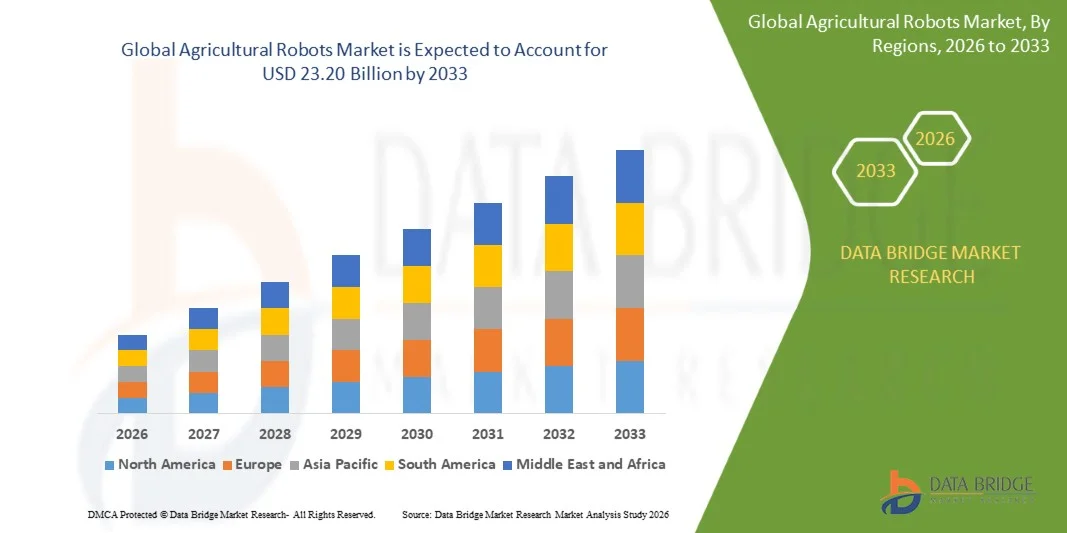
- As per Data Bridge Market Research analysis, the agricultural robots market was valued at USD 17.73 billion in 2025 and is projected to reach USD 23.20 billion by 2033, growing at a CAGR of 12.00% from 2026 to 2033.
- The market is experiencing consistent growth driven by rising farm labor shortages, growing demand for precision input application, and increasing adoption of AI-enabled autonomous machinery across crop, dairy, and horticultural operations.
- The increasing shift toward autonomous, data-driven farming, combined with falling sensor costs and growing availability of robotics-as-a-service models, is supporting market adoption. Agricultural robots are being applied across agriculture drones for spraying and scouting, driverless tractors for field operations, and AI in agriculture platforms for weed detection and harvesting, offering farmers lower labor dependence and more precise resource use.
Market Size & Forecast
- Global Market Value (2025): USD 17.73 Billion
- Expected Market Value (2033): USD 23.20 Billion
- Forecast CAGR (2026–2033): 12.00%
- Leading Region in 2025: North America
- Fastest Growing Region: Asia-Pacific
What are the Major Takeaways of the Agricultural Robots Market?
- North America dominated the agricultural robots market with the largest revenue share of 36.40% in 2025, supported by large farm sizes, high labor costs, strong precision agriculture adoption, and the presence of leading equipment manufacturers.
- Asia-Pacific is expected to be the fastest-growing region at a CAGR of 14.60% from 2026 to 2033, fueled by an aging farm workforce, rising adoption of agricultural drones, and government support for smart farming.
- The milking robots segment led the market with a 31.60% share in 2025, driven by labor savings, continuous herd monitoring, and widespread adoption on dairy farms.
- Harvesting & weeding robots are the fastest-growing type, projected to register a CAGR of 15.40%, reflecting demand for selective picking and chemical-free weed control in high-value crops.
- The hardware segment dominated the offering category with a 66.80% revenue share in 2025, led by sales of autonomous tractors, drones, milking systems, and field robots.
- Crop management accounted for 43.25% of the market share in 2025, supported by growing use of robots for planting, weeding, and precision spraying across row crops and orchards.
- The harvesting segment is the fastest-growing application category, with a CAGR of 15.10%, driven by rising pressure on seasonal labor and demand for consistent picking of fruits and vegetables.
Report Scope and Agricultural Robots Market Segmentation
|
Attributes |
Agricultural Robots Market Key Market Insights |
|
Segments Covered |
|
|
Countries Covered |
North America
Europe
Asia-Pacific
Middle East and Africa
South America
|
|
Key Market Players |
|
|
Market Opportunities |
|
|
Value Added Data Infosets |
In addition to the insights on market scenarios such as market value, growth rate, segmentation, geographical coverage, and major players, the market reports curated by the Data Bridge Market Research also include import export analysis, production capacity overview, production consumption analysis, price trend analysis, climate change scenario, supply chain analysis, value chain analysis, raw material/consumables overview, vendor selection criteria, PESTLE Analysis, Porter Analysis, and regulatory framework. |
What is the Key Trend in the Agricultural Robots Market?
- Agricultural robots are evolving from remotely operated machines into AI-enabled autonomous systems that use cameras, sensors, and machine learning to identify weeds, crops, and obstacles and act on them in real time.
- For instance, in November 2025, according to John Deere, its See & Spray technology was used across more than five million acres during the 2025 growing season, with customers reducing non-residual herbicide use by an average of nearly 50% and saving nearly 31 million gallons of herbicide mix.
- Targeted application, laser weeding, and selective harvesting are reducing chemical inputs and labor requirements while supporting more sustainable crop production.
- Supervised autonomy, where one operator manages several machines, is gaining traction in orchards, vineyards, and specialty crops with high labor intensity.
- For instance, in August 2025, according to John Deere, the company acquired GUSS Automation, whose autonomous sprayers can be supervised by a single operator managing up to eight machines, with more than 250 machines deployed globally and 2.6 million acres sprayed over 500,000 autonomous hours.
- As perception software, connectivity, and robotics-as-a-service models mature, agricultural robots are expected to expand from large farms into specialty crops, dairy, and small and mid-sized operations worldwide.
What are the Key Drivers of the Agricultural Robots Market?
- Shrinking and aging agricultural workforces, combined with rising wages and seasonal labor shortages, are pushing farmers to automate repetitive tasks such as weeding, spraying, milking, and harvesting.
- For instance, in November 2025, according to Japan's Ministry of Agriculture, Forestry and Fisheries, the number of self-employed farmworkers fell 25.1% from five years earlier to 1.02 million in 2025, the largest decline on record, highlighting the need for labor-saving machinery.
- Rising input costs and growing pressure to reduce herbicide and fertilizer use are increasing demand for precision technologies that apply inputs only where needed.
- For instance, in June 2025, according to the Government of Japan, Kubota had shipped around 700 machines from its Agri Robo series, including autonomous tractors, rice transplanters, and combine harvesters, to farms across Japan by 2024, supporting the goal of reducing workforce and labor requirements.
- Advances in computer vision, GPS, LiDAR, and AI are improving the reliability of autonomous machines and widening the range of crops and tasks that robots can handle.
What Factors Are Challenging the Growth of the Agricultural Robots Market?
- Agricultural robots require expensive sensors, computing hardware, and rugged machinery, and they must operate reliably in uneven terrain, weather, and variable crop conditions, which increases cost and technical complexity.
- For instance, in August 2025, according to a review published in Agriculture (MDPI), a study of 38 peer-reviewed papers, 12 survey articles, and 18 commercial robots found that farmers cited capital costs, technical complexity, and inadequate support systems as barriers, with navigation bottlenecks limiting broader implementation.
- High upfront investment and uncertain return on investment can discourage small and mid-sized farms, particularly where margins are low and the working season is short.
- Limited technical skills, weak rural connectivity, and the need for dealer support create additional hurdles to adoption in developing regions.
- For instance, in March 2025, according to a study presented at the ACM/IEEE International Conference on Human-Robot Interaction by Cardiff University researchers, previous implementation attempts, whether positive or negative, influence future adoption of collaborative robots in agriculture, and a multitude of barriers surround uptake across the sector.
- The combination of high capital cost, technical complexity, trust concerns, and limited support infrastructure can constrain adoption among cost-sensitive farmers, particularly where manual labor or conventional machinery still meets basic production requirements.
How is the Agricultural Robots Market Segmented?
The agricultural robots market is segmented on the basis of type, offering, application, and end user.
- By Type
On the basis of type, the agricultural robots market is segmented into driverless tractors, milking robots, agricultural drones, harvesting & weeding robots, and others. The milking robots segment dominated the market with 31.60% share in 2025, supported by labor savings and the ability to milk cows on demand. Automated systems collect data on milk yield, animal health, and feeding behavior that help farmers manage herds more precisely. Dairy operators with limited labor availability are adopting robotic milking to improve consistency and animal welfare. Established manufacturers also offer service networks that support installation and maintenance. Rising farm consolidation further supports demand for automation.
The harvesting & weeding robots segment is projected to register the fastest growth at a CAGR of 15.40% from 2026 to 2033, driven by labor shortages and demand for selective, chemical-free crop care. Computer vision and deep learning allow machines to identify weeds, ripe fruit, and crop rows in real time. Laser, mechanical, and precision-spray systems are reducing herbicide use in vegetables and specialty crops. Robotics-as-a-service models are lowering upfront investment for growers. Rapid improvement in gripper design and perception software is expanding the range of crops that can be handled.
- By Offering
On the basis of offering, the agricultural robots market is segmented into hardware, software, and services. The hardware segment dominated the offering category with 66.80% share in 2025, supported by sales of autonomous tractors, drones, milking systems, and field robots. Sensors, cameras, navigation units, and actuators account for a large share of machine value. Established equipment manufacturers are integrating autonomy kits into new and existing machines. Retrofit options allow farmers to automate current fleets rather than replace them. Demand for durable machines suited to outdoor conditions further supports hardware revenue.
The services segment is projected to register the fastest growth at a CAGR of 15.90% from 2026 to 2033, driven by robotics-as-a-service, maintenance contracts, and training offerings. Pay-per-use and subscription models reduce capital requirements for small and mid-sized farms. Remote monitoring and software updates help maintain machine performance throughout the season. Service providers also offer data analysis and agronomic support linked to robot operations. Growing complexity of autonomous systems is increasing reliance on specialized technical support.
- By Application
On the basis of application, the agricultural robots market is segmented into crop management, dairy & livestock management, harvesting, and others. The crop management segment dominated the application category with 43.25% share in 2025, supported by growing use of robots for planting, weeding, and precision spraying. Targeted application reduces herbicide and fertilizer use while maintaining yield. Autonomous platforms allow work to continue during narrow weather windows. Integration with field mapping and farm management software improves decision-making. Rising input costs are further encouraging adoption of precision technologies.
The harvesting segment is projected to register the fastest growth at a CAGR of 15.10% from 2026 to 2033, driven by shortages of seasonal workers and rising wages for picking fruits and vegetables. Robotic harvesters use cameras, soft grippers, and machine learning to pick produce at the right ripeness. Trials in berries, orchards, and greenhouse crops are moving toward commercial fleet deployment. Autonomous carrying and transport robots also assist human pickers. Growers value consistent picking quality and reduced post-harvest losses.
- By End User
On the basis of end user, the agricultural robots market is segmented into large farms, small & medium farms, agricultural contractors & cooperatives, and others. The large farms segment dominated the end-user category with 52.30% share in 2025, supported by greater capital availability and the ability to spread equipment cost over large acreage. Large operators benefit most from autonomy through reduced labor dependence and longer working hours. They also use data from robots to optimize inputs across multiple fields. Dealer networks and financing programs support purchases of high-value machines. Early adoption by these farms is shaping product development.
The agricultural contractors & cooperatives segment is projected to register the fastest growth at a CAGR of 14.80% from 2026 to 2033, driven by shared ownership and service-based use of robotic equipment. Contractors can deploy drones, sprayers, and autonomous implements across many farms, improving utilization. Cooperatives allow smaller growers to access advanced machines without individual purchase. Training and support from contractors lower the technical barrier to adoption. Subsidy programs for shared machinery are further supporting this segment.
Which Region Holds the Largest Share of the Agricultural Robots Market?
- North America dominated the agricultural robots market with the largest revenue share of 36.40% in 2025, supported by large farm sizes, high labor costs, strong precision agriculture adoption, and the presence of leading equipment manufacturers.
- The region also benefits from a mature dealer and service network, strong venture investment in agricultural technology, and growing adoption of autonomous spraying, weeding, and tractor technologies. Increasing use of robots across row crops, specialty crops, orchards, and dairy farms continues to strengthen North America's position in the global market.
U.S. Agricultural Robots Market Insight
The U.S. agricultural robots market is witnessing strong growth due to labor shortages, large farm sizes, and rising demand for precision spraying and autonomous tractors. Equipment manufacturers and start-ups are commercializing computer-vision weeding, autonomous sprayers, and harvesting systems for row crops and specialty crops. In addition, growing interest in reducing herbicide use and input costs is accelerating adoption among growers and custom applicators.
Asia-Pacific Agricultural Robots Market Insight
The Asia-Pacific agricultural robots market is expected to witness rapid growth, driven by an aging farm workforce, shrinking rural labor supply, and expanding use of spraying drones across countries such as China, Japan, and India. Government programs promoting smart agriculture and mechanization are supporting investment. In addition, strong electronics manufacturing capability is lowering the cost of drones and sensors for regional farmers.
Japan Agricultural Robots Market Insight
The Japan agricultural robots market is witnessing consistent growth due to a rapidly declining and aging farming population and strong public support for smart agriculture. Manufacturers offer autonomous tractors, rice transplanters, and combine harvesters that operate with limited supervision. Moreover, high technical capability in robotics and sensors, along with consolidation of farmland into larger operations, is further contributing to market growth in Japan.
China Agricultural Robots Market Insight
The China agricultural robots market is growing rapidly, driven by large-scale adoption of spraying and monitoring drones, policy support for agricultural mechanization, and a strong domestic technology manufacturing base. Domestic companies are expanding autonomous machinery and smart farm platforms across grain, cotton, and orchard operations. In addition, rural labor migration is encouraging farmers and service providers to adopt automated equipment.
U.K. Agricultural Robots Market Insight
The U.K. agricultural robots market is experiencing steady growth, supported by labor shortages in horticulture and strong public funding for agricultural innovation. Start-ups and research institutions are developing harvesting robots, autonomous platforms, and robotics-as-a-service models for berry and vegetable growers. Furthermore, field trials on commercial farms are helping to build grower confidence in autonomous systems.
Germany Agricultural Robots Market Insight
The Germany agricultural robots market is expanding steadily due to the country's strong agricultural machinery industry and growing emphasis on precision farming and sustainable crop protection. Manufacturers and technology firms are developing autonomous implements, camera-based spraying, and milking and feeding systems. Continuous advancements in sensors, connectivity, and farm management software, along with EU sustainability goals, are further driving market growth in the country.
Which are the Top Companies in Agricultural Robots Market?
The agricultural robots market is primarily led by well-established companies, including:
- Deere & Company (U.S.)
- SZ DJI Technology Co., Ltd. (China)
- Kubota Corporation (Japan)
- AGCO Corporation (U.S.)
- Trimble Inc. (U.S.)
- Lely Holding S.à r.l. (Netherlands)
- DeLaval International AB (Sweden)
- CLAAS KGaA mbH (Germany)
- GEA Group AG (Germany)
- Yanmar Holdings Co., Ltd. (Japan)
- Carbon Robotics (U.S.)
- Naïo Technologies (France)
- Ecorobotix SA (Switzerland)
- XAG Co., Ltd. (China)
- AgEagle Aerial Systems Inc. (U.S.)
- Fieldwork Robotics Ltd (U.K.)
- Burro (U.S.)
- BouMatic (U.S.)
- Mahindra & Mahindra Ltd. (India)
- Yamaha Motor Co., Ltd. (Japan)
What are Latest Developments in Agricultural Robots Market?
- In August 2026, University of Essex spinout Versatile RobotX secured over GBP 1 million in blended equity investment and grant funding from the British Design Fund, Innovate UK, and the Defra Farming Innovation Programme. The company will prepare its autonomous harvesting robots for volume manufacturing and support a robotics-as-a-service rollout.
- In July 2026, DJI Agriculture launched the Agras T55 and the Agras T100 Dual Battery Spraying System worldwide. The T55 is a lighter 50-liter spraying drone built around an upgraded safety stack, while the T100 dual-battery version is an endurance-focused revision of the flagship model shipped in November 2025.
- In April 2026, Fieldwork Robotics announced GBP 3 million in funding, including a GBP 2.2 million round led by Elbow Beach, to move its autonomous raspberry harvesting robots from validation to commercial trials. Trials are planned in Norfolk and Stafford, with multi-robot fleets expected on farms from 2027.
- In February 2026, Carbon Robotics announced its Large Plant Model, an AI system trained on more than 150 million labeled plants from over 100 farms in 15 countries. The model allows LaserWeeder users to target new weeds instantly, replacing a retraining process that previously took about 24 hours.
- In January 2026, Kubota presented a commercial autonomous solution integrated into its M5 Narrow specialty tractor, along with a concept versatile platform robot called Transformer, at CES 2026 in Las Vegas. The company said the technologies address labor shortages and growing efficiency requirements in agriculture.

- Interactive Data Analysis Dashboard
- Company Analysis Dashboard for high growth potential opportunities
- Research Analyst Access for customization & queries
- Competitor Analysis with Interactive dashboard
- Latest News, Updates & Trend analysis
- Harness the Power of Benchmark Analysis for Comprehensive Competitor Tracking
Data collection and base year analysis are done using data collection modules with large sample sizes. The stage includes obtaining market information or related data through various sources and strategies. It includes examining and planning all the data acquired from the past in advance. It likewise envelops the examination of information inconsistencies seen across different information sources. The market data is analysed and estimated using market statistical and coherent models. Also, market share analysis and key trend analysis are the major success factors in the market report. To know more, please request an analyst call or drop down your inquiry.
The key research methodology used by DBMR research team is data triangulation which involves data mining, analysis of the impact of data variables on the market and primary (industry expert) validation. Data models include Vendor Positioning Grid, Market Time Line Analysis, Market Overview and Guide, Company Positioning Grid, Patent Analysis, Pricing Analysis, Company Market Share Analysis, Standards of Measurement, Global versus Regional and Vendor Share Analysis. To know more about the research methodology, drop in an inquiry to speak to our industry experts.
Data Bridge Market Research is a leader in advanced formative research. We take pride in servicing our existing and new customers with data and analysis that match and suits their goal. The report can be customized to include price trend analysis of target brands understanding the market for additional countries (ask for the list of countries), clinical trial results data, literature review, refurbished market and product base analysis. Market analysis of target competitors can be analyzed from technology-based analysis to market portfolio strategies. We can add as many competitors that you require data about in the format and data style you are looking for. Our team of analysts can also provide you data in crude raw excel files pivot tables (Fact book) or can assist you in creating presentations from the data sets available in the report.