Global Myocarditis Disease Market, By Type (Acute Myocarditis, Chronic Myocarditis, Lymphocytic Myocarditis), Treatment (Medication, Surgery, Others), Diagnosis (Blood Tests, Imaging Tests, Cardiac Catheterization, Heart Muscle Biopsy, Others), Route of Administration (Oral, Parenteral, Others), End-Users (Hospitals, Specialty Clinics, Homecare, Others), Distribution Channel (Hospital Pharmacy, Retail Pharmacy, Online Pharmacy, Others) – Industry Trends and Forecast to 2029
Market Analysis and Size
In recent years, the myocarditis disease market is anticipated to grow rapidly during the forecast period. Myocarditis is a disease in which the heart muscle (myocardium) becomes inflamed. To pump blood into and out of the heart and throughout the body, this muscle contracts and relaxes. It can produce blood clots, which can lead to a heart attack or stroke, heart damage, or death in extreme circumstances. Because no widely available test can be used at a population level, population-based research cannot determine the incidence and prevalence of myocarditis. In 2010, nearly 400,000 individuals died worldwide from heart muscle disease (cardiomyopathy, which includes myocarditis), with 160,000 women and 240,000 men dying.
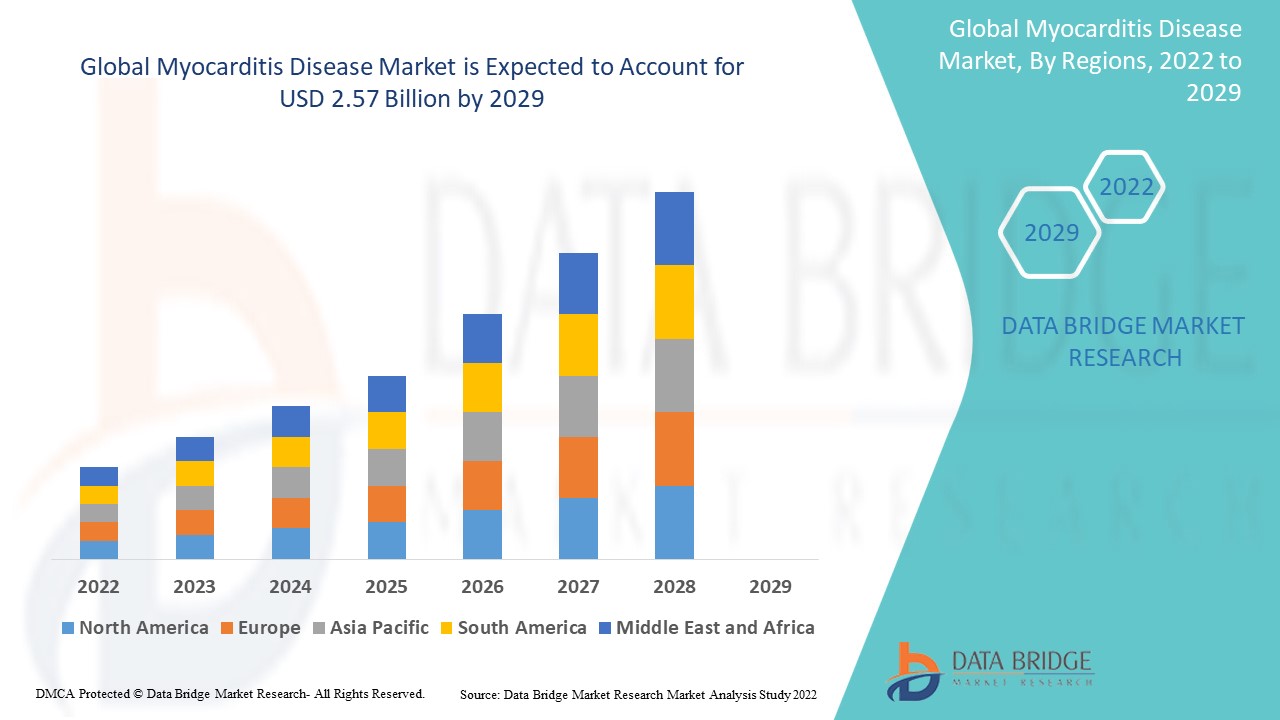
Data Bridge Market Research analyses that the myocarditis disease market was valued at USD 1.592 billion in 2021 and is expected to reach USD 2.57 billion by 2029, registering a CAGR of 6.15% during the forecast period of 2022 to 2029. The market report curated by the Data Bridge Market Research team includes in-depth expert analysis, patient epidemiology, pipeline analysis, pricing analysis, and regulatory framework.
Market Definition
When the heart muscle (myocardium) becomes inflamed, it is known as myocarditis. Inflammation occurs when your immune system, for instance, responds to infections. Viral infections or more systemic inflammatory illnesses including autoimmune disorders can induce myocarditis. The heart muscle weakens in severe cases of myocarditis, and it is unable to pump blood adequately to other regions of the body.
Report Scope and Market Segmentation
|
Report Metric |
Details |
|
Forecast Period |
2022 to 2029 |
|
Base Year |
2021 |
|
Historic Years |
2020 (Customizable to 2019 - 2014) |
|
Quantitative Units |
Revenue in USD Billion, Volumes in Units, Pricing in USD |
|
Segments Covered |
Type (Acute Myocarditis, Chronic Myocarditis, Lymphocytic Myocarditis), Treatment (Medication, Surgery, Others), Diagnosis (Blood Tests, Imaging Tests, Cardiac Catheterization, Heart Muscle Biopsy, Others), Route of Administration (Oral, Parenteral, Others), End-Users (Hospitals, Specialty Clinics, Homecare, Others), Distribution Channel (Hospital Pharmacy, Retail Pharmacy, Online Pharmacy, Others) |
|
Countries Covered |
U.S., Canada and Mexico in North America, Germany, France, U.K., Netherlands, Switzerland, Belgium, Russia, Italy, Spain, Turkey, Rest of Europe in Europe, China, Japan, India, South Korea, Singapore, Malaysia, Australia, Thailand, Indonesia, Philippines, Rest of Asia-Pacific (APAC) in the Asia-Pacific (APAC), Saudi Arabia, U.A.E, South Africa, Egypt, Israel, Rest of Middle East and Africa (MEA) as a part of Middle East and Africa (MEA), Brazil, Argentina and Rest of South America as part of South America |
|
Market Players Covered |
F. Hoffmann-La Roche Ltd. (Switzerland), Mylan N.V. (US), Teva Pharmaceutical Industries Ltd. (Israel), Sanofi (France), Pfizer Inc. (US), GlaxoSmithKline plc (UK), Novartis AG (Switzerland), Zydus Cadila (India), AstraZeneca (UK), Johnson & Johnson (US), Bayer AG (Germany), Sun Pharmaceutical Industries Ltd. (India), Merck & Co., Inc. (US), Bristol-Myers Squibb Company (US), Eli Lilly and Company (US), Cipla Inc. (US), Aurobindo Pharma (India), Lupin (India), AbbVie Inc. (US), LEO Pharma A/S (Denmark) |
|
Market Opportunities |
|
Myocarditis Disease Market Dynamics
Drivers
- Increasing prevalence of chronic disorders
The rising prevalence of chronic disorders is estimated to enhance the market's growth. Chronic disorders such as diabetes, HIV/AIDS cancer and others are the risk factors that lead to the emergence of myocarditis disease, hence, influencing the market dynamics during the forecast period of 2022-2029.
- Increasing investment for healthcare infrastructure
Another significant factor influencing the growth rate of myocarditis disease market is the rising healthcare expenditure which helps in improving its infrastructure. Also, various government organizations aims to improve the healthcare infrastructure by increasing funding and this will further influence the market dynamics.
- Growing number of geriatric population
The surging geriatric population is estimated to enhance the market's expansion during the forecast period of 2022-2029. According to the World Health Organization (WHO), the worldwide geriatric population, which was estimated to be over 524 million in 2010, is expected to increase to nearly 2 billion by 2050. Due to their compromised immune systems, geriatrics are more susceptible to get cardiovascular diseases, further estimated to enhance the market’s growth rate.
Furthermore, rising initiatives by public and private organizations to spread awareness will expand the myocarditis disease market. Additionally, changing lifestyle of people and rising consumption of various medicines including antibiotics, such as penicillin and sulfonamide drugs and some anti-seizure medications will result in the expansion of myocarditis disease market.
Opportunities
- Increase in the number of research and development activities
Moreover, the market's growth is fueled by an increase in the number of research and development activities. This will provide beneficial opportunities for the myocarditis disease market growth. Along with this, rising drug approvals and launches will further propel the market’s growth rate.
Moreover, rising investment for the development of advanced technologies and increase in the number of emerging markets will further provide beneficial opportunities for the myocarditis disease market growth during the forecast period.
Restraints/Challenges
On the other hand, high cost associated with the treatment will obstruct the growth rate of market. The dearth of skilled professionals and lack of healthcare infrastructure in developing economies will challenge the myocarditis disease market. Additionally, strict regulatory policies and lack of awareness among people will act as restrain and further impede the growth rate of market during the forecast period of 2022-2029.
This myocarditis disease market report provides details of new recent developments, trade regulations, import-export analysis, production analysis, value chain optimization, market share, impact of domestic and localized market players, analyses opportunities in terms of emerging revenue pockets, changes in market regulations, strategic market growth analysis, market size, category market growths, application niches and dominance, product approvals, product launches, geographic expansions, technological innovations in the market. To gain more info on the myocarditis disease market contact Data Bridge Market Research for an Analyst Brief, our team will help you take an informed market decision to achieve market growth.
Patient Epidemiology Analysis
Myocarditis disease market also provides you with detailed market analysis for patient analysis, prognosis and cures. Prevalence, incidence, mortality, adherence rates are some of the data variables that are available in the report. Direct or indirect impact analyses of epidemiology to market growth are analysed to create a more robust and cohort multivariate statistical model for forecasting the market in the growth period.
COVID-19 Impact on Myocarditis Disease Market
Since its emergence in December 2019, the COVID-19 virus has spread to nearly every country on the planet, prompting the World Health Organization (WHO) to declare it a public health emergency. COVID-19, a new coronavirus, was identified as the causal agent in the pneumonia cases. This virus spread quickly over the world, killing a large number of people. COVID-19 was labelled a global pandemic by the World Health Organization (WHO) in March 2020, and rigorous measures to prevent the disease's spread were recommended. Since then, the pandemic has delayed the expansion of the healthcare sector and disrupted the supply chain. Furthermore, governments in a number of nations had imposed nationwide lockdowns in order to halt the spread of COVID-19. Similarly, healthcare organizations in numerous nations throughout the world were having difficulty continuing their supply chain activities. The myocarditis disease market was hampered by the supply chain slowness.
Global Myocarditis Disease Market Scope
The myocarditis disease market is segmented on the basis of type, treatment, diagnosis, route of administration, end-users and distribution channel. The growth amongst these segments will help you analyze meagre growth segments in the industries and provide the users with a valuable market overview and market insights to help them make strategic decisions for identifying core market applications.
Type
- Acute Myocarditis
- Chronic Myocarditis
- Lymphocytic Myocarditis
Diagnosis
- Blood Tests
- Cardiac Catheterization
- Heart Muscle Biopsy
- Imaging Tests
- Echocardiogram
- Chest X-ray
- Electrocardiogram (ECG)
- Magnetic resonance imaging (MRI)
- Others
- Treatment
- Medication
- Diuretics
- Beta blockers
- Angiotensin-converting enzyme (ACE) inhibitors
- Corticosteroids
- Others
- Surgery
- Heart transplant
- Extracorporeal membrane oxygenation (ECMO)
- Intra-aortic balloon pump
- Ventricular assist devices (VAD)
- IV medications
- Others
Route of Administration
- Oral
- Parenteral
- Others
End-Users
- Hospitals
- Specialty Clinics
- Homecare
- Others
Distribution Channel
- Hospital Pharmacy
- Retail Pharmacy
- Online Pharmacy
- Others
Myocarditis Disease Market Regional Analysis/Insights
The myocarditis disease market is analysed and market size insights and trends are provided by country, type, treatment, diagnosis, route of administration, end-users and distribution channel as referenced above.
The countries covered in the myocarditis disease market report are U.S., Canada and Mexico in North America, Germany, France, U.K., Netherlands, Switzerland, Belgium, Russia, Italy, Spain, Turkey, Rest of Europe in Europe, China, Japan, India, South Korea, Singapore, Malaysia, Australia, Thailand, Indonesia, Philippines, Rest of Asia-Pacific (APAC) in the Asia-Pacific (APAC), Saudi Arabia, U.A.E, South Africa, Egypt, Israel, Rest of Middle East and Africa (MEA) as a part of Middle East and Africa (MEA), Brazil, Argentina and Rest of South America as part of South America
North America dominates the myocarditis disease market because of the rising number of research activities in this region. Additionally, rising healthcare expenditure and presence of major key players will further propel the market’s growth rate in this region.
Asia-Pacific are expected to grow during the forecast period due to increasing cases of cardiovascular diseases in this region. Also, development of healthcare infrastructure and rising geriatric population will further propel the market’s growth rate in this region.
The country section of the report also provides individual market impacting factors and changes in regulation in the market domestically that impacts the current and future trends of the market. Data points like down-stream and upstream value chain analysis, technical trends and porter's five forces analysis, case studies are some of the pointers used to forecast the market scenario for individual countries. Also, the presence and availability of global brands and their challenges faced due to large or scarce competition from local and domestic brands, impact of domestic tariffs and trade routes are considered while providing forecast analysis of the country data.
Competitive Landscape and Myocarditis Disease Market Share Analysis
The myocarditis disease market competitive landscape provides details by competitor. Details included are company overview, company financials, revenue generated, market potential, investment in research and development, new market initiatives, global presence, production sites and facilities, production capacities, company strengths and weaknesses, product launch, product width and breadth, application dominance. The above data points provided are only related to the companies' focus related to myocarditis disease market.
Some of the major players operating in the myocarditis disease market are:
- F. Hoffmann-La Roche Ltd. (Switzerland)
- Mylan N.V. (US)
- Teva Pharmaceutical Industries Ltd.(Israel)
- Sanofi (France)
- Pfizer Inc. (US)
- GlaxoSmithKline plc (UK)
- Novartis AG (Switzerland)
- Zydus Cadila (India)
- AstraZeneca (UK)
- Johnson & Johnson (US)
- Bayer AG (Germany)
- Sun Pharmaceutical Industries Ltd. (India)
- Bristol-Myers Squibb Company (US)
- Eli Lilly and Company (US)
- Cipla Inc. (US)
- Aurobindo Pharma (India)
- Lupin (India)
- AbbVie Inc. (US)
- LEO Pharma A/S (Denmark)
SKU-
Accédez en ligne au rapport sur le premier cloud mondial de veille économique
- Tableau de bord d'analyse de données interactif
- Tableau de bord d'analyse d'entreprise pour les opportunités à fort potentiel de croissance
- Accès d'analyste de recherche pour la personnalisation et les requêtes
- Analyse de la concurrence avec tableau de bord interactif
- Dernières actualités, mises à jour et analyse des tendances
- Exploitez la puissance de l'analyse comparative pour un suivi complet de la concurrence
Méthodologie de recherche
La collecte de données et l'analyse de l'année de base sont effectuées à l'aide de modules de collecte de données avec des échantillons de grande taille. L'étape consiste à obtenir des informations sur le marché ou des données connexes via diverses sources et stratégies. Elle comprend l'examen et la planification à l'avance de toutes les données acquises dans le passé. Elle englobe également l'examen des incohérences d'informations observées dans différentes sources d'informations. Les données de marché sont analysées et estimées à l'aide de modèles statistiques et cohérents de marché. De plus, l'analyse des parts de marché et l'analyse des tendances clés sont les principaux facteurs de succès du rapport de marché. Pour en savoir plus, veuillez demander un appel d'analyste ou déposer votre demande.
La méthodologie de recherche clé utilisée par l'équipe de recherche DBMR est la triangulation des données qui implique l'exploration de données, l'analyse de l'impact des variables de données sur le marché et la validation primaire (expert du secteur). Les modèles de données incluent la grille de positionnement des fournisseurs, l'analyse de la chronologie du marché, l'aperçu et le guide du marché, la grille de positionnement des entreprises, l'analyse des brevets, l'analyse des prix, l'analyse des parts de marché des entreprises, les normes de mesure, l'analyse globale par rapport à l'analyse régionale et des parts des fournisseurs. Pour en savoir plus sur la méthodologie de recherche, envoyez une demande pour parler à nos experts du secteur.
Personnalisation disponible
Data Bridge Market Research est un leader de la recherche formative avancée. Nous sommes fiers de fournir à nos clients existants et nouveaux des données et des analyses qui correspondent à leurs objectifs. Le rapport peut être personnalisé pour inclure une analyse des tendances des prix des marques cibles, une compréhension du marché pour d'autres pays (demandez la liste des pays), des données sur les résultats des essais cliniques, une revue de la littérature, une analyse du marché des produits remis à neuf et de la base de produits. L'analyse du marché des concurrents cibles peut être analysée à partir d'une analyse basée sur la technologie jusqu'à des stratégies de portefeuille de marché. Nous pouvons ajouter autant de concurrents que vous le souhaitez, dans le format et le style de données que vous recherchez. Notre équipe d'analystes peut également vous fournir des données sous forme de fichiers Excel bruts, de tableaux croisés dynamiques (Fact book) ou peut vous aider à créer des présentations à partir des ensembles de données disponibles dans le rapport.