



North America Modular Kitchen Market, By Product (Floor Cabinet, and Wall Cabinet), Layout (Straight Layout, L-Shaped Layout, U-Shaped Layout, Parallel Layout, Island Kitchen, and G-Shaped), Raw Material (Wood, Metal, Fiber/Plastic, and Others), Application (Residential, and Commercial), Construction (New Construction, Renovation and Repair), Distribution Channel (Offline, and Online), Industry Trends and Forecast to 2029.
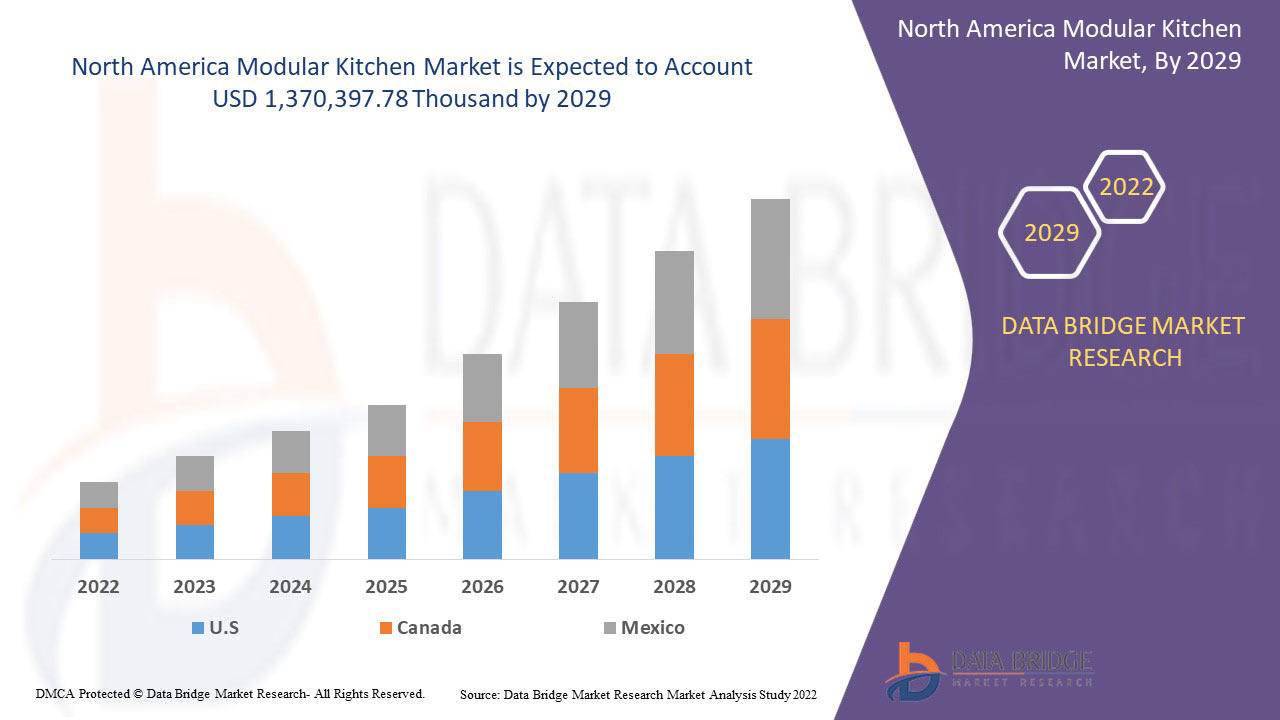
North America Modular Kitchen Market Analysis and Size
Growing residential construction and renovation activities across the globe are an important driver for the North America modular kitchen market. The increasing demand for space-saving and efficient storage among consumers and the rising consumer preference for a charcoal grey, champagne, and cream colors interiors are expected to propel the growth of the North America modular kitchen market.
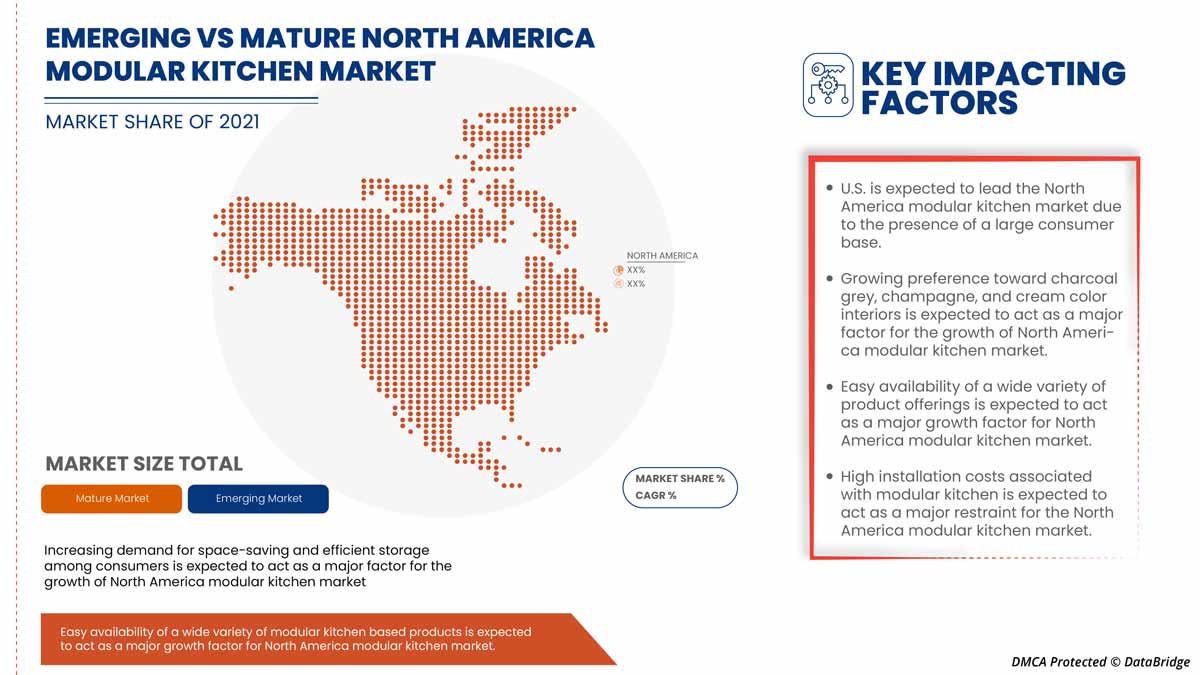
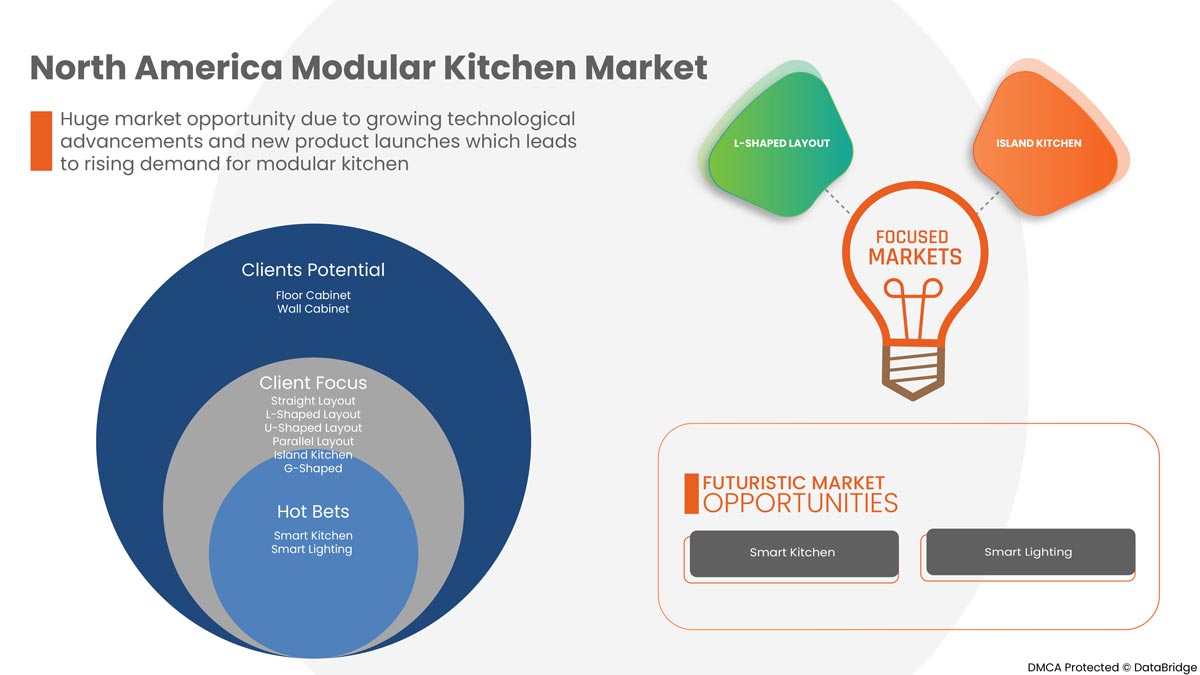
Data Bridge Market Research analyses that the modular kitchen market is expected to reach a value of USD 1,370,397.78 Thousand by the year 2029, at a CAGR of 5.7% during the forecast period. "Residential" accounts for the most prominent application segment in the respective market owing to the rise in modular kitchens. The market report curated by the Data Bridge Market Research team includes in-depth expert analysis, import/export analysis, pricing analysis, production consumption analysis, and climate chain scenario.
|
Report Metric |
Details |
|
Forecast Period |
2022 to 2029 |
|
Base Year |
2021 |
|
Historic Years |
2020 (Customizable to 2019 - 2014) |
|
Quantitative Units |
Revenue in USD Thousand |
|
Segments Covered |
By Product (Floor Cabinet and Wall Cabinet), Layout (Straight Layout, L-Shaped Layout, U-Shaped Layout, Parallel Layout, Island Kitchen, and G-Shaped), Raw Material (Wood, Metal, Fiber/Plastic, and Others), Application (Residential, and Commercial), Construction (New Construction, Renovation and Repair), Distribution Channel (Offline, and Online). |
|
Countries Covered |
U.S., and Canada. |
|
Market Players Covered |
nobilia, Hettich Holding GmbH & Co. oHG, Häcker Küchen, Bulthaup GmbH & Co KG, SieMatic Möbelwerke GmbH & Co. KG, Kohler Co., LINEADECOR, Pedini SpA, and Snaidero Rino Spa, among others. |
Market Definition
A modular kitchen is defined as a modern kitchen with furniture that has been constructed in modules or units. The name modular kitchen originates from the idea of the module. They consist of small sections or modules which are accumulated together to form a complete kitchen. They comprise of cabinets or storage units of standard sizes customized as per the kitchen sizes and layout. Modular kitchen designs break down large systems into essential parts to meet various customer needs, replicating flexibility and agility. They are usually a combination of wall units and base units.
Modular kitchen advances over the traditional kitchen in terms of hygiene, space management, cost-efficiency, and easy and low maintenance. The biggest advantage of modular kitchens is that they can be assembled and reassembled. They allow an efficient workflow even in very compact spaces. Modular kitchens are popular today because of their sleek and smooth finishes. They are light on the eyes as they are designed with fine and clean edges. The cabinets and other accessories are available in different styles, colors, and patterns.
Market Dynamics of the North America Modular Kitchen Market
This section deals with understanding the market drivers, opportunities, restraints, and challenges. All of this is discussed in detail as below:
Drivers/Opportunities Faced by the North America Modular Kitchen Market
- Growing residential construction and renovation activities across the globe
The modular kitchen construction is increasing in the residential sector, due to which the demand for modular kitchens is rising. These types of kitchens take less space and work efficiently. Several companies are engaged in providing designer and good-looking modular kitchens. Moreover, consumers who are moving to their new spaces and renovating older ones prefer modular kitchen solutions, which can contribute to the modular kitchen market. Thus, growing residential construction and renovation activities across the globe are expected to contribute to the North America modular kitchen market
- Increasing demand for space-saving and efficient storage among consumers
Several companies are producing space-saving and efficient storage modular kitchen solutions that consume less space and work efficiently. The manufacturers have also introduced the glossy and laminated theme for the modular kitchen. Nuclear families who need more space in their homes are more inclined toward installing a modular kitchen. Moreover, modular kitchen furniture is designed for modern spaces, which are more open and spacious. It keeps up with the new trends and is open for customization in drawers, cabinets, countertops, or micro-compartments for better organization. As a result, increasing demand for space-saving and efficient storage among consumers can be considered as one of the major drivers of the North America modular kitchen market growth
- High adoption of the modular kitchen due to changing the lifestyle pattern of consumers
As the standard of living increases, the socio-economic condition accessible to the person or a particular group of people improves. Since post-lockdown people spend most of their time in the kitchen cooking, eating, and working, the need for spacious and standard look kitchens is increasing. The desire to bring aesthetics to home and improve its look would cause a surge in the demand, sales, and profit of modular kitchens. Thus, lifestyle changes and living standards could be a substantial driver of the North America modular kitchen market growth
- Increasing investments in the construction industry
The growing hospitality and food service industry has led to an increase in the number of people traveling and dining out. The leading international hoteliers are expanding their businesses to drive next-level growth. Growing demand for food services such as restaurants, cafes, and food joints, among others, is penetrating the market. The number of fast-food chains and food outlets is also on the rise. The participants in the food service industry are exploring ways to optimize their facilities in terms of space and efficiency while maintaining proper hygiene, which directly impacts the demand for modular kitchens. Modular kitchens have merged into the living and dining spaces, creating one big space for family and friends to have a great time. Furthermore, the emergence of nuclear families, an increasing number of housing projects, growth in organized retails, and a shift in changing home aesthetics may provide various growth opportunities for the North America modular kitchen market
- Technological advancements and launching new products to flourish the market
With the entry of new players, the modular kitchen industry is witnessing a creative boom with multiple designs and ideas to choose from. Since these kitchens are customized based on the consumer's requirements, various elements can easily be considered in one place, such as layout, color scheme, accessories, and appliances. The participants in the modular kitchen industry are exploring ways to expand their services in every possible way. They are working on enabling online delivery facilities and providing better after-sale services. New-age marketing strategies and social media engagements are also being adopted. Various factors, such as internet penetration, the rise in smartphone users, and social media influence, among others, have boosted online sales. Furthermore, new lifestyles, higher disposable incomes, and increasing consumer awareness create demand for technologically advanced products. This, in turn, provides new opportunities for the growth of the North America modular kitchen industry
Restraints/Challenges Faced by the North America Modular Kitchen Market
- High costs associated with the installation of modular kitchen
There is a requirement for proper ventilation in a modular kitchen to vent out the cooking fumes and allow fresh air to enter. The smoke from cooking should not be allowed to collect inside the kitchen. Thus, installing a chimney or an exhaust fan becomes crucial. The door or window in the kitchen should ideally open into the balcony or open area to vent out the fumes. There should be enough space for fresh air to come in easily.
Moreover, it is important to ensure natural light is available during the day. However, there are overhead lights and under-cabinet lights available, which are in trend among consumers these days. Therefore, maintaining proper ventilation and lighting in the modular kitchen also costs additional. Therefore, the high installation costs for modular kitchens and the need for technical assistance while installation and repair may hinder the growth of the North America modular kitchen market
- Fluctuation in the prices of raw materials
The raw material is available in various qualities and at different rates, due to which production of modular kitchen products is very difficult for the manufacturers. Highly fluctuating raw materials costs and ineffective price management can greatly affect a manufacturer in the market. Due to the fluctuation in the raw material price, the manufacturers cannot fix the cost of the product, which further results in a loss for the manufacturers. Different types of raw materials, such as plastic, metal, and wood, are used to produce modular kitchen products. Thus, more fluctuation in the raw materials price will result in losses to the manufacturers and not the ability to invest more in the market. So, the fluctuation in the raw material prices is expected to challenge the market
- High maintenance costs associated with the modular kitchen
The materials used in the kitchen also play a crucial role in the durability, maintenance, and life cycle of the modular kitchen. It is important to select a justified material in terms of functionality, durability, and aesthetics. Therefore, it is essential to understand different materials, whether renovating an old kitchen or building a new one from scratch. The selection of the correct base materials is critical in determining the longevity of the kitchen. Selecting low-maintenance materials, especially for kitchens, is desirable by many customers. Customers even opt for color combinations that are easier to maintain and do not get stained frequently. However, reaching out to an expert regarding material and color consultations that would work for the kitchen again comes with additional costs
Post COVID-19 Impact on North America Modular Kitchen Market
COVID-19 impacted various manufacturing industries in the year 2020-2021 as it led to the closure of workplaces, disruption of supply chains, and restrictions on transportation. Due to the lockdown, the market has experienced a downfall in sales due to the shutdown of retail outlets and the restrictions on customer access over the past few years.
However, the growth of the market post-pandemic period is attributed to more people working from home and increased disposable income. This has led to the increased demand for furnishing and renovations. The key market players are making various strategic decisions to bounce back post-COVID-19. The players are conducting multiple R&D activities to improve their offerings. They are enhancing its market share by exploring different retail channels and expanding into new regions.
This North America modular kitchen market report provides details of new recent developments, trade regulations, import-export analysis, production analysis, value chain optimization, market share, the impact of domestic and localized market players, analyses opportunities in terms of emerging revenue pockets, changes in market regulations, strategic market growth analysis, market size, category market growths, application niches and dominance, product approvals, product launches, geographic expansions, technological innovations in the market. To gain more info on the Modular kitchen market, contact Data Bridge Market Research for an Analyst Brief. Our team will help you to make an informed market decision to achieve market growth.
Recent Developments
- In April 2022, Nobia introduced the first group-wide design concept Nordic Nature, inspired by the Nordic forests. This was launched by Marbodal (Sweden), Sigdal (Norway), and A’la Carte (Finland) in 2021 and this year by HTH and Invita (Denmark), and Magnet (UK). This development will help the company to increase its sales
North America Modular Kitchen Market Scope
The North America modular kitchen market is segmented on the basis of product, layout, raw material, application, construction, and distribution channel. The growth amongst these segments will help you analyze meager growth segments in the industries and provide the users with a valuable market overview and market insights to help them make strategic decisions for identifying core market applications.
Product
- Floor Cabinet
- Wall Cabinet
On the basis of product, the North America modular kitchen market is segmented into floor cabinet and wall cabinet.
Layout
- Straight Layout
- L-Shaped Layout
- U-Shaped Layout
- Parallel Layout
- Island Kitchen
- G-Shaped
On the basis of the layout, the North America modular kitchen market is segmented into straight layout, L-shaped layout, U-shaped layout, parallel layout, island kitchen, and G-shaped.
Raw Material
- Wood
- Metal
- Fiber/Plastic
- Others
On the basis of raw materials, the North America modular kitchen market is segmented into the wood, metal, fiber/plastic, and others.
Application
- Residential
- Commercial
Based on application, the North America modular kitchen market is segmented into residential, and commercial.
Construction
- New Construction
- Renovation And Repair
On the basis of construction, the North America modular kitchen market is segmented into new construction, renovation and repair.
Distribution Channel
- Offline
- Online
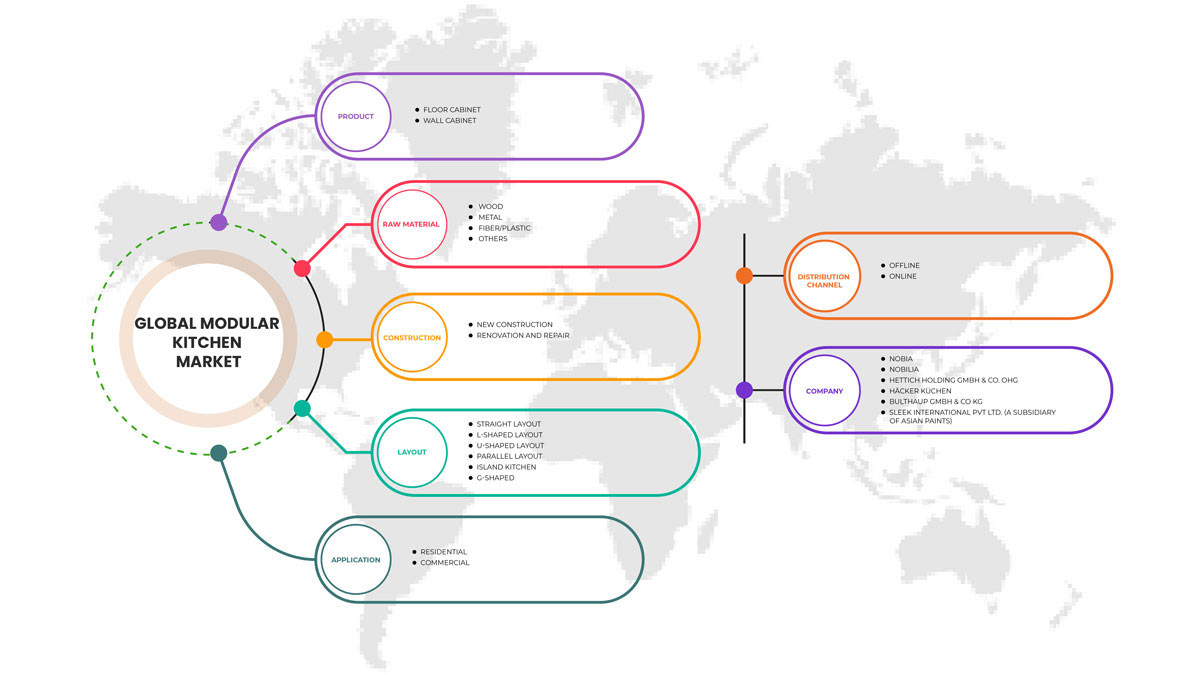
On the basis of the distribution channel, the North America modular kitchen market is segmented into offline and online.
North America Modular Kitchen Market Regional Analysis/Insights
The North America modular kitchen market is analyzed, and market size insights and trends are provided by country, product, layout, raw material, application, construction, and distribution channel, as referenced above.
The countries covered in the North America modular kitchen market report are the U.S., and Canada.
The U.S. is dominating the market due to a rise in consumer spending on modular kitchens in renovating homes and furniture in the region. The rise in investments and initiatives towards construction activities for both commercial and residential propelling the region's demand for modular kitchens.
The country section of the report also provides individual market-impacting factors and changes in market regulation that impact the current and future trends of the market. Data points such as downstream and upstream value chain analysis, technical trends, porter's five forces analysis, and case studies are some pointers used to forecast the market scenario for individual countries. Also, the presence and availability of global brands and their challenges faced due to large or scarce competition from local and domestic brands, the impact of domestic tariffs, and trade routes are considered while providing forecast analysis of the country data.
Competitive Landscape and North America Modular Kitchen Market Share Analysis
The North America modular kitchen market competitive landscape provides details by a competitor. Details include company overview, company financials, revenue generated, market potential, investment in research and development, new market initiatives, global presence, production sites and facilities, production capacities, company strengths and weaknesses, product launch, product width and breadth, and application dominance. The above data points provided are only related to the companies' focus related to the North America modular kitchen market.
Some major players operating in the Modular kitchen market are nobilia, Hettich Holding GmbH & Co. oHG, Häcker Küchen, Bulthaup GmbH & Co KG, SieMatic Möbelwerke GmbH & Co. KG, Kohler Co., LINEADECOR, Pedini SpA, and Snaidero Rino Spa, among others.
SKU-
Accédez en ligne au rapport sur le premier cloud mondial de veille économique

- Tableau de bord d'analyse de données interactif
- Tableau de bord d'analyse d'entreprise pour les opportunités à fort potentiel de croissance
- Accès d'analyste de recherche pour la personnalisation et les requêtes
- Analyse de la concurrence avec tableau de bord interactif
- Dernières actualités, mises à jour et analyse des tendances
- Exploitez la puissance de l'analyse comparative pour un suivi complet de la concurrence
Table des matières
1 INTRODUCTION
1.1 OBJECTIFS DE L'ÉTUDE
1.2 DÉFINITION DU MARCHÉ
1.3 APERÇU DU MARCHÉ DES CUISINES MODULAIRES EN AMÉRIQUE DU NORD
1.4 LIMITATION
1,5 MARCHÉS COUVERTS
2 SEGMENTATION DU MARCHÉ
2.1 MARCHÉS COUVERTS
2.2 PORTÉE GÉOGRAPHIQUE
2,3 ANS CONSIDÉRÉS POUR L'ÉTUDE
2.4 MONNAIE ET TARIFS
2.5 MODÈLE DE VALIDATION DES DONNÉES DU TRÉPIED DBMR
2.6 COURBE DE VIE DU PRODUIT
2.7 MODÉLISATION MULTIVARIÉE
2.8 ENTRETIENS PRIMAIRES AVEC DES LEADERS D'OPINION CLÉS
2.9 GRILLE DE POSITIONNEMENT DU MARCHÉ DBMR
2.1 GRILLE DE COUVERTURE DES APPLICATIONS DU MARCHÉ
2.11 MATRICE DES DÉFIS DU MARCHÉ DBMR
2.12 ANALYSE DES PARTS DES FOURNISSEURS DBMR
2.13 DONNÉES D'IMPORTATION-EXPORTATION
2.14 SOURCES SECONDAIRES
2.15 HYPOTHÈSES
3 RÉSUMÉ EXÉCUTIF
4 INFORMATIONS PREMIUM
4.1 LES CINQ FORCES DE PORTER :
4.1.1 MENACE DE NOUVEAUX ENTRANTS :
4.1.2 MENACE DE SUBSTITUTS :
4.1.3 POUVOIR DE NÉGOCIATION DU CLIENT :
4.1.4 POUVOIR DE NÉGOCIATION DES FOURNISSEURS :
4.1.5 CONCURRENCE INTERNE (RIVALITÉ) :
4.2 ANALYSE COMPARATIVE DES MARQUES
4.3 SCÉNARIO D'IMPORTATION-EXPORTATION
4.4 COMPORTEMENT D'ACHAT DES CONSOMMATEURS
4.4.1 FACTEURS CULTURELS
4.4.2 FACTEURS SOCIAUX
4.4.3 FACTEURS PERSONNELS
4.4.4 FACTEURS PSYCHOLOGIQUES
4.4.5 FACTEURS ÉCONOMIQUES
4.5 FACTEURS AFFECTANT LA DÉCISION D'ACHAT
4.5.1 FONCTIONNALITÉ
4.5.2 MATÉRIAUX UTILISÉS
4.5.3 PRIX
4.5.4 DURÉE DE VIE
4.5.5 DURABILITÉ
4.5.6 MARKETING
4.6 ANALYSE DE L'APPROVISIONNEMENT EN MATIÈRES PREMIÈRES
4.7 COUVERTURE RÉGLEMENTAIRE
4.8 CRITÈRES D'ADOPTION DU PRODUIT
4.8.1 APERÇU
4.8.1.1 NOTORIÉTÉ DU PRODUIT
4.8.1.2 INTÉRÊT POUR LE PRODUIT
4.8.1.3 ÉVALUATION DU PRODUIT
4.8.1.4 ESSAI DU PRODUIT
4.8.1.5 ADOPTION DU PRODUIT
4.8.2 CONCLUSION
5 ANALYSE DE LA CHAÎNE D'APPROVISIONNEMENT
5.1 APERÇU
5.2 SCÉNARIO DE COÛTS LOGISTIQUES
5.3 IMPORTANCE DES PRESTATAIRES DE SERVICES LOGISTIQUES
6 IMPACT DU RALENTISSEMENT ÉCONOMIQUE
6.1 APERÇU
6.2 IMPACT SUR LE PRIX
6.3 IMPACT SUR LA CHAÎNE D'APPROVISIONNEMENT
6.4 IMPACT SUR L'EXPÉDITION
6.5 IMPACT SUR LES DÉCISIONS STRATÉGIQUES DE L'ENTREPRISE
6.6 CONCLUSION
7 APERÇU DU MARCHÉ
7.1 PILOTES
7.1.1 CROISSANCE DES ACTIVITÉS DE CONSTRUCTION ET DE RÉNOVATION RÉSIDENTIELLES À TRAVERS LE MONDE
7.1.2 DEMANDE CROISSANTE DE STOCKAGE EFFICACE ET ÉCONOMIQUE EN PLACE PARMI LES CONSOMMATEURS
7.1.3 PRÉFÉRENCE CROISSANTE DES CONSOMMATEURS POUR LES INTÉRIEURS DE COULEUR GRIS ANTHRACITE, CHAMPAGNE ET CRÈME
7.1.4 FORTE ADOPTION DE LA CUISINE MODULAIRE EN RAISON DE L'ÉVOLUTION DU MODE DE VIE DES CONSOMMATEURS
7.2 RESTRICTIONS
7.2.1 COÛTS ÉLEVÉS ASSOCIÉS À L'INSTALLATION D'UNE CUISINE MODULAIRE
7.2.2 FLUCTUATION DES PRIX DES MATIÈRES PREMIÈRES
7.3 OPPORTUNITÉS
7.3.1 AUGMENTATION DES INVESTISSEMENTS DANS LE SECTEUR DE LA CONSTRUCTION
7.3.2 AVANCÉES TECHNOLOGIQUES ET LANCEMENT DE NOUVEAUX PRODUITS POUR FAIRE PROSPÉRER LE MARCHÉ
7.3.3 ÉVOLUTION DE LA PRÉFÉRENCE DES CONSOMMATEURS VERS LA POPULARITÉ DES CUISINES OUVERTES MODULAIRES
7.4 DÉFIS
7.4.1 COÛTS D'ENTRETIEN ÉLEVÉS ASSOCIÉS À LA CUISINE MODULAIRE
7.4.2 NOMBRE IMPORTANT D'ACTEURS LOCAUX QUI BÉNÉFICIENT DE L'IMPLANTATION DU MARCHÉ
8 MARCHÉ DES CUISINES MODULAIRES EN AMÉRIQUE DU NORD, PAR PRODUIT
8.1 APERÇU
8.2 ARMOIRE DE SOL
8.3 ARMOIRE MURALE
9 MARCHÉ DES CUISINES MODULAIRES EN AMÉRIQUE DU NORD, PAR DISPOSITION
9.1 APERÇU
9.2 DISPOSITION DROITE
9.3 DISPOSITION EN L
9.4 DISPOSITION EN U
9.5 DISPOSITION PARALLÈLE
9.6 CUISINE AVEC ÎLOT
9.7 EN FORME DE G
10 MARCHÉ DES CUISINES MODULAIRES EN AMÉRIQUE DU NORD, PAR MATIÈRE PREMIÈRE
10.1 APERÇU
10.2 BOIS
10.3 MÉTAL
10.4 FIBRE/PLASTIQUE
10,5 AUTRES
11 MARCHÉ DES CUISINES MODULAIRES EN AMÉRIQUE DU NORD, PAR APPLICATION
11.1 APERÇU
11.2 RÉSIDENTIEL
11.2.1 RÉSIDENTIEL, SUR DEMANDE
11.2.1.1 MAISONS UNIFAMILIALES
11.2.1.2 COPROPRIÉTÉ
11.2.1.3 MAISON DE VILLE
11.2.1.4 COOPÉRATIVE
11.2.1.5 AUTRES
11.3 COMMERCIAL
11.3.1 COMMERCIAL, PAR APPLICATION
11.3.1.1 QSRS
11.3.1.2 FSRS
11.3.1.3 CENTRES DE VILLÉGIATURE ET HÔTELS
11.3.1.4 CANTINES INSTITUTIONNELLES
11.3.1.5 HÔPITAUX
11.3.1.6 AUTRES
12 MARCHÉ DES CUISINES MODULAIRES EN AMÉRIQUE DU NORD, PAR CONSTRUCTION
12.1 APERÇU
12.2 NOUVELLE CONSTRUCTION
12.3 RÉNOVATION ET RÉPARATION
13 MARCHÉ DES CUISINES MODULAIRES EN AMÉRIQUE DU NORD, PAR CANAL DE DISTRIBUTION
13.1 APERÇU
13.2 HORS LIGNE
13.3 EN LIGNE
14 MARCHÉ DES CUISINES MODULAIRES EN AMÉRIQUE DU NORD, PAR RÉGION
14.1 AMÉRIQUE DU NORD
14.1.1 États-Unis
14.1.2 CANADA
15 MARCHÉ DES CUISINES MODULAIRES D'AMÉRIQUE DU NORD, PAYSAGE D'ENTREPRISE
15.1 ANALYSE DES ACTIONS DE L'ENTREPRISE : AMÉRIQUE DU NORD
15.1.1 PARTENARIAT
15.1.2 EXPANSION
15.1.3 PRIX
16 PROFILS D'ENTREPRISE
16.1 NOBIA
16.1.1 INSTANTANÉ DE L'ENTREPRISE
16.1.2 ANALYSE DES REVENUS
16.1.3 ANALYSE DES ACTIONS DE LA SOCIÉTÉ
16.1.4 SWOT
16.1.5 PORTEFEUILLE DE PRODUITS
16.1.6 ÉVOLUTIONS RÉCENTES
16.2 NOBILIA
16.2.1 INSTANTANÉ DE L'ENTREPRISE
16.2.2 ANALYSE DES ACTIONS DE LA SOCIÉTÉ
16.2.3 PORTEFEUILLE DE PRODUITS
16.2.4 SWOT
16.2.5 ÉVOLUTIONS RÉCENTES
16.3 HETTICH HOLDING GMBH & CO. OHG
16.3.1 INSTANTANÉ DE L'ENTREPRISE
16.3.2 ANALYSE DES ACTIONS DE L'ENTREPRISE
16.3.3 PORTEFEUILLE DE PRODUITS
16.3.4 SWOT
16.3.5 ÉVOLUTIONS RÉCENTES
16.4 CUISINES HÄCKER
16.4.1 INSTANTANÉ DE L'ENTREPRISE
16.4.2 ANALYSE DES ACTIONS DE L'ENTREPRISE
16.4.3 PORTEFEUILLE DE PRODUITS
16.4.4 SWOT
16.4.5 ÉVOLUTIONS RÉCENTES
16,5 BULTHAUP GMBH & CO KG
16.5.1 INSTANTANÉ DE L'ENTREPRISE
16.5.2 ANALYSE DES ACTIONS DE L'ENTREPRISE
16.5.3 PORTEFEUILLE DE PRODUITS
16.5.4 SWOT
16.5.5 ÉVOLUTIONS RÉCENTES
16.6 SLEEK INTERNATIONAL PVT LTD. (FILIALE D'ASIAN PAINTS)
16.6.1 INSTANTANÉ DE L'ENTREPRISE
16.6.2 ANALYSE DES REVENUS
16.6.3 PORTEFEUILLE DE PRODUITS
16.6.4 SWOT
16.6.5 ÉVOLUTIONS RÉCENTES
16.7 SIEMATIC MÖBELWERKE GMBH & CO. KG
16.7.1 INSTANTANÉ DE L'ENTREPRISE
16.7.2 PORTEFEUILLE DE PRODUITS
16.7.3 SWOT
16.7.4 ÉVOLUTIONS RÉCENTES
16.8 CUISINE MODULAIRE ALEA
16.8.1 INSTANTANÉ DE L'ENTREPRISE
16.8.2 PORTEFEUILLE DE PRODUITS
16.8.3 SWOT
16.8.4 ÉVOLUTIONS RÉCENTES
16.9 CUISINES EASYLIFE
16.9.1 INSTANTANÉ DE L'ENTREPRISE
16.9.2 PORTEFEUILLE DE PRODUITS
16.9.3 SWOT
16.9.4 ÉVOLUTIONS RÉCENTES
16.1 GODREJ INTERIO
16.10.1 INSTANTANÉ DE L'ENTREPRISE
16.10.2 PORTEFEUILLE DE PRODUITS
16.10.3 SWOT
16.10.4 ÉVOLUTIONS RÉCENTES
16.11 KOHLER CO.
16.11.1 INSTANTANÉ DE L'ENTREPRISE
16.11.2 PORTEFEUILLE DE PRODUITS
16.11.3 SWOT
16.11.4 ÉVOLUTIONS RÉCENTES
16.12 LINEADECOR
16.12.1 INSTANTANÉ DE L'ENTREPRISE
16.12.2 PORTEFEUILLE DE PRODUITS
16.12.3 SWOT
16.12.4 ÉVOLUTIONS RÉCENTES
16.13 CUISINE LUKWOOD
16.13.1 INSTANTANÉ DE L'ENTREPRISE
16.13.2 PORTEFEUILLE DE PRODUITS
16.13.3 SWOT
16.13.4 ÉVOLUTIONS RÉCENTES
16.14 NEXUS INTERIO PRIVATE LIMITED
16.14.1 INSTANTANÉ DE L'ENTREPRISE
16.14.2 PORTEFEUILLE DE PRODUITS
16.14.3 SWOT
16.14.4 ÉVOLUTIONS RÉCENTES
16h15 PEDINI SPA
16.15.1 INSTANTANÉ DE L'ENTREPRISE
16.15.2 PORTEFEUILLE DE PRODUITS
16.15.3 SWOT
16.15.4 ÉVOLUTIONS RÉCENTES
16.16 SNAIDERO RINO SPA
16.16.1 INSTANTANÉ DE L'ENTREPRISE
16.16.2 PORTEFEUILLE DE PRODUITS
16.16.3 SWOT
16.16.4 ÉVOLUTIONS RÉCENTES
16.17 MODULAIRES WUDLEY
16.17.1 INSTANTANÉ DE L'ENTREPRISE
16.17.2 PORTEFEUILLE DE PRODUITS
16.17.3 SWOT
16.17.4 ÉVOLUTIONS RÉCENTES
17 QUESTIONNAIRE
18 RAPPORTS CONNEXES
Liste des figures
FIGURE 1 MARCHÉ DES CUISINES MODULAIRES EN AMÉRIQUE DU NORD : SEGMENTATION
FIGURE 2 MARCHÉ DES CUISINES MODULAIRES EN AMÉRIQUE DU NORD : TRIANGULATION DES DONNÉES
FIGURE 3 MARCHÉ DES CUISINES MODULAIRES EN AMÉRIQUE DU NORD : ANALYSE DROC
FIGURE 4 MARCHÉ DES CUISINES MODULAIRES EN AMÉRIQUE DU NORD : ANALYSE DU MARCHÉ NORD-AMÉRIQUE PAR RAPPORT AU MARCHÉ RÉGIONAL
FIGURE 5 MARCHÉ DES CUISINES MODULAIRES EN AMÉRIQUE DU NORD : ANALYSE DE RECHERCHE DES ENTREPRISES
FIGURE 6 MARCHÉ DES CUISINES MODULAIRES EN AMÉRIQUE DU NORD : LA COURBE DE DURÉE DE VIE DU PRODUIT
FIGURE 7 MARCHÉ DES CUISINES MODULAIRES EN AMÉRIQUE DU NORD : MODÉLISATION MULTIVARIABLE
FIGURE 8 MARCHÉ DES CUISINES MODULAIRES EN AMÉRIQUE DU NORD : DÉMOGRAPHIE DES ENTRETIENS
FIGURE 9 MARCHÉ DES CUISINES MODULAIRES EN AMÉRIQUE DU NORD : GRILLE DE POSITIONNEMENT DU MARCHÉ DBMR
FIGURE 10 MARCHÉ DES CUISINES MODULAIRES EN AMÉRIQUE DU NORD : GRILLE DE COUVERTURE DES APPLICATIONS DU MARCHÉ
FIGURE 11 MARCHÉ DES CUISINES MODULAIRES EN AMÉRIQUE DU NORD : LA MATRICE DES DÉFIS DU MARCHÉ
FIGURE 12 MARCHÉ DES CUISINES MODULAIRES EN AMÉRIQUE DU NORD : ANALYSE DES PARTS DE FOURNISSEURS
FIGURE 13 MARCHÉ DES CUISINES MODULAIRES EN AMÉRIQUE DU NORD : SEGMENTATION
FIGURE 14 LA CROISSANCE DES ACTIVITÉS DE CONSTRUCTION ET DE RÉNOVATION RÉSIDENTIELLES À TRAVERS LE MONDE DEVRAIT STIMULER LA CROISSANCE DU MARCHÉ DES CUISINES MODULAIRES EN AMÉRIQUE DU NORD AU COURS DE LA PÉRIODE DE PRÉVISION
FIGURE 15 LE SEGMENT DES ARMOIRES DE SOL DEVRAIT REPRÉSENTER LA PLUS GRANDE PART DU MARCHÉ DES CUISINES MODULAIRES EN AMÉRIQUE DU NORD EN 2022 ET 2029
FIGURE 16 SCÉNARIO D'IMPORTATION-EXPORTATION (EN MILLIERS USD)
FIGURE 17 MARCHÉ DES CUISINES MODULAIRES EN AMÉRIQUE DU NORD : SCÉNARIO D'ADOPTION DU PRODUIT
FIGURE 18 MOTEURS, CONTRAINTES, OPPORTUNITÉS ET DÉFIS DU MARCHÉ DES CUISINES MODULAIRES EN AMÉRIQUE DU NORD
FIGURE 19 MARCHÉ DES CUISINES MODULAIRES EN AMÉRIQUE DU NORD : PAR PRODUIT, 2021
FIGURE 20 MARCHÉ DES CUISINES MODULAIRES EN AMÉRIQUE DU NORD : PAR AMÉNAGEMENT, 2021
FIGURE 21 MARCHÉ DES CUISINES MODULAIRES EN AMÉRIQUE DU NORD : PAR MATIÈRE PREMIÈRE, 2021
FIGURE 22 MARCHÉ DES CUISINES MODULAIRES EN AMÉRIQUE DU NORD : PAR APPLICATION, 2021
FIGURE 23 MARCHÉ DES CUISINES MODULAIRES EN AMÉRIQUE DU NORD : PAR TYPE DE CONSTRUCTION, 2021
FIGURE 24 MARCHÉ DES CUISINES MODULAIRES EN AMÉRIQUE DU NORD : PAR CANAL DE DISTRIBUTION, 2021
FIGURE 25 MARCHÉ DES CUISINES MODULAIRES EN AMÉRIQUE DU NORD : INSTANTANÉ (2021)
FIGURE 26 MARCHÉ DES CUISINES MODULAIRES EN AMÉRIQUE DU NORD : PAR PAYS (2021)
FIGURE 27 MARCHÉ DES CUISINES MODULAIRES EN AMÉRIQUE DU NORD : PAR PAYS (2022 ET 2029)
FIGURE 28 MARCHÉ DES CUISINES MODULAIRES EN AMÉRIQUE DU NORD : PAR PAYS (2021 ET 2029)
FIGURE 29 MARCHÉ DES CUISINES MODULAIRES EN AMÉRIQUE DU NORD : PAR PRODUIT (2022-2029)
FIGURE 30 MARCHÉ DES CUISINES MODULAIRES EN AMÉRIQUE DU NORD : PART DE L'ENTREPRISE 2021 (%)

Méthodologie de recherche
La collecte de données et l'analyse de l'année de base sont effectuées à l'aide de modules de collecte de données avec des échantillons de grande taille. L'étape consiste à obtenir des informations sur le marché ou des données connexes via diverses sources et stratégies. Elle comprend l'examen et la planification à l'avance de toutes les données acquises dans le passé. Elle englobe également l'examen des incohérences d'informations observées dans différentes sources d'informations. Les données de marché sont analysées et estimées à l'aide de modèles statistiques et cohérents de marché. De plus, l'analyse des parts de marché et l'analyse des tendances clés sont les principaux facteurs de succès du rapport de marché. Pour en savoir plus, veuillez demander un appel d'analyste ou déposer votre demande.
La méthodologie de recherche clé utilisée par l'équipe de recherche DBMR est la triangulation des données qui implique l'exploration de données, l'analyse de l'impact des variables de données sur le marché et la validation primaire (expert du secteur). Les modèles de données incluent la grille de positionnement des fournisseurs, l'analyse de la chronologie du marché, l'aperçu et le guide du marché, la grille de positionnement des entreprises, l'analyse des brevets, l'analyse des prix, l'analyse des parts de marché des entreprises, les normes de mesure, l'analyse globale par rapport à l'analyse régionale et des parts des fournisseurs. Pour en savoir plus sur la méthodologie de recherche, envoyez une demande pour parler à nos experts du secteur.
Personnalisation disponible
Data Bridge Market Research est un leader de la recherche formative avancée. Nous sommes fiers de fournir à nos clients existants et nouveaux des données et des analyses qui correspondent à leurs objectifs. Le rapport peut être personnalisé pour inclure une analyse des tendances des prix des marques cibles, une compréhension du marché pour d'autres pays (demandez la liste des pays), des données sur les résultats des essais cliniques, une revue de la littérature, une analyse du marché des produits remis à neuf et de la base de produits. L'analyse du marché des concurrents cibles peut être analysée à partir d'une analyse basée sur la technologie jusqu'à des stratégies de portefeuille de marché. Nous pouvons ajouter autant de concurrents que vous le souhaitez, dans le format et le style de données que vous recherchez. Notre équipe d'analystes peut également vous fournir des données sous forme de fichiers Excel bruts, de tableaux croisés dynamiques (Fact book) ou peut vous aider à créer des présentations à partir des ensembles de données disponibles dans le rapport.











