



Global Drone Analytics Market Segmentation, By Deployment (On-Premises and On-Demand), Solution (End- To- End Solutions and Point Solutions), Application (Thermal Detection, Geolocation Tagging, Aerial Monitoring, Ground Exploration, Volumetric Calculations, 3D Modeling, and Others), End User (Agriculture and Forestry, Construction, Insurance, Mining and Quarrying, Utility, Telecommunication, Oil and Gas, Transportation, Scientific Research, and Others)– Industry Trends and Forecast to 2032
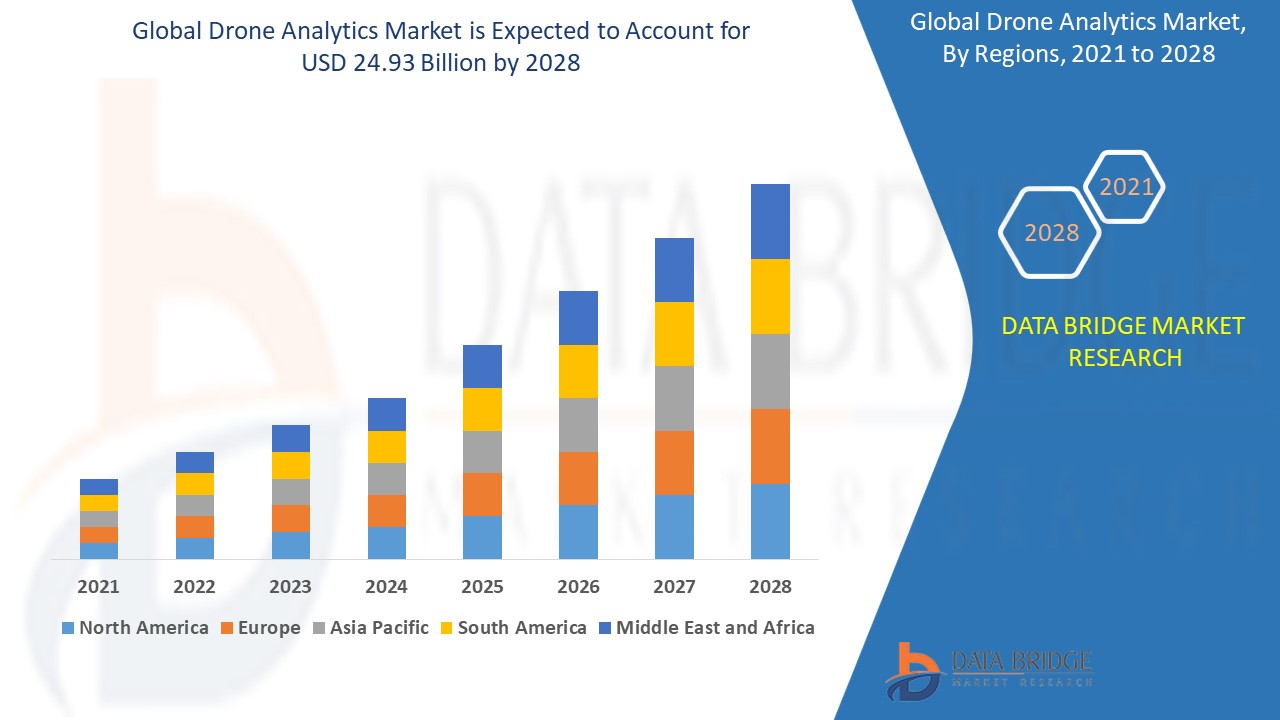
Drone Analytics Market Analysis
The drone analytics market has seen significant advancements in both technology and methodology, leading to enhanced usage across various industries. Key technology advancements include the integration of AI and machine learning with drones, enabling automated data collection, processing, and analysis. These drones are equipped with high-resolution cameras, LIDAR, and multispectral sensors, offering improved data accuracy and real-time analysis. AI algorithms process the vast amounts of data collected, providing actionable insights for industries such as agriculture, construction, and logistics.
In agriculture, drones are used for precision farming, allowing farmers to monitor crop health and optimize resource usage. In construction, drones offer aerial surveying and mapping, reducing time and costs. In logistics, drones enhance supply chain operations with real-time tracking and delivery optimization.
The growth of drone analytics is driven by the increasing demand for data-driven decision-making and cost reduction across industries. As drone technology becomes more accessible, adoption rates rise, fueling the market’s expansion.
Drone Analytics Market Size
The global drone analytics market size was valued at USD 9.07 billion in 2024 and is projected to reach USD 68.50 billion by 2032, with a CAGR of 28.75% during the forecast period of 2025 to 2032. In addition to the market insights such as market value, growth rate, market segments, geographical coverage, market players, and market scenario, the market report curated by the Data Bridge Market Research team includes in-depth expert analysis, import/export analysis, pricing analysis, production consumption analysis, and pestle analysis.
Drone Analytics Market Trends
“Increased Adoption of AI and Machine Learning in Drone Analytics”
One specific trend driving growth in the drone analytics market is the integration of AI and machine learning (ML) technologies. These technologies enable drones to process vast amounts of data in real time, offering valuable insights for industries such as agriculture, construction, and environmental monitoring. For instance, in agriculture, AI-powered drones analyze crop health and predict yields with high accuracy, enabling farmers to make data-driven decisions. Similarly, in infrastructure inspection, drones equipped with ML algorithms can detect structural anomalies, improving maintenance and safety. As AI and ML continue to advance, the demand for drone analytics is expected to grow significantly, enhancing operational efficiency across various sectors.
Report Scope and Drone Analytics Market Segmentation
|
Attributes |
Drone Analytics Key Market Insights |
|
Segments Covered |
|
|
Countries Covered |
U.S., Canada and Mexico in North America, Germany, France, U.K., Netherlands, Switzerland, Belgium, Russia, Italy, Spain, Turkey, Rest of Europe in Europe, China, Japan, India, South Korea, Singapore, Malaysia, Australia, Thailand, Indonesia, Philippines, Rest of Asia-Pacific (APAC) in the Asia-Pacific (APAC), Saudi Arabia, U.A.E, South Africa, Egypt, Israel, Rest of Middle East and Africa (MEA) as a part of Middle East and Africa (MEA), Brazil, Argentina and Rest of South America as part of South America |
|
Key Market Players |
Delair (France), AeroVironment, Inc. (U.S.), DroneDeploy (U.S.), Esri (U.S.), PrecisionHawk, Inc. (U.S.), Delta Drone (France), VIATechnik LLC (U.S.), Pix4D SA (Switzerland), Kespry Inc. (U.S.), Optelos LLC (U.S.), HUVRdata (U.S.), Sentera, Inc. (U.S.), BAE Systems (U.K.), Boeing (U.S.), Saab AB (Sweden), Thales Group (France), Textron Systems (U.S.), 3DR (U.S.), Elbit Systems Ltd. (Israel), and AgEagle Aerial Systems Inc. (U.S.) |
|
Market Opportunities |
|
|
Value Added Data Infosets |
In addition to the market insights such as market value, growth rate, market segments, geographical coverage, market players, and market scenario, the market report curated by the Data Bridge Market Research team includes in-depth expert analysis, import/export analysis, pricing analysis, production consumption analysis, and pestle analysis. |
Drone Analytics Market Definition
Drone analytics refers to the process of collecting, processing, and analyzing data captured by drones equipped with various sensors, cameras, and GPS systems. This data can include high-resolution images, videos, LiDAR scans, and thermal imaging, which are used to generate insights for different industries such as agriculture, construction, energy, and environmental monitoring. Drones provide real-time data, allowing for faster decision-making and improving efficiency. Through advanced analytics software, data collected from drones can be analyzed to detect patterns, monitor progress, and make predictions, enhancing operations, safety, and resource management across various sectors.
Drone Analytics Market Dynamics
Drivers
- Increasing Demand for Data-Driven Insights
The increasing demand for data-driven insights is a major driver of the drone analytics market. Industries are increasingly relying on real-time, precise data to make informed decisions, improve efficiency, and reduce costs. Drones, equipped with advanced sensors and analytics software, enable this by capturing high-quality data for applications in agriculture, construction, and energy. For instance, in agriculture, drones provide valuable insights into crop health, soil conditions, and irrigation needs, helping farmers optimize yields. In construction, drones offer aerial views of sites for real-time progress monitoring and 3D modeling, while in energy, drones inspect infrastructure such as power lines, ensuring better maintenance and reducing downtime. This growing reliance on actionable data accelerates market growth.
- E-commerce and Logistics Growth
The rapid growth of e-commerce is significantly driving the drone analytics market, as drones play an increasingly vital role in logistics operations. Drones are used for inventory management, real-time warehouse mapping, and improving efficiency in parcel delivery. For instance, companies such as Amazon and UPS are integrating drones into their logistics networks to streamline last-mile deliveries and optimize warehouse operations. The ability of drones to quickly scan inventory, track packages, and assess warehouse conditions in real-time is enhancing operational efficiency. This trend is expected to continue, with more logistics companies adopting drone technologies for faster, cost-effective, and data-driven decision-making, propelling the growth of the drone analytics market.
Opportunities
- Growth in the Construction and Infrastructure Sectors
Drones are creating significant opportunities in the construction and infrastructure sectors by transforming how projects are planned, executed, and monitored. With the ability to conduct real-time site surveys, drones enable faster and more accurate assessments of construction sites. This leads to improved planning and reduces costly delays. In addition, drones provide high-resolution imagery and 3D modeling, allowing project managers to track progress, identify potential issues, and enhance decision-making. For instance, Skanska, a leading construction company, uses drones to monitor large-scale infrastructure projects, improving efficiency and accuracy. As the demand for smart construction and digital transformation increases, drone analytics continues to drive growth and innovation in this market.
- Demand for Remote Monitoring
The demand for remote monitoring is a significant driver for the drone analytics market. Drones enable real-time monitoring of hard-to-reach and hazardous locations, such as pipelines, power lines, and disaster zones, without the need for human intervention. For instance, drones equipped with advanced sensors and cameras are used for pipeline inspections in remote areas, reducing the risks and costs associated with manual inspections. Similarly, in the aftermath of natural disasters, drones provide immediate aerial surveys of affected areas, aiding in quicker response times. This efficiency, coupled with the ability to collect and analyze data remotely, is fostering greater adoption and creating lucrative opportunities within the market.
Restraints/Challenges
- High Initial Investment
High initial investment is a significant challenge for the drone analytics market. The cost of purchasing drones, advanced sensors, and specialized analytic software can be prohibitively expensive, particularly for small and medium-sized businesses. This financial burden hinders the ability of many companies to adopt drone analytics, limiting their potential to benefit from these technologies. As a result, industries such as agriculture, construction, and logistics may struggle to integrate drone-based solutions into their operations. The high upfront costs create a barrier to entry, especially when businesses are unsure of the return on investment. Consequently, this financial obstacle slows the broader adoption of drone analytics across various sectors.
- Data Security and Privacy
Data security and privacy concerns are significant challenges hindering the growth of the drone analytics market. Drones capture large amounts of sensitive data, such as high-resolution images and videos, which can pose risks if not properly managed. The potential for data breaches or unauthorized access raises alarms, particularly in sectors such as agriculture, surveillance, and infrastructure monitoring, where privacy is critical. In addition, the storage and transmission of this data increase the risk of cyberattacks, further deterring businesses from adopting drone analytics. As regulatory frameworks around data protection continue to evolve, these concerns are probably to remain a key restraint, limiting the broader adoption of drone-based solutions.
This market report provides details of new recent developments, trade regulations, import-export analysis, production analysis, value chain optimization, market share, impact of domestic and localized market players, analyses opportunities in terms of emerging revenue pockets, changes in market regulations, strategic market growth analysis, market size, category market growths, application niches and dominance, product approvals, product launches, geographic expansions, technological innovations in the market. To gain more info on the market contact Data Bridge Market Research for an Analyst Brief, our team will help you take an informed market decision to achieve market growth.
Drone Analytics Market Scope
The market is segmented on the basis of deployment, solution, application and end user. The growth amongst these segments will help you analyze meagre growth segments in the industries and provide the users with a valuable market overview and market insights to help them make strategic decisions for identifying core market applications.
Deployment
- On-Premises
- Software
- Desktop-Based
- Mobile
- Services
- Deployment
- Integration
- Support and Maintenance
- On-Demand
- Software as a Service
- Cloud Computing
Solution
- End- To- End Solutions
- Point Solutions
Application
- Thermal Detection
- Geolocation Tagging
- Aerial Monitoring
- Ground Exploration
- Volumetric Calculations
- 3D Modeling
- Others
End User
- Agriculture and Forestry
- Construction
- Insurance
- Mining and Quarrying
- Utility
- Telecommunication
- Oil and Gas
- Transportation
- Scientific Research
- Others
Drone Analytics Market Regional Analysis
The market is analyzed and market size insights and trends are provided by deployment, solution, application and end user as referenced above.
The countries covered in the market report are U.S., Canada, Mexico in North America, Germany, Sweden, Poland, Denmark, Italy, U.K., France, Spain, Netherland, Belgium, Switzerland, Turkey, Russia, Rest of Europe in Europe, Japan, China, India, South Korea, New Zealand, Vietnam, Australia, Singapore, Malaysia, Thailand, Indonesia, Philippines, Rest of Asia-Pacific (APAC) in Asia-Pacific (APAC), Brazil, Argentina, Rest of South America as a part of South America, U.A.E, Saudi Arabia, Oman, Qatar, Kuwait, South Africa, Rest of Middle East and Africa (MEA) as a part of Middle East and Africa (MEA).
North America is expected to dominate the drone analytics market due to the high adoption of drone technology across industries such as agriculture, construction, and logistics. Business leaders in the region are increasingly leveraging drone analytics to enhance operational efficiency, improve decision-making, and gain competitive advantages, driving significant market growth.
Asia-Pacific is expected to expand at a significant growth rate in the drone analytics market due to the rapid expansion of the commercial sector in countries such as China, India, and Japan. The growing demand for drones in sectors such as agriculture, logistics, and infrastructure are driving these growth opportunities across the region.
The country section of the report also provides individual market impacting factors and changes in market regulation that impact the current and future trends of the market. Data points such as down-stream and upstream value chain analysis, technical trends and porter's five forces analysis, case studies are some of the pointers used to forecast the market scenario for individual countries. Also, the presence and availability of global brands and their challenges faced due to large or scarce competition from local and domestic brands, impact of domestic tariffs and trade routes are considered while providing forecast analysis of the country data.
Drone Analytics Market Share
The market competitive landscape provides details by competitor. Details included are company overview, company financials, revenue generated, market potential, investment in research and development, new market initiatives, global presence, production sites and facilities, production capacities, company strengths and weaknesses, product launch, product width and breadth, application dominance. The above data points provided are only related to the companies' focus related to market.
Drone Analytics Market Leaders Operating in the Market Are:
- Delair (France)
- AeroVironment, Inc. (U.S.)
- DroneDeploy (U.S.)
- Esri (U.S.)
- PrecisionHawk, Inc. (U.S.)
- Delta Drone (France)
- VIATechnik LLC (U.S.)
- Pix4D SA (Switzerland)
- Kespry Inc. (U.S.)
- Optelos LLC (U.S.)
- HUVRdata (U.S.)
- Sentera, Inc. (U.S.)
- BAE Systems (U.K.)
- Boeing (U.S.)
- Saab AB (Sweden)
- Thales Group (France)
- Textron Systems (U.S.)
- 3DR (U.S.)
- Elbit Systems Ltd. (Israel)
- AgEagle Aerial Systems Inc. (U.S.)
Latest Developments in Drone Analytics Market
- In October 2023, DroneDeploy introduced a comprehensive platform that allows seamless collaboration and management of data from both aerial and ground sources. The integration of exterior and interior data enhances reality capture accuracy. By merging with StructionSite, DroneDeploy simplifies data collection, making high-accuracy insights accessible without specialized survey knowledge, positioning itself as a leader in reality capture technology
- In October 2023, Verge Aero launched the Verge Aero X7 drone and upgraded its all-in-one drone show product suite. These advancements enhance operational capabilities, enabling dynamic performances and streamlined production processes. By making aerial entertainment more accessible, Verge Aero is lowering barriers for entry into the industry, establishing itself as a key innovator in transforming drone-based entertainment experiences
- In June 2022, AeroVironment, Inc. was awarded a contract valued at USD 6.17 million by the United States Marine Corps for the Puma 3 AE small unmanned aircraft systems (SUAS) and spares. The contract, finalized on May 3, 2022, is set for delivery by July 2022. This deal emphasizes AeroVironment’s leadership in providing advanced robotic systems for military applications
- In August 2021, The Indian state of Tamil Nadu launched a project to use drones to combat illegal mining by surveying and monitoring 1,700 quarries. The drone survey, estimated at USD 3.3 million (INR 25 crore) annually, allows for precise calculation of mined minerals, ensuring accurate tax collection and monitoring of transit licenses, promoting sustainability in mining operations
- In May 2021, AeroVironment Inc. acquired Telerob to enhance its portfolio of intelligent robotic systems. The acquisition strengthens AeroVironment’s offering, spanning from small and medium unmanned aerial systems (UAS) to tactical missile systems and unmanned ground vehicles. This expansion reflects AeroVironment’s commitment to advancing multi-domain robotic technologies across diverse applications, solidifying its position in the industry
SKU-
Obtenha acesso online ao relatório sobre a primeira nuvem de inteligência de mercado do mundo

- Painel interativo de análise de dados
- Painel de análise da empresa para oportunidades de elevado potencial de crescimento
- Acesso de analista de pesquisa para personalização e customização. consultas
- Análise da concorrência com painel interativo
- Últimas notícias, atualizações e atualizações Análise de tendências
- Aproveite o poder da análise de benchmark para um rastreio abrangente da concorrência
Metodologia de Investigação
A recolha de dados e a análise do ano base são feitas através de módulos de recolha de dados com amostras grandes. A etapa inclui a obtenção de informações de mercado ou dados relacionados através de diversas fontes e estratégias. Inclui examinar e planear antecipadamente todos os dados adquiridos no passado. Da mesma forma, envolve o exame de inconsistências de informação observadas em diferentes fontes de informação. Os dados de mercado são analisados e estimados utilizando modelos estatísticos e coerentes de mercado. Além disso, a análise da quota de mercado e a análise das principais tendências são os principais fatores de sucesso no relatório de mercado. Para saber mais, solicite uma chamada de analista ou abra a sua consulta.
A principal metodologia de investigação utilizada pela equipa de investigação do DBMR é a triangulação de dados que envolve a mineração de dados, a análise do impacto das variáveis de dados no mercado e a validação primária (especialista do setor). Os modelos de dados incluem grelha de posicionamento de fornecedores, análise da linha de tempo do mercado, visão geral e guia de mercado, grelha de posicionamento da empresa, análise de patentes, análise de preços, análise da quota de mercado da empresa, normas de medição, análise global versus regional e de participação dos fornecedores. Para saber mais sobre a metodologia de investigação, faça uma consulta para falar com os nossos especialistas do setor.
Personalização disponível
A Data Bridge Market Research é líder em investigação formativa avançada. Orgulhamo-nos de servir os nossos clientes novos e existentes com dados e análises que correspondem e atendem aos seus objetivos. O relatório pode ser personalizado para incluir análise de tendências de preços de marcas-alvo, compreensão do mercado para países adicionais (solicite a lista de países), dados de resultados de ensaios clínicos, revisão de literatura, mercado remodelado e análise de base de produtos . A análise de mercado dos concorrentes-alvo pode ser analisada desde análises baseadas em tecnologia até estratégias de carteira de mercado. Podemos adicionar quantos concorrentes necessitar de dados no formato e estilo de dados que procura. A nossa equipa de analistas também pode fornecer dados em tabelas dinâmicas de ficheiros Excel em bruto (livro de factos) ou pode ajudá-lo a criar apresentações a partir dos conjuntos de dados disponíveis no relatório.











